
DOWNLOAD THE APP


Customer Services
Copyright © 2025 Desertcart Holdings Limited
DOWNLOAD THE APP
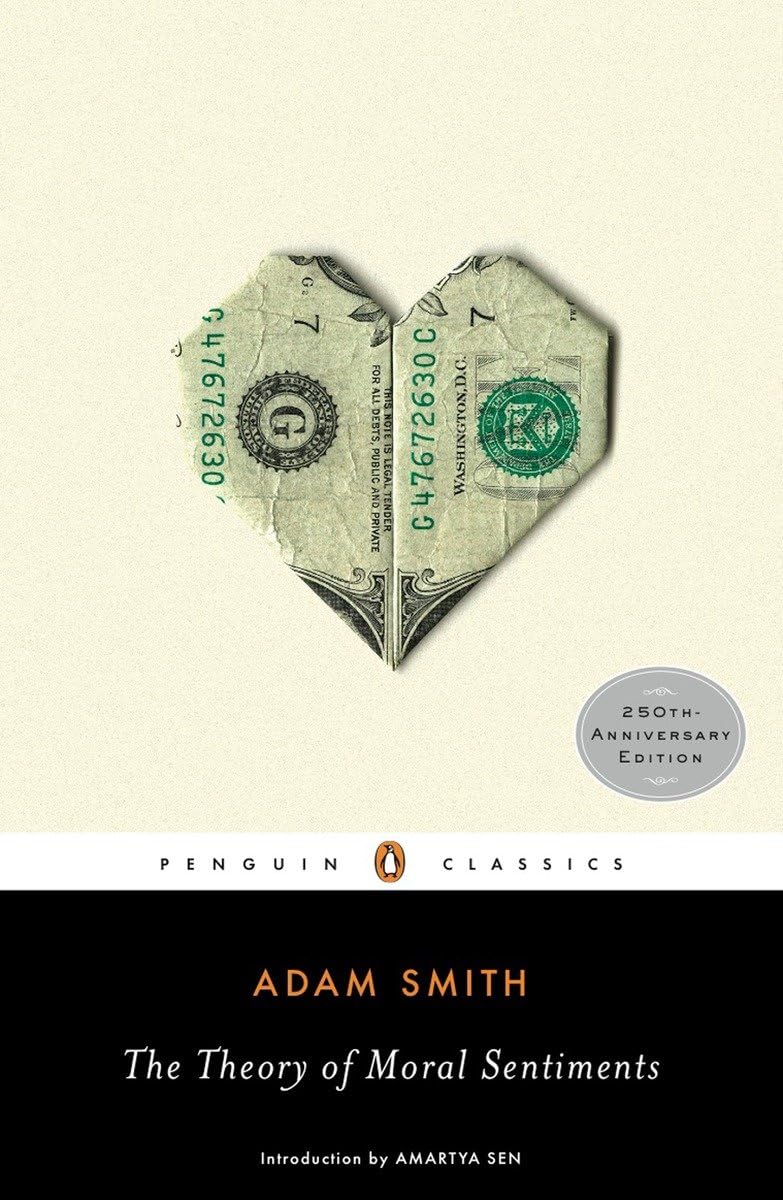
📖 Unlock the timeless wisdom that shaped modern ethics and economics!
Adam Smith’s 'The Theory of Moral Sentiments' is a foundational work in philosophy and social psychology, offering profound insights into human morality, ethics, and behavior. This Penguin Classics edition presents Smith’s eloquent exploration of sympathy, ethics, and economic thought, making it an essential read for anyone seeking to understand the roots of modern social and moral philosophy.
| Best Sellers Rank | 31,341 in Books ( See Top 100 in Books ) 67 in Philosopher Biographies 569 in Social & Health Issues Biographies 797 in Philosophy (Books) |
| Customer Reviews | 4.3 out of 5 stars 752 Reviews |
P**R
Adam Smith's other great masterpiece
This books is a masterpiece, not only of philosophical ethics, but also of social psychology. It recasts ethics by examining the psychology of why people think some actions good and other actions bad. It's examination of these psychological factors is both incisive and pretty exhaustive. At times, it contains pre-echoes of the ideas of modern evolutionary psychologists, as in the following passage: "Thus self-preservation, and the propagation of the species, are the great ends which Nature seems to have proposed in the formation of all animals. Mankind are endowed with a desire of those ends, and an aversion to the contrary; with a love of life, and a dread of dissolution; with a desire of the continuance and perpetuity of the species, and with an aversion to the thoughts of its intire extinction. But though we are in this manner endowed with a very strong desire of those ends, it has not been intrusted to the slow and uncertain determinations of our reason, to find out the proper means of bringing them about. Nature has directed us to the greater part of these by original and immediate instincts." These instincts are brought to bear in explaining, among other things, why parents are more likely to be excessive than deficient in love for their children, and why we are horrified by the deficiency, but tolerant of the excess. That's classic Evo Psych, a hundred years before Darwin. Apart from a very wide ranging survey of ethical topics, there is also an essay on aesthetics, which again is very much in tune with modern psychology, a discussion of economic behaviour (not surprising, given that Adam Smith pretty much invented modern economics), a discussion of cultural differences in ethics, an examination of some topics in politics, and an interesting reassessment of then-existing theories of ethics in the light of Adam Smith's psychological theory. Not only does the book give an excellent overview of ethical topics and a very well thought out and interesting theory, it's also an enjoyable read, and full of interesting thoughts on psychology. I'm inclined to think that a social psychologists could make a whole career by going through this book chapter by chapter and basing research projects around the ideas contained therein. It could also be used as a moral guide. It deserves to be very widely read.
L**K
Master piece of pure eloquence
What an excellent example of eloquent writing this book is, besides its suppositions and content this book is just a complete and utter pleasure to read for anyone who truly appreciates a good wordsmith and Smith really is one. From the opening chapters which describe his theory that via the medium of imagination individuals do comprehend others being, enjoy mutual sympathies etc. through all the chapters introducing ideas or thought experiments much appreciated by later liberals and philosophers such as the impartial observer, ideas about character, deep praise of stoicism, detachment and fortune to its finish I enjoyed all of this and would highly recommend it. I have not read the wealth of nations to know how it compliments the more famous work but regret that this is not more well known, my favourite chapters include those upon beauty and utility, while he does not mention utilitarian philosophers directly he does heap praise upon the philosophy and considers things beautiful which have the quality of utility. There are some great reflections in this part of the book about wealth and fortune and why those without envy those with means but also the ill fated destiny of many who suddenly, or even through hard graft and time, discover to themselves some means, with increased means the demands for further increased means being a big factor. Some of the musings about the accumulation of possessions, using examples of "tweezer boxes" or novelty trinkets of the time which sound something like swiss army knives,are pretty perennial (along with many others besides) and like later day criticisms of consumerism, hoarding types and Erich Fromm's "To Have or To Be?" idea, although only a footnote to other ideas and therefore a lot shorter. Overall this book impressed upon me someone with a great love of humanity, of a certain sort of literary humanism, without magnifying what it is to be human and experience the human condition to the point were it eclipses all else but a happy, humble, appreciative and reflective mode of being. Smith thought carefully, reflected a lot and enjoyed writing about it in a manner which allows the reader to enter into his experience readily and relate to it easily. Of this I am certain that reading this really enriched my life, understanding and thinking. Recommended.
A**R
Four Stars
As with previous Adam Smith product - really interesting stuff.
N**S
Excellent scholarly edition
This is an excellent scholarly edition of Professor Smith's "The theory of moral sentiments". Reading Adam Smith's "The theory of moral sentiments", I was engaged by his polite and careful writing and by his devotion to individual conscience ("The love of praise-worthiness is by no means derived altogether from the love of praise. Those two principles, though they resemble one another, though they are connected, and often blended with one another, are yet, in many respects, distinct and independent of one another" Part III Chapter II paragraph 2). Smith vigorously defends human integrity, rejecting Dr Mandeville's allegations that human beings are all hypocrites who make a mere show of public-spiritedness (Part VII Section II Chapter IV paragraph 7), while Smith acknowledges that occasionally this sort of behaviour occurs (for example, being visited hypocritically on your sick bed by a secret enemy Part III Chapter III paragraph 24). Smith stands a proud and enlightened man proclaiming how natural it is for human beings to adhere to moral and ethical laws. Yet in Part V Chapter I paragraph 4 he says (with principal regard to the arts, in fact, but relevant to morals as these too can be said to have beauty) "Few men have so much experience and acquaintance with the different modes which have obtained in remote ages and nations, as to be thoroughly reconciled to them or to judge with impartiality between them, and what takes place in their own age and country", and in Part VII Section III Chapter III paragraph 11 he acknowledges the influence the sentiments of others around you can have on your own moral perspective. I wish I could believe that mankind could possibly enjoy a secure moral anchor in the tempest of human affairs and not be gripped by social insanities such as the antisemitism of 1930s Germany, where people's influence on one another's moral perspectives allowed a pernicious doctrine to flourish. What sort of world must Adam Smith have lived in to allow him to form these opinions? Certainly Smith was a royalist with a firm belief in the hierarchical structure of society ("Nature has wisely judged that the distinction of ranks, the peace and order of society, would rest more securely upon the plain and palpable difference of birth and fortune, than upon the invisible and often uncertain difference of wisdom and virtue." Part VI Section II Chapter I paragraph 20). Is it really only from within the precincts of some enlightened dictatorship we can enjoy any real moral security? That even this might not be such a Utopia is suggested to a modern reader reading Part V Chapter II paragraph 4, where Smith, in explaining the different attitudes and behaviours expected from the different ranks within society, suggests that different moral codes apply too. Smith, of course, was a respectable part of the eighteenth century British establishment and there is no doubt that behind "The theory of moral sentiments" lies a certain degree of Christian utopianism. Revealing, I think, is what Smith says in Part II Section II Chapter III paragraph 2. "Society may subsist among different men, as among different merchants, from a sense of its utility, without any mutual love or affection; and though no man in it should owe any obligation, or be bound in gratitude to any other, it may still be upheld by a mercenary exchange of good offices according to an agreed valuation." It is apposite to mention briefly in memory of the recently deceased liberal and gentle Professor Robert Solow that, as is evident from Smith's irritated remarks about tooth-picks, ear-picks and nail cutters in Part IV Chapter I paragraph 8, Smith was at the time he wrote "The theory of moral sentiments" no technophile - an attitude which was going to have to change as the industrial revolution got going. A modern reader must be a little careful too over Smith's use of language as, for example, he uses the word "sympathy" not in the modern sense of feeling sorry for someone, but in a sense closer to the etymology of the word, namely, a parallel and simultaneous similar feeling to that being experienced by the other person. The word "diffidence" is another example. He does not mean shyness, but means something closer to the roots of the word, meaning scepticism or lack of trust. I personally find Smith very accessible and readable, however.
D**L
A Tome on Man's Nature
This is his certainly his magnum opus, surely outweighing The Wealth of Nations in substance and philosophical depth!! This book is a deeply interesting formulation of human emotional and motivational systems.
M**S
Beyond ordinary praise
The introduction as well as the book itself are both excellent and essential reading for anyone wanting to combat that ugly interpretations that have been pushed on Smith as the apostle of selfishness. Nothing could be further from the truth for this man who would have excoriated the thieves and swindlers of 2008 and held the institute that purports to honour his name in contempt. As readable as Tom Jones, published around the same time. A delight on every page.
M**R
Avoid, doesn't even have all of the first section of the book.
This is embarrassingly expensive for fewer than 50 pages of text. I shall be returning it and searching for a copy that is unabridged. There is no indication of any of this on the store page. This review is for the Kessinger reprint edition - reprint of the first chapter, that is...
G**I
It is indispensable reading for anybody who would like to understand Adam Smith's "Wealth of Nations" and the ...
The TMS is one of the masterpieces of modern Political Sciences ( and of Moral Philosophy). It is indispensable reading for anybody who would like to understand Adam Smith's "Wealth of Nations" and the proper roots of modern capitalism. The Galsgow Edition is mandatory. The Introduction by D.D. Raphael and AL. Macfie is splendid and an example of profound and solid scholarship.
Trustpilot
1 month ago
4 days ago