
DOWNLOAD THE APP


Customer Services
Copyright © 2025 Desertcart Holdings Limited
DOWNLOAD THE APP
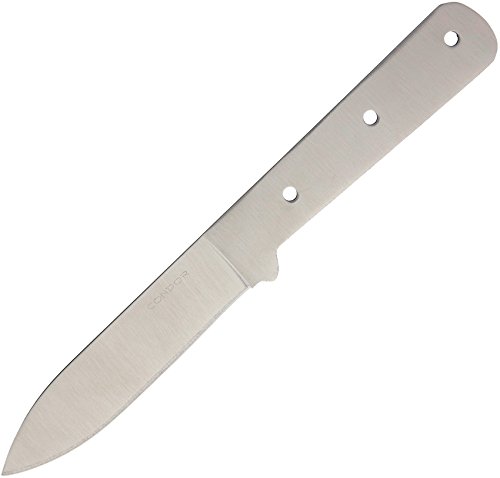


🗡️ Forge your legacy with the Kephart Blade Blank — where craftsmanship meets your creativity.
The Condor Kephart Blade Blank features a 4.5-inch polished 1075 high carbon steel blade with a full tang design, offering exceptional strength and durability. Made in El Salvador, this knife blank is perfect for outdoor enthusiasts and DIYers who want to customize their own handle. Lightweight and precision-crafted, it’s built to perform in camping, hiking, and survival scenarios.






| ASIN | B00WTH2TBK |
| Age Range | Adult |
| Batteries Included? | No |
| Blade Edge | 1075 High Carbon Steel |
| Blade Length | 4.5 Inches |
| Blade Material | 1075 High Carbon Steel |
| Brand | Condor |
| Color | Silver |
| Customer Reviews | 4.2 4.2 out of 5 stars (146) |
| Date First Available | 15 May 2015 |
| Department | unisex-adult |
| Features | Full Tang |
| Hand Orientation | Ambidextrous |
| Included Components | Kephart Blade Blank |
| Item model number | CB247-4.5HC |
| Manufacturer | Condor |
| Material Type | Synthetic |
| Number of Items | 1 |
| Product Dimensions | 29.21 x 5.08 x 0.38 cm; 22.68 g |
| Shape | Drop Point |
| Size | 5 بوصة |
| Style | Modern |
D**C
This is a really great option to save some money if you are handy enough to put your own scales on. The spine is square and sharp, and the blade is straight. The angle on the blade wasn't as steep as I wanted, but it was easy to reprofiled without the handles attached yet. It's a classic pattern, good steel, and a great price.
J**E
This is the third Condor blade blank I've added a handle to, the first two being their Woodlaw model. The blank is sharp, well-finished, and ready nearly as-is to have a have handle thrown on. For the money, this is an incredible value provided you're willing to work toward a finished product instead of receiving something 100% ready to go out of the box. The blade is a full flat grind, ready for a hone and stropping, and is flexible and nimble while still being quite tough and stout through the blade. The finished knife feels great in the hand and will make a fine camp companion. A note on the steel; I used a round file to enlarge the rear hole to just over ¼" so I could add a lanyard tube. The three holes in the handle are all just barely over 3/16", so that true 3/16" pins will easily fit through. I don't recommend enlarging these holes as it took me about an hour of solid, steady filing to get it where it needed to be. Save yourself the hassle and just add 3/16" pins. Trust me. An industrial drill bit wouldn't cut deeper than 1/64" before burning up. This is hard steel. For the handle build, I used curly maple handle scales, 3/16" brass rod, a piece of ¼" copper flush line, and Loc-Tite two-part epoxy. The finish is dark mahogany Danish oil. I used a drill press, a hacksaw, an angle grinder with a sanding disc, and a roll of 80 grit sandpaper belt to fit and shape the handle. I also used brake cleaner to take the finish off the blank and clean all the surfaces before gluing. The blank comes coated in a very tough, clear lacquer that I had to use a solvent and/or sandpaper to remove. This is necessary for at least the handle portion of the knife, as you want your epoxy sticking to the metal, not a coating sitting on top of the metal. I could have left the coating on the blade, too, but will likely force a patina on it later down the road so I prepared for that eventuality. To mate this to a handle, purchase some knife scales of your choice in ¼" to ½" thickness. Your final handle thickness will be the thickness of your two scales plus that of the ⅛" blade, so ½" handle scales (remember, times two scales) will yield a 1⅛" thick finished handle. This is all about personal preference. Try going to Home Depot and getting your hands on a wooden dowel rod of the finished size you're looking for and then find what feels best in your hand. Use that as a baseline for how thick you want your scales to be. Even a nicely figured set of curly maple scales shouldn't cost you more than ten bucks, max, so shop accordingly. Your scales will need to be at least 1½" wide by 4½" long for this blank. Once you have all your materials then remove the coating from the blank, scuff the hell out of the handle portion with sandpaper, clamp your blank how you want it to sit on your scales, and very carefully use a 3/16" drill bit to drill the holes in the scales. Use a clamp to keep everything steady so your holes all line up. Take your one drilled scale and clamp it to your undrilled scale. Now, drill all the way through the holes and out the other side to get both scales ready. Unclamp your two scales together and pencil in the blade blank's outline, using the drilled holes as your guide for where you need the blank to sit. Use a saw to trim to just outside that line. Cut your pins to length (I do 1½" long pins for good measure) and then dry fit everything. Make sure it goes together easy with no miss and no fuss. If the pins a re just a little bit tight, it's perfect. While your scales are rough cut, drilled, and clamped together finish shaping the top edge of the wood. It will be very hard and time-intensive to do this later, as that part of the scale will sit against the blade and be difficult to shape. When ready for final assembly, scuff every mating surface with sandpaper; pins, scales, and blank. Clean those surfaces with some brake cleaner on a shop towel, and set aside. Mix your glue and be sure to spread glue on every mating surface. Don't just put it on the scales, coat the blank and pins, too. Fit it all together, clamp it up with at least two clamps, and let it dry for a full 24 hours. Once dry, unclamp it and go to town with grinder and sandpaper. Once done shaping, hit it with some Danish oil. Easy peasy.
G**E
This knife blank was the start of a really great project. The finished product looks beautiful with the Curly Birch handles that I made from wood & brass pins that are easily available on Amazon and eBay.
M**L
A great knife blank for a reasonable price. With this blank, I was able to get a half decent knife at a reasonable price. My only beef is that the blade is a little different than the one that Condor uses in it's pre-made knife (the pre-made knife has a slightly more "robust" build). If they did a Hudson Bay blank, I'd probably get it.
K**R
Tenía mucha expectativa de este cuchillo y no debí ignorar los comentarios en los foros: Pros Muy afilado El desbaste es simétrico El diseño del mango es ergonómico El lomo está desbastado a 90 grados, perfecto para sacarle chispas al pedernal Cons La hoja está torcida, esto es común cuando no se cuida el proceso de templado La punta del cuchillo está destemplada por un mal desbaste Toda la hoja está llena de rasguños El estampado está irregular Es mucho más pequeño de lo que esperaba Tiene muchas imperfecciones que chocan con el costo del producto La falla fatal y por la que no alcanza al menos 3 estrellas es que el espesor del acero es de 3mm sólo en el mango, dónde empieza la hoja baja a 2.5mm y en la punta es de menos de 2mm. Es decir, el cuchillo es 15% más delgado de lo anunciado. En resumen, salvo que estés buscando un proyecto para pasar el tiempo mejor compra el mora companion HD, mucho más robusto y viene ya con funda. Mi opinión es que estos blade blanks son rechazos de la línea de producción y no productos hechos específicamente para aficionados y proyectistas
Trustpilot
1 month ago
4 days ago