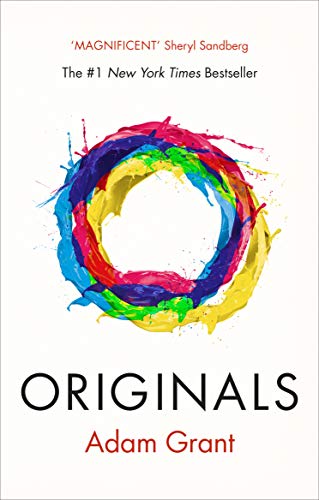
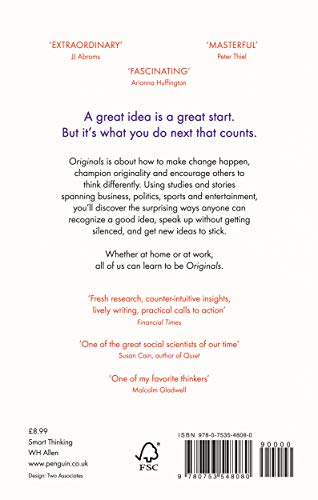

Buy Originals: How Non-conformists Change the World 1 by Grant, Adam, Sandberg, Sheryl (ISBN: 9780753548080) from desertcart's Book Store. Everyday low prices and free delivery on eligible orders. Review: Not So Much as Food For Thought as an Entire Banquet! - This is one of the most interesting (and original!) books which I've ever read. When I bought this book I thought that it would just contain a number of true stories about original thinkers and how they changed the world. Adam Grant's writings are all that but much more. Originals is really a manual on how to efficiently and effectively promote, develop and manage organisations. In this book Grant explores and explains tried and proven methods of influencing people and achieving significant results, whether your aim is starting a new business, managing a political organisation or trying to assert influence on any large body with a fixed mindset. Grant begins his book with the true story of the creation of Warby Parker, a mail-order firm which provides spectacles for millions of customers in the United States. The company's founders succeeded despite the grave reservations from friends and many people within the eye-care industry. They prospered because they were not afraid to challenge the status quo and the rigid thinking which was prevalent at the time. After doing their research they realised that they could provide quality spectacles at a much lower price than their competitors. They were original thinkers. Grant then goes on to demonstrate original thinking influenced everything, from the civil right movement to the high success rate of a top investment company. An original thinker also completely changed the culture within the US security services. But, like I said, this book is a manual: it provides practical advice on how to effectively promote an idea, or how to form a political coalition, or how to deal with stressful situations. Much of the advice appears to be counter-intuitive; for instance, when carrying out a presentation for a new product Grant believes that you should begin by emphasising the product's WEAK points! And coalitions are best formed not with people with the same aims, but with similar methods. The writer also believes that you can sell ideas more effectively by toning down and even disguising the true nature of your idea. Grant provides practical examples where these methods have worked. I found the most interesting of Grant's ideas was his promotion of dissent within organisations. He gives the example of a large company called Bridgewater, where its CEO actively encourages the firm's workers to criticise everybody, including himself. The company actively sought out the most critical people within the business. Towards the end of the book Grant demonstrates how even revolutions have been brought about by using tactics which at first don't appear the be very effective. Sometimes laughing at dictators is the best way to oust them. This piece of work is crammed with advice which is backed up with clinical psychological research. I found it to be absolutely fascinating. If you are thinking of starting up a new business, or if your are a senior manager in a large company or organisation then this book is a must-read. It will change they way you think about doing things. Review: You never too old to be original - We are working with a client on a project to support and develop top innovation achievers. One of the books we uncovered is “Originals” by Adam Grant. It sums up a lot of the thinking from other business thinkers. The book starts with this quote: “The reasonable man adapts himself to the world; the unreasonable one persists in trying to adapt the world to himself. Therefore, all progress depends on the unreasonable man". This book is about becoming the unreasonable man or women. With surprisingly reasonable or common sense conclusions and tips. What browser do you use? Starting with your browser. Nothing to do with filter bubbles, but everything to do with attitude. Employees who used Firefox or Chrome to browse the Web remained in their jobs 15 percent longer than those who used Internet Explorer or Safari. The employees who took the initiative to change their browsers to Firefox or Chrome approached their jobs differently. Mastery? You need to be a master in what you do. But at the same time realising that practice makes perfect, but it doesn’t make new. Our intuitions are only accurate in domains where we have a lot of experience. And because the pace of change is accelerating, our environments are becoming ever more unpredictable. This makes intuition less reliable as a source of insight about new ideas. Originality remains an act of creative destruction. Originality is not a fixed trait. It is a choice. You need to procrastinate True originals take a long time. The proposals from the procrastinators were 28 percent more creative. Delaying progress enabled them to spend more time considering different ways to accomplish it, instead of “seizing and freezing” on one particular strategy. In ancient Egypt, there were two different verbs for procrastination: one denoted laziness; the other meant waiting for the right time. In ancient Egypt, there were two different verbs for procrastination: one denoted laziness; the other meant waiting for the right time. You need fellow creators to assess you idea The biggest barrier to originality is not idea generation—it’s idea selection.When managers vet novel ideas, they’re in an evaluative mindset. To protect themselves against the risks of a bad bet, they compare the new notion on the table to templates of ideas that have succeeded in the past. Focus groups are effectively set up to make the same mistakes as managers. So neither test audiences nor managers are ideal judges of creative ideas. But there is one group of forecasters that does come close: fellow creators evaluating one another’s ideas. When artists assessed one another’s performances, they were about twice as accurate as managers and test audiences in predicting success. You need to study art Nobel Prize winners were dramatically more likely to be involved in the arts than less accomplished scientists. A representative study of thousands of Americans showed similar results for entrepreneurs and inventors. People who started businesses and contributed to patent applications were more likely than their peers to have leisure time hobbies that involved drawing, painting, architecture, sculpture, and literature. Just as scientists, entrepreneurs, and inventors often discover novel ideas through broadening their knowledge to include the arts, we can likewise gain breadth by widening our cultural repertoires. Research on highly creative adults shows that they tended to move to new cities much more frequently than their peers in childhood, which gave them exposure to different cultures and values, and encouraged flexibility and adaptability. You need to add familiarity to your idea Take a look at this list of familiar songs. Pick one of them and tap the rhythm to it on a table. Now, what do you think the odds are that one of your friends would recognise the song you’re tapping? This is the core challenge of speaking up with an original idea. When you present a new suggestion, you’re not only hearing the tune in your head. You wrote the song. You’ve spent hours, days, weeks, months, or maybe even years thinking about the idea. This explains why we often under communicate our ideas. You need to create an exposure effect —the more familiar a face, letter, number, sound, flavour, brand, or Chinese character becomes, the more we like it. “Familiarity doesn’t breed contempt,” says serial entrepreneur Howard Tullman. “It breeds comfort.” To come up with something original, you need to begin from a more unfamiliar place and then add familiarity, which capitalises on the exposure effect. On average, a novel starting point followed by a familiarity infusion led to ideas that were judged as 14 percent more practical, without sacrificing any originality. You should not be too radical The Goldilocks theory of coalition formation. The originals who start a movement will often be its most radical members, whose ideas and ideals will prove too hot for those who follow their lead. To form alliances with opposing groups, it’s best to temper the cause, cooling it as much as possible. Originals must often become tempered radicals. You need to create a common passion Commitment blueprints worked to build strong emotional bonds among employees and to the organisation. They often used words like family and love to describe the companionship in the organisation, and employees tended to be intensely passionate about the mission. Startups with founders that had a commitment blueprint, the failure rate of their firms was zero—not a single one of them went out of business. You need to create dissenting voices However, existing companies in volatile settings like the computer, aerospace, and airline industries, the benefits of strong cultures disappear. Company performance only improved when CEOs actively gathered advice from people who weren’t their friends and brought different insights to the table, which challenged them to fix mistakes and pursue innovations.Minority viewpoints are important, not because they tend to prevail but because they stimulate divergent attention and thought, They contribute to the detection of novel solutions and decisions that, on balance, are qualitatively better. Dissenting opinions are useful even when they’re wrong. Maverick in residence Which is why we like the maverick in residence as a concept so much. It creates the necessary dialogue to improve your organisation. Idea meritocracy The book uses Bridgewater Associates. Headquartered in a Connecticut as an example. Its philosophy is outlined in a set of over two hundred principles written by the founder. In a typical organisation, people are punished for raising dissent. At Bridge-water, they’re evaluated on whether they speak up—and they can be fired for failing to challenge the status quo. In hiring, instead of using similarity to gauge cultural fit, Bridgewater assesses cultural contribution. It wants people who will think independently and enrich the culture. By holding them accountable for dissenting, Dalio has fundamentally altered the way people make decisions. The goal is to create an idea meritocracy, where the best ideas win. You need get angry If you want people to modify their behaviour, you need to highlight costs of not changing. To drive people out of their comfort zones, you have to cultivate dissatisfaction, frustration, or anger at the current state of affairs, making it a guaranteed loss. Once commitment is fortified, instead of glancing in the rearview mirror, it’s better to look forward by highlighting the work left to be done. When we’re determined to reach an objective, it’s the gap between where we are and where we aspire to be that lights a fire under us. Anger counteracts apathy: We feel that we’ve been wronged, and we’re compelled to fight. Other tips: don’t take too much risk don’t believe in first mover advantage work hard quantity over quality have a vision Be old I am fifty years old. The best news from the book was that there is evidence that older employees tend to submit more ideas and higher-quality ideas than their younger colleagues, with the most valuable suggestions coming from employees older than fifty-five.
| Best Sellers Rank | 4,254,791 in Books ( See Top 100 in Books ) 26 in Occupational & Industrial Psychology 933 in Scientific Psychology & Psychiatry 1,792 in Business, Finance & Law |
| Customer reviews | 4.4 4.4 out of 5 stars (7,466) |
| Dimensions | 12.6 x 2.1 x 19.8 cm |
| Edition | 1st |
| ISBN-10 | 0753548089 |
| ISBN-13 | 978-0753548080 |
| Item weight | 234 g |
| Language | English |
| Print length | 336 pages |
| Publication date | 9 Feb. 2017 |
| Publisher | WH Allen |
B**Y
Not So Much as Food For Thought as an Entire Banquet!
This is one of the most interesting (and original!) books which I've ever read. When I bought this book I thought that it would just contain a number of true stories about original thinkers and how they changed the world. Adam Grant's writings are all that but much more. Originals is really a manual on how to efficiently and effectively promote, develop and manage organisations. In this book Grant explores and explains tried and proven methods of influencing people and achieving significant results, whether your aim is starting a new business, managing a political organisation or trying to assert influence on any large body with a fixed mindset. Grant begins his book with the true story of the creation of Warby Parker, a mail-order firm which provides spectacles for millions of customers in the United States. The company's founders succeeded despite the grave reservations from friends and many people within the eye-care industry. They prospered because they were not afraid to challenge the status quo and the rigid thinking which was prevalent at the time. After doing their research they realised that they could provide quality spectacles at a much lower price than their competitors. They were original thinkers. Grant then goes on to demonstrate original thinking influenced everything, from the civil right movement to the high success rate of a top investment company. An original thinker also completely changed the culture within the US security services. But, like I said, this book is a manual: it provides practical advice on how to effectively promote an idea, or how to form a political coalition, or how to deal with stressful situations. Much of the advice appears to be counter-intuitive; for instance, when carrying out a presentation for a new product Grant believes that you should begin by emphasising the product's WEAK points! And coalitions are best formed not with people with the same aims, but with similar methods. The writer also believes that you can sell ideas more effectively by toning down and even disguising the true nature of your idea. Grant provides practical examples where these methods have worked. I found the most interesting of Grant's ideas was his promotion of dissent within organisations. He gives the example of a large company called Bridgewater, where its CEO actively encourages the firm's workers to criticise everybody, including himself. The company actively sought out the most critical people within the business. Towards the end of the book Grant demonstrates how even revolutions have been brought about by using tactics which at first don't appear the be very effective. Sometimes laughing at dictators is the best way to oust them. This piece of work is crammed with advice which is backed up with clinical psychological research. I found it to be absolutely fascinating. If you are thinking of starting up a new business, or if your are a senior manager in a large company or organisation then this book is a must-read. It will change they way you think about doing things.
R**K
You never too old to be original
We are working with a client on a project to support and develop top innovation achievers. One of the books we uncovered is “Originals” by Adam Grant. It sums up a lot of the thinking from other business thinkers. The book starts with this quote: “The reasonable man adapts himself to the world; the unreasonable one persists in trying to adapt the world to himself. Therefore, all progress depends on the unreasonable man". This book is about becoming the unreasonable man or women. With surprisingly reasonable or common sense conclusions and tips. What browser do you use? Starting with your browser. Nothing to do with filter bubbles, but everything to do with attitude. Employees who used Firefox or Chrome to browse the Web remained in their jobs 15 percent longer than those who used Internet Explorer or Safari. The employees who took the initiative to change their browsers to Firefox or Chrome approached their jobs differently. Mastery? You need to be a master in what you do. But at the same time realising that practice makes perfect, but it doesn’t make new. Our intuitions are only accurate in domains where we have a lot of experience. And because the pace of change is accelerating, our environments are becoming ever more unpredictable. This makes intuition less reliable as a source of insight about new ideas. Originality remains an act of creative destruction. Originality is not a fixed trait. It is a choice. You need to procrastinate True originals take a long time. The proposals from the procrastinators were 28 percent more creative. Delaying progress enabled them to spend more time considering different ways to accomplish it, instead of “seizing and freezing” on one particular strategy. In ancient Egypt, there were two different verbs for procrastination: one denoted laziness; the other meant waiting for the right time. In ancient Egypt, there were two different verbs for procrastination: one denoted laziness; the other meant waiting for the right time. You need fellow creators to assess you idea The biggest barrier to originality is not idea generation—it’s idea selection.When managers vet novel ideas, they’re in an evaluative mindset. To protect themselves against the risks of a bad bet, they compare the new notion on the table to templates of ideas that have succeeded in the past. Focus groups are effectively set up to make the same mistakes as managers. So neither test audiences nor managers are ideal judges of creative ideas. But there is one group of forecasters that does come close: fellow creators evaluating one another’s ideas. When artists assessed one another’s performances, they were about twice as accurate as managers and test audiences in predicting success. You need to study art Nobel Prize winners were dramatically more likely to be involved in the arts than less accomplished scientists. A representative study of thousands of Americans showed similar results for entrepreneurs and inventors. People who started businesses and contributed to patent applications were more likely than their peers to have leisure time hobbies that involved drawing, painting, architecture, sculpture, and literature. Just as scientists, entrepreneurs, and inventors often discover novel ideas through broadening their knowledge to include the arts, we can likewise gain breadth by widening our cultural repertoires. Research on highly creative adults shows that they tended to move to new cities much more frequently than their peers in childhood, which gave them exposure to different cultures and values, and encouraged flexibility and adaptability. You need to add familiarity to your idea Take a look at this list of familiar songs. Pick one of them and tap the rhythm to it on a table. Now, what do you think the odds are that one of your friends would recognise the song you’re tapping? This is the core challenge of speaking up with an original idea. When you present a new suggestion, you’re not only hearing the tune in your head. You wrote the song. You’ve spent hours, days, weeks, months, or maybe even years thinking about the idea. This explains why we often under communicate our ideas. You need to create an exposure effect —the more familiar a face, letter, number, sound, flavour, brand, or Chinese character becomes, the more we like it. “Familiarity doesn’t breed contempt,” says serial entrepreneur Howard Tullman. “It breeds comfort.” To come up with something original, you need to begin from a more unfamiliar place and then add familiarity, which capitalises on the exposure effect. On average, a novel starting point followed by a familiarity infusion led to ideas that were judged as 14 percent more practical, without sacrificing any originality. You should not be too radical The Goldilocks theory of coalition formation. The originals who start a movement will often be its most radical members, whose ideas and ideals will prove too hot for those who follow their lead. To form alliances with opposing groups, it’s best to temper the cause, cooling it as much as possible. Originals must often become tempered radicals. You need to create a common passion Commitment blueprints worked to build strong emotional bonds among employees and to the organisation. They often used words like family and love to describe the companionship in the organisation, and employees tended to be intensely passionate about the mission. Startups with founders that had a commitment blueprint, the failure rate of their firms was zero—not a single one of them went out of business. You need to create dissenting voices However, existing companies in volatile settings like the computer, aerospace, and airline industries, the benefits of strong cultures disappear. Company performance only improved when CEOs actively gathered advice from people who weren’t their friends and brought different insights to the table, which challenged them to fix mistakes and pursue innovations.Minority viewpoints are important, not because they tend to prevail but because they stimulate divergent attention and thought, They contribute to the detection of novel solutions and decisions that, on balance, are qualitatively better. Dissenting opinions are useful even when they’re wrong. Maverick in residence Which is why we like the maverick in residence as a concept so much. It creates the necessary dialogue to improve your organisation. Idea meritocracy The book uses Bridgewater Associates. Headquartered in a Connecticut as an example. Its philosophy is outlined in a set of over two hundred principles written by the founder. In a typical organisation, people are punished for raising dissent. At Bridge-water, they’re evaluated on whether they speak up—and they can be fired for failing to challenge the status quo. In hiring, instead of using similarity to gauge cultural fit, Bridgewater assesses cultural contribution. It wants people who will think independently and enrich the culture. By holding them accountable for dissenting, Dalio has fundamentally altered the way people make decisions. The goal is to create an idea meritocracy, where the best ideas win. You need get angry If you want people to modify their behaviour, you need to highlight costs of not changing. To drive people out of their comfort zones, you have to cultivate dissatisfaction, frustration, or anger at the current state of affairs, making it a guaranteed loss. Once commitment is fortified, instead of glancing in the rearview mirror, it’s better to look forward by highlighting the work left to be done. When we’re determined to reach an objective, it’s the gap between where we are and where we aspire to be that lights a fire under us. Anger counteracts apathy: We feel that we’ve been wronged, and we’re compelled to fight. Other tips: don’t take too much risk don’t believe in first mover advantage work hard quantity over quality have a vision Be old I am fifty years old. The best news from the book was that there is evidence that older employees tend to submit more ideas and higher-quality ideas than their younger colleagues, with the most valuable suggestions coming from employees older than fifty-five.
S**D
developing yourself
Very good book for developing yourself
A**N
Actionable ideas based on examples and research. Excellent
the tools and ideas are not just for non-conformists.. they are for all of us whether we want to , challenge the status quo in a business, become a better parent, set the world on fire.. or simply know how to best respond in a given situation.. whether it is perceived as risky or a a certain gain.
R**N
easy read, but only about ok in terms of insight
This is a book full of well written chapters with interesting insights based on solid research. It could have been a 5 star book, but struggles for a few reasons. Firstly, it wanders around bringing in some topics which seem to have little to do with the topic of originality. The second issue is similar, it can't seem to decide if it wants to be a book about originality in the situation of entrepreneurship and business, or originality in terms of wider creativity and innovation. Thirdly, some of the examples used seem to be of successful businesses, but I struggle to see them as hugely original. Finally, the perennial problem of many business books - its very US centric. Don't get me wrong I've got no problem with the US and many of us can learn a lot from US businesses, but there is a wider world out there with plenty of originals in it! An easy read, some useful information, but it does not really live up to the original promise. Still, the good bits and quite good, so it manages 3 stars from me.
N**A
Speed and Quality - EXCELLENT
SPEEDY DELIVERY AND BOOK IN GOOD CONDITION. VERY HAPPY WITH THIS 2ND HAND PURCHASE. THANKS
M**S
Êtes-vous plutôt Chrome ou Internet Explorer ? Si vous avez fait l’effort de télécharger Chrome plutôt que de vous contenter de l’explorateur par défaut, vous avez une prédisposition pour l’originalité et la capacité à sortir des sentiers battus. Une prédisposition sans doute accentuée si vous êtes le dernier né de votre fratrie : ils ont plus le goût de risque et la volonté de se distinguer que leurs aînés ! D’autres découvertes surprenantes vous attendent à la lecture de cette étude psychologique et sociologique des originaux et autres rebelles. L’auteur utilise de nombreux exemples tirés de l’entreprise et du monde de l’éducation. Il montre notamment combien le poids du groupe fait taire les originaux et prive le groupe de solutions créatives, voire le conduit à des échecs cuisants. L’ouvrage est riche d’enseignements sur la prise de risque : les personnalités originales se caractérisent par leur facilité à oser. Pour les autres, quelques principes simples permettent de prendre des risques mesurés et de faire face à la peur. Reconnaître sa peur et se préparer au pire est finalement plus efficace que de chercher à se rassurer. Cet ouvrage bouscule nos idées reçues et nous incite à changer nos comportements, tant au travail qu’en famille. Il s’appuie sur des études et des exemples précis, tout en étant passionnant à lire !
M**N
I**D
Grant continues to highlighs the characteristics of the business leaders. the book reviews the different aspects of the Non-Conformists behavious and traits. As in his other books, Grant's style of writing makes the journey with the book very enjoyable.
S**Y
This is a very good read, particularly if you’re willing to make use of the wisdom, to take action. I liked the chapter about procrastination, it made me consider the benefits of procrastination. I’ll no longer see procrastination as something negative, but something that can actually be beneficial to the development of innovation and ideation.
A**S
.. and full of interesting hints also outside originality
Trustpilot
2 months ago
1 day ago