
DOWNLOAD THE APP


Customer Services
Copyright © 2025 Desertcart Holdings Limited
DOWNLOAD THE APP

💡 Illuminate smarter, not harder — the 100W LED chip that means business.
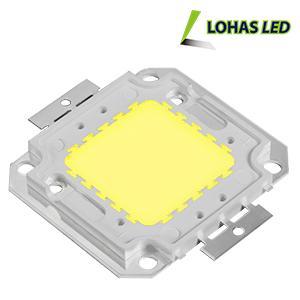
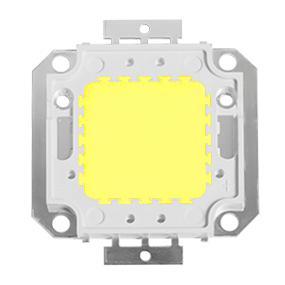
The LOHAS® 100W LED Chip delivers ultra-bright, cool white light at 8500 lumens with exceptional energy efficiency and a wide 140° beam angle. Designed for professional-grade lighting projects, it features durable aluminum construction and a long 30,000-hour lifespan. Ideal for custom installations requiring advanced power management and cooling solutions, this chip outperforms traditional halogen bulbs while reducing heat output and energy consumption.
| ASIN | B00CZ75TWA |
| Accepted voltage frequency | 100 to 240 Volts and 50 Hertz to 60 Hertz |
| Average Battery Life | 30000 Hours |
| Average Life | 30000 Hours |
| Batteries Included? | No |
| Batteries Required? | No |
| Best Sellers Rank | #200,827 in Industrial & Scientific ( See Top 100 in Industrial & Scientific ) #8,712 in LED Bulbs |
| Brand | L LOHAS LED |
| Brightness | 8000.00 |
| Bulb Base | E26 |
| Bulb Shape Size | B17 |
| Color | Cool White |
| Color Rendering Index | 10 |
| Color Temperature | 6000 Kelvin |
| Control Method | App |
| Customer Reviews | 4.4 4.4 out of 5 stars (432) |
| Date First Available | May 24, 2013 |
| Efficiency | 80-90 lm/W |
| Global Trade Identification Number | 06002322087404 |
| Incandescent Equivalent Wattage | 100 Watts |
| Included Components | Light |
| Indoor/Outdoor Usage | Indoor |
| Is Discontinued By Manufacturer | No |
| Item Package Quantity | 1 |
| Item Weight | 0.01 ounces |
| Item model number | LH-XP-100W-6000k |
| Light Color | Cool White |
| Light Source Type | led |
| Light Source Wattage | 100 Watts |
| Light Type | LED |
| Manufacturer | L LOHAS LED |
| Material | Aluminum |
| Number of Items | 1 |
| Part Number | LH-XP-100W-6000k |
| Power Consumption | 100 Watts |
| Power Source | AC |
| Product Dimensions | 1.57"W x 2.17"H |
| Shape | Square |
| Size | 1 Count (Pack of 1) |
| Special Feature | Durable, Easy to Install, High Performance, Powerchip, Quiet |
| Special Features | Durable, Easy to Install, High Performance, Powerchip, Quiet |
| Specific Uses For Product | Fishing |
| Unit Count | 1.0 Count |
| Voltage | 30 Volts |
| Wattage | 100.00 |
| White Brightness | 8500 Lumens |
S**F
Great chip - needs more hardware to realize full potential
This is an awesome little chip. It is extremely bright - everyone who has seen it has been blown away with the amount of light. It floods my backyard much better than halogen floodlights. It outshines the highbeams on my car. It makes a 250 W halogen work light look like it's not even on. It's also very inexpensive for what you get. That said, there is more hardware required to run this light properly. You need a power supply that can deliver 100+ Watts. I'm currently using a computer power supply with 300 W available on the 12 V rail. You need a way to step up the power supply voltage to the LED operating voltage. I'm using a boost converter rated for 150 W made by DROK, also from Amazon. The output voltage can be controlled very easily by adjusting a trim pot. I have pulled up to 142 W (at 37 V) from this device. At that power level, the heatsinks do get hot (60 °C vs 28 °C ambient) but it does recommend the use of a fan at power levels above 100 W. You need a way to cool the LED. The LED does not come with any heatsink. At high power levels it will quickly fry itself. Even though LEDs are efficient compared to other light sources, most of the input energy is wasted at heat. I have mine attached with thermal grease to an old AMD processor stock heatsink/fan that is designed for a 125 W processor. With the fan running and pushing 120 W through this chip, the temperature of the chip remains below 40 °C. Optionally, you need a lens to focus the light. I got one right here on Amazon that takes the normally 140° cone of light of the bare chip and brings it down to 60°, increasing the luminous intensity by a factor of 5. Both focused and unfocused, the light is very uniform, and works very well as a flood light. Also optionally, you need a driver to control the output. If you run the LED straight from the boost converter it will be at full brightness all of the time. If that is all you require, then no driver is necessary. I built an Ardunio powered circuit that offers more control. It uses a low side N-channel MOSFET to switch the LED. If I want to dim the LED, the Arduino switches the FET at 490 Hz and varies the duty cycle to change the brightness. 0-100% brightness is available. Another mode keeps the duty cycle constant at 50%, but varies the frequency from 1 to 100 Hz, creating a powerful strobe light. In either mode (dimming or strobe) the duty cycle or frequency is controlled by a potentiometer. I am planning on adding a momentary switch that immediately puts the LED at full brightness, as well a temperature sensor that turns on the heatsink fan when it gets hot. If you want this to be a standalone unit and not a jumble of wires, you will need an enclosure to mount everything and keep it cool. I'm planning on making mine able to run from AC from the wall, or a battery pack. This is not a plug and play device. It needs more hardware and assembly to get it running optimally. Once it is running though, it is very impressive.
O**S
good buy
perfect light very bright used for over a year and going good
D**B
Great and Hot LED, also terminals are in correct place, please read to see.
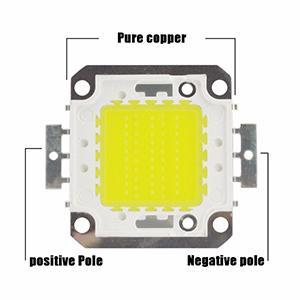
Okay, lets talk about bright. These things are super bright, and don't be fooled when others say they get exceptionally hot, they do. So if buying these buy a heat sink, bigger than what you think you'll need, especially running at higher voltages. Now to clear one thing that others are saying about the polarity not being correct, it is correct, but lack of information from Lohas doesn't make it any easier to know this. If you look at the image attached, one shows just a 100 watt chip the other shows the same chip but how to identify which terminal is positive and negative. Look at the LED where the white plastic frame meets the yellow lens that covers the smaller LED chips. If you look closely at the corners, (you may need a magnifying glass) you can see there is a break in 2 of the corners. Follow this wire, it connects the smaller LED's on the chip. The Red circles show where the break is in the wire. Follow the wire to verify which terminal is which. Most likely, the terminal you are looking for is 90° from where it is marked on the chip. It's hard to explain, but easy when you see it.
M**1
VERY GOOD QUALITY!
After assembling the Stratus driver heat sink fan LED and 60 degree lens I hooked it up to my Yeti 1000 and installed the jumper clip. With the potentiometer all the way down I gave it juice. All 100 emitters where glowing with the same amount of lumens, nice! Under powered I hooked it up to my LUX meter chamber and got a staggering 347,000 lux! I went on to test my Acebeam L30, 4000 real lumens and got 127,000 lux, Convoy L6 modded 4000 lumens 126,000 lux and my completely modified SkyRay King and got 146.000 lux. This LOHAS emitter kick some serious lumens and while being under powered. Price per lumens this is a great deal. Now time will tell on quality because I am designing a 4 100 watt emitter light bar with 125mm parabolic reflectors for my custom lifted Forester XT.
A**G
Good for the money, but some minor issues with design
Overall, the light is good for the money. I have bought three of these at various points in time for some DIY projects. On the whole, the cost more than fits the product. That said... I have found some minor issues with the design. Mainly, the negative and positive terminals are not clearly laid out. It's sort of a matter of guesswork and using some equipment to figure out which terminal is positive (+) or negative (-). Sort of a risky move, considering LED's are polarized devices and can be damaged if hooked up incorrectly. There are (+) and (-) markings on two parallel corners of the plastic bezel, but since there is no documentation to show how those orient with the actual terminals, the markings are entirely useless. Something that could be easily overcome with a simple design change. But again, it's a cheap light, so you get what you pay for. Lastly, there are a few pixels that don't light up right away (at the 24V starting point). Once you get to 25 Volts, things tend to completely come on. Again, a cheaper product (money-wise) so within the range of acceptable behavior. On the whole, a decent product that puts out decent light. Not professional video or photo quality with it's 70-80ish CRI, but good enough for general uses. To the hobbyist or amateur, I would recommend this as a good starter. To the experienced individual looking for more professional uses, there are higher quality lights (at higher prices) out there. It all depends on what you want to do for 10(ish) dollars.
A**R
Rated for 100w, only 50w led chip, dont bother
G**A
Estos modulos son exelentes para un diseño económico y muy interesantes, su aplicación es muy amplia y muy fácil de diseñar
H**A
Worst product.
L**E
Very bright, need to monitor current for initial checks, running them at 28-31 vdc. Definitely need lots of heat sink. Really compact using them to illuminate electronics testing bench. Watch the price, first batch cost me $11.73 each, next ones I found for $1.73 each.
J**H
Super good. If you can get 3s(just to make 12v) Li-Ion or lipo battery pack, buy a boost converter and switch, slap it on a heatsink and you will have one of the cheapest and best flood lights possible.
Trustpilot
2 weeks ago
1 month ago