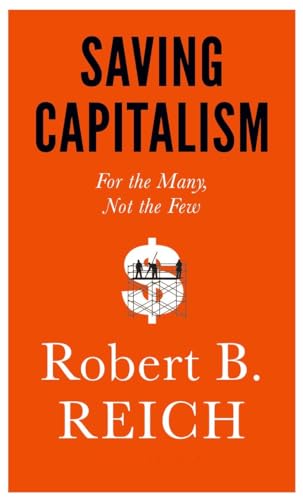

Saving Capitalism: For the Many, Not the Few [Reich, Robert B.] on desertcart.com. *FREE* shipping on qualifying offers. Saving Capitalism: For the Many, Not the Few Review: Invaluable data on structural inequality, so why the desire to save capitalism? - The book is extremely rich on both the details of inequality in the USA and the legislative enactments that have made it possible. When it comes to what to do about it, Reich speaks of countervailing power (within a capitalist framework, as the title makes clear). He believes that different enactments could indeed reduce inequality without the need to get into left-right arguments about the appropriate size of government or even any debate about a possible shift towards socialism. For example, he says in Chapter 17 ('The Threat to Capitalism') that 'Americans have always tended to choose pragmatism over ideology'... {that} whenever capitalism has before reached points of crisis, we have not opted for communism or fascism or any other grand scheme. Again and again we have saved capitalism from its own excesses by making necessary corrections'. For a book published in 2015, Chapter 19 ('Restoring Countervailing Power') is very percipient, reading ahead of time the populism that propelled Trump to the Presidency in 2016. He is clear that the countervailing power will not come from the Democratic Party until it re-invents itself, reminding us that during the election campaign big business very much favoured Clinton over the anti-establishment stance of most Republican front-runners (including Trump of course). Whether the protests that started the day after Trump's inauguration signal the new beginnings of an effective countervailing power remain to be seen. Quite appropriately, those protests were triggered by Trump's misogynist views. But will these and future broader-based protests be enough to push capitalism back into (???) a progressive populist direction? Or will the clash lead to a bigger government role and an adoption of socialist practice that Reich seems to believe could not be democratic (for reasons that he does not discuss in this book despite his strong support for Bernie Sanders)? Reich provides us a wealth of invaluable information but doesn't help us to identify the (within capitalism) that will change the thirty-year drift towards ever greater inequality and now with Trump, the rush towards fascism. Review: Upward Predistribution - Excellent read! It's a must if you want to understand the causes of rising inequality... In my opinion robots (the rise of the robots by Martin Ford is another must read) are certainly part of the cause, but an important cause is democracy, and balance of power. It boils down to democracy, and the lack of it! Inequality of income is caused by inequality in political power. This book points out that it's not about "big government" versus "Free market"... There is no such a thing as free market, the market is ruled by laws, the "rules of the game", and laws must exist for the market to work. But the rules of the game today are written in such a way that they create an "upward predistribution", from the poor to the rich. They are making the rich richer at the disadvantage of the poor. Taxes should re-balance things by distributing downward, but not enough! The very basic principle of democracy is that every citizen of the US should have equal political representation regardless of their economic power. The Walmart employee should have the same political power as the Walmart CEO. And that is true when it comes to voting right: they both get one vote. But we know very well that as a practical matter it's not! And this books shows in how many ways that is not true. The vote is a tiny representation of power. Washington lobby money is what really matters when it comes to power. I like this number: the Walmart family is worth as much as the bottom 42% of Americans! That's an enormous unbalance of wealth. Now 51% of the bottom poorest Americans, in theory, in a democracy, is a majority. 51% of people, if they happen to get together and agree, could represent a majority and they could pass any proposition into law, yes that's power! In theory that 51% of Americans could pass a law that for example would redistribute 90% of the money from the top 1% wealthiest Americans to the bottom 51% of Americans. That's easy! I know that's just theoretical, but it's a sign that some sort of civil revolution, more or less aggressive and violent, could happen very soon, if things keep going in the same direction.
| Best Sellers Rank | #1,136,460 in Books ( See Top 100 in Books ) #96 in Economic Policy #174 in Economic Policy & Development (Books) #781 in Economic Conditions (Books) |
| Customer Reviews | 4.5 4.5 out of 5 stars (1,725) |
| Dimensions | 6 x 1.2 x 9.5 inches |
| Edition | First Edition |
| ISBN-10 | 0385350570 |
| ISBN-13 | 978-0385350570 |
| Item Weight | 1.25 pounds |
| Language | English |
| Print length | 304 pages |
| Publication date | September 29, 2015 |
| Publisher | Knopf |
P**.
Invaluable data on structural inequality, so why the desire to save capitalism?
The book is extremely rich on both the details of inequality in the USA and the legislative enactments that have made it possible. When it comes to what to do about it, Reich speaks of countervailing power (within a capitalist framework, as the title makes clear). He believes that different enactments could indeed reduce inequality without the need to get into left-right arguments about the appropriate size of government or even any debate about a possible shift towards socialism. For example, he says in Chapter 17 ('The Threat to Capitalism') that 'Americans have always tended to choose pragmatism over ideology'... {that} whenever capitalism has before reached points of crisis, we have not opted for communism or fascism or any other grand scheme. Again and again we have saved capitalism from its own excesses by making necessary corrections'. For a book published in 2015, Chapter 19 ('Restoring Countervailing Power') is very percipient, reading ahead of time the populism that propelled Trump to the Presidency in 2016. He is clear that the countervailing power will not come from the Democratic Party until it re-invents itself, reminding us that during the election campaign big business very much favoured Clinton over the anti-establishment stance of most Republican front-runners (including Trump of course). Whether the protests that started the day after Trump's inauguration signal the new beginnings of an effective countervailing power remain to be seen. Quite appropriately, those protests were triggered by Trump's misogynist views. But will these and future broader-based protests be enough to push capitalism back into (???) a progressive populist direction? Or will the clash lead to a bigger government role and an adoption of socialist practice that Reich seems to believe could not be democratic (for reasons that he does not discuss in this book despite his strong support for Bernie Sanders)? Reich provides us a wealth of invaluable information but doesn't help us to identify the (within capitalism) that will change the thirty-year drift towards ever greater inequality and now with Trump, the rush towards fascism.
L**A
Upward Predistribution
Excellent read! It's a must if you want to understand the causes of rising inequality... In my opinion robots (the rise of the robots by Martin Ford is another must read) are certainly part of the cause, but an important cause is democracy, and balance of power. It boils down to democracy, and the lack of it! Inequality of income is caused by inequality in political power. This book points out that it's not about "big government" versus "Free market"... There is no such a thing as free market, the market is ruled by laws, the "rules of the game", and laws must exist for the market to work. But the rules of the game today are written in such a way that they create an "upward predistribution", from the poor to the rich. They are making the rich richer at the disadvantage of the poor. Taxes should re-balance things by distributing downward, but not enough! The very basic principle of democracy is that every citizen of the US should have equal political representation regardless of their economic power. The Walmart employee should have the same political power as the Walmart CEO. And that is true when it comes to voting right: they both get one vote. But we know very well that as a practical matter it's not! And this books shows in how many ways that is not true. The vote is a tiny representation of power. Washington lobby money is what really matters when it comes to power. I like this number: the Walmart family is worth as much as the bottom 42% of Americans! That's an enormous unbalance of wealth. Now 51% of the bottom poorest Americans, in theory, in a democracy, is a majority. 51% of people, if they happen to get together and agree, could represent a majority and they could pass any proposition into law, yes that's power! In theory that 51% of Americans could pass a law that for example would redistribute 90% of the money from the top 1% wealthiest Americans to the bottom 51% of Americans. That's easy! I know that's just theoretical, but it's a sign that some sort of civil revolution, more or less aggressive and violent, could happen very soon, if things keep going in the same direction.
A**Y
Saving Capitalism: For The Many, Not The Few is a timely and provocative book by Robert B. Reich, a former US Secretary of Labor and a professor of public policy at the University of California, Berkeley. In this book, Reich challenges the conventional wisdom that the free market is the best guarantor of freedom, prosperity and democracy. He argues that the market is not a natural or neutral force, but a human creation that reflects and reinforces the power of those who shape its rules and institutions. He exposes how the wealthy and influential have rigged the system to their advantage, creating a new oligarchy that undermines the common good and threatens the future of the American experiment. Reich does not advocate for abandoning capitalism, but for saving it from its own excesses and distortions. He calls for restoring the countervailing power of the many - the workers, consumers, small businesses, citizens and public servants - who can balance and check the power of the few. He proposes a series of reforms to make the market more responsive to the needs and preferences of the majority, such as raising the minimum wage, expanding the earned income tax credit, strengthening antitrust laws, reforming campaign finance, regulating Wall Street, investing in education and infrastructure, and expanding social security and health care. Reich writes with clarity, passion and conviction, drawing on his extensive knowledge and experience as an economist, a policymaker and a public intellectual. He combines empirical evidence, historical analysis, moral arguments and personal anecdotes to make his case compelling and accessible. He also anticipates and addresses some of the common objections and criticisms that his proposals might face from different ideological perspectives. He does not claim to have all the answers or to offer a silver bullet solution, but he invites readers to join him in a constructive dialogue about how to make capitalism work for the many, not the few. Saving Capitalism: For The Many, Not The Few is a must-read for anyone who cares about the state of American democracy and economy in the 21st century. It is a book that challenges us to rethink our assumptions, to question our complacency, and to act on our responsibility as citizens. It is a book that offers hope and inspiration for a more fair and sustainable future.
A**N
Capitalism most definitely is at a crossroads. To claim otherwise is, at best, denial. What’s more worrying is that that there is next to no debate on the relevant issues. I disagree with, dunno, four out of five conclusions Robert Reich draws in “Saving Capitalism,” but it is regardless the best book I’ve read in years because it defines the terms of the debate. You read that right. I consider this left-wing book by a former Clinton (wash my mouth) Labor Secretary one of the best I can remember reading. I’m buying copies for my whole family. The first major issue he tackles is the false debate that pits “free markets” versus “the government,” and this he does straight from the Mancur Olson playbook: spontaneous free markets exist everywhere. A visitor to the former Soviet Union would be confronted with tons of black markets that of necessity sprung up in the absence of official ones, same way a visitor to Marrakesh can walk into the suk where he can find practically anything. (My favorite such market is the former Soviet market for dead lightbulbs you could then bring to work to screw into the fixture left open by the functioning light bulb you’d pilfer from work to bring back to your apartment) But here’s the deal: A bunch of rules must be in place for orderly markets that go beyond the flea market. If you want free markets to thrive, then you need an institution that comes up with and enforces the rules for: 1. What am I allowed to own? Can I own other people? Can I own my beachfront? (In Greece, for example, you don’t, the beach is everybody’s). How about ideas? If I can’t own them, will I bother having them? If I own a life-saving idea is it OK for me to own it? Who is allowed to buy me out of a house that’s blocking a new highway and what must he pay? 2. If I own something, can I sell it? Where does the statute trump the contract? Californian women can sell their womb, but they can’t sell their blood. Dutch people can own cannabis, but, to quote from Pulp Fiction, to sell it they need a license. And here in the west you can’t sell your children (or yourself) to strangers, period. 3. When is it fine to run a monopoly? In pretty much all countries the military is up to the government. The police, not entirely. It is illegal to sell protection, of course, but it is becoming legal to hire security. Most governments are busy giving up the monopoly on mail. Nobody cares that one company in America sells pretty much all chewing gum. Overall, the decision on market power is not trivial. 4. What if I can’t pay for something I bought? What recourse should my seller have? Can he seize my property? My family’s property? What am I allowed to contract into offering as security? The institution that (i) decides and (ii) enforces these rules has a name. We call it our government. No government, no market. Just flea markets. The discussion that pits “free markets” versus “government” is dust in our eyes, Robert Reich says and he says so in a non-patronizing, wonderful narrative a kid can follow. He does not stop there. This beautifully penned call to arms breaks the taboos of the unsophisticated, parochial American Left and spares nobody. On page 183, Robert Reich takes aim at the preoccupation of Americans on his “progressive” side of the argument with “noneconomic issues such as same-sex marriage, abortion, guns, race and religion,” and urges them to find common economic cause, because that’s the arena where the politics of the government have true influence first and foremost. Chapeau! What we have here is the bare bones of a ten-star book as far as I’m concerned. I find tons of stars to take off from there, of course, because I disagree with a lot that he has to say. So, for example, I think shareholder capitalism is self-correcting and I genuinely think the stock market is about to punish self-dealing corporates that issued debt to buy their own stock with a massive correction that will bring the practice into disrepute for at least a generation. The government would be hopeless in terms of attempting to adjudicate on who can and who can’t buy his own stock (though I totally agree with Reich that it should not tax-favor such behavior, of course) New competitors, unburdened by silly amounts of debt will spring up and devour the dinosaurs, bet your house on it. (Well you can’t, in this zero rates forever world, they are all privately owned, it drives me crazy) Along the same vein, I think there’s nothing to do about globalization or the progress of science. You just need to give “palliative care” to the victims and assure they can afford to give the necessary education to their children. I don’t think a futures floor trader will ever earn as much money again shouting and gesticulating and I don’t think a petroleum engineer will ever earn as much money again drilling holes and I have zero problem if they join the girl who used to look at me funny from behind the screen and book my airline tickets at STA travel in whatever endeavors she has chosen to pursue. As for the guy who lost his job reading legal documents to some guy in India, he hasn’t really lost all that much: the outsourced job is about to move somewhere to the cloud. Same as all those Chinese manufacturing jobs. At this point, China fires more people from manufacturing jobs every year than we do. Let us not forget that in 1910 some 25% of Americans used to work in Agriculture. That number is now 2% and the US remains the world’s biggest exporter of grain. And fewer than half of those who officially work in Agriculture actually get dirt under their fingers, they mostly work for companies like the Monsantos Robert Reich seems to dislike for monopolizing what is now a tiny (though obviously vital) part of the American economy. My point is that the children of the 23% did not disappear into an abyss, the Great Depression was their parents’ problem and society made sure it wasn’t theirs (chiefly through the GI bill that followed WWII). Our job is not to restore the jobs of the parents. It’s to make sure the kids fit in the new economy. Yes, it’s a massive job, but let’s talk about that, please, let’s not cry about what’s lost and never coming back. And I think he’s barking up the wrong tree with all the campaign finance stuff. The billion dollar charitable foundations set up by the Clintons and Blairs and so on mainly sell exemption from tax. Suppose corporate tax was set to some extremely low number (dunno, 5%) you would not collect a penny less from Amazon, you would help the law-abiding small corporates Reich loves and you would deliver a very targeted punch in the stomach of the gatekeepers of tax exemptions in Congress, the lobbyists, the 10^3 tax accountants GE employs etc. It would not be without its challenges of, course. You’d have to then be draconian about taxing the people who would rush to dress themselves up as companies. All I’m saying is Reich is not at all imaginative when it comes to looking for the right place to strike at the status quo, he’s repeating some of the old solutions and just shouting louder. So when he says we must give power to the unions, he’s ignoring that in the new economy we keep changing jobs all the time. The companies themselves come and go. And he’s ignoring progress. GM had to shut down because it makes cars 8 times more efficiently than it used to. It makes twice as many cars as before, but that means it needs a quarter as many people to make them. Them guys can’t carry four retired people on his back each, all of whom are living longer than it was anticipated they would, incidentally. We cannot “magic” a solution to this problem. The union actually exists, it’s called the UAW and it’s rather powerful, but it cannot work miracles. More generally, unions can either be all-encompassing, like in France, where they cover millions of people across the entire industry, or they can be more industry-specific (example: teachers, autos etc.) or they can even be firm-specific. The all-encompassing union is what we chiefly have in Europe and the results are out: it redistributes to its members from other poor people. Germany’s super successful Hatz reform was all about allowing more specialized unions, in order to reward industries that were performing better AND THUS INCENTIVISE PEOPLE OUT OF INEFFICIENT INDUSTRIES AND INTO MORE EFFICIENT INDUSTRIES whose workers command more power at the negotiating table. In summary, unions of course have a role to play, but they are already playing it and (much as the managers at Walmart are not exactly angels with wings and halos) this role is being diminished by the realities on the ground. And so on. The rant against Steve Cohen, for example, should also have been included in his list of red herrings, along with same-sex marriage, abortion, guns, race and religion. There’s plenty wrong with finance, but the (tens of billions of) profits from insider trading are not on my top-ten list, much as they are distasteful. There are trillions at stake here and if you get the trillions right, the billions will follow. And I get to watch the same movies and same football games as Steve Cohen, it turns out. They don't make different ones for him. I still have (marginally) more hair than him too. I avoid jail by not breaking the law, on the other hand, but I don't find that enormously burdensome and I have bigger cares than cutting him down to size. I also thought the sundry solutions involving a minimum endowment for every citizen were rather off the wall. We need to look at what it is we’re already doing and we need to fix it. There cannot be a deus ex macchina, that’s the wrong place to look. I can go on taking stars off and discussing points where I disagree rather vehemently with Reich. But I can’t get below five stars, because this is a tremendous call to arms for the American Left to come to the table to discuss the real, material issues we all face. I’m not aware of an equivalent book for the Right.
安**子
○Reich がStiglitzと同じことを言っている。トップ1%への富の集中とミドルクラスの没落は大きな問題だという。アメリカで起きていることは他の先進国でも起きているはずだ。そして、その際によく言われる「市場か政府介入か」という問題設定が最も問題隠ぺいに寄与している。なぜなら、と著者はいう、マーケットとは自然に存在するものではなく、構成されるものだから。所有権、行為規範、争訟解決、その強制等のルールがあって初めてマーケットは存在する。そしてそのルールは様々な選択の幅がある。実は、そのルールが富める者に都合が良いように少しずつ変えられてきているのだ。それが最も問題なのだ、と言う。まさに目から鱗。深く共感する。 ○以下では、私なりに本書のポイントを整理する。関心があるかたはご覧ください。 ○何ら不正が行われているわけではないが、金持ちがカネを使ってロビーイングや訴訟を通じて、自らに有利になるように制度を変え、税制も変え、制度の運用にも影響をあたえている。その結果、社会全体の利益配分がトップ(大企業幹部)に厚く、ミドルクラスと貧困層に薄くなっている。富者も貧者も、自分の所得は自分の価値に応じてもらっていると思い込んでいるが、そうではない。現在の制度が現在の富の配分を生んでいるのだ。Wall Streetがやっていることは、社会価値の創造でもなく、富の創出でもない。ゼロサムゲームでいち早く利益を手に入れているだけのことだ。真に社会に貢献している人々(福祉労働者、教員など)には、その貢献に見合った収入を与えるべきだ。さもないと若い才能が、本当に創造的な仕事に向かわず、Wall StreetやLawyerなど非生産的な仕事に向かってしまう、と言う。根底には、経営者が一般社員の300倍の収入を得るのはおかしいという感覚がある。 ○1970年代に敵対的企業買収が行われるようになって状況が大きく変わる。それまでは企業経営者は、多様なステークホルダーの間のバランスをとる調整役であり、アメリカ社会において公的責任を帯びた存在と考えられていた。自身もそう自負していた。優良企業は高い賃金を払い生涯雇用を実現していた。ところが買収が行われるようになると、企業は株主のものという新思想が広まり、経営者は買収に備えるようになる。そうなるとコスト削減も必要になり、人員削減・賃金削減に動く。GEのジャックウェルチなどがその手の経営者の代表である。株式市場はこのような企業の株価を上げて歓迎したため、産業界に一気に広まった。 ○さて、これに対する著者の処方箋である。当面は次のふたつだ。①富裕層以外の人々が(男も女も、人種を問わず、会社員も農民も商店主も、民主も共和も)自分たちの立場は同じだと認識すること、②個別の問題からでよいからこれらの人々が連携すること、そうして制度改正によって市場の仕組みを1970年代以前の状態に戻すよう努めることだ。著者によれば、すでにそのような動きが各地で認められる。将来は、政治的対立が、民主党対共和党でなく、establishment対反establishmentとなる可能性がある。大統領選で第3党設立の動きも出て来よう。実際には、かかる動きを察知したら既存政党のいずれかが、これを取り込む方向に動くのだろう(過去もそうであった)。 ○かくして、力を握ったとすれば、やることは金権政治改革だ。つまり、①選挙からbig moneyを締め出す、②政治資金の公開または公費選挙の実施、③天下りの制限、④専門家(経済学者等)の資金源の開示だ。こうして1970年代より前に戻す。 ○もうひとつ注意すべきは、The winner takes allの経済になっていることだ(デジタル化、ロボット化など)。この解決には、パテント制度・著作権制度等の改正が必要だ。留意すべきは、①富の一極集中を防ぐ、②イノベーションへのインセンティブを損なわないようにすること。つまりは、上手にバランスを取る必要がある。一つの方法として、知財のように一定の期間が立ったところで、失効させてpublic domainに移すことが考えられる ○これについては、国際競争を忘れていないか?という疑問が湧く。その答えは、①貿易協定によって、世界の知財制度をうえのように変える(できるかな?)、②貿易協定によって、世界の最低賃金を一定の水準(国民平均の半額など)とすることが提案されている(大変そう)。 ○さらに遺産対策が必要だ。アメリカのincomeの3分の1は遺産相続等の不労所得だと言う。Basic minimum income制度も真剣に考えるべきだ。 ○いずれにせよ、われわれはこれまでも問題が生じるたびに市場の制度を改めてきた。今度もきっとできるはずだ、という著者の楽観主義で締めくくられている。
V**Y
Robert Reich authors a well-written and researched book on the future of our economy, sharing his concerns if we continue down our current path of distribution to the few - but also offering a hopeful vision of a society in which the many can prosper.
J**S
Full of insight and useful information. Really gives the reader the facts of how our society is structured. What I like about the book the most is that it informs the reader in simplified terms the game of capitalism and the role that governments should play and how they should gear the rules. Well done book! 👏 One of my favorite books as of late.
Trustpilot
2 weeks ago
1 month ago