
🚀 Elevate your storage game with speed, control, and style!
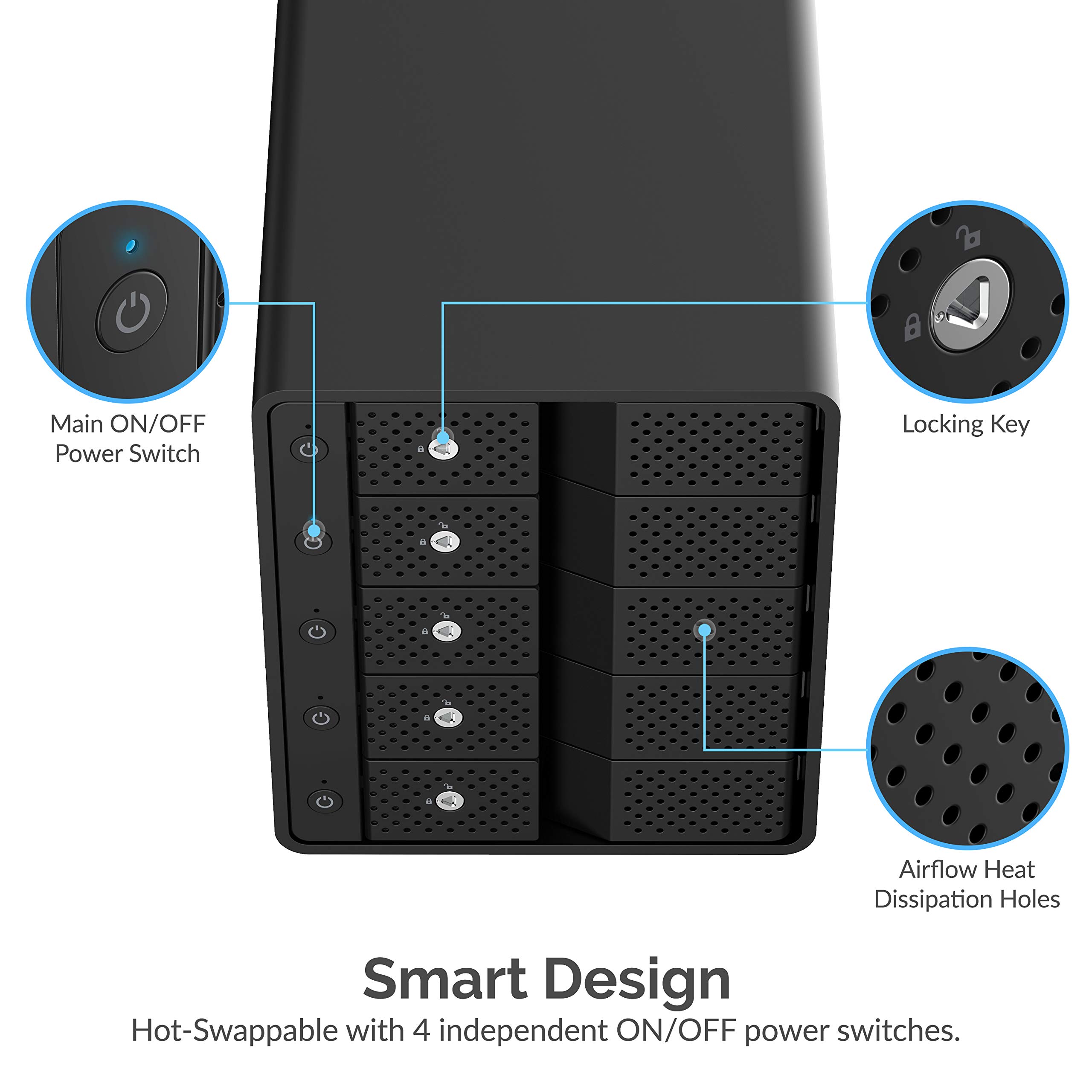
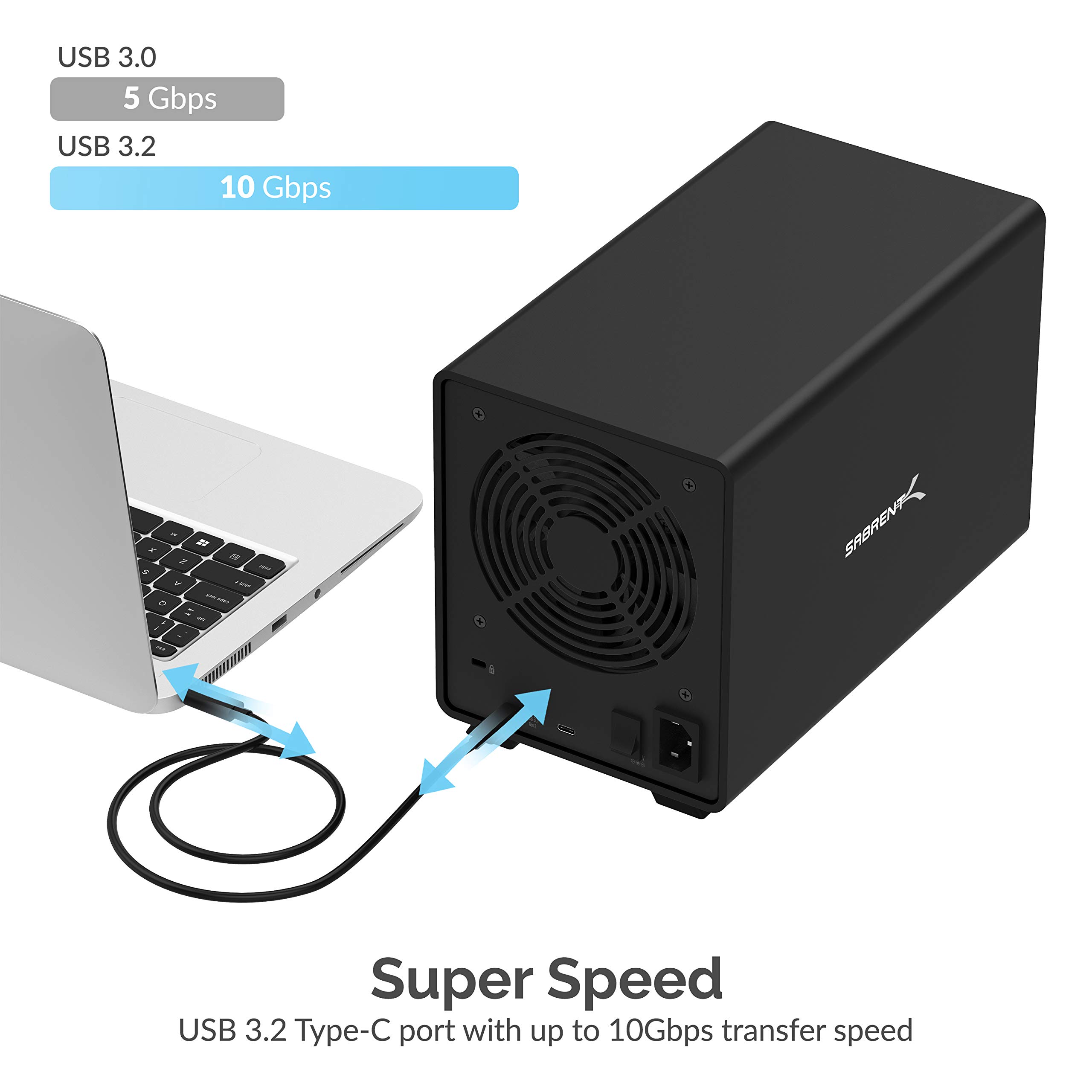
The SABRENT 5-Bay USB 3.2 Gen 2 SATA Docking Station offers professional-grade, tray-less hot-swappable storage for up to five 3.5” HDDs or SSDs. Featuring individual power switches, a robust aluminum build with active cooling, and blazing 10Gbps USB-C connectivity, it delivers reliable, flexible, and high-speed direct-attached storage without RAID complexity—ideal for demanding multimedia professionals and data managers.


| ASIN | B07Y4F5SCK |
| Best Sellers Rank | #12 in Hard Drive Docking Stations #74 in Enclosures |
| Brand | SABRENT |
| Built-In Media | Locking Key., Power cable., USB Type-C to Type-A cable., USB Type-C to Type-C cable. |
| Color | Black |
| Compatible Devices | Most USB Compatible Devices |
| Customer Reviews | 3.9 out of 5 stars 3,179 Reviews |
| Data Transfer Rate | 10000 Megabytes Per Second |
| Enclosure Material | Aluminum |
| Global Trade Identification Number | 00840025227279 |
| Hard Disk Form Factor | 3.5 Inches |
| Hardware Interface | SATA 1.5 Gb/s, SATA 3.0 Gb/s, SATA 6.0 Gb/s, USB 3.2 Gen 2, USB Type C |
| Hardware Platform | Windows |
| Item Dimensions L x W x H | 10.4"L x 5.9"W x 7.3"H |
| Item Height | 7.3 inches |
| Item Type Name | HARDWARE-DOCKING-STATIONS |
| Item Weight | 10 Pounds |
| Item Width | 5.9 Inches |
| Manufacturer | SABRENT |
| Material | Aluminum |
| Memory Storage Capacity | 110 TB |
| Product Dimensions | 10.4"L x 5.9"W x 7.3"H |
| Supported Devices Quantity | 5 |
| UPC | 840025227279 |
| Warranty Description | 1 Year limited |
I**Y
Solid, stable, and fast.
The Sabrent 10-bay USB enclosure is the single best addition to my PC system in years. It's about the size of a medium-sized desktop tower pc. It is solidly built of metal, and is quite heavy. Drives simply slide in to the ten bays, each of which has its own door and it's own power switch. The controller in the enclosure handles handles access and governs traffic, requiring only a single USB-C connection to your laptop or desktop. The internal power supply is fed by a single standard three-prong grounded AC cable. I've found this to be a solid, reliable, and very fast platform for my various SATA drives, and a huge improvement over the tangled bedlam of external single drives, RAID enclosures, power supplies, extension cables, data cables, hubs, power supplies for hubs etc., etc., that had become a plague to my computer system. I see in some reviews that folks have expressed trouble with the drives disconnecting. My experience had been the exact opposite. I think the disconnection troubles I had in the past were due to running through one or more powered USB hubs just to accommodate all the external drives; I think various firmware-based power timeouts were involved. In this case, I've got the entire stack of ten connected to the OC by a single USB cable, going directly into the computer: no hubs. The drives go to sleep, certainly, but awake immediately upon demand. I've had zero trouble with disconnections. This is a big part of why I've characterized this unit as "solid, stable, and fast." This could not be more welcome. A long time pc user, I kind of moved sideways from desktops to laptops as a primary platform, gaining flexibility, portability, and convenience - in many ways. But. In other ways, the laptop form factor imposes strict limitations, most especially, in storage expansion. As a multi-decade serious photographer and at-home video and music producer, the move from analog to digital has introduced serious, grown-up, storage, archive and preservation issues, not to mention capacity issues. So what began for me as a couple of USB external expansion drives grew over time into a glutted city of USB drives and USB RAID enclosures, accompanied by an increasingly unmanageable tangle of cables, power supplies, and hubs. I was plagued with disconnects, time-outs, and other issues, intermittent, yet never ending. This enclosures has alleviated all of that. The drives simply work, and work well. I broke up the RAID-1 enclosures, and over a period of several weeks, sequentially copied all the material on them onto individual drives installed in this enclosure: a kind of extended bucket brigade process. The drives originated mostly as bare drives I already had in use as RAID pairs. As a pair of RAID drives would become empty and available, I split them up, reformatted them, and moved them into the 10-bay enclosure. What about RAID? Well, Windows does a decent job of handling RAID in software. If you think about it, all RAID is actually in software, just some of that software is installed as firmware in hardware. So far, I haven't rebuilt any of the four RAID-1 groups I had before, opting, for now, to manage mirroring and backup manually across the drives in the enclosure. If and when that becomes too unwieldy, I'll move back to RAID-1 pairs, but software-based, on drives in the enclosure. To sum up moving my drives into this enclosure has been a rigorous but welcome project. It has resulted in fewer duplicate management issues, hugely increased efficiency, and much improved reliability. I am delighted with the Sabrent 10-bay enclosure.
J**K
5-Disk Version - Built like a tank, works like a champ!
This is absolutely one of the best tech purchases I've made: I can't recommend it highly enough. I purchased this because I needed an easy-to-use external storage device capable of handling both 3.5" spinning platter HDDs and 2.5" SSD drives. The 2.5" drives need a 2.5" to 3.5" adapter, which can be had for $7 to $20-ish depending on the materials used. I'm a hobbyist photographer and I wanted an easy way to share digital images between macOS and Win10 computers. This completely fits the bill. Here's what I love about this device: - It is absolutely built like a tank - all metal, heavy, great construction - small footprint - it's roughly the size of a small toaster - no crazy or irritating drive brackets needed - you just pop open the drawer, slide the drive in, and close the door - viola! All set to use - individual power buttons! This is huge. I can load up the device with five separate drives, and select which ones I want to be active - under macOS or Windows 10, the drives are automatically detected when powered up, and it's easy to eject / unmount them when done and shut power off to the drive - the USB 3.2 Gen 2 connection provides full drive speed for HDD and SATA3 SSD drives - access is just as fast as connecting the drives directly to the SATA connectors on the motherboard - the unit also provides a USB-C connector on the back of the unit, so it's possible to attach a second device if needed All in all, I'd recommend this external enclosure without hesitation. Granted, It's a bit on the pricey side and the small, single drive external USB enclosures are much less expensive. Also, given the size and weight, it's definitely designed to be a desktop unit - you're not going to throw this in your laptop bag or take it on a flight with you. There are much better options if that's what your need is. Keep in mind that this the connection speed for USB 3.2 Gen 2 is a maximum of 10 Gbps, or 1250 MB/s, which is absolutely more than enough for SATA3 drives. This speed is ample for digital photography needs. I've used the lastest versions of Adobe Photoshop, Lightroom, ON1 Photo Raw, and the DxO NiK Collection apps without hiccup. If you're a videographer, however, this likely will not give you the speed you'll need, particularly if you're shooting in large format (e.g., 4K or greater) and/or RAW formats. In this case, a Thunderbolt 3 or 4 type drive would be a far better choice. If you're on the macOS platform, your iMac or Macbook should support these connections if you're using anything reasonably current. If you're on the PC platorm under Windows 10 or 11 and a PC builder, then your choices are a bit more constrained - Asrock has licensed Thunderbolt from Intel and several of their motherboards support TB 3 or TB 4. Alternatively, some Gigabyte MB's have a TB 3 header, which can connect to their PCIe expansion card ($89 as of the time of this review). A quick search on the internet should give you an idea of what your options are. BTW, this drive enclosure does NOT support hardware RAID. If that's what you need, you'll have to look elsewhere. Under both macOS and Windows 10, there are software RAID-ish options available - I haven't had the need or desire to attempt these, but in theory, they are possible. Good luck and hope this helps!
M**R
Higher price, but absolutely worth it if you find it on sale.
I picked up one of these on sale. I was replacing my old Drobo 810n and wanted at least 8 bays and USB 3.2 for 10Gbs. I run a 10Gbs home network, so I wanted to ensure I was not bottlenecking there. It's connected to a Mac mini, and I created a RAID 5 on it. It's using 10 x 8TB 7200 RPM drives. This has been running for 22 months now, no drive failures, good cooling, good bandwidth. I've had zero issues. I ended up finding a second one on sale for $300, and it's now backing up the first. Unlike some other USB DAS's, it's reporting all the SMART data back to the Mac (I just got a warning that one of the drives through it's first error). For staying cool, fan noise isn't an issue. The price is a bit high, compared to 8 bay systems, but if you can find it on sale, it's quality kit. I also have the 5 bay SSD USB 3.2 bay, and that has also been rock solid, and is much more reasonable price.
D**D
Sabrent EC-DSK2 Dual-Dock is Severly Flawed! Poor design or Poor Quality Control -
Please note this review is for SABRENT "EC-DSK2" USB 3.0 to SATA Dual Bay External Hard Drive Docking Station and not the newer EC-HD2B version. Please also note that Sabrent has withdrawn the EC-DSK2 from the market and is no longer available. I would have given "0" stars if I could. This is a long review! My intended use for the dual SATA HDD EC-DSK2 dual-dock is to simply transfer selected data between two 4TB data backup 3.5" HDD's, but not clone disks. I purchased two of the EC-DSK2 docks and neither of them work with any SATA drive more than 1TB capacity. I have two Windows PC's and two Mac machines in my home network. When connecting and powering 'ON' the EC-DSK2, the Red power LED lights up and the side HDD1 and HDD2 LED's light up for a few moments and then go dark. 4TB drives never show up in Windows or Mac Finder. Windows and Mac OS both want to "reformat the drives" when the EC-DSK2 is connected. Both Windows and Mac show the drives as either raw drives or as unallocated partitions in their respective disk utilities. I contacted Sabrent Customer Support via eMail and eventually received a reply from a Sabrent Tech Support technician. To paraphrase Sabrent Tech Support response: "The EC-DSK2 utilizes a different chipset from other USB docks, which can lead to compatibility issues if the drives were previously formatted using a different chipset. The EC-DSK2 is operating within specifications, as it correctly detects the connected drives and reports their full storage capacity. However, drives formatted on other USB docks may not be immediately recognized by the EC-DSK2 without reformatting. To resolve this, we recommend backing up your data using the USB docks that work, then formatting the drives using the EC-DSK2. Afterwards, test the newly formatted drive on one of the single-bay docks to confirm whether the compatibility issue persists. If the drive is no longer recognized by the single dock after formatting it with the EC-DSK2, this confirms that the behavior is due to chipset discrepancies between the docking stations." Well folks, all I can say is Sabrent factory response is an example of Gaslighting at its finest. Total nonsense. The international USB standard requires that all USB devices are supposed to play nice with each other. That's it. End of my story is I didn't check out the Sabrent docks within the 30 day return period so I could not return them. I kept the power supplys and trash binned the docks. The EC-DSK2 is no longer available so if you ever get the chance - Don't Buy It!! YMMV
A**R
An excellent enclosure if you don't need RAID
This is for the 5-bay usb-c version. start with the bad, hence 4 star: 1. it drops connection sometimes when use usb-A to usb-c cable connecting to usb-A 3.0 port on a thinkpad T470. it happens when creating soft-raid and writting to 4 HDDs at the same time. I had to use usb-c to usb-c cable, which runs robustly. 2. sometimes, it will slow down for a while before picking up to full speed now the positive sides, which are quite many 1. when using usb-c to usb-c connection with thinkpad T470, it has been rock solid. I have been running windows storage space in 4 disk parity on it and wrote > 1TB to it, and never had once disconnection 2. HDD install is extremely easy and the door mechanism is strong so that I don't worry HDD falls out if move around. 3. the back circuit board does not block airflow, large opening between HDD and fan. sustained writing at full speed to 4 HDD for half hour, HDD still ~35C. 4. fan is very quiet. similar to one in my synology NAS 5. individual HDD has its own power button, you can shot-swap without worrying short-circuit anything. but it does create initial confusion as I was wondering why nothing happened after I pushed the main switch on the back 6. HDD and fan power down when HDDs are inactive and with computer power down. naturally, it resumes also with computer power-on 7. throughput has been great. can sustain writting to 4 HDD at 150MB/sec 8. usb-c hub allows expansion in future, although I have not tested it yet. 9. the led lights are quite small and do not feel disturbed by it I have looked through, twice, every single 4/5 bay usb-c enclosure; I do feel this is the best one, not one of, if you don't need hardware RAID. update after a week. moved 10TB of data both to it and from it. all done with storage space in parity, meaning 4 HDD writing/reading at the same time. rock solid. did not disconnect or slow down even once. excellent. update after 6 months. 24x7 for the last 6 months. Absolutely no problem. no single disconnect. still quiet as day-one. no complaints.
G**S
Easy to Set Up - Replaced a Different Enclosure
Amazon made me re-write my review as they said it didn't meet community standards. However, none of the things on their complaint list were in my original review and they never explained what didn't meet their standards. So, here is my new ultra-sanitized review for Amazon. I hope it is still informative enough for you. The box was very easy to set up. From the time Amazon delivered it to my porch to the time it was up and running with drives was less than 15 minutes. This is replacing a Mediasonic 8 bay box I've had for 12 years that was starting to die. I absolutely got my money out of the Mediasonic unit as I run a media server for myself and my system is basically up 24/7. The Sabrent box appears to be even sturdier than the old box and the trayless slots are nice and work fine. Currently the box is housing 6 drives. Will probably be 7 shortly. Cooling isnt an issue even with all of the drives in. Using Crystal Disk, the drives generally ran in the high 30's in the Mediasonic. In the Sabrent they are running in the mid to low 30's so the cooling is more than adequate. Drives hot-swap fine without resetting the entire box which is very nice. Things are running faster too as the Sabrent has about double the transfer speed of the old box but, hey, it was 12 years old. Technology improves. The old box only took drives up to 12tb. The Sabrent will take drives up to 20tb. Again, an improvement for my media server. I've only had the box about a week but I am very satisfied and just hope I get the longevity from the Sabrent I got from the Mediasonic. My only complaint is that if you lose power, when the box comes back up, it comes up without any drives on,. You have to manually push the power buttons to start the drives. We don't lose power often though so that will just be a minor aggravation.
M**K
Good, but not Perfect Storage Option
I purchased a new computer and wanted to add additional storage for my photography/video files and game files. I watched a couple YouTube reviews and did some research and decided this was the best option to meet my needs. 1. SETUP: relatively simple but the supplied USB-C cable is so short as to be unusable. I knew that before I purchased based on other reviews so I ordered a USB-C 3.0 cable that would meet my needs. I purchased the USB-C to USB-C from Amazon https://smile.amazon.com/gp/product/B0874HH4ZZ/ref=ppx_yo_dt_b_asin_title_o04_s00?ie=UTF8&th=1. It was an additional cost but works great. INSTALLING: I'm a big fan of plug and play and this meets that criteria...mostly. Adding disks is easy enough, insert into the slot, close the door and turn the power on (power up the unit first, then power the disk(s) individually). I recommend installing/powering up the disks one at a time to ensure each disk is properly identified and accessible by your computer. I'll explain why next: INSTALLION ISSUES: I had four disks to install. One was from my old computer and contained photo and other files. This disk installed with no issues and works perfectly. The other three disks were removed from external Seagate hard drive storage devices. Each of those devices required its own power and USB source. They also occupied a lot of real estate on my computer table. They were also prone to falling over when the table was jostled or the cables/power cords were disturbed. Removing the HDD from the enclosures was simple enough and the drives recovered saved me from the additional cost of buying new disks. The issue I ran into when installing the drives was straight forward enough, but took some diagnostic work on my part to resolve. Two of the disks contained data/files and installed without issue. The other two were formatted and empty. These disks did not install with a popup window indicating the disks required formatting to be used. HMMM...the disks were formatted immediately prior to inserting into the drive bay, but I clicked yes and the disks installed. When I checked my file explorer properties for each disk the two empty (formatted) disks only read as 2TB drives. Knowing the disks were 4TB disks and verifying that they were fully functional prior to installing into the drive bays I was confused. I removed both disks from their drive bays and checked them with a separate drive reader. The same drive reader I used to originally format and verify the disks before putting them into the drive bays. They did read as 2TB drives...so what happened to the lost drive space? I used the windows disk management utility to examine each disk. What I found was that the second formatting required by the Sabrent disk storage unit had converted the disk from a GBT to an MBR allocation format. Using the disk management utility I was able to redefine the allocation format and recover the missing 2TB. (MBR allocation is old technology that limited disk allocation to 2TB of usable space regardless of the size of the disk). It still exists in some environments but I haven't encountered it for a long while. After the fix, I reinstalled the disk into the Sabrent drive bay and got the same "format required" popup. This time I clicked no and the disk did not show up in file explorer. Back to the disk management utility...once again the disk had been converted to an MBR allocation. After reallocating the disks a second time they worked perfectly. It seems like a lot of extra effort and for those who are looking for a truly plug and play system, this one may not be for you. Additionally, if you're not familiar with the Windows disk management utility, it may be too intimidating for casual or novice users. PERFORMANCE: After everything was installed and functioning properly I started a transfer between the disks to check the transfer speed. I moved 2.5TB of photo/video files to another installed disk. Transfer speed fluxuated between 120-130Mbs which is impressive for a consumer level device. FINAL THOUGHTS: I like the device and it suites my needs BUT the provided USB-C cable is useless and the installation process can be more than the average user will be able to resolve. The device seems well made and the performance is impressive given the price. Sabrent needs to identify and resolve the disk allocation/formatting required issue and provide a better SUB-C cable.
R**K
Better than expected
Excellent. Does the full 10Gbps under Linux USB 3.2 (~4Mbps using USB 3.0), kernel 5.17, Raid-0. No trays required, just insert the bare disks and close. Copied over 45 TB, not one error. Cooling is good, but could be a little better. Biggest downside, have to manually power-on each drive, therefore, if power fails, you need to be at the enclosure to power drives on. On an older 4.9 Linux kernel, sometimes /dev/sda (or another) fails, but other drives show up. Have to power cycle the missing /dev/sd?, then it will work. Overall, better than expected. I bought three in the end.
Trustpilot
2 months ago
2 weeks ago