Desert Online General Trading LLC
Dubai, United Arab Emirates
Desert Online General Trading LLC
Dubai, United Arab Emirates

Full description not available
B**B
Excellent practical reference
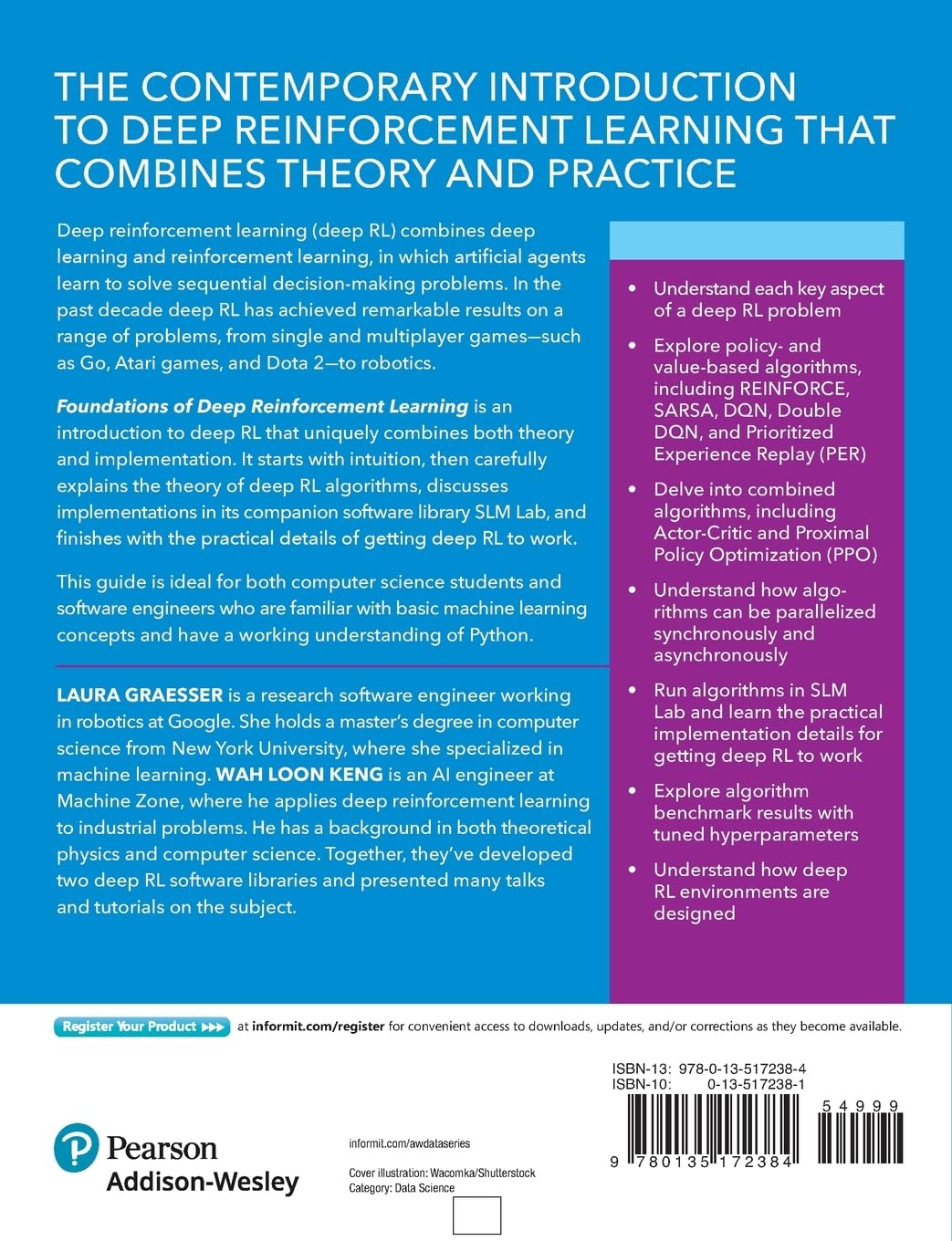
I already had a fair understanding of RL from reading the Sutton and Barto book and implementing regular TD learning as well as REINFORCE. This book clearly outlines the other common deep RL algorithms with pseudo and actual code. Enough mathematics is provided to support without delving too deeply into theory or proofs.Very useful for actually being able to code up RL algorithms yourself.
A**1
highly recommended
A wonderful book—highly recommended for RL enthusiasts.
A**R
Decent, no fluff book with one problem.
Overall, the book is decent. The writing is clear and the amount of information on each technique is good - just detailed enough that you can understand it, without excessive detail. It also covers a nice selection of topics. The selection of methods should leave the reader in a good place to learn the more advanced stuff on their own.However, the authors make the same mistake countless other instructors make - with the exception of a single, self-contained example for REINFORCE, all the examples in the book make use of their own personal framework (the SLM lab). This is done in an effort to reduce boilerplate, but it means the examples are no longer self-contained and it adds the additional burden of learning their framework, which I'm entirely uninterested in doing because in practice I will use my own. Ideally, all the examples would be pure PyTorch, and each should entirely self-contained in a single file so you can run the example as is, without learning a new framework or having to reference other modules. Obviously nobody would write production code this way, but for pedagogic purposes, this is by far the easiest way to learn. Note to instructors everywhere: we're not interested in your framework, no matter how proud of it you are. It doesn't belong in an instructional text.Otherwise, it's a very good book and despite my complaint, I would recommend it.
Y**O
Good content, not so good paper quality
I really like the book. It explains all the concepts very well, tying anecdotal points to bring everything to the final algorithm. Its example code is also easy to read. I just wish they’d use better paper quality. It’s very thin and doesn’t feel premium at all for the price.
A**Y
Excellent resource
An invaluable guide to deep RL. As many reviews have pointed out, the use of SLM-Lab is quite flawed, but that doesn't take away from the value of the book itself. Its difficult to find clear explanations of recent advancements in policy gradient methods, and this book does a good job of doing so. I'd recommend using this book as a resource, and implementing algorithms through other frameworks.
H**T
Kindle Edition displays wrong formulas
This review is NOT about the quality of the contents of the book, but only about the usability and readability of the Kindle edition. As mentioned elsewhere, the formulas for the Kindle version do not properly render subscript and superscript, resulting in unreadable and wrong formulas, making the Kindle version unusable, as can be seen in the photo comparing the display of the formulas in both the print and Kindle edition.Tested on Mac, on PC, on Chrome, on Firefox, and the Kindle app on iOS, none work properly.
J**A
Buen libro.
Este es un buen libro de consulta.
K**A
Good book, but for using self-written library as base for all algorithms - only 4 stars
The book contains a good intro to Deep RF, and the descriptions are clear. However, the authors use the self-written library as the base framework for all algorithms without a deep description of that library (only from the user's POV). I consider it as a minus, so 4 stars.
Trustpilot
2 months ago
2 months ago