
DOWNLOAD THE APP


Customer Services
Copyright © 2025 Desertcart Holdings Limited
DOWNLOAD THE APP
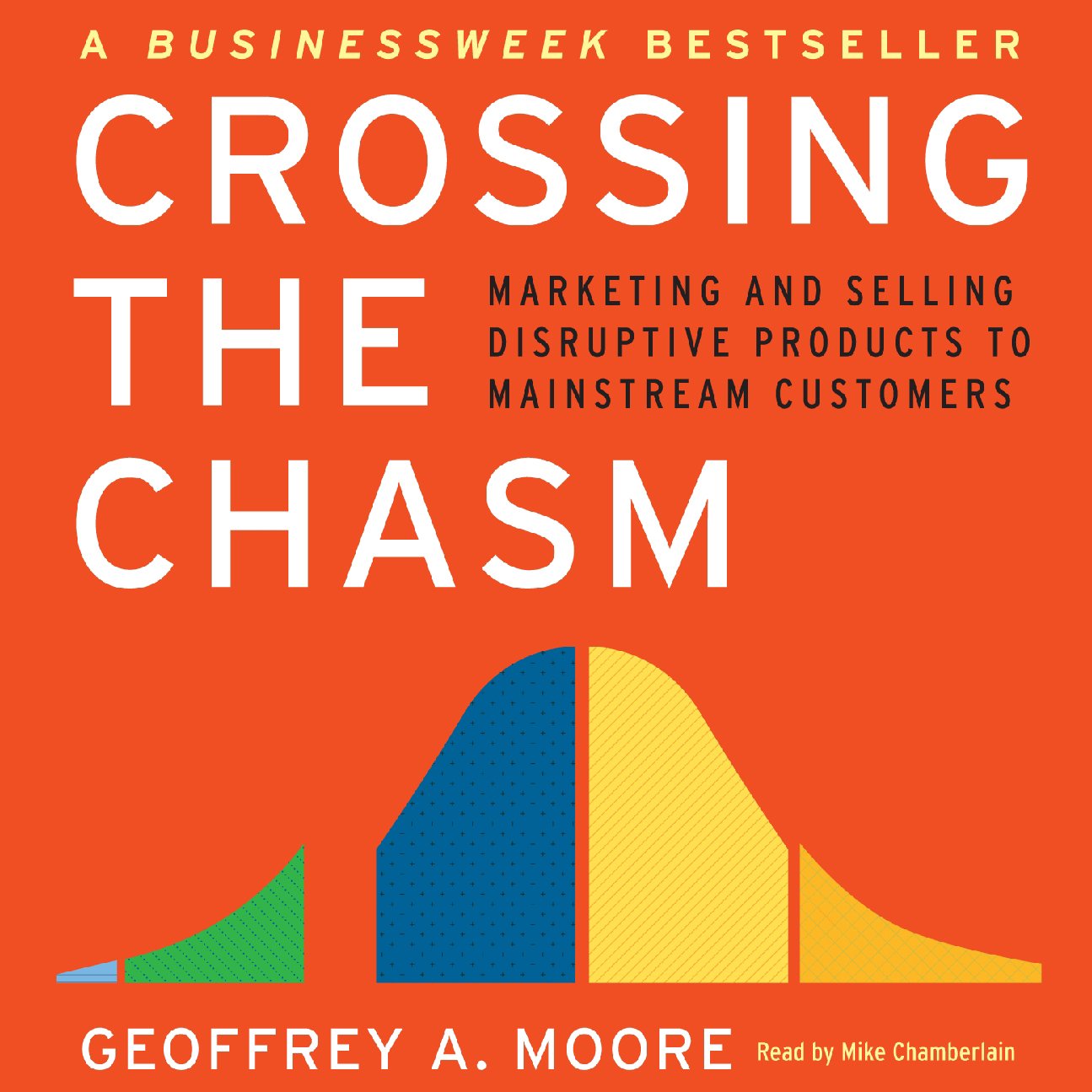
desertcart.com: Crossing the Chasm: Marketing and Selling Technology Projects to Mainstream Customers (Audible Audio Edition): Geoffrey A. Moore, Mike Chamberlain, Harper Business: Audible Books & Originals Review: Awesome book - This book is about market segmentation and the challenge of retargeting a business from early adopters to mainstream buyers. I have seen businesses fail because of insufficient market segmentation, including my own business. One company I once worked for had about 30 software products (acquired through mergers) and perhaps $100M/year in revenue, but did not distinguish in its catalogs, presentation, or sales force training, between mainstream products and experimental (buggy) early adopter products. Within a year they had failed. If they understood this book they would still be around. If I had read this book ten years earlier I would be much wealthier than I am today. The book is packed with examples, strategies, tactics and marketing insights which are not easily sumarized in a brief review. It is a pleasure to read and will withstand several re-readings. I highly recommend it to any businessperson, engineer, entrepreneur or investor. Review: two good points, but a longwinded book - Moore's primary point in this book is that the early adopters of a technology are not necessarily the same as the mainstream market. Moore points out that early adapters often buy things because they're cool, not for practical reasons. Early adapters deal with pain in the form of bad interfaces, minimal network effects. etc. Following this informal observation, Moore divides the population into innovators, early adopters, early majority, late majority, and laggards. This is his "Technology Adoption Life Cycle", of which the "underlying thesis is that technology is absorbed into any given community in stages corresponding to the psychological and social profiles of various segments within that market" (p. 15). He illustrates this with a bell curve with a horizontal axis corresponding to time of adoption. There's no explanation for why a Bell curve; I'm guessing it just looks pretty in PowerPoint. Moore continues with "this process can be thought of as a continuum with definite stages, each associated with a definable group" (p. 15), although actual definitions are notable by their absence. So Moore advises us that marketing to the two groups might have to be different. Complex? No. Obvious? Perhaps. In any case, this observation is followed with 185 pages of examples and pep talks which I found perfectly readable, but without much additional content. The second point, which is really just as important, is that the way to "cross the chasm" is by targeting a single industry or group of users, a so-called "vertical market". The only way customers who are beyond the early adopter phase are going to buy into a new product is if it is easy to adopt or if it truly fills a perceived desperate need. That is, it looks less "disruptive". Usually this means a lot of custom integration with industry-specific infrastructure. It's easier to build something well integrated with existing, for say, just the airline industry and their SABRE database backend, than it is to try to target the entire Fortune 500, each sector of which has adopted different sorts of databases. It worked just the way Moore described for my company, where Moore's book was required reading. You can get much more insight about sales and marekting (as well as finance and logistics) about disruptive technologies from Clayton Christensen's excellent "The Innovator's Dilemma". You can learn more about marketing segmentation and network effects from Shapiro and Varian's "Information Rules". I might be biased as both a techie and a recovering academic, but I liked the more heavily researched, serious case-study orientation as well as the precise, restrained, academic tone of these two books from business professors. On the other hand, Moore's book gives you an excellent feel for the seat of the pants consulting and hype side of the business world, which itself is a useful education. Moore's book is breezy and highly readable. This is great can't-sleep-on-the-airplane material. And two good ideas are more than you get out of most pop business books.
C**N
Awesome book
This book is about market segmentation and the challenge of retargeting a business from early adopters to mainstream buyers. I have seen businesses fail because of insufficient market segmentation, including my own business. One company I once worked for had about 30 software products (acquired through mergers) and perhaps $100M/year in revenue, but did not distinguish in its catalogs, presentation, or sales force training, between mainstream products and experimental (buggy) early adopter products. Within a year they had failed. If they understood this book they would still be around. If I had read this book ten years earlier I would be much wealthier than I am today. The book is packed with examples, strategies, tactics and marketing insights which are not easily sumarized in a brief review. It is a pleasure to read and will withstand several re-readings. I highly recommend it to any businessperson, engineer, entrepreneur or investor.
B**R
two good points, but a longwinded book
Moore's primary point in this book is that the early adopters of a technology are not necessarily the same as the mainstream market. Moore points out that early adapters often buy things because they're cool, not for practical reasons. Early adapters deal with pain in the form of bad interfaces, minimal network effects. etc. Following this informal observation, Moore divides the population into innovators, early adopters, early majority, late majority, and laggards. This is his "Technology Adoption Life Cycle", of which the "underlying thesis is that technology is absorbed into any given community in stages corresponding to the psychological and social profiles of various segments within that market" (p. 15). He illustrates this with a bell curve with a horizontal axis corresponding to time of adoption. There's no explanation for why a Bell curve; I'm guessing it just looks pretty in PowerPoint. Moore continues with "this process can be thought of as a continuum with definite stages, each associated with a definable group" (p. 15), although actual definitions are notable by their absence. So Moore advises us that marketing to the two groups might have to be different. Complex? No. Obvious? Perhaps. In any case, this observation is followed with 185 pages of examples and pep talks which I found perfectly readable, but without much additional content. The second point, which is really just as important, is that the way to "cross the chasm" is by targeting a single industry or group of users, a so-called "vertical market". The only way customers who are beyond the early adopter phase are going to buy into a new product is if it is easy to adopt or if it truly fills a perceived desperate need. That is, it looks less "disruptive". Usually this means a lot of custom integration with industry-specific infrastructure. It's easier to build something well integrated with existing, for say, just the airline industry and their SABRE database backend, than it is to try to target the entire Fortune 500, each sector of which has adopted different sorts of databases. It worked just the way Moore described for my company, where Moore's book was required reading. You can get much more insight about sales and marekting (as well as finance and logistics) about disruptive technologies from Clayton Christensen's excellent "The Innovator's Dilemma". You can learn more about marketing segmentation and network effects from Shapiro and Varian's "Information Rules". I might be biased as both a techie and a recovering academic, but I liked the more heavily researched, serious case-study orientation as well as the precise, restrained, academic tone of these two books from business professors. On the other hand, Moore's book gives you an excellent feel for the seat of the pants consulting and hype side of the business world, which itself is a useful education. Moore's book is breezy and highly readable. This is great can't-sleep-on-the-airplane material. And two good ideas are more than you get out of most pop business books.
S**P
Even if you think you know it, you should read it
I had heard of this book so many times during my MBA and startup days so I always wanted to read it. But because this book is so highly quoted, I had also read various summaries and articles written around it. Reading these gave me the feeling that I know enough of what this book is all about and so perhaps I can give it a skip. Turns out I was wrong. No matter how much you think you know it, this book is still a goldmine. In spite of knowing the basics of diffusion curve and the way innovation spreads, I still got to learn many new things. Just to highlight a few: - Why do products with better features don't always end up winning the market? - What are the peculiarities of users in each segment of diffusion curve? - Difference between a sales driven and a market driven company and which one you should be? - The importance of hitting the right pain point and choosing the right niche Certain not so good things about the book: - Most examples are bit dated as this book was written quite sometime ago so young folks might not have heard of these companies - Certain parts of the book specially the sales strategy seem to be applicable more to the B2B businesses and less for B2C type consumer internet businesses - Also certain portions of the book, specially the last chapter or so, seems like a little outdated in present context of 2013 Nonetheless, overall this book is a must recommend for all entrepreneurs, technology enthusiasts and product managers. It should be a part of your library as there will be times when you will have to look back and reference certain parts of it.
P**S
Have not read it yet, but SImon Sinek used it to convey an important message - looking forward.
What I do know is that book addresses a classic issue - that of how to build towards acceptance. Very topical for us at this stage. Looking forward Paul Pretorius
T**E
Very insightful for new Product Manager
As an application engineer on the verge of making the transition to Product Line Management, this book has been very enlightening and insightful. While there are several marketing nuggets, I found the commentary detailing how to categorize prospective customers based upon their risk tolerance very interesting. In an effort to come up to speed quickly, I've read several interesting books over the past several months but "Crossing the Chasm" inspired the most thought as its definitely a theoretical read with a nice mix of real-world marketing examples and company references.
R**R
Brilliant book. Has tons of insights regarding how to make the leap between being a small company to being a big company with many relevant and dissected examples. It's a short book that contains tons of relevant information. Must read.
A**L
A classic.
S**R
Excelente livro
P**I
« Crossing the chasm », que l'on peut traduire en français par « franchir le gouffre », fait partie de ces livres intemporels qu'il est impératif de connaître. Même 20 ans après sa parution (il n'a bizarrement jamais été traduit en français'), ses concepts marketing sont toujours autant d'actualité et ceux qui les ont ignorés le paient chèrement' Geoffrey Moore, ancien consultant au sein du McKenna Group, constate qu'une entreprise lançant un produit innovant ou disruptif traverse un parcours quasi banalisé : - Cela commence par un certain succès, les ventes commencent à décoller, l'euphorie se poursuit lorsqu'elle signe quelques contrats avec quelques gros clients. - Arrive l'heure des investissements pour une croissance forte' Mais alors que le décollage semble inéluctable, la progression des ventes stagne puis chute radicalement, entraînant souvent la mort prématurée de l'entreprise ou sa restructuration forcée. Ce scénario catastrophe n'est pas l'apanage exclusif des startups, nombre de sociétés « établies » qui étaient en transition de phase l'ont connu avec des conséquences plus ou moins graves ! Ce constat va permettre à Geoffrey Moore de déduire le cycle d'adoption des innovations en 5 étapes : 1) Les « Innovators » (précurseurs ou techno-enthousiastes) 2) Les « Early Adopters » (adopteurs précoces ou stratégiques) 3) La « Early Majority » (majorité avancée) 4) La « Late Majority » (majorité tardive) 5) Les « Laggards » (retardataires) Lorsque l'on analyse plus précisément le cycle d'adoption des innovations, on s'aperçoit qu'entre le segment des « Innovators / Early Adopters » et celui de la « Early/Late Majority » il n'y a pas une continuité, mais un véritable gouffre (le « chasm ») excessivement compliqué à franchir sans une stratégie ad hoc. En effet le mode d'achat de la « Early/Late Majority » repose quasi exclusivement sur le principe des références à d'autres acheteurs, et pas n'importe lesquelles ! Ce segment ignore les populations « Innovators » et « Early Adopters » qu'il considère comme des inconscients prenant des risques inconsidérés à choisir une technologie produite par une société n'ayant pas de références établies. Leur credo : n'acheter qu'aux leaders du marché pour diminuer les risques (risques souvent évalués sur le fait qu'en cas de pépin, l'acheteur pourrait perdre son job). C'est ici que Geoffrey Moore intervient en énonçant une stratégie très simple : mieux vaut être gros sur un marché minuscule que petit sur un gros marché ! Pour cela, il nous propose de réinventer notre stratégie en réduisant à l'extrême prétentions et marché (opération beaucoup plus compliquée qu'il n'y paraît') et de se limiter au départ à l'exploration d'un micromarché dans lequel le produit ou le service obtiendra une valeur ajoutée très significative, voire unique. L'entreprise aura ainsi plus de facilité à cibler ses premiers clients caractérisés par des besoins précis et identiques. Ce recentrage permet de se servir efficacement de ses premières ventes comme des références solides auprès des autres clients de ce groupe. Très rapidement il faudra, parmi ses premières ventes, identifier le (ou les) client(s) phare, celui qui vous apportera l'image de leader tant convoité. Fort des premiers succès, il est impératif de conserver le focus et d'explorer complètement ce micromarché pour devenir incontournable et toucher la « Early/Late Majority » propre à ce segment. Dès que ces segments de population sont atteints, ne pas s'attarder sur celui des « Laggards » (retardataires) mais ouvrir son marché en choisissant un autre micromarché et continuer ainsi jusqu'à ce qu'une taille critique globale permette de s'établir sur un marché plus vaste.
R**Z
Moores Crossing the Chasm ist ein Must Read für jeden Produktverantwortlichen, der ein neues Hightech Produkt auf dem Markt platzieren muss.
Trustpilot
3 weeks ago
4 days ago