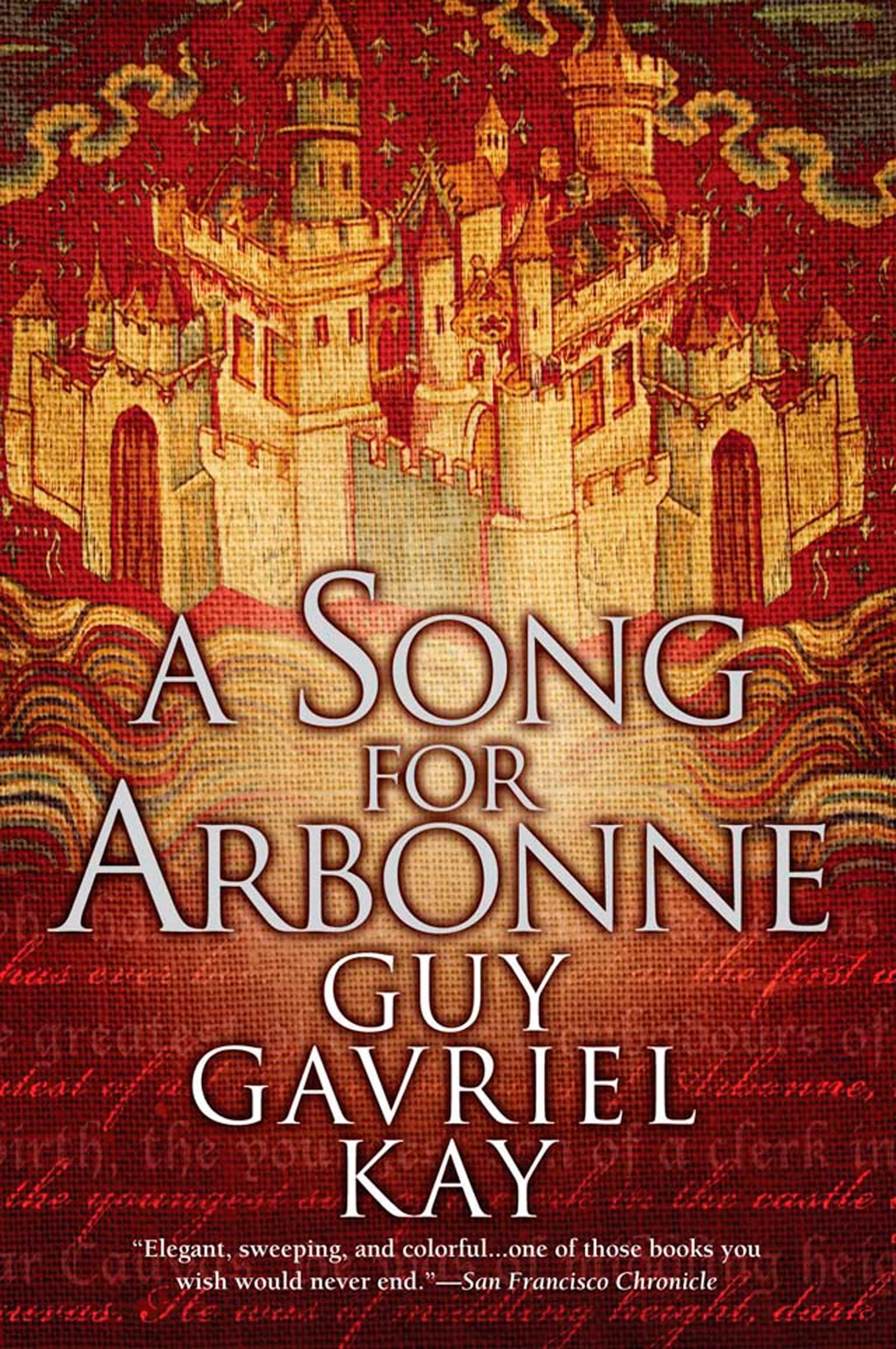
A Song for Arbonne
Product ID: 6930545
Desertcart purchases this item on your behalf and handles shipping, customs, and support to Peru.
desertcart.com: A Song for Arbonne: 9780451458971: Kay, Guy Gavriel: Books Review: This guy, Guy can flat out write - I actually started reading this book 20 years or so ago but for some undetermined and totally unfathomable reason I didn't finish it. Perhaps I was too busy being a parent helping to raise our three children. Perhaps I was too involved in my career. I'm sure those two reasons were part of it but I think that what really contributed the most was a real bad case of Muse envy. My Muse was just beginning to awaken after a long dormant period and I was beginning to do a little writing around the time I was reading A Song for Arbonne and my Muse was so shaken by the immaculately flowing style of the author that she, through her envy, forced me to stop reading it. Since then, however, my Muse has matured enough to admit that she will most likely never attain the high standards of Mr. Kay and the brilliant Muse who inspires him, so, it was okay to read the book. This feeling was enhanced by a conversation, of the social media variety, with one of my favorite authors, SJA Turney in which he, in a not so mild a suggestion, implored me to give it another go as this book was his favorite of all time and had done much to set him on the path to becoming an author. So, dear reader, what did I find the second time around? A masterful bit of storytelling full of great characters and a plot that kept me mesmerized throughout as it wove around and through the fabric of human emotions. One thing I realized about a third of the way through was that I basically knew the path the character of Blaise de Garsenc was going to take to become who I imagined he would be in the end. However, what I could not imagine was the many different forks that path would take, a long, winding and entertaining road indeed. As to this being a work of fantasy, it does, after all, feature an earth with two moons, it is also a work of real history as well,especially in the way the author portrays the misuse of religious power and the dangers inherent in that type of elitist exclusivity. To me it calls to mind the Crusading Popes and the modern Islamic jihadists. One thing that is certain is that I am in awe of the writing acumen of Mr. Kay and will certainly be adding his other works to my ever growing "to be read" pile. 5 stars for this brilliant and beautifully written book. Review: An epic novel to read, a song to sing - Born from the history of troubadour culture evolving in large areas covering the south of France, (Aquitaine, Provence, Occitanie), the country of the langue d’oc, north of Italy (Occitan Valley, Piedmont) and north of Spain (V’al D’Aran), A Song for Arbonne is a pseudo-historical fantasy set in a fictional yet easily recognizable medieval Western Europe. There is also a Germanic substrate, with names like trovaritz (troubadour) singers, Aulensburg and Götzland. The novel is slow, but it flows in a lyric way that makes everything feel like an epic song, written a long time ago, brought again to live by a troubadour named Gavriel Kay, only to prove that a slow pace can provide an entertaining experience too. It is a multi-centered story, in which internal and external conflicts, religious and cultural differences move together toward an epic battle final. One third in the book, the path of Blaise de Garsenc, an enigmatic mercenary, becomes deceptively predictable, only to realize that everything goes along a road resembling a river with many meanders and a large delta at its mouth. You will know only in the last moment which path will carry you to the end. Most characters are introspective and, seeing them from some place far above, makes a connection difficult, even with Blaise, but that, in a strange way, only strengthens the connection with the book itself. Some of them seem to be aimless, like the troubadour Lisseut, yet she resembles a reader who reads the novel from inside, a vehicle to provide more insight into that particular world. We have also the Duke of Talair, an enigma inside a riddle, sympathetic and uncaring in equal parts. In the end, A Song for Arbonne, feels like Ramir’s song, which is the main theme of the novel, a mesmerizing piece of storytelling, lyrical and romantic, weaving adeptly through the fabric of human emotions.
| Best Sellers Rank | #176,230 in Books ( See Top 100 in Books ) #470 in Historical Fantasy (Books) #1,426 in Sword & Sorcery Fantasy (Books) #2,567 in Epic Fantasy (Books) |
| Customer Reviews | 4.7 out of 5 stars 969 Reviews |
P**T
This guy, Guy can flat out write
I actually started reading this book 20 years or so ago but for some undetermined and totally unfathomable reason I didn't finish it. Perhaps I was too busy being a parent helping to raise our three children. Perhaps I was too involved in my career. I'm sure those two reasons were part of it but I think that what really contributed the most was a real bad case of Muse envy. My Muse was just beginning to awaken after a long dormant period and I was beginning to do a little writing around the time I was reading A Song for Arbonne and my Muse was so shaken by the immaculately flowing style of the author that she, through her envy, forced me to stop reading it. Since then, however, my Muse has matured enough to admit that she will most likely never attain the high standards of Mr. Kay and the brilliant Muse who inspires him, so, it was okay to read the book. This feeling was enhanced by a conversation, of the social media variety, with one of my favorite authors, SJA Turney in which he, in a not so mild a suggestion, implored me to give it another go as this book was his favorite of all time and had done much to set him on the path to becoming an author. So, dear reader, what did I find the second time around? A masterful bit of storytelling full of great characters and a plot that kept me mesmerized throughout as it wove around and through the fabric of human emotions. One thing I realized about a third of the way through was that I basically knew the path the character of Blaise de Garsenc was going to take to become who I imagined he would be in the end. However, what I could not imagine was the many different forks that path would take, a long, winding and entertaining road indeed. As to this being a work of fantasy, it does, after all, feature an earth with two moons, it is also a work of real history as well,especially in the way the author portrays the misuse of religious power and the dangers inherent in that type of elitist exclusivity. To me it calls to mind the Crusading Popes and the modern Islamic jihadists. One thing that is certain is that I am in awe of the writing acumen of Mr. Kay and will certainly be adding his other works to my ever growing "to be read" pile. 5 stars for this brilliant and beautifully written book.
A**F
An epic novel to read, a song to sing
Born from the history of troubadour culture evolving in large areas covering the south of France, (Aquitaine, Provence, Occitanie), the country of the langue d’oc, north of Italy (Occitan Valley, Piedmont) and north of Spain (V’al D’Aran), A Song for Arbonne is a pseudo-historical fantasy set in a fictional yet easily recognizable medieval Western Europe. There is also a Germanic substrate, with names like trovaritz (troubadour) singers, Aulensburg and Götzland. The novel is slow, but it flows in a lyric way that makes everything feel like an epic song, written a long time ago, brought again to live by a troubadour named Gavriel Kay, only to prove that a slow pace can provide an entertaining experience too. It is a multi-centered story, in which internal and external conflicts, religious and cultural differences move together toward an epic battle final. One third in the book, the path of Blaise de Garsenc, an enigmatic mercenary, becomes deceptively predictable, only to realize that everything goes along a road resembling a river with many meanders and a large delta at its mouth. You will know only in the last moment which path will carry you to the end. Most characters are introspective and, seeing them from some place far above, makes a connection difficult, even with Blaise, but that, in a strange way, only strengthens the connection with the book itself. Some of them seem to be aimless, like the troubadour Lisseut, yet she resembles a reader who reads the novel from inside, a vehicle to provide more insight into that particular world. We have also the Duke of Talair, an enigma inside a riddle, sympathetic and uncaring in equal parts. In the end, A Song for Arbonne, feels like Ramir’s song, which is the main theme of the novel, a mesmerizing piece of storytelling, lyrical and romantic, weaving adeptly through the fabric of human emotions.
H**S
Intricate characterisation in the time of the troubadours
If you care at all for fantasy, even just Harry Potter and Frodo and Gandalf, you should read Guy Gavriel Kay. This is such a masterful work it stands with his greatest: Fionavar, Sailing to Sarantium, the River of Stars. As always, the plot trajectory is a bit, well, fantastical, and the characterisations are deep and rich. And he makes it all work with an embrace of ambiguity that reminds this reader of George Eliot or Thomas Hardy. Just when you think you have a character pegged, he turns them slightly and shows a side you had not suspected, and you find it believable and even insightful. A mercenary finds himself in the middle of trouble in Arbonne, where troubadours extol forbidden love, and women exercise more choice than was the case in the medieval days the tale is modelled after. Arbonne is vulnerable because of twenty years of feuding between a noble husband and his wife's lover, who has unexpectedly become a nobleman himself. To the North, the harsh land of Gorhaut is preparing to exploit this weakness. But the dominating, manipulative priest of the God Corannos, the power behind the throne, has a way of making enemies. I will save you the spoilers - it is fun to watch things unfold, and Kay is as inventive as ever. His work is as interesting as great historical fiction like the Three Musketeers or Tale of Two Cities, but with a feel for the enchantment that has always been part of human life. Give it a look, if you haven't.
F**S
Enjoyable, if Somewhat Forgettable Medieval Pseudo-Fantasy
Song for Arbonne is, like many of Guy Gavriel Kay's works, a pseudo-historical fantasy set in a fictional yet wholly recognizable time and place in our own world, in this case, 13th century France, specifically, the southern provinces (Aquitaine, Provence, Burgundy, etc.). Here the eponymous fictional kingdom of Arbonne acts as the stand-in. Like most of Guy Gavriel Kay's works, the writing, language, and rhythm of the prose is hypnotic. If you're used to the usual sparse and barely functional prose of most fantasy writing, Kay can be a bit of a jarring experience. Jumping from throw-away dime pulp fiction style to something entirely literary can take some getting used to. Be warned, Kay does not stay in one viewpoint in his novels. If you're one of those who dislikes jumping from viewpoint to viewpoint, you may find Kay's approach frustrating. However, given the scope of the plot and the depth of character insight in his books, staying with one character the entire way would mar the overall effort of Kay's writing. In Song for Arbonne, our main character is Blaise de Garsenc, son of an overbearing priest from the pseudo-Germanic country of Gorhaut to the north. Blaise is thrust into a world of courtly intrigue, betrayal, and assassination, ultimately forced to make a choice between himself, the well-being of his homeland, and the friendships he forms with Arbonne's nobility, particular the Duke of Talair, a former troubador. In the interest of full disclosure, I think that Kay's novel Under Heaven is one of the finest pieces of fiction I've ever read, and his novel Tigana is not far behind. So I'm obviously a fan, and with that said, the rating here is somewhat me being generous to Kay for past enjoyments. Truthfully, Song for Arbonne is probably a 3.5 star novel, not a 4 star. While the writing is sublime, and the three main characters are compelling (Blaise, the Duke de Talair and the Queen of Arbonne), Kay's supporting characters in this novel (and there are many, many, many of them) never quite rise to the level of care or realism that he reaches with his other novels. Particularly egregious is the young female troubadour Lisseut, who is given multiple chapters of viewpoint in the novel that ultimately end up being aimless. She's a spectator to the real action, has no real arc to her character, and kept finding myself disappointed that nothing happened from her viewpoint. Likewise, the villain characters (Blaise's father, his brother, and the king of Gorhaut) are so over-the-top vile and irredeemable that I didn't want to spend any time with them at all. In a sense they exist as a counterpoint to Blaise, to show how much better/humane Blaise is than others of his time and culture, but as characters they're flat, one-dimensional cardboard cutouts of moustache twirling eeeeviil. Too, more than any other of his books I've read so far (out of the five), the character introspections in this text simply don't resonate. The Duke of Talair's dilemma is supposed to be this soul-wrenching, timeless treatise on love, but really his entire backstory is based on the premise that he's a serial adulterer. He's an interesting character, but not entirely sympathetic--which, come to think of it, is probably my biggest problem with the book as a whole. While the world and characters presented are interesting, they're just not relatable. I simply didn't connect with any of the characters. Thus, their choices were all ultimately coin tosses; yes, they could choose one thing or another, and the choices made would have an impact on others around them, but I simply wasn't tied to any outcome for the characters individually. They could have all died, or all lived in bliss and frivolity, and ultimately their chosen ends would be met with a quiet, "Eh. Okay." With Tigana and Under Heaven I couldn't put the book down, was driven to finish them as quickly as I could. With Song for Arbonne, I found myself going days, even a week at a time without really feeling the need to dive in. That said, compared to most fantasy literature, Song for Arbonne is a clear step above the usual morass of mediocrity, but it certainly doesn't reach the heights of Kay's best works, nor even those of other entries to the genre. At the end it's something you remember somewhat pleasantly, but with no real recollection of the details. Enjoyable, but ultimately forgettable.
D**E
Classic Gavriel Kay
Another terrific yarn by Guy Gavriel Kay! If you are a fan of his writing/ style/ quality, this is yet another great read. Set in a misty past and loosely based on the trouvere court traditions of south western France, this story - with its multiple plot lines - is lush, almost operatic in the telling and the convolutions of a complicated political and religious period. Of interest is the recently available overlay on PBS of the three part series from BBC 'Divine Women', For many casual readers of history, the concept of powerful women in society is often thought of as a recent event. It ain't true. Historically there is a rich but mostly glossed over body of work by women who not only changed history but often created societies which thrived. Mostly ignored or denigrated by historians (most likely men) Song for Arbonne is a sensitive creation of what a woman's society could have looked like - from the inside. While this is fiction, it seems to be really well researched by Kay and then very aptly recreated as a fiction. The last three chapters are some of the best thread tying I've ever experienced. Perhaps the only caveat is for readers of Kay to not read this book immediately after exploring any of his other work. All his works stand alone and for me, should be explored as a unique event rather than 'just another' book by Kay. This is a good read ...
A**Y
Full of grace, wit, and heart
Guy Gavriel Kay creates a world filled with intrigue, bitterness, love, and music. Arbonne, the rich southern land ruled by a goddess, exists as the exemplar of music and culture. The failure of its leaders put at risk for an invasion from the north. Gorhaut honors the god Corranos and exalts his warrior culture. Love between people, of music, and of country thread the story of conflict and war as Gorhaut seeks to invade its southern neighbor for its rich fields, natural harbors, and for a holy war. Kay transforms troubadour culture into the foundations of a country wrestling with great and hurtful divisions as it responds to another lost to honor. I haven't given specifics here because it is such a rich, mournful,honest story of men and women as the deal with the great events of their day.
M**R
Love Song for Country
This is one of my favorite Kay stories, and one of the most female-oriented. Like the women of Sarantium, the women of Arbonne have shaped their country and their court. It may seem that they need a man's strength to preserve what the women have created, but in the final twists, you see that is not quite so. Mirrored by the partnership of their gods, male and female share in the protection of their country. I love the music and the lyrical writing. The scene when the old joglar sings a love song to his country brings me to tears. I love the way we see much of the story through the eyes of secondary characters. I love the plot twists and surprises, although a careful reader is given plenty of clues so the surprises shouldn't be unfair. Ademar and Galbert are the most evil of villains, immediately shown as such in the most grotesque manner. There are no shades of grey with them, unlike other villains from Kay's stories. They are Stalin or Hitler - desiring only to dominate and destroy. It is the good characters who have shades of grey. Aelis's selfishness causes the near destruction of her country. Dukes Bertran and Urte are unable to let the past go. Those three annoyed me intensely. But Blaise, Signe, Beatritz, Ariane, Rudel, Lisseut, Valery, Daufridi, and Rosala captured my heart.
D**.
Wonderful!
This is the 6th novel I've read by Kay and it's my favorite. His other novels had so many characters and places I couldn't pronounce or keep track of, it became a chore to get through them. This one was the opposite. A novel shouldn't be a lot of work, it should be a pleasure. This one delivers. The pace was perfect, the characters were interesting, the plot twists kept my interest high. Loved it!
Trustpilot
3 weeks ago
2 months ago