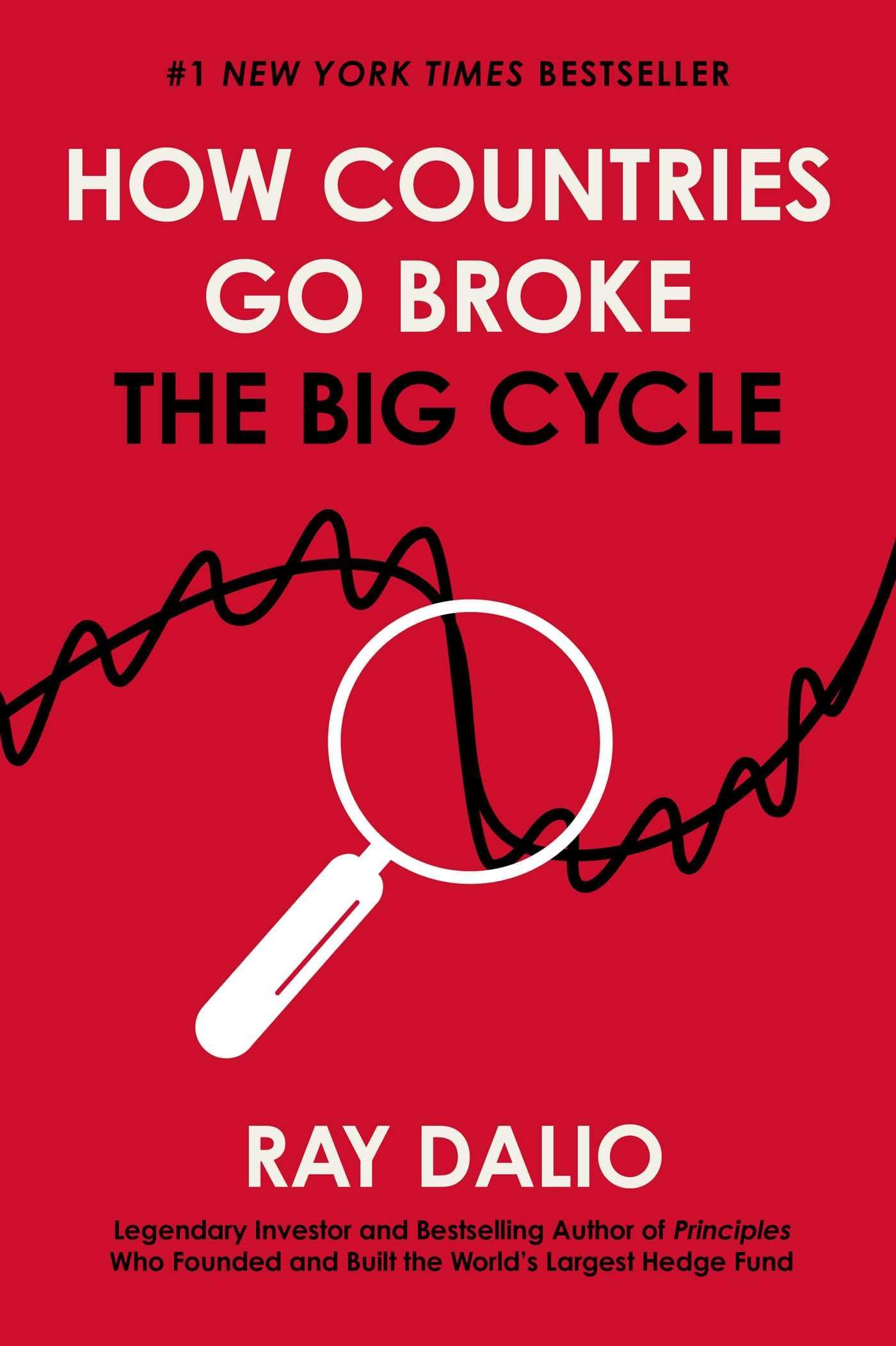
How Countries Go Broke: The Big Cycle (Principles)
Product ID: 619419794
Desertcart purchases this item on your behalf and handles shipping, customs, and support to Peru.
#1 NEW YORK TIMES BESTSELLER “Advance copies of Ray Dalio’s new book about how countries go broke have become a hot read in Washington.” — The New York Times “This book is a gift to humanity….Ray provides a solution to what is the biggest and most certain threat to our prosperity.” —Henry M. Paulson Jr. “An invaluable resource for policymakers, investors, and citizens.” —Lawrence H. Summers An urgent warning about the American economy from Ray Dalio, the #1 New York Times bestselling author of Principles . Do big government debts threaten our collective well-being? Are there limits to debt growth? Can a big, important reserve currency country like the United States really go broke—and what would that look like? For decades, politicians, policymakers, and investors have debated these questions, but the answers have eluded them. In this groundbreaking book, Ray Dalio, one of the greatest investors of our time who anticipated the 2008 global financial crisis and the 2010–12 European debt crisis, shares for the first time his detailed explanation of what he calls the “Big Debt Cycle.” Understanding this cycle is critical for helping policymakers, investors, and the general public grasp where we are and where we are headed with the debt issue. Dalio’s model points toward surprisingly straightforward solutions for dealing with the debt problems that the US, Europe, Japan, and China face today. How Countries Go Broke also shows how these debt problems are related to the other forces—political within countries, geopolitical between countries, natural (droughts, floods, and pandemics), and technological (most importantly, AI)—that together are causing what Dalio calls the “Overall Big Cycle” changes in the world order. By reading this book, you will improve your understanding of what’s happening now and what to do about it. Review: Unique Writing Style Lends Itself to Understanding Material - I'm not sure if I felt good after reading this, but I definitely felt more informed. It's written for different accessibility levels as well. Dalio makes it a point to try to keep the writing incredibly accessible for the casual person who really just wants to understand the overarching points. At the same time, however, he also gives the reader the option to dive deeper into any given topic. Think of it like if your college economics professor decided to let you decide how detailed the class would be. If you want to keep it at an Econ 101 level, great. You can do that. if you want a deeper dive into some grad level information, well, that's here as well. I think it makes for a great read. Review: A must read for well-informed news junkies! - This book should be mandatory reading for all college graduates. This is the economic side of The Fourth Turning” and these books complement each other. Current events become more comprehensible and scary international and domestic news fit well into Dalio’s analysis.
| Best Sellers Rank | #10,229 in Books ( See Top 100 in Books ) #2 in Public Finance (Books) #17 in Economic Conditions (Books) #30 in Introduction to Investing |
| Customer Reviews | 4.6 out of 5 stars 965 Reviews |
D**A
Unique Writing Style Lends Itself to Understanding Material
I'm not sure if I felt good after reading this, but I definitely felt more informed. It's written for different accessibility levels as well. Dalio makes it a point to try to keep the writing incredibly accessible for the casual person who really just wants to understand the overarching points. At the same time, however, he also gives the reader the option to dive deeper into any given topic. Think of it like if your college economics professor decided to let you decide how detailed the class would be. If you want to keep it at an Econ 101 level, great. You can do that. if you want a deeper dive into some grad level information, well, that's here as well. I think it makes for a great read.
D**O
A must read for well-informed news junkies!
This book should be mandatory reading for all college graduates. This is the economic side of The Fourth Turning” and these books complement each other. Current events become more comprehensible and scary international and domestic news fit well into Dalio’s analysis.
B**D
Dalio is trying to keep the plane from crashing!
Ray Dalio’s How Countries Go Broke is a challenging but rewarding read that offers a powerful framework for understanding how nations rise, stagnate, and decline financially. Dalio explains both short-term and long-term debt cycles and breaks the long cycle into clear stages—from money creation and debt bubbles to deleveraging and, eventually, a return to hard money. While some sections are dense, the structure helps make sense of incredibly complex economic forces. The case studies of Japan, the United States, and China are especially compelling. Dalio’s analysis of Japan stood out to me, particularly how decades of flat growth and currency weakness have quietly eroded prosperity. It’s a sobering reminder that economic decline doesn’t always come through collapse—it can come through stagnation. The book also becomes surprisingly practical. Dalio argues that the U.S. must reduce its budget deficit to around 3% of GDP and outlines realistic ways to do it. Even when I didn’t fully agree, I appreciated the disciplined, non-ideological approach. This isn’t a light read, but it’s an important one. I’d especially recommend reading it with others—it’s the kind of book that gets better through discussion.
M**O
Control debt.
Great book that offers understandable reasons for countries demise.
B**D
Ray Dalio’s Most Alarming Forecast Yet
Ray Dalio’s new book, How Countries Go Broke, is his most sobering work yet and a worthy successor to Principles for Dealing with the Changing World Order. In my review of that earlier book, I compared Dalio to Hari Seldon from the Foundation series, an economist who unlocks the mathematical logic behind the rise and fall of nations. This time I am not sure if Dalio is still Seldon or if he has become Cassandra warning Troy of what is already unfolding. His gift for synthesizing history, markets, and human behavior into clear patterns makes the book both gripping and unsettling. When Dalio shows how debt cycles, political polarization, and declining productivity signal a country’s slide, it feels less like theory and more like diagnosis. The book is part history lesson and part economic weather report, yet it reads with the urgency of a thriller. Dalio walks the reader through the stages that lead nations into crisis, using simple language to explain complicated forces that shape the global economy. What makes it so compelling is that Dalio is not guessing. He is tracing the same patterns that have repeated for centuries, and he connects them to events happening right now in a way that is hard to ignore. His argument that we may be entering a period marked by geopolitical conflict and internal instability is not presented for shock value. It is presented because history points in that direction when certain conditions line up. I gave the book five stars because Dalio manages something rare. He teaches, warns, and clarifies all at once. The book leaves you better informed about how nations rise and fall, but it also leaves you uneasy, because Dalio is simply too good at seeing around corners. Whether he is Seldon, Cassandra, or even a modern Nostradamus, Dalio has once again shown that understanding the past is the only way to prepare for the future.
J**S
Good read
Does a good job explaining how countries go broke. Well worth reading.
L**N
How economic cycles work and fail.
This is written by a 75 year old investor who built the Bridgewater Hedge Fund and made a personal fortune. The book explains how governments manage the economy by controlling money availability and interest rates while a natural economic cycle happens - sometimes to economic disaster. An analysis is given at the end of the book of where the US economy stands and offers suggestions about steps that should be taken to avoid economic disaster. This book is heavy reading with many graphs showing economic history of many countries and some economic projections. The author provides bold type passages throughout the book with suggestions that casual readers can skip the rest of the text and still get the important economic message. This is an economic education for anyone who reads through it, investor or just a curious person.
A**R
Macro insight.
I’m in the middle of this book— WOW. Mind opening.
F**O
Leitura obrigatória para Ministros da Fazenda
Excelentes exemplos para o Brasil não ir para uma situação fiscal irreversível.
A**E
Top
Ein weiteres Meisterwerk
C**E
Completo y claro, aunque profundo para un no profesional
Muy completo y bien explicado, aunque en ocasiones demasiado técnico para un no profesional
A**E
Good read
Great insight and very helpful. What he describes is a financial meltdown but he also explains how countries get out of that mess
M**K
Un semplice estratto di un altro libro di Dalio
È sostanzialmente l’estratto di una parte del libro “The changing world order” dello stesso Ray Dalio. Completamente inutile se avete già letto quel libro e decisamente non vale i 30+ euro che costa.
Trustpilot
1 month ago
1 month ago