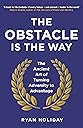
Obstacle Is The Way
Product ID: 58876261
🌟Timeless principles
📚300+ pages of wisdom
🧠Mindset transformation
Desertcart purchases this item on your behalf and handles shipping, customs, and support to Peru.
🚀 Turn Trials into Triumphs!
The Obstacle Is the Way is a transformative guide that draws on the timeless principles of Stoicism, offering readers over 300 pages of practical strategies and inspiring stories to help them turn life's challenges into opportunities for growth and success.
| Best Sellers Rank | #45,803 in Books ( See Top 100 in Books ) #40 in Job Hunting (Books) |
| Customer Reviews | 4.6 out of 5 stars 24,900 Reviews |
N**E
This book is a "must read" and, for me, a "must re-read"
I have been a long time follower of Ryan and his work so when this book came out I grabbed it. Ryan gives a great overview of Stoicism and applies it to our everyday lives. For those of you who don’t know, Stoicism is a philosophy teaching individuals to improve their moral and ethical well-being come what may. He takes example after example of great leaders who followed Stoicism and used it to leverage their problems to come out with solutions and to emerge as better people. Why you should read this book Ryan talks about something we all love to talk about: Our problems. Problems are something we face daily on both a small scale and a large scale, but instead of magnifying our problems, he shows us how to use these to our advantage. Instead of sulking or feeling bad for ourselves, he shows us how to find the benefit of the tragedy that has just befallen us and actually utilize it to make us better people. He shows us things from harnessing our negative emotions and using them as a catapult, to being aware of the fact that we are mortal to empower us to live each day. Who this book is for I don’t know a single person who wouldn’t benefit from this book. Every day we are faced with problems and we can always control how we view them and what we will do in the middle of them. This is an empowering book, if only you will take the lessons and start using them. How I applied it in my life: The other day I had a situation happen to me where I could have panicked but instead I embraced the problem and was able to face the obstacle, re-frame it in a positive light and work out a solution. Here’s what happened: I was in Houston and about start the 3 hour drive back to Austin when my car engine started smoking. I pulled over and figured out it was either the radiator or a hose and walked to the gas station to get water to figure out where the leak was. On the way there, I thought I may have to hitchhike back to Austin and leave my car there, depending on how bad the problem was. When I returned to my car, I realized I didn’t know where to add the water to, so my hitchhiking idea popped back into my head and I went back to the gas station to get cardboard and a marker. With my new “Need Mechanic” sign, I had help within 5 minutes. I headed to Autozone and found the hose I needed and ALSO happened to find a mechanic. I got to use my hitchhiking skills, learn more about how to fix my car and practice some Spanish (my mechanic was Mexican and only spoke Spanish). I could have been stressed, but I viewed it all as an adventure and it gave me energy and great ideas to get through it. Ryan explains how to re-think the situation in a way that will empower you to come up with a solution, where a lot of times we paralyze ourselves by getting stuck focusing on the problem, how bad it is and how unfair it is. This book makes you re-think your problems, turn them into obstacles and leverage them to a solution that will carry you further than you would have ever gone without having the “problem” in the first place. Another situation where I have used knowledge from the book….My work started putting some really heavy demands on me (whose work doesn’t) and at first I had a negative reaction to this thinking about how unfair it was. I started thinking of some concepts Ryan talked about and I re-framed the issue in my mind, was able to identify the areas that were causing work issues and delays, and offer proactive solutions by focusing on positive business outcomes. Three points i found most useful in the book 1. Use the idea that we are all going to die someday to enable you to live each day to the fullest. This was key for me since My mom passed at the young age of 47. 2. We can’t control every situation, but we can control our thoughts about them and our feelings. This allows us to ‘let go’ of so many things we worry about and focus on creating solutions. 3. Use our “negative”: feelings toward something to propel us forward. Many times we allow negativity to paralyze us, but we can use it to fuel us and get us to a better position than we would have been without the problem. I know I'll be revisiting this book in the future. It was exactly what I needed right now.
R**P
A manual for everyday living rooted in the principles of Stoicism.
Ryan Holiday’s The Obstacle Is the Way is a superb primer on the Stoic principles. For one thing, at 224 pages, it is less than half the size of the last book I read on the same theme, Derren Brown’s superb Happy. This is by no means a bad thing, however, for while Brown’s book delves into the history of Stoicism and man’s eternal search for that which will make us happy, Holiday’s is a quicker, lighter read, but one that packs a hell of a punch. The gist of the book is that if one applies the principles of Stoicism carefully and mindfully, then no matter what happens (good, bad, or indifferent) then it becomes possible to deal with the highs, lows, and plateaus of life with equal poise and calmness. Obstacles, Holiday posits, represent opportunity, and should be welcomed rather than feared, for they offer us chances to grow and become more than we currently are. There’s nothing really new here, and I say that without being critical. The tenets around which Holiday builds his case are thousands of years old, being drawn primarily from Epictetus and Marcus Aurelius, among others. The great success of the book is its ability to distill these concepts down into usable, everyday ways of thinking which can benefit each and every one of its readers, if they are disciplined enough to apply them to their own lives. It points out (quite correctly) that the problems faced by the average Greek or Roman citizen were, at their core, fundamentally no different than the ones that vex us today, for they are based upon the same old negative emotions: fear, jealousy, anxiety, greed, a desire for celebrity, and so forth. Marcus Aurelius, one of Rome’s five so-called “Good Emperors,” wrestled with all these issues and more on a daily basis, and used Stoicism in order to successfully conquer them…and himself. There are very good reasons why Meditations is still read so widely (and re-read so frequently) today. I have returned to the book regularly ever since I discovered it as a teenager, and will probably do so for as long as I live. These truths are timeless, and invaluable. Holiday refers to the Stoic philosophy as “an operating system for living,” which seems very apt in this digital day and age. If that is indeed the case, then The Obstacle Is the Way serves as an introductory manual for that operating system, a primer that helps one get to grips with how it works. Some of the complexity and nuance may be left out or abstracted, but the thrust of it is covered succinctly, with plenty of easily understandable contemporary examples to clarify things. I highly recommend this book to anybody who could use a little help in dealing with the stresses and strains of everyday living…and at the end of the day, isn’t that all of us?
I**N
Amazing, but never true
No doubt, you are trying to get ahead in whatever ‘getting ahead’ means to you. But so often an obstacle seems to stand in your way. Yes, there are a few people who report having planned their charmed life or their business success and had it unfold almost exactly as planned, and with style and elegance. Amazing, but never true. Most people blocked by the obstacles of time, money, connections, opportunity and more, do nothing. This book has a fascinating take on ‘being stuck’ – it is a primer on how to turn adversity to advantage, as the subtitle explains. Let me state upfront – I am bored by motivational talks and books. I find very little about them interesting or useful twelve hours later. This book is not a motivational text, though it is motivating as many good books are. The “Ancient Art” of the subtitle is referring to the wisdom and insight of the Stoic philosophers. These writings or thoughts influenced all the people Holiday uses as examples of this approach to obstacles of life. The circumstances of these people would leave most disoriented, reactive, torn and even paralyzed. As Holiday shows “some seem to turn those very obstacles, which stymie us, into launching pads for themselves.” Knowing that there are heroes doesn’t help us to become heroes, but knowing how they became heroes, does. The value of this book is that it offers an ancient and profound method and framework for understanding, appreciating, and acting in the face of the obstacles life throws at us. Turning obstacles into the way forward takes many forms. For the great Athenian orator, Demosthenes, it was a relentless drive to improve himself through action and practice. For Abraham Lincoln it was humility, endurance, and compassionate will. In each case, all the people cited in this book were not born with the attributes it took to succeed, and many faced unimaginable horrors, from imprisonment to debilitating illnesses, and of course the day-to-day frustrations we all endure. So, what did they do? “They had the ability to see obstacles for what they were, the ingenuity to tackle them, and the will to endure a world mostly beyond their comprehension and control,” Holiday explains. The perspective is not a self-delusional, positive and happy one, ‘this is not so bad’, but rather, ‘I can make this good’. The starting point is maintaining a state of mind that one of Holiday’s examples, the extraordinary businessman, John D. Rockefeller, had perfected: cool headedness and self-discipline. When America send the first astronauts into space, they trained them in one skill more than in any other: the art of not panicking. When people panic, they make mistakes. They just react, but not to what they need to react to, but to their survival hormones. At 150 miles above Earth, panic is suicide. Panic had to be trained out of the astronauts and it does not go easily. It must be trained away, through persistent, repeated attempts at not panicking, until you don’t. Talent isn’t the most important characteristic for success, grace and poise are, because these precede the opportunity to deploy your talent. The action after the panic allows for a change of perception that is a prerequisite for right action. George Clooney spent his first years in Hollywood getting rejected at every audition. He desperately wanted the producers and directors to like him, and they didn’t. He blamed them for not seeing how good he was. His life changed when he changed perspective, from self-centredness to that of other-centeredness, not possible in panic mode. Producers need to find the right actor to cast in their film, and they all hope that the next person to walk into the room is the right actor. When Clooney realized that he was the answer to their prayers, not the other way around, his performance improved and so did his career. Consider the refusal to fund your company. I could be an obstacle, or a call for a change of action. Getting the person to fund you this isn’t up to you, but the decision to refine and improve your presentation is. Consider the number of exceptional businesses started during depressions or economic crises. Fortune magazine was founded soon after the crash of 1929. Hewlett-Packard, and Revlon in the Great Depression. General Motors in the panic of 1907. Microsoft in the recession in 1973-75. LinkedIn during the burst of the dot-com bubble. Half the companies in the Fortune 500 were started under adverse conditions. Rather than focus on the difficulties of an economy in free-fall, they focused on what they needed to do to succeed, and that produced the difference. This difference requires presence of mind. Andy Grove, former CEO of Intel, said “Bad companies are destroyed by crisis. Good companies survive them. Great companies are improved by them.” In like fashion, great individuals find a way to transform weakness into strength. This is essentially a very practical book which will introduce you to a wealth of important ideas beyond what I have introduced in this column. They will be of extraordinary value as you try to facedown business crises. Readability Light --+- Serious Insights High +---- Low Practical High -+--- Low *Ian Mann of Gateways consults internationally on leadership and strategy and is the author of the soon to be released ‘Executive Update’.
S**H
Just what you need to face the important obstacles in life
(Review via http://masculinebooks.com/2015/06/22/the-obstacle-is-the-way-by-ryan-holiday/) I was vaguely familiar with Ryan Holiday, but didn’t know quite what he was all about. I got a better taste of what he does after listening to him on the Tim Ferriss Show. The show discussed Stoicism at length, which I found interesting as it was a show about marketing. Yet if these two marketing gurus put such an emphasis on the Stoics, they must truly believe in that philosophy. In fact, the Obstacle is the Way is rooted in Stoicism. Better yet, it is Stoicism. What Obstacles are You Facing? What is holding you back in life? What do you fear? Why can’t your pursue the things you really want in life and just seize it? These are tough life questions that many people often find themselves contemplating. In the Obstacle is the Way by Ryan Holiday (Amazon) he seeks to answer these questions. But he does this not through telling you to engage in new-agey nonsense, rather he uses anecdotes from the most brilliant and successful minds in history, dissects their obstacles and shows you how they overcame. Whatever we face, we have a choice: Will we be blocked by obstacles, or will we advance through and over them?” I want you to think about some of the biggest obstacles that you face right now. Do they make you cringe and squirm? It feels awful, having these things hanging over your head. Most of us would like to deal with them by trying to avoid the obstacles altogether, but this really misses the larger lesson, because: The obstacle in the path becomes the path. Never forget, within every obstacle is an opportunity to improve our condition.” Instead of avoiding these obstacles we must face them head on. We must embrace them, and use them to better ourselves. But how do we face our obstacles? They stare it down, they aren’t intimidated. Leaning into their problem or weakness or issue, they give everything they have, mentally and physically. Even though they did not always overcome it in the way they intended or expected, each individual emerged better, stronger.” How to Overcome Any Obstacle Some people tend to think that their problems will always be with them. That’s “just the way they are”. Yet, this is far from the truth: No one is born a gladiator. No one is born with an Inner Citadel. If we’re going to succeed in achieving our goals despite the obstacles that may come, this strength in will must be built.” In the future, when you come to a road block, don’t panic. Don’t fret or pout—look at this obstacle as an opportunity for growth. And from what we know, he truly saw each and every one of these obstacles as an opportunity to practice some virtue: patience, courage, humility, resourcefulness, reason, justice, and creativity.” Everything in life really comes down to mindset. When you change the way you think, then you will start to live the way you should. What blocked the path now is a path. What once impeded action advances action. The Obstacle is the Way.” A Vast Wealth of Knowledge I’m always fascinated by what books successful and talented people are reading. And from reading this book, I can tell Holiday reads a ton. In fact, his bibliography is basically dozens of books on my own ‘To-Read List’. He also has a ton of recommendations, one list which I just sent out in my newsletter this weekend (Hint Hint: Sign Up). Beyond just creating wish list of books, the breadth of books that he read really comes in handy when writing these books as he uses numerous anecdotes from a variety of sources to really rive his points home. Also, if you’re familiar with Robert Greene’s books, this may seem similar. Both authors make use of stories from the lives of great men, such as in the 48 Laws of Power.
A**F
It's not about the obstacles in life, it's about how to face it and to overcome every single one and turning trails into triumph
It's not about the obstacles in life, it's about how to face it and to overcome every single one and turning trails into triumph. A great book by Ryan Holiday, and definitely it's not another self-development book. Here are some thoughts i found it useful: "WHAT IS WILL? Will is our internal power, which can never be affected by the outside world." "Napoleon described war in simple terms: Two armies are two bodies that clash and attempt to frighten each other. At impact, there is a moment of panic and it is that moment that the superior commander turns to his advantage" "Frankl (Viktor Frankle author of Man's search for meaning), survivor of three concentration camps, found presumptuousness in the age-old question: “What is the meaning of life?” As though it is someone else’s responsibility to tell you. Instead, he said, the world is asking you that question. And it’s your job to answer with your actions." "We shy away from writing a book or making a film even though it’s our dream because it’s so much work—we can’t imagine how we get from here to there." "The process is about finishing. Finishing games. Finishing workouts. Finishing film sessions. Finishing drives. Finishing reps. Finishing plays. Finishing blocks. Finishing the smallest task you have right in front of you and finishing it well." “Don’t think about winning the SEC Championship. Don’t think about the national championship. Think about what you needed to do in this drill, on this play, in this moment. That’s the process: Let’s think about what we can do today, the task at hand.” - Coach: Nick Saban "I would never claim it doesn’t. But can we acknowledge that anticipated, temporary failure certainly hurts less than catastrophic, permanent failure? Like any good school, learning from failure isn’t free." "When failure does come, ask: What went wrong here? What can be improved? What am I missing? This helps birth alternative ways of doing what needs to be done, ways that are often much better than what we started with. Failure puts you in corners you have to think your way out of. It is a source of breakthroughs." "What is defeat? Nothing but education; nothing but the first steps to something better." —WENDELL PHILLIPS "Too many people think that great victories like Grant’s and Edison’s came from a flash of insight. That they cracked the problem with pure genius. In fact, it was the slow pressure, repeated from many different angles, the elimination of so many other more promising options, that slowly and surely churned the solution to the top of the pile. Their genius was unity of purpose, deafness to doubt, and the desire to stay at it." "Genius is the ability to put into effect what is in your mind. There’s no other definition of it." —F. SCOTT FITZGERALD "Our understanding of the world of business is all mixed up with storytelling and mythology. Which is funny because we’re missing the real story by focusing on individuals. In fact, half the companies in the Fortune 500 were started during a bear market or recession. Half." "as billionaire serial entrepreneur Richard Branson likes to say, is that “business opportunities are like buses; there’s always another coming around.” “Nothing either good or bad, but thinking makes it so,” as Shakespeare put it. "Many great figures, from Nelson Mandela to Malcolm X, have come to understand this fundamental distinction. It’s how they turned prison into the workshop where they transformed themselves and the schoolhouse where they began to transform others." "There are a few things to keep in mind when faced with a seemingly insurmountable obstacle. We must try: To be objective To control emotions and keep an even keel To choose to see the good in a situation To steady our nerves To ignore what disturbs or limits others To place things in perspective To revert to the present moment To focus on what can be controlled" "You will come across obstacles in life—fair and unfair. And you will discover, time and time again, that what matters most is not what these obstacles are but how we see them, how we react to them, and whether we keep our composure." Highly Recommended Book
T**P
For my son
My son likes Ryan holiday
M**0
A poor man's Robert Greene
The premise of this book is great: instead of trying to avoid obstacles or complaining about them, embrace adversity and learn to thrive in spite of it. The first few pages were like an inspiring halftime talk from a football coach, and they had me excited and ready to take on the world. As I delved further into the book, I found that the principles of Stoicism are incorporated in a smooth, teachable manner (so I didn't feel like I was being lectured incessantly about Stoic philosophy) and each chapter starts out with a thought-provoking quote. The author's writing style is direct and easy to understand, and multiple times I found myself highlighting a phrase I found impactful. In spite of these assets, I ultimately felt that the book fell short. Like his mentor Robert Greene, the author weaves in stories of famous historical figures to illustrate each lesson. Unlike Greene's books, however, I found this book's analysis to be quite superficial. For example, in the chapter titled "Channel Your Energy" the author brings up Toussaint Louverture, the fascinating individual who led the only successful slave insurrection in history that led to the creation of a nation. I was expecting an exciting tale from Louverture's life, yet the author simply referenced him for one paragraph to say that his name meant "the opening" because he was "fluid" and "uncontainable." That's it? Why even bother to bring him up? Many, many times the author would bring up a figure from the past only to mention a brief, shallow connection to the chapter's topic before re-engaging in his own pontification, which for the most part revolved around challenging the reader to stop "playing video games" and get off the couch. This might be good advice for some, but not every reader is sitting in front of a PlayStation wondering where life went wrong and awaiting a tongue-lashing from the author. Although the writer has a good voice and I enjoyed his style, there were times where I thought the book could have benefitted from much better editing to tease out some of the fluff. When I read the phrase, "whatever you're doing, it's going to be harder if your plan includes defying physics or logic" I found myself thinking, "no kidding? I'm glad I paid money to read this." Some of the stories were a little less than factual. Was Antietam a huge victory for the Union in the Civil War? It's been a while since I've taken a history course, but it was my understanding that Antietam is considered by most to have been a bloody stalemate. Also, the author made a good point about Obama handling the Reverend Wright fiasco pretty well with a great speech, but I think it's a stretch to say this "propelled" Obama into the White House. I even found some of the author's statements to be contradictory. When describing Jack Johnson's boxing match against the Great White Hope, he said Johnson was "smiling, joking, playing the whole fight" in response to the racial tension of the crowd because "there's no value in any other reaction." Really? Well then why did you praise Joe Louis just a few chapters before for making a point to show no emotion at all during his boxing matches, also in regard to racial tension? Selectively choosing people or instances from history to back up your beliefs leads to inconsistencies, of which the book has many. Demosthenes is praised for not giving up and becoming a great orator, but Jefferson is praised for giving up on becoming a great orator and instead focusing on writing. Well, which is correct? If you want to succeed in politics and aren't a great orator, should you practice and never give up until you succeed, or acknowledge your weakness and focus on becoming a better writer? The truth is, there are many paths to success and ways around obstacles, so many of these so-called principles or rules make sense in one context and are valueless in another. Even so, the author deserves credit for putting together a considerable list of great quotes, providing an overarching yet flawed framework for applying Stoicism to your daily life, and occasionally saying something inspiring that prompts the reader to action and inspires the belief that obstacles are not to be cursed but embraced and overcome.
J**A
A very good practical book
I wasn't sure what to expect from this book, but after reading it I think this is a very practical book that will get you thinking that you can achieve just about anything. It will at least get you to know how others have done it and still do it. Just knowing about Stoicism is worth getting this book. You will find something that you can use to motivate yourself when you hit some roadblock. Ryan has written a book that is easy to read, understand and apply. The book is very strong the first half and loses some of its steam the second half, so it should have been no more than 150 pages. It gets repetitive at the end, but it is worth getting it for the first half and well put together glossary to further your study.
J**N
Recomendado
Muy buen libro sobre estoicismo y cómo afrontar los obstaculos en el día a día. Escrito muy bien y en capítulos cortos que no se extienden innecesariamente.
M**O
A very inspiring book nicely written!
The book "The Obstacle is the Way" by Ryan Holiday is very inspiring and nicely written, such as "Ego is the Enemy", which I read before, and both are worth the time spent to enjoy them. My suggestion is to read both books slowly, say, about a chapter each time. While reading "The Obstacle is the Way", I would constantly recall a Nietzsche's saying (not mentioned by Ryan Holiday in his books) that conveys the idea: "What does not kill me makes me stronger".
M**Z
Not bad.
But (way) better is to actually read the books, author is basing on.
M**A
Stoicismo a portata di mano
Questo libro è incredibile. E' stato il mio primo contatto con il mondo dello 'stoicismo' e Ryan Holiday scrive egregiamente. Si tratta di un libro che va letto ed elaborato, meglio se più di una volta. Quando mi trovo ad affrontare una nuova sfida o delle difficoltà lo rispolvero per trovare nuovi consigli o spunti di riflessione
W**S
Absolutely incredible
Really one of the best books I've read and will make you see setbacks and struggle in a completely different/empowering way!
Trustpilot
2 weeks ago
4 days ago