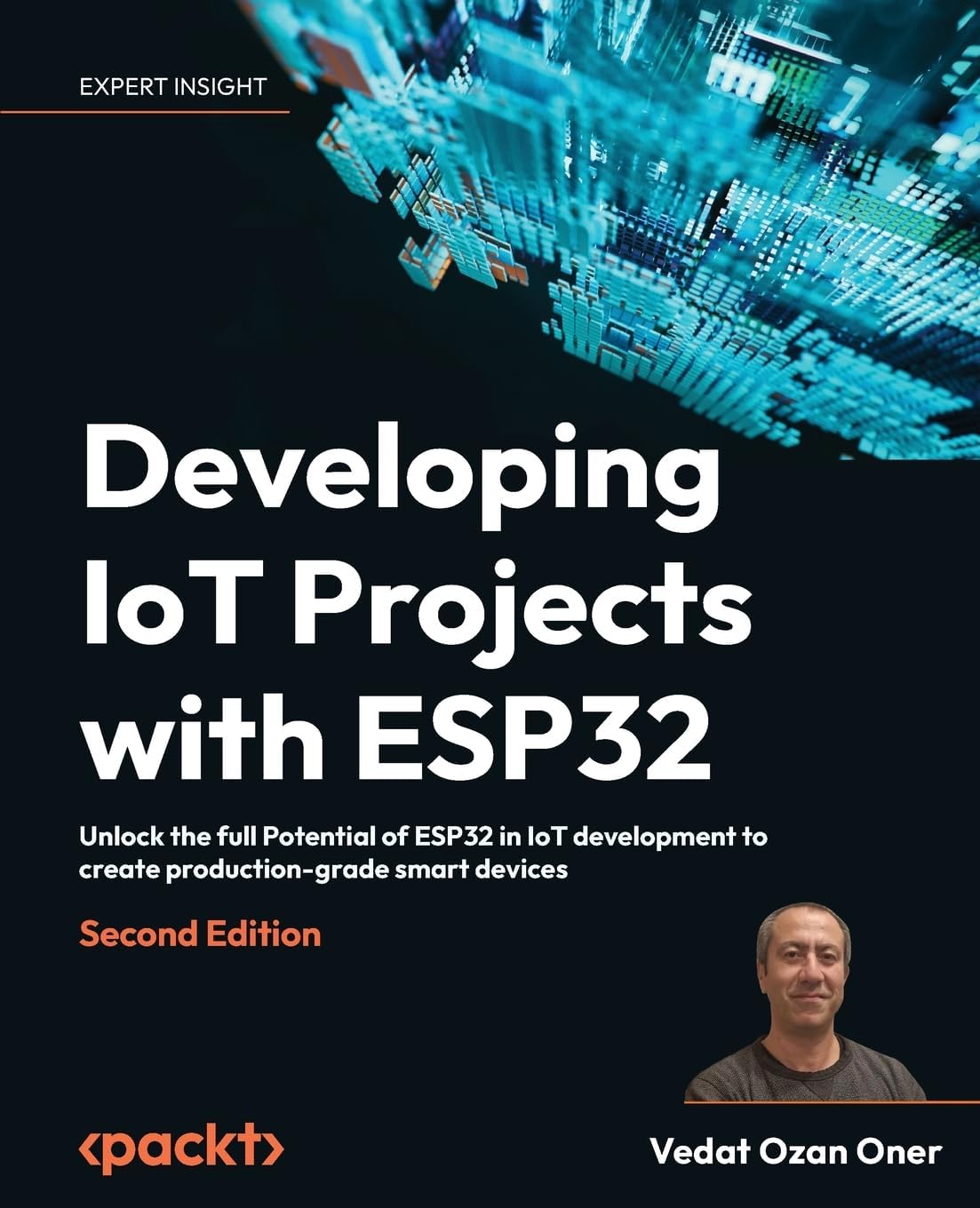
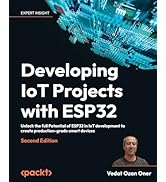
Developing IoT Projects with ESP32: Unlock the full Potential of ESP32 in IoT development to create production-grade smart devices
Product ID: 517100696
From smart sensors to cloud integration and the world of TinyML, this book is your comprehensive guide to the IoT ecosystem, using the ESP32 and industry-standard tools and technologies Key Features Build IoT projects from scratch using ESP32 Customize solutions, take them to cloud, visualize real-time data, implement security features Practice using a variety of hands-on projects such as an audio player, smart home, and more Book Description ESP32, a low-cost and energy-efficient system-on-a-chip microcontroller, has become the backbone of numerous WiFi devices, fueling IoT innovation. This book offers a holistic approach to building an IoT system from the ground up, ensuring secure data communication from sensors to cloud platforms, empowering you to create production-grade IoT solutions using the ESP32 SoC. Starting with IoT essentials supported by real-world use cases, this book takes you through the entire process of constructing an IoT device using ESP32. Each chapter introduces new dimensions to your IoT applications, covering sensor communication, the integration of prominent IoT libraries like LittleFS and LVGL, connectivity options via WiFi, security measures, cloud integration, and the visualization of real-time data using Grafana. Furthermore, a dedicated section explores AI/ML for embedded systems, guiding you through building and running ML applications with tinyML and ESP32-S3 to create state-of-the-art embedded products. This book adopts a hands-on approach, ensuring you can start building IoT solutions right from the beginning. Towards the end of the book, you'll tackle a full-scale Smart Home project, applying all the techniques you've learned in real-time. Embark on your journey to build secure, production-grade IoT systems with ESP32 today! What you will learn Explore ESP32 with IDE and debugging tools for effective IoT creation Drive GPIO, I2C, multimedia, and storage for seamless integration of external devices Utilize handy IoT libraries to enhance your ESP32 projects Manage WiFi like a pro with STA & AP modes, provisioning, and ESP Rainmaker framework features Ensure robust IoT security with secure boot and OTA firmware updates Harness AWS IoT for data handling and achieve stunning visualization using Grafana Enhance your projects with voice capabilities using ESP AFE and Speech Recognition Innovate with tinyML on ESP32-S3 and the Edge Impulse platform Who this book is for If you are an embedded software developer, an IoT software architect or developer, a technologist, or anyone who wants to learn how to use ESP32 and its applications, this book is for you. A basic understanding of embedded systems, programming, networking, and cloud computing concepts is necessary to get started with the book. Table of Contents Introduction to IoT development and the ESP32 platform Understanding the Development Tools Using ESP32 Peripherals Employing Third-Party Libraries in ESP32 Projects Project - Audio player Using Wi-Fi Communication for Connectivity ESP32 Security Features for Production-Grade Devices Connecting to Cloud Platforms and Using Services Project – Smart Home Machine Learning with ESP32 Developing on Edge Impulse Project – Baby Monitor



| Dimensions | 7.5 x 1.31 x 9.25 inches |
| Edition | 2nd |
| Isbn 10 | 1803237686 |
| Isbn 13 | 978-1803237688 |
| Item Weight | 2.16 pounds |
| Language | English |
| Print Length | 578 pages |
| Publication Date | November 30, 2023 |
| Publisher | Packt Publishing |
User
Indispensable reference guide for moving from beginner to intermediate ESP32 development
Full disclosure: I was given a copy of the book to write a review.The ESP32 is a fan favorite among engineers, makers, and tinkerers looking to create various IoT projects. For the most part, I stick with the Arduino IDE and libraries when working with the ESP32. However, the non-Arduino option for development, ESP-IDF, is a wonderful suite of tools built to work with nearly any editor. If you are looking to develop professional, robust IoT projects with the ESP32, you will likely gravitate toward ESP-IDF.“Developing IoT Projects with ESP32” starts with a brief overview of the ESP32 hardware and ESP-IDF. In reality, the author assumes you have some working knowledge and experience with the ESP32, which is not a bad thing. This is not a book for beginners. Even though a “getting started” tutorial is provided for ESP-IDF, I would highly recommend using other online resources for setting up and using ESP-IDF. The official Espressif documentation covers more details and is plenty easy to follow.However, the book really shines after you have a basic grasp of ESP-IDF. It covers many topics required for developing professional projects that are sorely lacking in most online content. For example, it goes over the basics of FreeRTOS (the ESP-IDF flavor), step-through debugging, advanced libraries, REST, MQTT, security, IoT cloud services, and machine learning. If I were considering using the ESP32 for developing a professional project, this is the book I would want as my companion and reference guide.The biggest drawback is the lack of Bluetooth content. This chapter was apparently present in the first edition but sadly removed for this version. Even if WiFi is more popular, I think dismissing Bluetooth is a mistake, as plenty of developers still want to use low-energy, wireless connections to various devices (such as smartphones). The addition of machine learning chapters is welcome, but having both Bluetooth and ML would have been better.Additionally, the book switches between PlatformIO and native ESP-IDF tooling for installing third-party libraries. I recognize that PlatformIO is very popular, but I have generally struggled with it. My preference would be a focus on using the ESP-IDF and CMake for installing/linking such libraries, as that is a more portable approach.While the book is best used as a reference guide, it contains several projects that you can build to further grasp the concepts and tools: an audio player, a smart home plug, and a baby monitor. I highly recommend the book to anyone who wants to move beyond Arduino and level up their IoT skills using the ESP32.
User
ESP-32-s3 and vs
Too many broken links. Haven’t responded to my pdf request. Be prepared to know or learn visual studio. Make sure you have the esp32-s3 because the book concentrates on this version
User
A Welcome Update to a Great Book
I am a software developer with over 40 years in the software industry. The Second edition is a major rewrite of the excellent First Edition. It has been updated for newer generations of the ESP32 SoC. It is clearer and better organized than the First Edition. All code examples are now in C++, allowing for the use of publicly available libraries that speed up development as well as object-oriented development. I also enjoy the expanded description of the ESP32 family of SoCs and refer back to it.Chapters on Machine Learning and Machine Learning Operations (MLOps) have been added introducing TensorFlow, TinyML, and the EdgeImpulse platform. An important chapter on free and open-source third-party libraries, which can significantly reduce development time, has also been added in the Second Edition.The author’s explanations are thorough and detailed, as in the First Edition. I have been able to use many principles and techniques I have learned from his books on other computing platforms. While the projects and examples in the First Edition were informative and instructive, I feel that the projects in the Second Edition are more meaningful and applicable to today’s problems.Several chapters include a New Features section to further stimulate ideas for enhancing the example projects. Many of the more advanced chapters also include a Further Reading section as well.That said, I’m a bit disappointed that the chapter on Bluetooth in the First Edition was dropped in the Second and the chapter on displays was also dropped, though a brief treatment of LCD displays was folded into Chapter 3 of the Second Edition. I’m glad I still have my copy of the First Edition.In conclusion, to me, the value of this new edition far exceeds its price. Despite a few missing “nice to haves,” it is a wonderful resource to come up to speed on the Internet of Things. While it starts at the very beginning and is suitable for beginners, there is plenty for more advanced developers as well. It will quickly bring the beginner to an advanced level.I would go so far as to say that purchasing both editions if you don’t already own the First, would be money well spent. If your budget only allows you to buy one, get the Second Edition.
User
A Comprehensive Guide for Aspiring IoT Developers
As someone who has been toying with an IoT idea for some time, finding a resource that moves beyond the basics has been a challenge. "Developing IoT Projects with ESP32" by Vedat Ozan Oner, however, stands out as a beacon of hope. Aimed primarily at C++ programmers, the book presents concepts that are solidly constructed and applicable across languages, including C. This adaptability is a testament to the author's thorough approach.The book is expansive, covering a breadth of topics essential for IoT development. What sets it apart is the manner in which example code is not only explained but also supplemented with GitHub resources for practical testing. This hands-on approach is further enhanced by detailed testing and troubleshooting guides for each example—a rarity in computer programming literature, and a feature for which Oner deserves high praise.Despite its strengths, the book isn't without areas for improvement. Crucial information on preparing for the examples is tucked away until page 92, a placement that might slow down eager learners. However, once discovered, this insight accelerates the learning process, especially when utilizing Espressif tools.Another highlight is the dual focus on PlatformIO and ESP-IDF development paths, catering to varied preferences and potential challenges faced by developers. This inclusivity underscores the book's utility as a comprehensive guide.My only critique lies in the omission of the ESP-NOW protocol—an essential element for my project, given my desire to avoid MQTT or REST. Nevertheless, the book equips readers with the foundational knowledge to incorporate third-party libraries and navigate Espressif documentation, making the leap to using ESP-NOW more of a stride than a leap.In conclusion, "Developing IoT Projects with ESP32" is a valuable resource I foresee revisiting frequently. It's not just a book but a toolkit for anyone serious about mastering IoT development with the ESP32. Whether you're a seasoned C++ programmer or branching out from another language, this book offers a solid foundation, comprehensive examples, and the nuances of troubleshooting—a combination that promises to propel your IoT ambitions into reality.
User
A useful addition to developing IoT Projects
I would like to thank Meghal Patel of Packt Publications for giving me the opportunity to review the copy of Vedat Onar's Developing IoT Projects with ESP32 - Fourth Ed. As a reviewer, I enjoyed the book, especially the instructions for IoT projects such as Audio Player, Smart Home, and Baby Monitor.Here is a thorough review based on some chapters I liked.Chapter 1, the loT technology is covered in general, along with the basic architecture of a loT solution and how ESP32 functions as a tool in those solutions. The chapter explains what ESP32 offers, its capabilities, and its limits, which will help you understand the broad picture from a technological standpoint whether you're new to IoT technology or considering utilizing ESP32 in any project. To make things understandable, the last step is to grasp the fundamental architecture of IoT systems.Chapter 2 discusses the creation of actual hardware. The fundamental concepts and the appropriate instruments for the task are clarified. It includes a detailed discussion of the essential skills needed to obtain practical expertise in order to design real applications using ESP32.Chapter 3 explains the uses for ESP32 peripherals. Chips from the ESP32 series are also discussed as peripherals. The ESP32 chip family is the basis for the chapter's emphasis on various peripheral kinds and channel counts. The use of a few well-known ESP32 peripherals is covered in detail in this chapter.Chapter 4 explains the third-party open-source libraries that could be used to help construct Internet of Things projects. These are a few examples of free and open-source (FOSS) third-party libraries: LittleFS, Nlohmann JSON, Miniz; Flatbuffers, LVGL (Light and Versatile Embedded Graphics Library), ESP-IDF Components library, Espressif Systems frameworks and libraries.As a cybersecurity professor, I would recommend this book for gaining IoT knowledge. The author's in-depth writing of the subject matter shows the passion for this discipline. I found this book to be the one I can rely on for a better understanding of the family of ESP32 chips.Final thoughts: This book is appropriately written, and new and seasoned developers will find it helpful. Thank you, Vedat, for your contribution to the literature.
User
Book depends on discontinued product
I was excited to dive into this book when I found that the bulk of the projects depend on Espressif ESP32-S3-BOX-LITE, which appears to be discontinued and unavailable. The standard Espressif ESP32-S3-BOX-3 Dev kit is still produced, but out of stock everywhere for many months. I am hopeful that when this dev kit is back in stock the projects in the book will still be relevant and not be exclusive to the Lite version, rendering the books irrelevant.
User
Solid IoT and ESP reference
I found "Developing Products with the ESP32" to be a valuable resource. The book provides a well-rounded introduction to the ESP32 line of chips, emphasizing their security features, which is crucial in the IoT space.The author's detailed overview of hardware debugging and unit testing is especially beneficial, given the complexity often encountered in these areas. Additionally, the solid coverage of Real-Time Operating Systems (RTOSes), with a focus on FreeRTOS, complements the technical depth of the book. The book assumes a basic level of electronics knowledge and a solid programming background.For developers delving into embedded systems, the book covers the essentials: storage, GPIO, GUI, and WiFi, alongside a useful introduction to MQTT and REST protocols. While it doesn't dive deep into other IoT protocols and GraphQL, this choice by the author streamlines the content without compromising its utility.The inclusion of discussions on the Rainmaker IoT Platform and AWS IoT Core, with insights into device shadows and time series data, is particularly pertinent. The book also touches upon AI and TinyML, bringing an added dimension to IoT development.What I appreciate most is how the author ties these diverse topics together with practical smart-home projects, offering plenty of examples and clear explanations. It's worth noting, though, that the book is lighter on protocols like BLE, LoRa, and NB-IoT. While these are conscious choices by the author, readers should be aware of the need to seek additional resources for these areas.Overall, it's an excellent introduction to the ESP32 and basic IoT development, but it's not a beginner's guide. For anyone looking to enter the IoT domain, this book provides a solid foundation, although it doesn't delve into the finer details of production-grade systems. Highly recommended for those wanting to get up to speed with the Espressif ecosystem and the essentials of IoT development.
User
Demands a very high skillset in advance.
Lack intro to most tools and demands a lot of knowledge in advance. I have the skills needed, but I dont think the book is very well written in regards to teaching others. I will not reccomend this to my students.
User
Good
Good
User
Absolutely great book!
The book has been great so far; I’m just wrapping up Chapter 3. It covers everything you need to know about debugging, wiring, different IDEs—pretty much all the details to dive into the ESP32 world. Note that some libraries and code require updates since the book was published, but there’s an updated branch on the official GitHub page with the latest revisions. Additionally, you can easily use the ESP32-S3-Box-3, which is widely available, instead of the Box-3 Lite, as the newest updates were made for this device.
User
Bra bok
Bra kvalitet på boken.Lätt lästa texter och bra översikt.
Trustpilot
2 weeks ago
2 weeks ago