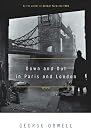
Down and Out in Paris and London
Product ID: 4593782
Desertcart purchases this item on your behalf and handles shipping, customs, and support to Peru.
From the author of 1984, the classic semi-autobiographical story about the adventures of a penniless British writer in two cities. Down and Out in Paris and London follows the journey of a writer among the down-and-out in two great cities. Without self-pity and often with humor, this novel is Orwell at his finest―a sobering, truthful protrayal of poverty and the reality of social class in Europe. Review: excellent writing - I am a fan of Orwell. There is nothing that I've read of his that I did not like, although I have only read a few things. So I was predisposed to like this book. This story is odd. The "plot" is very repetitive; it consists of Orwell's more or less daily account of his seeking work in Paris and London in the 1930s Great Depression, mostly unsuccessfully, and the seeking of work is woven through with his description of near starvation in the process. Even though the book is repetitive in its accounting of these experiences, the writing is clear, insightfully detailed, and down to earth, and it does not get tiresome to read; I read the book in about two days. It's a close look at the underbelly of a few English settings, cities during the late 20s and perhaps early 30s of the 20th century. Furthermore, the narrative is punctuated with some wonderful character profiles of the (mostly) men that he buddies with along the way. It has significant good humor, despite the horrible conditions that Orwell experiences and describes; the characterizations of the handful of men he tramps with are especially humorous: Orwell was good, apparently, at picking out good mates in similar circumstances, men he could count on in a pinch. The first half of the book, set in Paris, is a bit more upbeat in tone than the second half, set in London. In the Paris section, much of the reportage is about Orwell's working as a dishwasher/busboy/gopher in a fancy hotel restaurant, and I found this reportage to be very accurate to what I know of current-day restaurants, which I know are still operated in the same chaotic way. The dining room is a different world from the kitchen. The second half of the book, the London section, is much more "down and out." I discovered from this book that during this time and probably in the Great Depression as well, England managed its tens of thousands of unemployed, homeless men (mostly men: 10:1 men to women) by providing them room and board, but the "tramps" could only stay one night, and were forced to march up to fifteen miles the next day to the next "accommodation"; these large institutional shelters were called "spikes." The accommodations were vermin-infested and the food was usually "tea and two slices": two pieces of bread with oil slathered on them and a cup of tea. To my mind, this book reminded me of a long New Yorker-like article in which the writer goes undercover to expose the horrors of a situation. Apparently, however, Orwell was not undercover but instead an unknown unemployed writer who was truly forced into this degraded, dangerous, unhealthy lifestyle. I knew that Orwell died before he was fifty, and after reading the book I wondered if these harrowing experiences did not somehow contribute to his early physical decline. This book is touted as a minor masterpiece. I don't know if I agree with that but it is essential reading for one who is studying Orwell. It certainly must have drawn on his socialist thinking, and he makes some astute recommendations for how England might better deal with the problem of massive unemployment. Review: Walk a mile in my shoes - 'Down And Out' was first published in 1933, an account of the poverty stricken streets of both Paris and London during the era. It bears little resemblance to today's homeless problems, but is an interesting study in older times where sweeping a sidewalk could make a difference between bread and no bread. A friend of mine told me that if I liked 'The Jungle' by Upton Sinclair that I should read 'Down And Out In Paris And London'. I found few similarities other than the filthy kitchens that Orwell describes, but I was glad this Orwell book was referred to me. All I've read by the author before are the standard 'Animal Farm' and '1984' that most people have read. (If you haven't read them, you should, they're great) Orwell's protagonist begins the story in the slums of Paris, occasionally teaching English classes for a bit of money. (One of the things I had a hard time translating is the foreign currency: a shilling, a franc, a sou, a pence, a crown, a pound, etc. But the prices are so out of date now in 2008 that it mattered very little) He's down and out on his luck, and running out of rent money. When he thinks he's at his lowest his friend Boris brings them a job at Hotel X, where the protagonist works as a plongeur (dishwasher/gopher/whatever). He works long, hot hours for little money, but can afford his rent. Boris has another dream though, that they both become employed at a 'yet to be opened' restaurant where Boris is promised a higher position. By the time our protagonist works at the new restaurant, he begins to believe that all the violations and harassments at Hotel X were superior. Becoming fed up with the harsh conditions and long hours, the protagonist writes to a friend in London for a position, which his friend promises. Worthy of note are the descriptions of the Hotel's and restaurant's kitchens. They are filthy beyond imagination, and the working conditions deplorable. Though the book is older and there are more inspections nowadays than there were back then, you'll still question the next meal that is served before you, even from a fancy restaurant. Our protagonist packs up and leaves Paris. Unfortunately, the position promised to him in London, that of looking after a feeble patron, isn't ready, so he's on the streets without lodging, food, or work to provide for himself. He spends time in the charity lodgings of London, meeting up with Paddy and Bozo and other characters. He quickly learns the ways of the street, and extrapolates on the cause and condition of the homeless society he finds himself in. The characters are fascinating. There's Boris - loud, lame, and strange. Charlie, who lives off a pittance from his family and will not work (and who loves the ladies - once portrayed in a horrible story he told). There's Paddy, resigned to his fate. There's Bozo, a screever (pavement artist), and a star-gazer who has an astonishingly bright outlook on street life. The concept of work vs idleness is explored, along with the concept of how hard the homeless actually "work" (panhandling, selling matches, selling herbs like lavender, getting up early and waiting in line for jobs, "screeving", pawning, even stealing) for the privilege of a bug ridden cot and watered down tea. The book is a study in poverty even though its outdated. The one thing I didn't like about it was the abrupt ending. The story could have used a little more conclusion, in my opinion. Overall, I'm glad I explored this addition to my Orwell collection, and highly recommend it. Enjoy!
| Best Sellers Rank | #66,265 in Books ( See Top 100 in Books ) #25 in Paris Travel Guides #152 in Biographical & Autofiction #176 in Classic American Literature |
| Customer Reviews | 4.4 out of 5 stars 5,878 Reviews |
G**N
excellent writing
I am a fan of Orwell. There is nothing that I've read of his that I did not like, although I have only read a few things. So I was predisposed to like this book. This story is odd. The "plot" is very repetitive; it consists of Orwell's more or less daily account of his seeking work in Paris and London in the 1930s Great Depression, mostly unsuccessfully, and the seeking of work is woven through with his description of near starvation in the process. Even though the book is repetitive in its accounting of these experiences, the writing is clear, insightfully detailed, and down to earth, and it does not get tiresome to read; I read the book in about two days. It's a close look at the underbelly of a few English settings, cities during the late 20s and perhaps early 30s of the 20th century. Furthermore, the narrative is punctuated with some wonderful character profiles of the (mostly) men that he buddies with along the way. It has significant good humor, despite the horrible conditions that Orwell experiences and describes; the characterizations of the handful of men he tramps with are especially humorous: Orwell was good, apparently, at picking out good mates in similar circumstances, men he could count on in a pinch. The first half of the book, set in Paris, is a bit more upbeat in tone than the second half, set in London. In the Paris section, much of the reportage is about Orwell's working as a dishwasher/busboy/gopher in a fancy hotel restaurant, and I found this reportage to be very accurate to what I know of current-day restaurants, which I know are still operated in the same chaotic way. The dining room is a different world from the kitchen. The second half of the book, the London section, is much more "down and out." I discovered from this book that during this time and probably in the Great Depression as well, England managed its tens of thousands of unemployed, homeless men (mostly men: 10:1 men to women) by providing them room and board, but the "tramps" could only stay one night, and were forced to march up to fifteen miles the next day to the next "accommodation"; these large institutional shelters were called "spikes." The accommodations were vermin-infested and the food was usually "tea and two slices": two pieces of bread with oil slathered on them and a cup of tea. To my mind, this book reminded me of a long New Yorker-like article in which the writer goes undercover to expose the horrors of a situation. Apparently, however, Orwell was not undercover but instead an unknown unemployed writer who was truly forced into this degraded, dangerous, unhealthy lifestyle. I knew that Orwell died before he was fifty, and after reading the book I wondered if these harrowing experiences did not somehow contribute to his early physical decline. This book is touted as a minor masterpiece. I don't know if I agree with that but it is essential reading for one who is studying Orwell. It certainly must have drawn on his socialist thinking, and he makes some astute recommendations for how England might better deal with the problem of massive unemployment.
S**Y
Walk a mile in my shoes
'Down And Out' was first published in 1933, an account of the poverty stricken streets of both Paris and London during the era. It bears little resemblance to today's homeless problems, but is an interesting study in older times where sweeping a sidewalk could make a difference between bread and no bread. A friend of mine told me that if I liked 'The Jungle' by Upton Sinclair that I should read 'Down And Out In Paris And London'. I found few similarities other than the filthy kitchens that Orwell describes, but I was glad this Orwell book was referred to me. All I've read by the author before are the standard 'Animal Farm' and '1984' that most people have read. (If you haven't read them, you should, they're great) Orwell's protagonist begins the story in the slums of Paris, occasionally teaching English classes for a bit of money. (One of the things I had a hard time translating is the foreign currency: a shilling, a franc, a sou, a pence, a crown, a pound, etc. But the prices are so out of date now in 2008 that it mattered very little) He's down and out on his luck, and running out of rent money. When he thinks he's at his lowest his friend Boris brings them a job at Hotel X, where the protagonist works as a plongeur (dishwasher/gopher/whatever). He works long, hot hours for little money, but can afford his rent. Boris has another dream though, that they both become employed at a 'yet to be opened' restaurant where Boris is promised a higher position. By the time our protagonist works at the new restaurant, he begins to believe that all the violations and harassments at Hotel X were superior. Becoming fed up with the harsh conditions and long hours, the protagonist writes to a friend in London for a position, which his friend promises. Worthy of note are the descriptions of the Hotel's and restaurant's kitchens. They are filthy beyond imagination, and the working conditions deplorable. Though the book is older and there are more inspections nowadays than there were back then, you'll still question the next meal that is served before you, even from a fancy restaurant. Our protagonist packs up and leaves Paris. Unfortunately, the position promised to him in London, that of looking after a feeble patron, isn't ready, so he's on the streets without lodging, food, or work to provide for himself. He spends time in the charity lodgings of London, meeting up with Paddy and Bozo and other characters. He quickly learns the ways of the street, and extrapolates on the cause and condition of the homeless society he finds himself in. The characters are fascinating. There's Boris - loud, lame, and strange. Charlie, who lives off a pittance from his family and will not work (and who loves the ladies - once portrayed in a horrible story he told). There's Paddy, resigned to his fate. There's Bozo, a screever (pavement artist), and a star-gazer who has an astonishingly bright outlook on street life. The concept of work vs idleness is explored, along with the concept of how hard the homeless actually "work" (panhandling, selling matches, selling herbs like lavender, getting up early and waiting in line for jobs, "screeving", pawning, even stealing) for the privilege of a bug ridden cot and watered down tea. The book is a study in poverty even though its outdated. The one thing I didn't like about it was the abrupt ending. The story could have used a little more conclusion, in my opinion. Overall, I'm glad I explored this addition to my Orwell collection, and highly recommend it. Enjoy!
C**Y
Down and Out - A timeless classic
Prior to serving in the Republican forces during the Spanish Civil war, George Orwell worked as a plongeur or dishwasher in Paris. He also wandered England as a homeless tramp staying in doss-houses. George Orwell transformed these experiences into the book Down and Out in Paris and London which was published during the great Depression in 1933. This was, to say the least, an unusual path for an "old Eton boy" to take. Nietzsche once wrote, "Poets are shameless with their experiences: they exploit them." Orwell did not hesitate to exploit his experiences as a "plongeur" in Paris or a tramp in England. If Trip Advisor Had been around in 1933 Orwell might have posted a review something like this: "Avoid all restaurants and hotels in Paris and beyond! The sanitary conditions are appalling. There is filth on the kitchen floors. Rats infest every kitchen. The staff could care less about their customers. How many Stars? Zero!" Here is what Orwell actually wrote after working at the Hotel X in Paris, "The dirt in the Hotel X, as soon as one penetrated into the service quarters, was revolting. Our cafeteria had year-old filth in all the dark corners, and the bread-bin was infested with cockroaches. Once I suggested killing these beasts to Mario (he was in charge of the cafeteria). 'Why kill the poor animals?' he said reproachfully. The others laughed when I wanted to wash my hands before touching the butter...In the kitchen the dirt was worse. It is not figure of speech, it is a mere statement of fact to say that a French cook will spit in the soup--that is, if he is not going got drink it himself. He is an artist, but his art is not cleanliness. To a certain extent he is even dirty because he is an artist, for food, to look smart, needs dirty treatment. When a steak, for instance is brought up for the head cook's inspection, he does not handle it with a fork. He picks it up with his fingers and slaps it down, runs his thumb around the dish and licks to taste the gravy, runs it round and licks again, then steps back and contemplates the piece of meat like an artist judging a picture, then presses it lovingly into place with his fat, pink fingers, every one of which he has licked a hundred times that morning. When he is satisfied, he takes a cloth and wipes his fingerprints form the dish, and hands it to the waiter. And the waiter, of course, dips his fingers into the gravy--his nasty, greasy fingers which he is forever running through his brilliantined hair." Orwell then moved on to work at a restaurant in Paris called the Auberge de Jehan Cottard as a plongeur or dishwasher. He wrote about his employer, "The Auberge was not the ordinary cheap eating-house frequented by students and workmen. We did not provide an adequate meal at less than twenty-five francs, and we were picturesque and artistic, which sent up our social standing. There were indecent pictures in the bar, and the Norman decorations--sham beams on the walls, electric lights done up as candlesticks, "peasant" pottery, even a mounting-block at the door--and the patron and the head Waiter were Russian officers, and many of the customers titled Russian refugees. In short, we were decidedly chic. Nevertheless, the conditions behind the kitchen door were suitable for a a pigsty. For this is what our service arrangements were like. The kitchen measured fifteen feet long by eight broad, and half this space was taken up by the stoves and tables. All the pots had to kept on shelves out of reach and there was only room for one dustbin. This dustbin used to be crammed full by midday, and the floor normally an inch deep in compost of trampled food... There was no larder. Our substitute for one was a half-roof shed in the yard, with a tree growing in the middle of it. The meat, vegetables and so forth lay there on the bare earth, raided by rats and cats." One of Orwell's colleague at the Auberge was a waiter named Jules. Orwell confides that 'Jules took a positive pleasure in seeing things dirty. In the afternoon, when he had not much to do, he used to stand in the kitchen doorway jeering at us for working too hard: 'Fool! Why do you wash that plate? Wipe it on your trousers. Who cares about the customers? They don't know what's going on. What is restaurant work? You are carving a chicken and it falls on the floor. You apologize, you bow, and you go out; and in five minutes you come back by another door--with the same chicken. That is restaurant work." Has the restaurant world really changed much since 1933? One can certainly hope so, but there are many parts of the world where restaurant sanitation standards are little improved from the Paris of 1933. Orwell then moved on to England where he tramped about the country moving from flop house to flop house. He survives on a "cuppa" and two slices with a bit of margarine. He is nearly molested at night by "Nancy" boys. He and other tramps are preached to by religious do-gooders and Salvation Army warriors. He offers one piece of advice which is as sound for today's London as it was in 1933. Handbills were distributed on the streets of London by local merchants then as they are now. Orwell writes, "When you see a man distributing handbill you can do him a good turn by taking one, for he goes off duty when he has distributed all his bills." Orwell writes with genuine understanding, sympathy and, often, humor in his descriptions of the grinding poverty of the working classes and those unfortunates who are unemployed and homeless. His account helps us to appreciate how fascism was able to exploit the suffering of so many throughout Europe during the Great Depression. Check out George Orwell's Down and Out in Paris and London. At minimum, you may never think of restaurants and hotels in the same way again. Has George Orwell's review been helpful to you? If you like Orwell's Down and Out in Paris and London you may also enjoy America Invades: How We've Invaded or been Militarily Involved with almost Every Country on Earth by Kelly / Laycock and Italy Invades
A**E
A True Account of How to Survive in Paris and London in the 1920s and '30s
This is an autobiography of George Orwell, known in real life as Eric Blair, when he spent some time on the streets of Paris and London when he, in his early years (1920s or 30s) was destitute. Then, Blair, who I shall refer to Orwell as his real name, was starting out as a journalism/writer, after World War I (The Great War). Eric Blair doesn't explain how he ended up in this situation of poverty in the first place, but does provide a good account of his life on the streets of Paris and London, and his struggle to survive day by day. It was rough. Blair live hand to mouth, and being among the tramps, beggars, the destitute, he always had to watch his back, for there was always someone out to take his money, clothes, food, anything, at the first chance he gets. Needless to say, Mr. Blair survived and was able to give a clear account. The book is evenly divided between his stints in Paris, then London. He covers Paris first. Paris is pictured as the lap of luxury, fashions, French architecture. I've been there myself, and it is amazing. Deep down below, in the unseen sections, are the workers, the dishwashers, those who do the dirty jobs to keep Paris glittering. Blair worked as a dishwasher and other similar, back breaking jobs at luxurious hotels, where the work was hard, conditions were unsanitary, and the pay was low. He literally had to pawn his clothes, look for the cheapest rooms to rent, and worked sometimes for 18 hours a day, with very little time to sleep. There were tough bosses and tough landlords, and he had to be tight with his money, buying the cheapest, and lowest quality food. Blair did have buddies to team up with, looking out for each other, and being there for the other when he was starving. Survival produces enemies off the streets, but it also produces great friendships. Blair had to take whatever job was available, for one hotel was opening up promising good paying jobs, but there were delays, so one could not depend on any "promises," for anyone. London had it own adventure. Here Blair was traveling from spike (a hostel like place where tramps could spend one and only one night, with strict rules with a jail sentence for violating them) to spike, with a partner named Paddy. Again, there are situations where one smuggles in food and money against the rules, where other tramps steal them, and their clothes. If the tramp complained, he would go to jail. There were religious sponsored hostels, with strict rules also, and this simply tells of the travels of Blair and his buddy, obtaining money and food and shelter for the night. In this book, Orwell/Blair does sympathize with the tramp, where his present situation is not always his fault. These are situations where one loses a job, then his home because he was unable to pay for it, or could never find a job, or many other reasons. This is very similar to today's situations where people are evicted from their homes forcing them to live out on the street or in their cars. This book is a chronicle of what these people go through, and their actions are a result of their desperate attempt simply to survive.
R**M
Dated But Still Sad (and Accurate)
There is no doubt that Orwell became a great writer. And this book (along with "Burmese Days") may have provided the first indications of his brilliance. However, unlike some of his other works, this one has not passed the test of time. While his writing is good, the book has become somewhat dated; it is locked into the world as it was nearly 100 years ago, and it consequently is less relevant and shocking than one might expect, particuarly given what we've come to expect from Orwell. His descriptions of what poverty was like in Paris and London do not paint a happy picture, but they pale in comparison to some more modern works -- Barbara Ehrenreich's "Nickled and Dimed", to mention just one. What is most sad and distressing about the book is that despite the passage of so many years, and despite our belief that we've become a kinder, gentler society, not much has changed when it comes to poverty and how we treat the poor. And, of course, there was nothing that Orwell could do about that -- though he certainly seems to have been able to predict the future in his most famous works.
J**H
A SPECIFIC AGAINST FEELINGS OF ENTITLEMENT
The kind of Entitlement we feel as Americans is something made up mostly of the funk exuded from the idol we revere of ourselves as Middle Class people -- one myth created by decades of Madison Avenue advertising, and a lie like most of them -- which we don't recognize because TV and pulp infortainment have blinded us with the vulgar dazzle of celebrity-hood, until dopey, we have come to feel that we know them, the celebrated PEOPLE people; that we share their quirks and inhsecurities; that we have so much in common with them -- trouble with excess weight, with prescription drugs, papparazzi, out-of-control credit card debt -- that we are celebrities too. That we too are people who need people who need people like us. I mean, we're all American, aren't we? A rich, successful and powerful classless society? ...Of ordinary people, with excellent credit. No? But... Haven't you ever travelled to strange places and looked at your fellow-citizens and wondered sometimes, Who in the world do they think they are? So rude! So inane! So pretensious! And, of course, they're our Neighbors. Our selves. I've heard it said, "With foreign travel its either palaces or poverty." But you don't have to go to another country to come face-to-face with the big P; with the unspeakable danger, Poverty. And that's what everybody's afraid of. Looking at a recently released and much-praised movie recently, THE WRESTLER, one sensed that this evocation in contemporary style of a favorite genre from Depression days, one had the feeling that much of the attention to it and praise of it was generated by the fact that it looked as though it might have been filmed in Manesquan, NJ; that is, on location somewhere below the poverty line. And the public reaction was sincere embarassment on one hand, and on the other, gratitude for not being that poor oneself. DOWN AND OUT was published in 1933, that fateful year Roosevelt got his Congress and HItler got his Reischtag; the nadir of the Great Global Depression that began in '29, and the book was possibly written two or three years earlier. Considering the shape the world was in, with the financial systems of Europe and America and everywhere else in collapse, and including the inevitable unemployment and the resulting wide-spread poverty, it is astonishing to contemplate Orwell, young and only trying to make a career for himself, deciding to not run off to a foreign country, as he did later when he went to Spain, but deciding to leap head-first, as it were, into Poverty, POVERTY ITSELF, in the country just across the channel. Simply to have experiences? Simply to have something to write about? To have subjects for his fledgling journalism? Yes! Apparently so. On the final page of the book he writes that he believes he may have written a kind of Travel Book. He did! And the means are shocking; the effects quite free of tinted light. Except that the second, third and fourth letter of the commonest Anglo-Saxon epithet are deleted in print, there are no euphemisms. But oh! my foes and ah! my friends, the results are spectacular. What extraordinary courage! What powers of observation and description! Here is a tourist who does not intend to look at the world through the windows of the Hilton lobby. Imagine: Without even a credit card! You don't know what to say. You stand back, gasp in admiration and wonder if you would ever have the nerve to undertake anything like it; the discomfort, the embarassment. Work as a Dishwasher? Me? And you wonder if you would ever have the nerve to be as honest with yourself as you wrote it? Honest about your squeamishness? About your dirt hatred. About being seen among uneducated people. About the fear of looking dirty. Or going a week without changing clothes. The English have written some great travel books. I've always admired Cunningham-Grahame and Maugham, but this book is different. It doesn't cover much land or take a great deal of time, but it plummets to depths often ignored by other authors. Depths of the human soul and condition so terrifying to many -- which never terrified him -- I'm reminded of that french song... "Children with faithful hearts have no fear of wolves." Ritz Plongeur? Moi? Quelle cauchemar.
E**N
Orwell Tells It Like It Is Because He's Been There
Life at the bottom is no piece of cake. This is one fact you notice from reading George Orwell's memoir Down and Out in Paris and London. The book details what a life of menial labor and poverty consists of. The book is divided into two parts, the first being Orwell's experiences in Paris and the lessons he learned, such as how the starving manage to subsist, as he was one of them. In the latter part of his Paris life, Orwell works as a dishwasher in a hotel restaurant kitchen and lives in a slum. He also writes about the conditions at a charity hospital in Paris. Much of the book features stories about the array of characters he meets along the way along with details of the squalor and indignities people endure to survive. Occasionally, however, he steps back to interpret what he's seen, sharing conclusions he's drawn from his experiences. What's fascinating, disturbing or discouraging (depending on yout point of view) is how relevant these matters remain, In chapter 22 he questions how there has come to be such a disparty between rich and and poor. More importantly, why do the middle classes side with the rich and separate themselves from the "vermin" who slave away all their waking hours doing work that is demeaning and sometimes useless? Orwell concludes: I believe that this instinct to perpetuate useless work is, at bottom, simply fear of the mob. The mob (the thought runs) are such low animals that they would be dangerous if they had leisure; it is safer to keep them too busy to think. A little further on he elaborates. They (middle class) side with the rich because they imagine that any liberty conceded to the poor is a threat to their own liberty. Foreseeing some dismal Marxian Utopia as the alternative, the educated man prefers to keep things as they are. Possibly he does not like his fellow-rich very much, but he supposes that even the vulgarest of them are less inimical to his pleasures, more his kind of people, than the poor, and that he had better stand by them. It is this fear of a supposedly dangerous mob that makes nearly all intelligent people conservative in their opinions. Fear of the mob is a superstitious fear. It is based on the idea that there is some mysterious, fundamental difference between rich and poor, as though they were two different races, like negroes and white men. But in reality there is no such difference. The mass of the rich and the poor are differentiated by their incomes and nothing else, and the average millionaire is only the average dishwasher dressed in a new suit. Change places, and handy dandy, which is the justice, which is the thief? Everyone who has mixed on equal terms with the poor knows this quite well. But the trouble is that intelligent, cultivated people, the very people who might be expected to have liberal opinions, never do mix with the poor. For what do the majority of educated people know about poverty? In my copy of Villon's poems the editor has actually thought it necessary to explain the line "Ne pain ne voyent qu'aux fenestres" by a footnote; so remote is even hunger from the educated man's experience. From this ignorance a superstitious fear of the mob results quite naturally. The educated man pictures a horde of submen, wanting only a day's liberty to loot his house, burn his books, and set him to work minding a machine or sweeping out a lavatory. "Anything," he thinks, "any injustice, sooner than let that mob loose."
A**R
Delightful
An intelligent and perceptive account which blends two strands into one coherent story against a backdrop of complacency and then fear in the run up to World War II.
G**H
Relatable
Insightful and relatable , a good reading when you are out of work….
B**N
おもしろかった
パリとロンドンで放浪生活をオーウェルがしてその体験を書いたものです。 大学の時読んだのですがとても面白かったです。
D**S
An eye opener from Orwell
I remember growing up in London in the 1960s and seeing these unfortunate men around but not understanding their plight or reasons for being in their situation. Also I didn’t know there were categories of tramps. I don’t recall them being aggressive or begging. Orwell’s descriptions are truly an eye opener.
S**R
Awesomesauce
Awesome book, read it, you will like it and if not, try again I love mr Blair
P**N
A Chronicle Of Life At The Very Bottom
Orwell experiences first hand, the extremes of poverty. The setting is in both the cities of Paris and London. Orwell has a very keen sense of observation. He notes the smallest of everyday details. Please be warned, that the potential reader is in for some rather foul details. How these people survived such disgusting filth, bugs, and malnutrition, is beyond my comprehension. Orwell also describes, all the eccentric characters he encounters in London and Paris. There is quite a wide range of people and nationalities, found throughout the novel. He also explains how poverty affects the way an individual thinks. He contrasts the poor persons outlook, with rich and middle class attitudes. At the ending, Orwell suggests lots of possible solutions. He is not just complaining about poverty, he wants to try and fix the problem. This book was an outstanding snapshot of poverty in 1930s Europe. Orwell was a very gifted writer. I highly recommend this novel.
Trustpilot
1 day ago
1 week ago