
Desertcart purchases this item on your behalf and handles shipping, customs, and support to Peru.
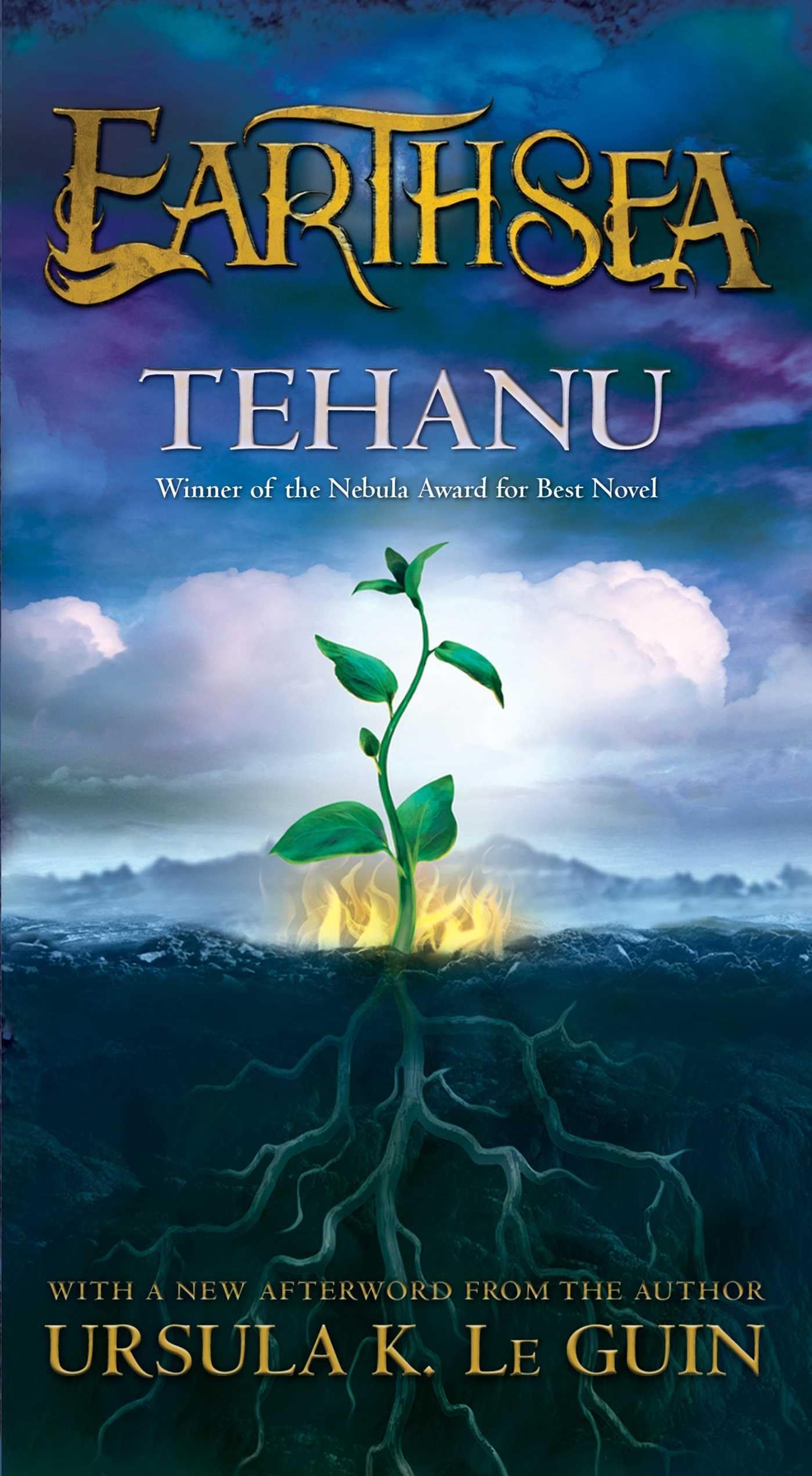
The Nebula Award and Locus Award-winning fourth novel in the beloved Earthsea series by Ursula K. LeGuin Years before, they had escaped together from the sinister Tombs of Atuan—she, an isolated young priestess, he, a powerful wizard. Now she is a farmer's widow, having chosen for herself the simple pleasures of an ordinary life. And he is a broken old man, mourning the powers lost to him not by choice. A lifetime ago, they helped each other at a time of darkness and danger. Now they must join forces again, to help another -- the physically and emotionally scarred child whose own destiny remains to be revealed. With millions of copies sold, Ursula K. Le Guin's Earthsea Cycle has earned a treasured place on the shelves of fantasy lovers everywhere. Complex, innovative, and deeply moral, this quintessential fantasy sequence has been compared with the work of J.R.R. Tolkien and C.S. Lewis, and has helped make Le Guin one of the most distinguished fantasy and science fiction writers of all time. Review: mature themes - I loved the first three books of the Earthsea trilogy when I read them as a child. I encountered Tehanu for the first time when I re-read the series as an adult. Tehanu is a marked departure from the previous three books: years after writing the first three books, Le Guin, now an established author, revisits her beloved characters and addresses complex questions and themes that she couldn't tackle when she wrote the original series. The main theme is an exploration of power - not on a grand scale, but the power we have over our own lives and decisions, the overt power of men vs the subtle powers of women in a traditional society, etc. The book explores gender roles, aging, parenthood, violence and abuse in a very tender and sensitive way. Young children may find it less exciting than the first three, but for adults and kids who are mature enough to appreciate it, It's a much richer, deeper book than its predecessors, with much wisdom in it. Review: Ladies to the Forefront - As book four in the Earthsea saga, this book is a radical departure from the tone and feel of the first three. There is very little magic in this book; rather what we have is a very fine delineation of everyday living in a world where things do not always go right, where the rape, burning, and near murder of a child, while not an ordinary occurrence, is part of the way things are. Tenar, who we first met in book two, The Tombs of Atuan, is the point of view character of this book, a now middle-aged woman who has settled down to an ordinary life as a farmer’s wife, whose days have become a matter of routine, where magic, mages, and kings are merely fond memories. But her husband is now dead, she has ‘adopted’ the poor abused child Therra mentioned above, and change comes in the form of a message that Origon, Ged’s teacher and master mage of Gont island, is dying. From here we follow Tenar’s attempts to forge just what her place in life is, accompanied by a now magic-less Ged, in terms of both everyday living and the place of women within the power structure of mages and kings. There is a very definite turning in this book towards feminist themes, at times almost stridently so, in sharp contrast to the male-dominated earlier books. Tenar comes to question the right of any man to order her life, while at the same time recognizing that there is an incompleteness to her life without a complementary man to live it with. Issues of home, hearth, and children’s education (embodied by the physically and emotionally scarred Therra) are of prime importance here. All this makes for a very gritty, real-world feel to this book, certainly far away from fairy-tale land. Those who loved the earlier books may find this too much of a change, but I found that for myself, this book makes a great counter-point to those books, providing the whole with a balance that is perfectly in key with the general philosophy of Earthsea, that all things must be kept in balance. At the same time, this is not a book for younger children, as the themes and events are too dark, violent, and rife with heavy emotional freighting. Older teens can probably derive much from this book, with Tenar as a strong female role model and coping with loss and tragedy are so well presented. Le Guin’s prose style is still the simple, minimalist structure that we have grown so used to over the years, a fine vehicle for presenting difficult concepts in easily digestible thought flavors. Things are never over-described, but rather left with a certain amount of incompleteness that allows the reader to add his own mental picture. Very different from the first three books, but with its own power to capture your imagination, and with much to say about the everyday world where bad things must be met, handled, and then continue on with your life.
| Best Sellers Rank | #642,261 in Books ( See Top 100 in Books ) #28 in Teen & Young Adult Fairy Tales & Folklore #45 in Teen & Young Adult Fiction about Self Esteem & Reliance #58 in Teen & Young Adult Classic Literature |
| Customer Reviews | 4.5 out of 5 stars 4,107 Reviews |
C**S
mature themes
I loved the first three books of the Earthsea trilogy when I read them as a child. I encountered Tehanu for the first time when I re-read the series as an adult. Tehanu is a marked departure from the previous three books: years after writing the first three books, Le Guin, now an established author, revisits her beloved characters and addresses complex questions and themes that she couldn't tackle when she wrote the original series. The main theme is an exploration of power - not on a grand scale, but the power we have over our own lives and decisions, the overt power of men vs the subtle powers of women in a traditional society, etc. The book explores gender roles, aging, parenthood, violence and abuse in a very tender and sensitive way. Young children may find it less exciting than the first three, but for adults and kids who are mature enough to appreciate it, It's a much richer, deeper book than its predecessors, with much wisdom in it.
P**D
Ladies to the Forefront
As book four in the Earthsea saga, this book is a radical departure from the tone and feel of the first three. There is very little magic in this book; rather what we have is a very fine delineation of everyday living in a world where things do not always go right, where the rape, burning, and near murder of a child, while not an ordinary occurrence, is part of the way things are. Tenar, who we first met in book two, The Tombs of Atuan, is the point of view character of this book, a now middle-aged woman who has settled down to an ordinary life as a farmer’s wife, whose days have become a matter of routine, where magic, mages, and kings are merely fond memories. But her husband is now dead, she has ‘adopted’ the poor abused child Therra mentioned above, and change comes in the form of a message that Origon, Ged’s teacher and master mage of Gont island, is dying. From here we follow Tenar’s attempts to forge just what her place in life is, accompanied by a now magic-less Ged, in terms of both everyday living and the place of women within the power structure of mages and kings. There is a very definite turning in this book towards feminist themes, at times almost stridently so, in sharp contrast to the male-dominated earlier books. Tenar comes to question the right of any man to order her life, while at the same time recognizing that there is an incompleteness to her life without a complementary man to live it with. Issues of home, hearth, and children’s education (embodied by the physically and emotionally scarred Therra) are of prime importance here. All this makes for a very gritty, real-world feel to this book, certainly far away from fairy-tale land. Those who loved the earlier books may find this too much of a change, but I found that for myself, this book makes a great counter-point to those books, providing the whole with a balance that is perfectly in key with the general philosophy of Earthsea, that all things must be kept in balance. At the same time, this is not a book for younger children, as the themes and events are too dark, violent, and rife with heavy emotional freighting. Older teens can probably derive much from this book, with Tenar as a strong female role model and coping with loss and tragedy are so well presented. Le Guin’s prose style is still the simple, minimalist structure that we have grown so used to over the years, a fine vehicle for presenting difficult concepts in easily digestible thought flavors. Things are never over-described, but rather left with a certain amount of incompleteness that allows the reader to add his own mental picture. Very different from the first three books, but with its own power to capture your imagination, and with much to say about the everyday world where bad things must be met, handled, and then continue on with your life.
K**R
Sad, wonderful, nurturing, magical..
It has finished unexpectedly as it began, led through plenty of miserable moments, as well as deeply bright, tender moments full of love. Aged has lost his power but gained something much greater than that.. heartbreaking and heartwarming at the same time and deeply comforting
E**R
Paths of the powerless (some spoilers if you have not read through book 3)
I read the Earthsea trilogy when I was a teen in the 90's. I heard rumors then of a 4th book, Tehanu, and wanted badly to read it, but never saw it in stores. The internet didn't exist yet, so I did not pursue it further, believing I would read it someday. I finished reading it today, as a woman in my mid-30's. It's a book I am glad I didn't try to grasp when I was younger. Like Le Guin mentions in the afterword, she said she needed nearly 18 years to gain the experience to write the book, and I think I needed my 20 years to read it and be ready to hear what it had to say. I understand the book has been criticized by some for being overly 'feminist', and she addressed that in the afterword deftly, and without shrinking or apologizing for what she wrote, and I love her all the more for it. I don't want to spoil anything, but I feel the heart of this book is in Tenar's character development through maiden and then mother, and her relationship to crones as she looks forward to the next stage of her life. Her relationships to power are explored--both the power she possesses innately, and the powers that have influenced her externally. She cares for a girl who has been disfigured and disused beyond the point of healing, such that only a transformation would allow her to thrive. Ged spent the last of his power at the end of 'The Farthest Shore', and must find a renewed purpose to continue living, as his power is no longer the core of his identity, and he is no longer effectual in the ways in which he has been accustomed his whole life. This book explores further the role of death in the life cycle, and the pressures of pain and injustice that push each of these lives deep into the earth, from which they must all burst forth and transform renewed as seedlings must reach for the sunlight. Reading a high fantasy book with a woman past her flower (invisible as they often are) as the main protagonist has affected me profoundly. I wish desperately that I could still thank Ursula K. Le Guin for what her writing and vision have mean to to my life, but I am too late to catch her before her final departure. I felt as though, reading this, that in the telling she had whispered a piece of her true name in my ear, and left behind a home in Earthsea, and her books and sage insight, and the cycle continues unbroken.
J**E
Bold Choices, Masterfully Executed, Challenging Result
The writing is superb. The world is more vivid than it has ever been. But the topic is not light, and LeGuin never lets the reader off the hook. This is not your usual Earthsea book. Perhaps I am granting this story 5 stars because when I read the other books I was young and now that I am old I have the feeling that this wold has aged with me. Perhaps it is because I am walking away from this story with a clear, new vision of what it can be to live as a woman in a world that does not make room for them. Perhaps it is because the difficult passages were rewarded with moments of sublime beauty that dropped me to my knees. Whatever the reasons, I believe this book matters. But if you are expecting a simple, painless escape, you will certainly be disappointed.
B**D
The plot is engaging and wrapped up nicely at the end, satisfyingly, and with room for more stories.
I am considering this one a 3.5 star rating. I enjoyed Tehanu more so than The Farthest Shore, but not quite as much as A Wizard of Earthsea or The Tombs of Atuan. Speaking of The Tombs of Atuan, I was very pleased to be reacquainted with Tenar, some 25 years after we left her in that book. I was pleased to see that she found a simple life on Gont, away from the terror and blind fanaticism that was her experience on Atuan. In this, Tehanu is a different story. It is slower paced than the books preceding it, but I found that it didn't suffer for this. Quite the opposite. Tenar (as well as Therru, Ogion, Ged, and a few other side characters on the island) is interesting to read about whether she is escaping pitch black labyrinthine depths, or whether she is planting peach trees and sewing a new red dress. Now, that isn't to say that Tehanu is without conflict; on the contrary the plot is engaging and wrapped up nicely at the end, satisfyingly, and with room for more stories (I'm especially looking forward to the Other Wind). And in true Le Guin fashion she raises many worthwhile topics of conversation in these pages.; especially the focus on a woman's 'place' in Earthsea. Things are changing in the islands of Earthsea, and as far as I can see, for the better. Her prose is as efficient as ever, and every once in a while she hits you with one of those short little passages that is so intricately beautiful that you can't help but stop and read it again. There are a couple of those throughout.
S**G
An exploration of feminism and identity
"Tehanu" steps back from the series' focus on epic journeys and instead focuses on Tenar and her place in the world. I like the exploration of identity and autonomy. Ged has lost his magic, so he has to shape a new identity for himself, and Tenar's life is changing. There is the idea of a person being shaped by the events around them and playing a role rather than being their own person. Tenar says, "I chose to mold myself like clay... I made myself a vessel. I know the shape. But not the clay. Life danced me. I know the dances. But I don't know who the dancer is." She is saying that even when she was given choices, she was only choosing a role for herself and that she didn't know who she was as a person. I like that discussion because it eloquently lays out a question that many people have: who am I? Where does the individual begin and the social conditioning end? I disagree with the overall answer, though, because I don't think that there is a transcendent self separate from the person immanent in the world. As Chuck Palahniuk said, "Nothing of me is original. I am the combined effort of everyone I've ever known." In Tenar's analogy, the clay gains its meaning only as a vessel; the dancer is defined by the dances. The question shouldn't be trying to figure out who the dancer "really is" (as if there were some meaningful answer to that question) but rather to figure out the right dances to do. We shouldn't ponder on the nature of clay; we should make things with it. The book has a focus on social structures. I remember reading some second-wave feminist writings by Catherine MacKinnon where she describes women as superior for reasons relating to their connection to the earth and bearing children and having periods and breastfeeding (if I recall correctly). Le Guin reflects, in her afterword, about a conversation. One character, Moss, says, "Who knows where a woman begins or ends?... I have roots... I go back into the dark!... Who'll ask the dark its name?" and the protagonist, Tenar, responds, "I will... I lived long enough in the dark." Moss' statement seems very much like MacKinnon's writing, and Tenar's response, very much in the theme of her explorations in the book, is an expression of dissatisfaction with the simple mysticism of second wave feminism. She feels as though other peoples' explorations of identity aren't helping her own search, and a reflection of the power structures and systemic injustices that she has experienced are more relevant to her than discussions of intrinsic identity.
T**S
Good series
Nephew likes reading them
シ**庵
ドラゴンイェーイ!
ドラゴン退治とか勇者の冒険とかそういうのが好きな方におすすめです。 スタジオジブリの映画ゲド戦記ってこれのことなんですか?全然ちがくないですか?固有名詞が共通してるだけで人物の容姿とか全部無視してませんか?あの映画なんだったんですか?
L**S
Great book
Brilliant author, enjoyed this book,thank you
S**S
Avaliação
Um livro muito bem escrito A entrega do livro foi espectacular, correu tudo bem
A**E
Ein tolles Buch
Dieses Buch erzählt die Geschichte von Ged und Tenar weiter. Ursula LeGuin hat nur wenige Bücher aus Earthsea hinterlassen, doch die sind Teil des Fantasy-Weltkulturerbes!
E**É
Mass market paperbacks not in the same size
If you are like me; buying all the mass market paperbacks of this wonderful series, because you love the covers and want the books all to be in the same size: think again. The don’t come in the same size. A bit of a dissapointment
Trustpilot
1 month ago
1 month ago