⚡ Empower Your Electronics Game with Precision & Speed!
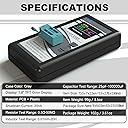
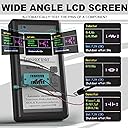
The DROK Transistor Tester LCR Meter is a versatile, battery-powered diagnostic tool featuring a vibrant 1.8" TFT color LCD that auto-identifies a wide range of electronic components including transistors, MOSFETs, diodes, and more. Designed for professionals and enthusiasts alike, it combines portability with smart technology and energy-saving features to streamline your testing workflow.

| ASIN | B01MS1FOYM |
| Best Sellers Rank | #378,874 in Industrial & Scientific ( See Top 100 in Industrial & Scientific ) #40 in LCR Meters |
| Brand | DROK |
| Brand Name | DROK |
| Compatible Devices | Transistors (NPN, PNP), MOSFETs (N-channel, P-channel), Diodes, Thyristors, Resistors, Capacitors, Inductors, MOS, SCR, ESR meters |
| Customer Reviews | 4.5 out of 5 stars 1,055 Reviews |
| Item Weight | 4 pounds |
| Manufacturer | DROK |
| Measurement Type | LCR Meter |
| Min. Operating Voltage | 9 volts |
| Minimum Operating Voltage | 9 volts |
| Model | Transistor Tester |
| Number of Items | 1 |
| Number of Packs | 1 |
| Part Number | 300427 |
| Power Source | Battery Powered |
| Style | Voltage Tester |
| Style Name | Voltage Tester |
| Unit Count | 1 Count |
| Upper Temperature Rating | 85 °C |
B**G
Some measurement devices are far more useful than you would ever learn about in electronics/EE
I spend a good amount of time troubleshooting electronic faults at work, replacing faulty components. In many cases, I am working with circuit boards that I don't have the ability to power on the circuit using a DC power supply or batteries, for regular troubleshooting by measuring voltages with a DMM and a oscilloscope. This device is handy, it's always with me. For example, some LEDs can be tested using a DMM such as Fluke, set to the diode test measurement, depending on the power requirements for a particular LED and its color and illumination characteristics. On some LEDs one can see the diode light up briefly using a Fluke (or other DMM). Some LED's however will not illuminate using just a diode tester on a DMM. When testing LEDs, I reach for this device before a DMM, it reliably illuminates and LED with briefly or a rapid series of pulses, including Cree LEDs. As another reviewer has mentioned, not all circuit-testing is done on live circuits simply because the ability to energize the circuit may not be feasible or possible. This device has saved me a lot of time where a circuit arrangement that I test results in a complete oddball of a test result, such as reporting a double diode instead of a bijunction transistor, or other circuit boards do not result in the same repeatable test result for faulty boards, while the board is not energized. I could not do my work without a multimeter available as my most important tool, I simply wouldn't bother. At the same time, this device reports results that are arrived at by intuition and practice using just a DMM. One other valuable function of this device is that I can take a number of transistors and get a consistent reading for range of performance so that I can match a number of transistors in cases there they must perform almost equally well. Using this device is far simpler than creating a test fixture to test transistors so they can be matched. I do this even with resistors too, 1% tolerance sounds nice but is not always the case--I use the ohmmeter function on my DMM for that, it's simple. For testing transistors or diodes, this device makes segregating similar performers together, much simpler. I haven't even needed to change the 9V battery in almost two-years of use.
J**R
Great value for the price!
I would have given this 4 1/2 stars if I could. The only CON I have found is the mounting of the ZIF socket. It tends to be a little "wobbly" at times and requires care in inserting/removing components. Other than that one issue, this device is amazing for the price. As far as accuracy goes, it is certainly sufficient for "go/no go" testing of most electronic components. I tested several resistors, diodes, transistors, capacitors, and inductors. For all of the components I tested, the results were within similar ranges measured using other instruments on my workbench. This is a great little tool for pre-checking components before installing them. The biggest PRO I can name is the simple fact that you can place any component in almost any orientation in this device and it will automatically detect the type of component and report the proper measurement. For the price, this is a great little tool. The only other complaint I might have is the size of the screen; with my older eyes, reading glasses are a must when using this.
J**.
Good and Bad, mostly Good
Overall, I am happy with this tester. The bad: the LCD display is small/hard to read for people over 40, the ZIF socket is flimsy and this impacts the user's ability to securely attach component wires you want to test. It could definitely be improved. Finally, the 40 second automatic shutoff is a pain. It sounds like a long time, but in practice, it is not. If they extended the automatic shutoff time to something like two minutes, it would be perfect and I suspect the battery life wouldn't be impacted all that much. Finally, the "manual" is not much use, more of a spec sheet than a user manual. The good: it is accurate. Very accurate. I have benchmarked it against various components of known value, as well as another component measurement device. The unit also provides very detailed component information. The color LCD display is nice, though as I said previously, you will have to wear reading glasses if you are middle-aged or older. I have used this device frequently over the last 6 months and it has never had even a hiccup. Overall, this is a nice, reasonably priced testing device.
W**W
This Drok tester is a pretty good go/no-go tester for components
The Drok tester is similar to many units, but is better built than most. The product includes a zero insertion force socket which may be plugged into the header socket holes protruding from the front of the unit. The fit of the ZIF could be firmer, and it probably would have been just as well to mount the ZIF to the circuit board and not bother with headers. The operation is pretty straight forward and the unit had no trouble identifying various types of thyristors, junction transistors, MOSFETs and diodes I tried. The only device which tripped up detection was a 50 Amp Schotty diode, which showed as “no component.” To be fair, that diode also eluded an expensive tester. I know the diode is good because it behaves properly under load. I believe this tester is a handy addition to have on the work bench as long as you keep your expectations realistic about what it can do.
A**R
Works great.
I acquired this after sending back another cheaper solution...twice. This one measures great so far - resistors, capacitors, diodes and transistors. Like other comments, the extra socket is a bit of an afterthought that tries to pop out when you push the lever down. For anything with two leads I've been using some jumpers that have mini-hooks on one end. One product suggestion: if they have anything to do with it, put the logo on the device label and put the website address in the manual. The startup delay is annoying and I don't really want to see it every time I power on.
T**K
Easy to use, quick and accurate
It would be difficult to get easier to use, make sure every lead is in a different numbered connection and press the test button. It accurately identified all bipolar transistors, resistors, capacitors and diodes I threw at it. It identified a diode protected MOS transistor, showing the protective diode in the diagram. It correctly identified back to back diodes, whether they were common anode or common cathode. I'm very pleased and feel that this was well worth the money I spent. I was able to identify unmarked semi-conductors as well as those whose markings where smeared or otherwise difficult to read. If you need to quickly identify components, this should do the job with all but the most complex devices.
S**E
Pretty good, but there are better ones available.
There are a bunch of these Testers on Amazon. They started as kits, then some mfgs decided to build an enclosure to house the components for a more professional look. They seem to have 2 basic designs, this one and the other "thicker" unit with the "lead clamper" matrix built-in. I purchased both to see which one I liked better. This DROK Tester looked more "professional" with the "hand-held calculator" formfactor. However, when I actually used it, there were some serious issues. Obviously the ZIF (the aqua rectangle with the lever) was an afterthought. It fits in the socket, but the usual bumps on the underside of the ZIF (used to keep it above the PC board so solder can flow under it) keep it from seating properly. When moving the lever to clamp onto the leads of the component to be tested, the entire ZIF tips to the left. Unless you hold the ZIF in-place, the lever will unseat the pins on the right-side as it tilts to the left. Feels really wiggly, and very unprofessional. It could be glued in-place, but that seems like a ghetto work-around. The other option is to NOT use the ZIF and just put the leads directly into the socket. This would work, but it required forcing all leads into the socket holes simultaneously. For 2-lead components, this is fine, but for transistors or others with 3+ leads, this is much more time consuming. The ZIF allows the leads to be inserted "loose", and the lever does the clamping. Much more convenient! And that is why they added the ZIF to this Tester, even though it is an afterthought. It uses a 9-volt battery for power, not included. It displays the voltage of the battery on the screen. In fact it takes up the bottom 20% of the display, which is a bit of a waste. I would rather see more room for info about the component being tested than the onboard battery. Speaking of batteries, it eats batteries. I ran maybe 10 tests of different components. The battery started at 9.3v, and was drained to 9.0v. If a typical session requires the testing of 20 components, I would need to keep a spare battery around, or purchase pricey rechargeable 9v batteries. Conversely, the Aideepen Tester has a rechargeable battery on-board. The deal breaker for me was the display. Although I like how "clean" it looks, it doesn't display the data as well as the other Test unit. (Please refer to the screen shots.) On the left is the display from this DROK Tester. On the right is the competing Tester from Aideepen: https://smile.amazon.com/dp/B07RZRSBC5?ref=ppx_yo2ov_dt_b_product_details&th=1 Both Testers are testing the same component, which is a simple transistor. The part I do NOT like about the DROK display is the pins are labeled as "123=EBC", which means I have to translate the pins to the EBC (Emitter, Base, Collector) pins of the transistor. A better way to display this information is to place the EBC next to the pins (1, 2 & 3) in the diagram. This is shown in the screen shot on the right. Much less mental gyration required to correlate the pins to the EBC of the transistor. If the DROK Tester were the only game in down, I would keep it, but I like the way the other Tester displays the information. Though it has a more "toy like" appearance, it is a good design ergonomically. Both are about the same price, around $30. Frankly, I would expect a Tester this sophisticated to be closer to $100. They are a bargain, considering trying to test components without one is an Easter Egg Hunt. Knowing a component's true values (vs. the published ones) is so much easier! :-D
P**T
Limit of 1 mV accuracy for transistor Vbe testing
I've tried this so far with BJT transistors and capacitors, and so far it seems to do a good job with both. The unit comes with no instructions, but couldn't be easier to use... plug each lead of the component into the ZIF socket, and press test. It's pretty magical actually to see the pinout and the component type automatically identified. In the case of a transistor, it will also show you the Hfe and Vbe... indeed, I bought this primarily for transistor matching and binning. A limitation here is that the unit's Vbe reading only goes down to the millivolt level, whereas demanding Vbe matching applications might demand 100 microvolts or even better. Nevertheless, I still think this is a win.. for getting really well matched resistors, the easiest approach is to use one of the simple breadboard rigs that you can find online that compares a test transistor to a reference transistor. This unit will let you do some easy prescreening for that workflow.. i.e. you can pre-identify the most promising reference transistor with respect to Hfe, and you will then also have a much smaller pool of candidate matches to screen (presuming you start with a pool that are already matched at the mV level). Two other factors lead me to knock of a star -- my unit arrived with a cosmetic scratch across the screen and faceplate. Also, unlike some of the other units out there, this one has no contact pad that will allow you to directly test SMD units, if that is important to you.
A**F
شكرا خدمةعملاء امازون
الجهازوصل و يوجد به عيب فني هو يتعرف علي كل القطع علي انها مقاومة فقط السوفت به مشكلة ما اضطررت لارجاعه حدثت مشكلة اثناء الارجاع تعامل معهافريق خدمة العملاء الخا ص بامازون بمنهي الاحترافية شكرا لخدمةعملاءامازون وهوالشئ الوحيد الجديربالذكر
A**Z
Muy funcional.
No incluye batería
N**I
Sehr littig
Der Ziffsockel wackelte,ich habe ihn deshalb mit Heißkleber unterfüttert.Es zeigt meißtens "kein oder defektes Bauteil" an. Hält auch nicht besonders lange. Ich würde es nie wieder kaufen
B**Y
Nice and does the job!
I’ve initially bought it to measure matched paired transistors in power amplifiers. It basically does the Job. In terms of build it’s a little flimsy and the socket is not of a great quality as it keeps falling out. For this price point it’s perfect!
A**K
The best measurement product I have ever bought!
This is by far the best measurement product I have ever bought. The schematic representation and precise readings are useful for parts that have worn off and do not show markings like old caps and multicolored LED's. I just got it, so long term reliability has not been validated but still it is worth the price no doubt about it! I want another one.
Trustpilot
3 weeks ago
1 day ago