
Desertcart purchases this item on your behalf and handles shipping, customs, and support to Peru.
๐ง Rewire your mind, reshape your future โ donโt get left behind!
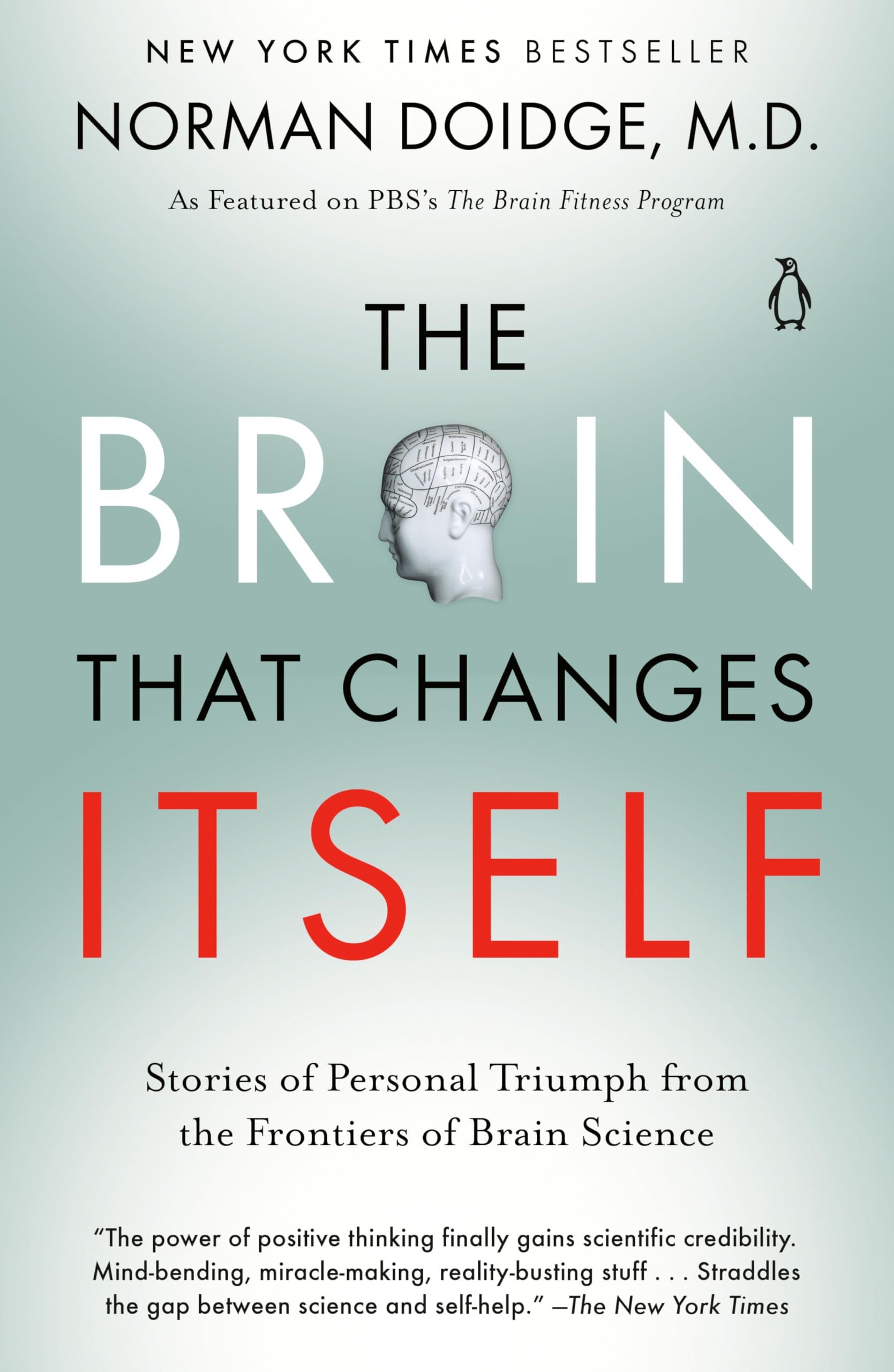
โThe Brain That Changes Itselfโ by Norman Doidge, M.D. explores the revolutionary science of neuroplasticity through captivating real-life stories and cutting-edge research, revealing how the brain can physically rewire itself to overcome injury, disorders, and limitations. A top-ranked bestseller in neuroscience and medical neuropsychology, this book offers a paradigm-shifting perspective on human potential and brain adaptability.


| Best Sellers Rank | #4,945 in Books ( See Top 100 in Books ) #4 in Neuroscience (Books) #5 in Medical Neuropsychology #5 in Popular Neuropsychology |
| Customer Reviews | 4.7 out of 5 stars 5,602 Reviews |
A**R
A Guided Tour of Neural Plasticity
As the title implies, "The Brain That Changes Itself" is an extensive and thoroughly enjoyable look at the history of neural plasticity, albeit from the point of view of a staunch supporter. I found the book to be very well organized, and Doidge's arguments to be very cohesive. The book chapters are filled mostly with stories and case studies regarding a common theme in the study of neural plasticity. Doidge begins by relating the story of Paul Bach-y-Rita's research and efforts to debunk the widely held localizationist theories of the 20th century. He presents some more dramatic case studies such as Cheryl who used her tongue to learn to stand after a debilitating brain injury or Barbara, a seemingly retarded woman, who ended up with advanced degrees and a successful research career (these stories are every bit as interesting as they sound). Doidge relates again and again how massive and usually debilitating brain injuries were overcome by physical and mental therapies. Following his analysis of catastrophic brain injuries and defects, Doidge gives examples of more everyday plasticity. He relates how common disorders such as autism, ADHD, and dyslexia can be attributed to (often minor) traumas and incidents during the critical childhood period. He talks about several schools which have had great success rehabilitating victims of those and other disorders through concentrated and prolonged efforts to retrain the brain. He also gives examples of how plasticity can affect even our emotions or sexual tastes. In the final chapters, Doidge relates what he calls the "paradox of plasticity." He explains that, while plasticity can be used to treat crippling injuries, it can also be responsible for equally crippling mental disorders such as obsessive compulsive disorder. He explains how rewired neural circuitry can create phantom pain in amputated limbs, reinforce bad habits into addictions, and give rise to compulsive behavior. He further delves into the field of psychoanalysis and reveals the power of thought. He describes many cases where psychoanalysis and new ways of thinking provoke measurable changes in the structure of the brain. He relates one study where a group of people were able to strengthen their finger muscles just by imagining daily finger exercises. As Doidge puts it: "...But now we can see that our "immaterial" thoughts too have a physical signature, and we cannot be so sure that thought won't someday be explained in physical terms. While we have yet to understand exactly how thoughts actually change brain structure, it is now clear that they do, and the firm line Descartes drew between mind and brain is increasingly a dotted line." Finally, for those that make it past the last chapter, the appendices and notes section actually contains a wealth of interesting information. Doidge annotated and explained all of the case studies and references that he uses in the preceding chapters, and included some interesting additional arguments about the nature of culture and its effects on the brain. As with any book that isn't a textbook, "The Brain That Changes Itself" is filled with opinions. Fortunately, many of these opinions are well supported, but readers new to the field could benefit from some time spent in the notes section. Overall the writing style is casual, easy to follow, and very engaging. I particularly enjoyed Doidge's heavy use of case studies to prove his points. Most of the case studies were tremendously interesting, and I regard them as one of the book's best features. I would say that this book is a good read for any audience, but less interesting for those that already have an extensive background in neuroscience. As a final note, I would highly recommend the Kindle version of this book. Unlike some electronic books I have read, the formatting was great, there were no typos, and the book was organized in such a way that I didn't waste time constantly scrolling or flipping pages back and forth.
D**Y
The Leopard Can Change His Spots
Neuroplasticity has recently become a bit of a buzzword. Long the preserve of neuroscientists, this is one of a number of new books on the topic written for the public. I recently reviewed Sharon Begley's superb book - Train Your Mind, Change Your Brain - and this one is in a similar vein. Though it is rather different from Sharon's book in which the main focus was on the changes wrought in the brains of meditators, while this one looks at the extraordinary responses of the brain to injury or congenital absence of sensory organs. Since this book went to press, yet another study, this time from India, has shown that some blind children may be able to regain their sight, an observation that is helping turn a lot of neurology on its head. Neuroplasticity is a topic of enormous practical importance. The increasing evidence that the brain is a highly adaptable structure that undergoes constant change throughout life is a far cry from the idea that we are simply the product of our genes or our environment. Our genes help determine how we can respond to the environment; they do not make us who we are. And we all have untapped potential. This is more than the old nature/nurture debate in a new bottle. It has implications for human potential: how much can you develop your own brain and mind? Can you really teach a child to be a kind, loving person who can dramatically exceed his or her potential? Can psychotherapy really help change your brain for the better? Can we help re-wire the brain of a psychopath? Do we have the right to try? The author is both a research psychiatrist and a psychoanalyst who has interviewed many experts in the field. His book is full of well chosen and detailed stories about scientists and their discoveries as well as case reports of triumph over unbelievable adversity. There is also a good discussion of people who have remarkable abilities despite the absence of key regions of the brain. This book is a good complement to Sharon Begley's and if you can afford it, then I strongly recommend that you get both books. If your interest is more in personal development and its effects on the brain, then Sharon's book will be the one for you. If you are more interested in the science and anecdotes about scientists and some amazing patients, then this book may be the one to go for. Highly recommended. Richard G. Petty, MD, author of Healing, Meaning and Purpose: The Magical Power of the Emerging Laws of Life
Q**X
Using Neuroplasticity in Real Time -- is required for the Kindle version of this book
The content of this book was a delight. Very well explained. The author presents a credible and logical development of the story behind localization of function (a somewhat pessimistic and dominating paradigm in education and medicine that has limited our potential for growth and recovery now for decades) versus a solid and fascinating array of evidence for not-so-strict localization supplemented by very substantial plasticity. While the latter is not new, the evidence supporting it has been harder to demonstrate and the hope it offers has unfortunately been deferred. Dr. Doidge's book is a beautiful presentation of the human story behind the scenes -- including that of the researchers who committed their lives to this work as well as of the patients who discovered hope and help through it. No particular science background is required, because he does a wonderful job of explaining just what's needed in lay language. I had a hard time putting it aside even to sleep!!! _________________________________________________ Comments specific to the Kindle Edition Only My major reservation and why the book receives 4 rather than 5 stars regards a dilemma with presenting it on Kindle media. Interestingly Dr. Doidge starts to evaluate the role of technology and media in influencing our brain function -- given its ready plasticity. He discussed TV, internet, video games, and the printing press, but unfortunately not Kindle versions of e-books, including his. Itt would be valuable to address what was gained and lost with the Kindle version. Because Kindle is still a relatively new media -- now is the best time to exercise its own plasticity toward better wholeness. Positive sparks for the Kindle: I indeed like the ability to receive the book within minutes of purchase. I like not needing to prop it open on the table in order to keep my place. I like not being tempted to fold over a page edge when the book won't stay propped or needing to scramble for some scrap paper to tear up and insert. It is a relief to be able to add notes which don't clutter up the margins with scribbled lines and highlights. However, some negative Kindling was ignited as well trying to make my way through this book -- particularly over the loss of context and critical visuo-spatial clues. Reading is not a strictly linear activity. There were key features of the global spatial organization that are sadly missing in the Kindle version. Examples: 1. There are no clues as to what chapter you are reading once you have dived into one. So if you lay down your Kindle and resume latter...who knows? Many non-fiction books would have a header or footer on every page as a reminder or you can rapidly flip a chunk of pages in a matter of milliseconds to find out. Much more tedious to page backwards or forwards an unknown number of "location blocks" to find out. (Instead of page numbers you are shown locations blocks.) There are several potential solutions -- having a menu item that zooms out to context information like this, or implementing better use of the horizontal position bar at the bottom of the screen so that instead of showing you the percentage of the entire book you have passed through, the bar at least shows where you are with respect to major chapter divisions as a contextual map. 2. Finding natural rest breaks is nearly impossible. I like to have an idea how far into a chapter I have progressed, and whether reading just a couple more pages will leave off at a "good stopping point" (i.e. after a good night's sleep). Not possible. The progress marker at the bottom of the text refers to what percent of >7000 locations you have completed -- which refers to the percentage of the whole book. The only thing less useful would be to tell me how many words or characters I've completed out of the whole. 3. Use of supplmentary material is very cumbersome. After the first chapter or so, I like to know the scope of the remaining text, how much is really text versus supplements. How good the supplements and illustrations are and how they would be used while reading the text. Yes...I really do want to know what is actually in the appendices so I can see if I will use them as I am reading. Again. Not much to go on here. In this book the appendices do contain several items but these are not cataloged in the table of contents -- its a total mystery box. Once you start into Appendix 1 or Appendix 2 you can't tell what is coming up next or where you are within and between the internal sections. You don't know whether you will miss something valuable or not without going through every single screen. You can't perform a search for something you don't know yet is there. 4. The index likewise is not helpful other than to serve as a reminder of key phrases in the book. These do not work as links back to the relevant part of the text. No location or page numbers are shown. No frequency of occurrences is given. Nothing to suggest any relative perspective about where in the book the information occurs. Instead you must type the phrases one at a time into the search box. I do like some features of the the resulting list of occurrences for that word or phrase, the 2-4 line capture of the surrounding sentence(s) and the ability now to link back to the text. However, most of the critical context is still lost. There is no easy way to "zoom out" and see whether the clip you have been transported to is in chapter three, five or chapter nine. You don't know if the topic covers a range of several pages and is a major occurrence or whether it is single line/paragraph hit. You can't tell whether it is before, after or anywhere near the passage where you remember reading about a favorite or related phenomenon. Looking up the related phenomenon next might help; however, it is likewise floating adrift in a contextless sea. I do realize that one can look at the location numbers. But these are so ridiculously large and not subdivided into chapters -- they are relatively meaningless. At least some memory functions work by chunking -- but these chunks need to have meaning!! 5. Similar constraints limit the usefulness of the notes section. they are not easily associated with the text to which they refer, nor is it easy to find them chapter by chapter -- only as giant a "clump" at the end. It seems possible that an unfortunate side-effect of engaging in Kindle- reading, until these contextual and spatial clues are restored, would actually interfere with the forms of photographic memory unconsciously employed by most of us and especially by those who have a gift for photographic memory. It becomes nearly impossible to stamp into memory 7000 locations devoid of almost all other landmarks and that change based on text size. A truly functional and fascinating part of our brain function is potentially sacrificed. Thus, I think it would be useful to gather some master publishers of printed works along with Dr. Doidge and the best of these surviving neuroscientists/neuroengineers he interviewed and put them into a think tank project -- these creative minds and Amazon's Kindle developers need to invest a bit more thought into ways to maximize the Kindle interface with: a)this book, and b) the human brain. Surrendering so many visuospatial and organizational cues for contextless leaps between linear text clusters does not seem like a productive tradeoff to me. Neuroscience professionals working out these dilemmas on his intriguing book could solve similar problems for many other books -- the nonfiction and academic books are most in need. Navigating a novel with only a few trail markers may be fine. But not so fine for the less narrative works; its an especially vulnerable way to travel for anything academic. Over time publishers have acquired a great deal of information about the organization and contextual patterns which truly improve understanding, learning, recall and motivation to return to a book for reference purposes. I really don't want to give up this acumulated wisdom. So far computer assisted publishing has added substantial depth to the ordering and visual aspects of the printed page. So...now with the Kindle...let's truly improve rather than just subtract contextual and multisensory clues. I'd rather not rewire my brain backwards toward chaos through my exposure to Kindle books.
A**R
A Fascinating Book
The stories bring context, relevance, and nuance to the complicated and deeply layered nature of brain science. A book that should be read more than once.
J**R
Enjoyable Read
I really enjoyed this book. When I bought it I did not read the description thoroughly. I have been buying numerous books on the brain that appear to be good choices simply because I am fascinated with the subject. While this book may help someone looking for self-improvement books, this book has no sections specifically focused on how you can improve your own brain. What this book does do is educate you on what has been done scientifically on medical studies and results of individuals who went through transformations to alter their brains. If you are using other book(s) on self improvement processes for your brain this book will reinforce and motivate you to stay with your plan. It will also give you facts about what may work and what doesn't work. I bought audible version first. The narration is a very good voice. The chapter material kept me interested. It didn't just throw facts at me. It essentially followed through with entire stories about people who dealt with brain issues, scientist experiment results, etc. I do have one warning. Many of the studies from the past cover times where research was done with animals. The information sticks to the facts but you need to be okay with hearing something that occurred when laws, attitudes, etc. were different. This book also goes into the history a little bit regarding PETA being formed. .... Definitely a great purchase
S**A
My Book of Hope
This is my "Book of Hope". Rarely do I read a book that is beautifully written and easily read, but which also changes my understanding and fills me with hope. The mantra when I entered Medical School, in 1965, was that as we approached early adulthood, we possessed about 10 10 or 100,000,000,000 nerve cells, and that the links between them were already formed. From early adulthood, we basically lost around 1000 cells per day, and by old age, this accumulated reduction in the number of cells caused us to lose our faculties and to wither away, and that was that! I remember a friend of mine in the early 70's saying he was going to specialize in Neurology, as we were entering the era of knowledge of the Brain. Well, he will be retiring around now, but the beginning of the era of increased understanding the Brain is upon us. We now know the Brain is not a static organ, but is capable of great flexibility or "Plasticity". Dr Norman Doidge, a Canadian-born psychiatrist and medical researcher, has written a wonderful summary of the physicians, scientists, individuals, who have contributed to our new understanding of the plasticity of the brain, and of the technologies, where we can see the changes in the brain occurring. Brain Plasticity gives so many folk new hope - those with stroke recovery needs, psychiatric problems, learning disabilities and for those of us Boomers, who will have to learn new knowledge and skills, our brain is capable of learning anew, of making new neurons and connecting new pathways. It isn't easy and indeed may take a considerable effort and persistence to alter pathways and re-tool our brains, but much can be done. So, read this book and revel in the exciting prospect of the beginnings of a new era for our understanding of the brain, and with it the awareness that we can change ourselves. Two Canadian Broadcasting Company documentaries on the "Brain that Changes Itself" can be found at the "Nature of Things" and are available for viewing on line. Sadly, I feel the first documentary, which is a summary of the book, is poorly presented, fragmented and doesn't smoothly tell the tale as in the book. The second documentary "Changing Your Mind" with case studies is better, but I guess the problem is that the medium of television can never offer the detail and understanding that can be obtained from a book.
B**E
Astonishing Stories of Damaged Brains Repairing Themselves
"The Brain That Changes Itself: Stories of Personal Triumph from the Frontiers of Brain Science" by Norman Doidge, is an easily readable, enjoyable, and thought-provoking book that gives the nonprofessional an overview of the new science of neuroplasticity--the brain's ability to reorganize itself by forming new neural connections over the life span. We learn that the brain is no longer thought of as being hard-wired, that people are no longer believed to be merely products of their genes and environment, and that damaged brains have the remarkable ability to repair themselves. Doidge recounts stories of real people who have benefited from advances in neuroplasticity. He gives us just enough background information about each case so that we find ourselves genuinely caring about these people--each person comes to life, like characters in a fine novel. He tells us stories about stroke victims with major physical dysfunction who were able to recover nearly everything that they lost, and then go on to live normal lives again. There is an astonishing story of a woman who lost her balance mechanisms; with help from neuroplasticians, she was able to rewire her brain to use other senses to achieve the same goal. We learn that neuroplastic physicians can design high-technology devices capable of bringing sight to the blind, hearing to the deaf, and movement to the paralyzed. We learn about an utterly courageous woman who, completely on her own, was able to rewire her brain to compensate for a large number of severe learning disabilities. Eventually, she goes on to found a very successful network of schools devoted to the methodologies she used. The basic concept is simple: the brain can change itself--rewire itself, so to speak. Often it needs only a little structured help to force it into making the new connections. The implications of this new science are staggering. Imagine retraining the brains of the severely mentally disadvantaged--the learning disabled, the autistic...perhaps even the psychopath--so that they are able to function almost normally in society. Imagine the impact this new science may have on prison rehabilitation, special education, psychiatry, and rehabilitation therapy, to name but a few. This is a truly astonishing new frontier, and Doidge makes the concepts easy and enjoyable. I recommend this book highly.
H**N
My long-time personal experiences attest to the subject matter of this book.
I thank Dr. Doidge for writing this very fascinating book about a very important subject. I believe that doing so also required not only great insight but also a certain amount of courage. His book explains the apparent paradox of my personal experiences as a toddler, and far beyond. Beginning when I was a baby, I suffered severe illnesses: diphtheria, whooping cough and a middle ear infection that left me with a big surgical scar behind one ear, and with a chronic ear infection that lasted for decades. I even had to have two more surgeries as an adolescent to remove "wild meat," that is granulation, proud flesh, from my remaining ear cavity. Forgive my self-promotion, but I am an outstanding, albeit unwitting, lab rat role model whose experiences verify, at least to some extent, some of the subject matter of Doidge's book. As a matter of fact, since my latest episode of healing I have become obsessed to share these healing experiences whenever I can. After my original ear surgery so long ago, I was not able to walk anymore and people also thought that I had become an "idiot." However, Dr. Doidge's book has convinced me that these early-life physical traumas, along with many other diverse, intense, prolonged ones during the first two dozen years of my life, were changing my brain through frequent re-mapping to adapt to them. Many people that have read my story cannot believe that I am still sane and even alive. You can read my very unusual and almost unbelievable memoir at: Heroes from the Attic: A Gripping True Story of Triumph Unfortunately, after its publication I had to greatly curtail my public contact and marketing of it because of slow poisoning that was very difficult to diagnose. However, after it was finally diagnosed, I was able to very slowly recover, and in some ways, I now feel better than ever. Again, thank you, Dr. Doidge, you have helped me understand my seemingly miraculous endurance through unbelievable traumatic experiences. The knowledge I gained from your book encourages me to continue to write another book about what I have learned and gained from my long journey to excellent health. Wishing you the best of health, Herman I Neuman
K**Y
tremendous book about NEUROPLASTICITY
This is a terrific book. I highly recommend it. The book focuses on neuroplasticity (the terrific functional flexibility of the brain), and very often is able to tell the story of the latest ideas in that field whilst relating them to particular human stories. It is written in a clear, thoughtful, engaging way. It's an important book because it is popularising important new ideas. I rather agree with the reviewer who says that Doidge overstates his case and tends to explain everything in terms of neuroplasticity, ... but I am very impressed by the quality and clarity of the book as a whole. I have had a stroke, and I read with interest chapter 5 (which deals with stroke). I felt it was well written and convincing. I found the basic message (that the brain's ability to recover from injury is enormously greater than conventionally understood) tremendously encouraging. That is not to say that my problems of hemiplegia have been solved, but my understanding of the potential for recovery, and how to achieve it, has been improved. As I read the book, I felt that important insights and clues to research were sometimes introduced briefly with little fanfare. E.g. 1) I think the discussion about neuroplastic change and evolution should lead us to question further the orthodoxy about how species evolve, that is natural selection is not the only force at work; and 2) isn't it a puzzlement that in a plastic environment anything is stable and solid? I wonder if the plastic brain is analogous to a fly-by-wire aircraft?
R**Y
Good book about how our brains work
Good book , better understanding of human Brian
J**L
One of the most interesting and rewarding books I have ever read.
This book reads well and the organization is easy to follow. Much more importantly it delves into a subject which I think is critical to understanding ourselves, essentially how our brain functions. There are things so pertinent and fundamental that I could effectively put them to work while reading the book. It is also reassuring that the writer and people in this field understand that there are negative aspects as well to the tenets of the book. I have already given the book as a gift to friends and relatives close to me and recommended it to many others. I am now starting to read it a second time in order to create an outline of all the themes and in order to better understand how this may change and improve my life as well as my relationships with others.
T**N
้็ๅคงๅฅฝใใใใ
ๆฅๆฌ่ช็ใ่ชญใใใใๅ ๅฎน็่งฃใในใ ใผในใงใใใใชใใใฏใใๆจๆธฌใใ ใใใไบบ้ใฎใ่ณใใฎ็ด ๆดใใใใ็ฅ็งใใ็ฅใใ่ชๅใงใๆดใซไฝใๅบๆฅใใใ ใใจ็ขบไฟกใงใใๅ ๆฐใๅบใฆใใพใใใ ใพใใฏใTOEICใในใใซใ๏ผ๏ผๆญณใซใใฆๅๆๆฆใใใใจ่จ็ปใใฆใใใพใใไปฅไธ
M**A
I'm still in the beggining, but what a great book! (The book came a little dented at the spine)
To Amazon, The book came a little dented at the spine, so I suggest you start wrapping it with bubble wrap so this doesn't happen anymore (I've seen more people with this problem). To the readers, I'm not English so I was a little scared that the book might be written in very technical language. However, the writing is very fluid and simple, it is very easy to understand and visualize what the author is telling us and explaining. I've only read the first chapter yet, but so far the book is super interesting (not boring at all) and almost makes me hooked. I totally recommend it - especially if you have an interest in neuroscience and neuropsychology!!
Trustpilot
2 days ago
2 weeks ago