We remain fully operational. Our teams are working around the clock to ensure your deliveries continue safely.

DOWNLOAD THE APP


Copyright © 2025 Desertcart Holdings Limited
DOWNLOAD THE APP
Buy anything from 5,000+ international stores. One checkout price. No surprise fees. Join 2M+ shoppers on Desertcart.
Desertcart purchases this item on your behalf and handles shipping, customs, and support to Peru.
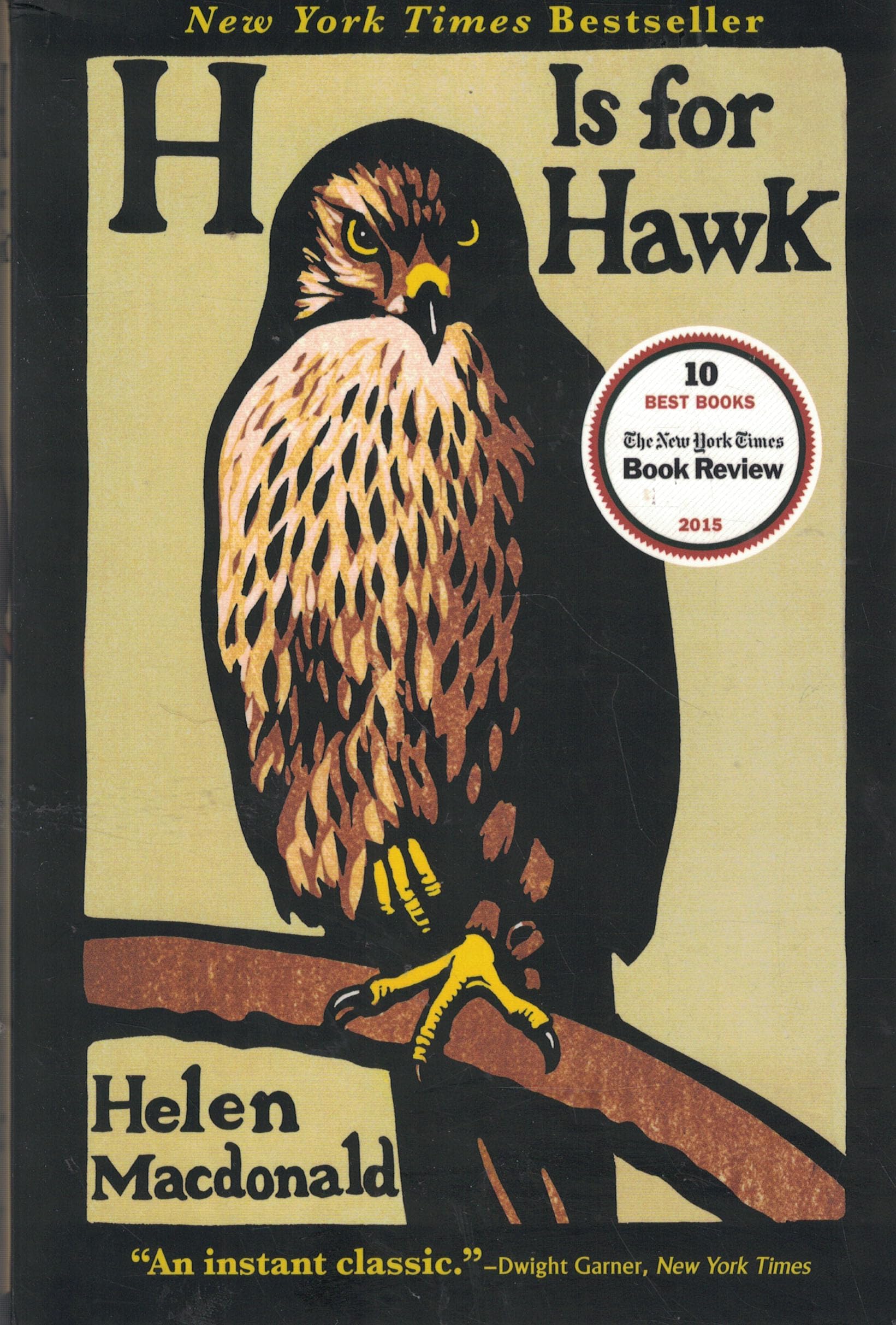
desertcart.com: H Is for Hawk: 9780802124739: Macdonald, Helen, Macdonald, Helen, Macdonald, Helen: Books Review: A beautiful and poetic memoir. - In these days of climate change and wholesale destruction of nature, we hang all hopes for the future on nature’s resilience. That resilience is the theme underlying Helen Macdonald’s memoir H Is For Hawk (Grove Press, 2014). Hers is a triangulated story shifting from her father’s death to the life of Arthurian legend writer T.H. White to Macdonald’s training of Mabel the goshawk, the medium-large raptor Accipiter gentilis of the title. If these seem like strange bedfellows, Macdonald makes these transitions smoothly and by the end of the book, weaves a story of personal redemption and self-discovery that is both wise and profound. T. H. White also wrote a book about raising and training a goshawk, and Macdonald turns to the celebrated author’s book as a guide for her own journey with Mabel. He was not as prepared as Macdonald, and therefore his account is more fraught with difficulty and disappointment. Yet he is a touchstone for Macdonald, a connection to an experience with an animal who has as much to teach her trainer as her trainer has to understand this predatory bird. With a goshawk, however, there is no taming her nature; Macdonald, with great difficulty, simply trains the bird to follow her own instincts as a hunter of prey, and human and hawk learn to work as a unit on the hunt. Macdonald’s father was a photojournalist who died in 2007. She recounts his passing while on the job, and how she had to go with family members to pick up his belongings and find his car, which had been towed away when he did not return to pick it up while covering his final story. Macdonald was very close to him, and the loss is almost overwhelming. Part of her own training is to learn to live with loss and grief. She recounts how her father taught her patience as the most important virtue. He tells her that one must be willing to stay still and wait for her moment, much like a piece of reindeer moss can survive “just about anything the world throws at it” and remain resilient. It is ironic that she finds herself staring at the moss when her mother informs her of her father’s passing. The life of an Astringer—a solitary trainer of goshawks and sparrowhawks—is a lonely one, and Macdonald describes her daily life and routines with Mabel in poetic and deeply harmonic language. The setting of the book is the Brecklands, a place known as the broken lands, and the area lives up to its name. She clings to the words of Marianne Moore: “The cure for loneliness is solitude.” She tells us she has learned to hold tight and survive, much like the security of the jesses, leather straps that bind the hawk to the Astringer. Her twin brother did not survive the difficult birth that brought Macdonald into the world. Macdonald is so good at distilling the wisdom she absorbs from training Mabel. She tells us there are two things she has learned about training hawks: the Astringer must learn to become invisible, and the way to a hawk’s heart is through positive reinforcement with food. Hawks are not social animals like dogs or horses. They are predators, and their predatory nature is bred in their bones. She equates training goshawks with “white-knuckle jobs” as described by her father. These are dangerous journalism assignments. Her father’s defense against the fear is to “look through the viewfinder” and stop being involved. Instead, become the witness. “All that exists is a square of finely ground glass and the world seen through it,” he tells her. His advice in stressful, dangerous situations is to be mindful of “exposure and depth of field and getting the shot you hope for.” Macdonald sees her father’s work in each photograph as “a record, a testament, a bulwark against forgetting, against nothingness, against death.” Rooted in her father’s philosophy is one that Macdonald also discovers in nature when training Mabel. The world is forever; we are only a blink in its course. Macdonald references Henri Cartier-Bresson, the great French street photographer, and his photographs of a decisive moment. A good photograph means being open to all life offers and in an intuitive moment, click the shutter to capture. If one misses the moment, it is gone forever. Our lesson is to live in that moment—no past, no future, only the here and now. Throughout the book, Macdonald’s writing is poetic and beautiful. She writes: “There is a time in life when you expect the world to be always full of new things. And then comes a day when you realize that is not how it will be at all. You see that life will become a thing made of holes. Absences. Losses. Things that were there and are no longer. And you realize, too, that you have to grow around and between the gaps, though you can put your hand out to where things were and feel that tense, shining dullness of the space where the memories are.” She also does not neglect the mythological elements of hawks and falcons, one that has played out over millennia: in ancient shamanic traditions in Eurasian cultures, “hawks and falcons were seen as messengers between this world and the next.” Mabel comes into Helen Macdonald’s life right at a time of need, and in working with this intense and intelligent animal, she finds peace and purpose in her life. She illuminates a culture that most of us never experience: training a fierce and intense goshawk to hunt with her human counterpart. In the end, Macdonald comes to understand the overwhelming grief and loss inherent in this life. Her story is extraordinary and extraordinarily beautiful. Review: Although the author had previously published lesser books this publication marks her sudden ascendancy to #1 on the NY Times Bes - When the title of this book first flashed across my Kindle screen I thought it would be another in Sue Grafton’s “alphabet series” of murder mysteries. But no, it is the highly acclaimed memoir of British author Helen MacDonald. “H is for Hawk” describes her experience as a falconer training a young northern goshawk (acciper gentilis) to hunt free from the fist in the countryside near Cambridge where she taught. The zooligical name of the bird belies its true nature - which is quite vicious - especially while in pursuit of prey. It is also the most difficult of hawks to train. Although the author had previously published lesser books this publication marks her sudden ascendancy to #1 on the NY Times Best Seller list for non-fiction. By profession a historian and teacher of English Ms MacDonald is also an accomplished falconer, having raised and trained many different kinds of hawk since her seemingly idyllic childhood. The sudden death of her father in the prime of his life while photographing on assignment catapults her into inconsolable grief. A momentous decision to raise and train a young goshawk abruptly changes the trajectory of her life. In this memoir covering less than one year in her life she describes in great detail one experience after another – from the initial acquisition of the bird to its first spring molting season. These experiences are colored by her intensely felt and palpable emotions. It is an account filled with numerous flashbacks to earlier events – not only in her life – but more significantly to the life experiences and writings of T.H. While. An earlier English writer he is probably best known for “The Sword in the Stone” and “The Once and Future King” – Arthurian fantasies which served as he basis of a popular Disney animation. Terence Hanley White was also the author of “Goshawk” – a memoir chronicling his disastrous relationship to a goshawk he raised and trained in the most inappropriate manner. While there are parallels between the two experiences – his and hers – they are vastly different in their outcomes. One might think that such a story could lead to a boring book – unless one were fascinated by the sport of falconry – which I certainly am not. While reading one is exposed to myriad details pertaining to hawks and falconry. However, the structure is skilfully pieced together and the writing is of the highest caliber. Ms MacDonald’s prose is both elegant and eloquent. The stages of her grief and her relationship with this bird – as well as the countryside – become tangible to a reader. Some would find it a depressing work – since clearly she has gone through – and seemingly recovered to some extent from – a deep state of depression. I did not find it depressing or boring to read. Though at times I wished – like some other reviewers – that she would eliminate many of the paraphrases of White’s text – I nevertheless found the brilliancy of the writing made up for these excursions.


| Best Sellers Rank | #14,110 in Books ( See Top 100 in Books ) #11 in Nature Writing & Essays #29 in Bird Field Guides #228 in Memoirs (Books) |
| Customer Reviews | 4.0 out of 5 stars 7,394 Reviews |
P**N
A beautiful and poetic memoir.
In these days of climate change and wholesale destruction of nature, we hang all hopes for the future on nature’s resilience. That resilience is the theme underlying Helen Macdonald’s memoir H Is For Hawk (Grove Press, 2014). Hers is a triangulated story shifting from her father’s death to the life of Arthurian legend writer T.H. White to Macdonald’s training of Mabel the goshawk, the medium-large raptor Accipiter gentilis of the title. If these seem like strange bedfellows, Macdonald makes these transitions smoothly and by the end of the book, weaves a story of personal redemption and self-discovery that is both wise and profound. T. H. White also wrote a book about raising and training a goshawk, and Macdonald turns to the celebrated author’s book as a guide for her own journey with Mabel. He was not as prepared as Macdonald, and therefore his account is more fraught with difficulty and disappointment. Yet he is a touchstone for Macdonald, a connection to an experience with an animal who has as much to teach her trainer as her trainer has to understand this predatory bird. With a goshawk, however, there is no taming her nature; Macdonald, with great difficulty, simply trains the bird to follow her own instincts as a hunter of prey, and human and hawk learn to work as a unit on the hunt. Macdonald’s father was a photojournalist who died in 2007. She recounts his passing while on the job, and how she had to go with family members to pick up his belongings and find his car, which had been towed away when he did not return to pick it up while covering his final story. Macdonald was very close to him, and the loss is almost overwhelming. Part of her own training is to learn to live with loss and grief. She recounts how her father taught her patience as the most important virtue. He tells her that one must be willing to stay still and wait for her moment, much like a piece of reindeer moss can survive “just about anything the world throws at it” and remain resilient. It is ironic that she finds herself staring at the moss when her mother informs her of her father’s passing. The life of an Astringer—a solitary trainer of goshawks and sparrowhawks—is a lonely one, and Macdonald describes her daily life and routines with Mabel in poetic and deeply harmonic language. The setting of the book is the Brecklands, a place known as the broken lands, and the area lives up to its name. She clings to the words of Marianne Moore: “The cure for loneliness is solitude.” She tells us she has learned to hold tight and survive, much like the security of the jesses, leather straps that bind the hawk to the Astringer. Her twin brother did not survive the difficult birth that brought Macdonald into the world. Macdonald is so good at distilling the wisdom she absorbs from training Mabel. She tells us there are two things she has learned about training hawks: the Astringer must learn to become invisible, and the way to a hawk’s heart is through positive reinforcement with food. Hawks are not social animals like dogs or horses. They are predators, and their predatory nature is bred in their bones. She equates training goshawks with “white-knuckle jobs” as described by her father. These are dangerous journalism assignments. Her father’s defense against the fear is to “look through the viewfinder” and stop being involved. Instead, become the witness. “All that exists is a square of finely ground glass and the world seen through it,” he tells her. His advice in stressful, dangerous situations is to be mindful of “exposure and depth of field and getting the shot you hope for.” Macdonald sees her father’s work in each photograph as “a record, a testament, a bulwark against forgetting, against nothingness, against death.” Rooted in her father’s philosophy is one that Macdonald also discovers in nature when training Mabel. The world is forever; we are only a blink in its course. Macdonald references Henri Cartier-Bresson, the great French street photographer, and his photographs of a decisive moment. A good photograph means being open to all life offers and in an intuitive moment, click the shutter to capture. If one misses the moment, it is gone forever. Our lesson is to live in that moment—no past, no future, only the here and now. Throughout the book, Macdonald’s writing is poetic and beautiful. She writes: “There is a time in life when you expect the world to be always full of new things. And then comes a day when you realize that is not how it will be at all. You see that life will become a thing made of holes. Absences. Losses. Things that were there and are no longer. And you realize, too, that you have to grow around and between the gaps, though you can put your hand out to where things were and feel that tense, shining dullness of the space where the memories are.” She also does not neglect the mythological elements of hawks and falcons, one that has played out over millennia: in ancient shamanic traditions in Eurasian cultures, “hawks and falcons were seen as messengers between this world and the next.” Mabel comes into Helen Macdonald’s life right at a time of need, and in working with this intense and intelligent animal, she finds peace and purpose in her life. She illuminates a culture that most of us never experience: training a fierce and intense goshawk to hunt with her human counterpart. In the end, Macdonald comes to understand the overwhelming grief and loss inherent in this life. Her story is extraordinary and extraordinarily beautiful.
D**F
Although the author had previously published lesser books this publication marks her sudden ascendancy to #1 on the NY Times Bes
When the title of this book first flashed across my Kindle screen I thought it would be another in Sue Grafton’s “alphabet series” of murder mysteries. But no, it is the highly acclaimed memoir of British author Helen MacDonald. “H is for Hawk” describes her experience as a falconer training a young northern goshawk (acciper gentilis) to hunt free from the fist in the countryside near Cambridge where she taught. The zooligical name of the bird belies its true nature - which is quite vicious - especially while in pursuit of prey. It is also the most difficult of hawks to train. Although the author had previously published lesser books this publication marks her sudden ascendancy to #1 on the NY Times Best Seller list for non-fiction. By profession a historian and teacher of English Ms MacDonald is also an accomplished falconer, having raised and trained many different kinds of hawk since her seemingly idyllic childhood. The sudden death of her father in the prime of his life while photographing on assignment catapults her into inconsolable grief. A momentous decision to raise and train a young goshawk abruptly changes the trajectory of her life. In this memoir covering less than one year in her life she describes in great detail one experience after another – from the initial acquisition of the bird to its first spring molting season. These experiences are colored by her intensely felt and palpable emotions. It is an account filled with numerous flashbacks to earlier events – not only in her life – but more significantly to the life experiences and writings of T.H. While. An earlier English writer he is probably best known for “The Sword in the Stone” and “The Once and Future King” – Arthurian fantasies which served as he basis of a popular Disney animation. Terence Hanley White was also the author of “Goshawk” – a memoir chronicling his disastrous relationship to a goshawk he raised and trained in the most inappropriate manner. While there are parallels between the two experiences – his and hers – they are vastly different in their outcomes. One might think that such a story could lead to a boring book – unless one were fascinated by the sport of falconry – which I certainly am not. While reading one is exposed to myriad details pertaining to hawks and falconry. However, the structure is skilfully pieced together and the writing is of the highest caliber. Ms MacDonald’s prose is both elegant and eloquent. The stages of her grief and her relationship with this bird – as well as the countryside – become tangible to a reader. Some would find it a depressing work – since clearly she has gone through – and seemingly recovered to some extent from – a deep state of depression. I did not find it depressing or boring to read. Though at times I wished – like some other reviewers – that she would eliminate many of the paraphrases of White’s text – I nevertheless found the brilliancy of the writing made up for these excursions.
A**R
Life with Mabel.
Macdonald has written an interesting book. She has a story to tell and she has done a good job. The fact that the subject is not suspenseful, thrilling or moving is explained by the subject matter. The writer is a troubled person, she is going through a difficult time, grieving the loss of her father. I felt she was insightful to follow her dream at this time. It was a unique way of handling her grief, she didn't just curl onto a ball and sob. I admire her decision to get the bird, yet I don't think it served her well. Mentally she escaped into a more troubling lifestyle. The time, pressure and solitude it took to train her goshawk was not the best medicine. Yet she realized she was depressed and went for medication and treatment. Many people fail to take this necessary step. Macdonald's writing brought the hawk Mabel to life. I was with her every step as she trained, related, worried and loved her bird. I was only mildly interested in the parelle story of T H White and his failure as a goshawk owner. The story was slow to start and had too much data and history at the beginning. I nearly quit reading but finally got to the heart of the story. This subject is rare, therefore it held my interest and I learned a lot I have respect for the people who choose this way of life, it is not a hobby, it is much more . MacDonald regretted that she had no way to balance her one sided life with Mabel.
P**N
H is for Hawk by Helen Macdonald: A review
Helen Macdonald, as she tells it in H Is for Hawk, was an awkward, unlovely, unpopular child. But though her life in the outside world may not have been so auspicious, she had a rich interior life that allowed her to escape from all that. She had an obsession: birds. She was fascinated by birds in general, but the ones which held the strongest attraction for her were the raptors, the magnificent killing machines of the avian world. She read everything she could find about the birds and about humans working with those magnificent killing machines and training them in the sport of falconry. Her most passionate desire was to be a falconer when she grew up. Helen, unlike many of us, had parents who did not discourage her obsession. They accepted it as normal and encouraged her in it. Her father, a professional news photographer, took her into the fields and woods to observe birds and to look for raptors. He taught her to focus as through a lens, in order to put herself outside the frame and maintain distance from the subject. Helen was especially close to her father. He was the much-loved, much-adored center of her life, the person who gave her her grounding in the world. When he collapsed and died unexpectedly on a London street while working, Helen's world also collapsed. She had lost her center and didn't know how to find her way. She was floundering. She retreated to her world of obsession. She had long worked with hawks in various types of situations, but she had never owned one or trained one on her own. At length, she decides that this is what she must do. She will train a hawk. But not just any hawk - a Goshawk, one of the most high-spirited and difficult to train birds of prey. She receives her bird, which she names Mabel, and just like that, she has found a new center for her being. The training begins. As she works with Mabel, she rereads an old book by T.H. White called The Goshawk. It recounts his experience in trying to tame and train a Goshawk. He had no idea what he was doing and his "training" methods were more like torture. Macdonald is appalled by his book but also mesmerized by it and by what it tells her about the man. She reflects on the man and his life as an outsider, a repressed homosexual, a sadist. She ruminates on the connections between the man's personal life, the influence of World War II, his experience with the Goshawk, and how all of that came together to impact and shape his writing about the tales of King Arthur in The Sword in the Stone. She weaves all of these topics together and they become the prism through which she looks at her own life and her experience of grief, and, in the end, she pulls it all together and begins to make sense of it so that she can get on with that life. This is a highly praised and much-honored book and, in my opinion, it deserves all of that. It is an amazing, almost unclassifiable book. It is a memoir and yet at times it reads with the urgency of the best fiction. I wouldn't necessarily describe it as a page-turner though. It is slow in parts, but there's nothing wrong with that. It just gives one time for reflection, time to absorb what one is reading. My only quibble with the book was a certain irritation and impatience with Macdonald herself. She completely gives herself up to grieving. She's able to do that because she is single with no family depending on her. She does have a mother (the widow of her father who died) and a brother and yet she is so self-absorbed with how the death of this man has affected her that she seems to have no understanding or empathy for what it has meant to these other people who loved him. Her grief insulates her and cuts her off from other human relationships. In the depths of mourning, she is as much a loner as T.H. White ever was. In the end, this is a book about Nature, the human and the avian kind, and about the profound and complex relationships that can develop between two species. I could never be a falconer, because I believe wild birds should be free. In fact, it distresses me to see an animal caged or tied up. But there is no discounting the effect that working with Mabel had on Helen Macdonald. At a time when she was spinning out of control, it helped her to find her way back, get her life back on track. H Is for Hawk. H is also for healing.
F**S
but when I read good nonfiction I just want to tell the world about ...
I know I said I was a fiction fanatic, but when I read good nonfiction I just want to tell the world about it. So let me tell you about “H Is For Hawk”. Helen Macdonald’s “H Is For Hawk” is a beautifully written and thoughtful book that includes patience as one of its many themes. And initially a reader must be patient as the story gradually evolves and draws the reader into Macdonald’s world. H is for Hawk is in part a memoir, and in part literary musings and environmental and ecological warnings. But at its heart, H is for Hawk is a reminder of the deep and irreplaceable importance of love, kindness and humanity in each of our lives. It is also a book of deep introspection and grief. At the start of H is for Hawk, Helen Macdonald focuses on her own grief over the death of her father and her separate but related obsession with goshawks. We travel with her as she acquires and trains her own wild goshawk, Mabel. She loses herself in the training of Mabel, while isolating herself from the people in her life and slowly sinking into a deep depression. At the same time, she takes us through English author T. H. White’s fascination with the goshawk and his ongoing personal crises which he too tries to bury in the training of a goshawk. His story becomes intertwined with hers and we learn about the likely inspiration and personal history behind his well-known novels, “The Sword in the Stone” and “The Once and Future King.” As the book progresses, Macdonald recognizes her depression and the role her preoccupation with Mabel has played and slowly heals. Interestingly, as MacDonald heals, she thinks less frequently of T. H. White. She continues to focus on Mabel, with a healthier understanding that she and Mabel are linked, but distinct. She thinks more about her father and the characteristics that bind them. At the same time she begins again to interact with the people in her life. And although there are disappointments, she is able to recognize the irreplaceable rewards of love and companionship. Throughout the process we get a look at the complex relationship between people and animals and people with each other. Macdonald’s descriptions are often painful and vivid illustrations of human and animal cruelty, but there are always lessons to be learned and every action has meaning. For instance, when Macdonald helps Mabel kill and feed on a rabbit, Macdonald comments that “Hunting makes you animal, but the death of an animal makes you human… But the regret wasn’t that I had killed an animal. It was regret for the animal. I felt sorry for it. Not because I was better than the animal. It wasn’t a patronizing sorrow. It was the sorrow of all deaths.” And when she encounters seemingly kind people espousing xenophobic views, she ponders the impact of her failure to respond. “I should have said something. Stomping along, I start pulling on the thread of darkness they’d handed me. I think of the chalk-cult countryside and all its myths of blood-belonging, and that hateful bronze falcon, of Goring’s plan to exclude Jews from German forests.”. Every action (or inaction) has its consequences. Macdonald’s journey is a slow and sometimes painful one. She acknowledges the need for patience to work through the complexities of experience, just as the reader needs some patience to make her way through the book to obtain an appreciation of the depth and rewards that can be found in Macdonald’s story. If you like this review, check out more at [...]
D**E
fascinating memoir
H IS FOR HAWK is written by Helen Macdonald. Ms. Macdonald is an English writer, naturalist and an affiliated research scholar at the University of Cambridge. H IS FOR HAWK has won untold prizes and recognition. The title appears on many (too many to count) Best Books Lists. H IS FOR HAWK is a book about falconry. It is a book about training a goshawk. It is a memoir; an auto-biographical account of a period in Ms. Macdonald’s life when she was reeling from the sudden death of her father. It is a book about deep, all-consuming sorrow and despair. A book about grief, loss and ultimately hope. I was very interested in the study of falconry with its world-wide, diverse cultures and techniques. Fascinating. I always like a ‘naturalist’s’ point of view and descriptions. The lyrical narrative was very mesmerizing. It was a love poem to birds, in general. An ode to hawks, in particular. Much of the book was taken up with Ms. Macdonald’s study of T. H. White. While I found ‘her’ writing very interesting, I was not at all impressed with T.H. White. I also found all the death and the tearing apart of small animals’ limbs and organs very off-putting. Some of the passages resonated so much with me that I include them here. “Looking for goshawks is like looking for grace: it comes, but not often, and you don’t get to say when or how.” p. 5 “”Hunting with the hawk took me to the very edge of being a human. Then it took me past that place to somewhere I wasn’t human at all. The hawk in flight, me running after her, the land and the air a pattern of deep and curving detail, sufficient to block out anything like the past or the future.” p. 195 “Hunting makes you an animal, but the death of an animal makes you human.” p.196 A very resonating memoir. Highly recommended. ****
M**R
Highly unusual, moving unsentimental book about grief and the wild
H is for Hawk, by Helen Macdonald, a memoir of her mourning after her father’s sudden death, stirs the heart through the loss and the intellect, through her scholarly researched and annotated study of hawk training and particularly the falconer T.H. White, who wrote a book Macdonald read as a child, The Goshawk. Macdonald moves us through the classic stages of grief with the literal and figurative training of her own goshawk, Mabel. The book is notable because falconry, no longer a highly common sport or one might argue after reading this moving account, art, serves the process of loss, anger, terror, despair with a scholarly hand and close-to-the bone telling. Macdonald pulls no punches on how low she falls after her father's death while the hawk she trains learns to soar and to return to her glove. She quotes White on his own journey of failing his hawk—he later did learn the art of falconry and succeeded but the book he finally published in 1951, persuaded by friends to do so, describes his despair and his discovery—it dives into depths she herself must enter. Macdonald notes, “He asks us to imagine what it was like, to put ourselves in the hawk’s bewildered, infant mind; to experience the heat and noise, confusion and terror that was its journey to his door. ‘It must have been like death,’ he wrote,‘the thing which we can never know beforehand.'” And with that sentence she joins him in her loss and his. Macdonald, a scholar and professor, gives up her job, removes herself from the world to mourn and train her hawk. In this way she can think about her father, his life as an observer, and her life as disappearing in the face of his loss. Some may argue for more of her father in this telling, and I too admit that I yearned for his story inside the story, but the goshawk and her despair take over the journey and I give her the privacy she needs for that part of this memoir. I hand it back to her as a gift in thanks for raw grief so rarely found on the page. And raw, indeed, it is. She describes White’s “constant self sabotage,” as she reveals her own. About White, who was an alcoholic, she notes: “for it is a common trait of alcoholics to make plans and promises, to oneself, to others, fervently, sincerely, and in hope of redemption. Promises that are broken, again and again, through fear, through loss of nerve, through any number of things that hide that deep desire, at heart, to obliterate one’s broken self.” And though she is most certainly not an alcoholic, his despair is her despair. His self-sabotage is her self-sabotage. And so the metaphor, literal and figurative, of training her hawk Mabel while chronicling her own disappearance from the world is joined with White’s journey. We journey with her. I honor her for the bravery of the falconry work but more for the courage to tell the story of grief, with hard, straight, unflinching despair on the discovery for both the self and its redemption.
J**G
Too Much & Too Little
Although Ms. MacDonald is a writer of obvious gifts and talent, her foray into a midlife memoir of personal grief and character growth is at times difficult reading. In the aftermath of her beloved father's sudden death, she withdraws nearly completely from life - friends, family, work - and secrets herself away with a young goshawk. She has studied and practiced falconry since childhood and hits upon the idea that training and bonding with the hawk might somehow assuage her bereft heart and wounded spirit. 'Mabel', as she names the goshawk, proves formidable, challenging the author's skill as a trainer of raptors and her confidence as a competent human being: over and again, chasing Mabel across the fields and through the woods of wet, wintry England, MacDonald is reduced by her bird to a tearful, quivering, wet and dirty, and occasionally bloody mess. Others might have climbed a mountain, sailed a stormy sea, joined the foreign legion; MacDonald raised, trained and bonded with a goshawk. A different sort of grief counselling not available or prudent for all. This is not an "entertaining" read; it is a gut wrenching account of the purgatory of pain called grief. People do, at times, one way or another, die from such pain. MacDonald survived and came back to earth, but her journey is as difficult to read as her hawk is beautiful to behold. Her descriptions of Mabel's beauty, physicality, and 'personality' are exquisite; by the end of the tale, I felt I knew this hawk personally and intimately. Other reviewers have discussed MacDonald's choice to include T. H. White (perhaps best known as the author of "The Once and Future King") in her book. His story, as a fellow austringer (a trainer of hawks and falcons, I learned) and tortured soul, help to anchor the story in commonality: both are devotees of falconry, both are isolated outsiders who spent a year attempting to train a goshawk, White far less successfully. This book was a slog, a chore to finish, requiring discipline from me in the same way certain works assigned to read in college once did. I purchased the book based on a short review in The New Yorker, which was very positive. I applaud the author for the effort she must have put forth in writing "H Is for Hawk"; she undoubtedly dug hard and deep, to bring forth the enormity of her feelings. But her tone throughout is dark, as gray as the English winter which her story inhabits.
Trustpilot
2 days ago
3 weeks ago