
Written on Skin
Product ID: 22206857
Details
- FormatClassical NTSC
- GenreClassical / &
- LanguageEnglish
- Runtime1 hour and 38
Desertcart purchases this item on your behalf and handles shipping, customs, and support to Peru.
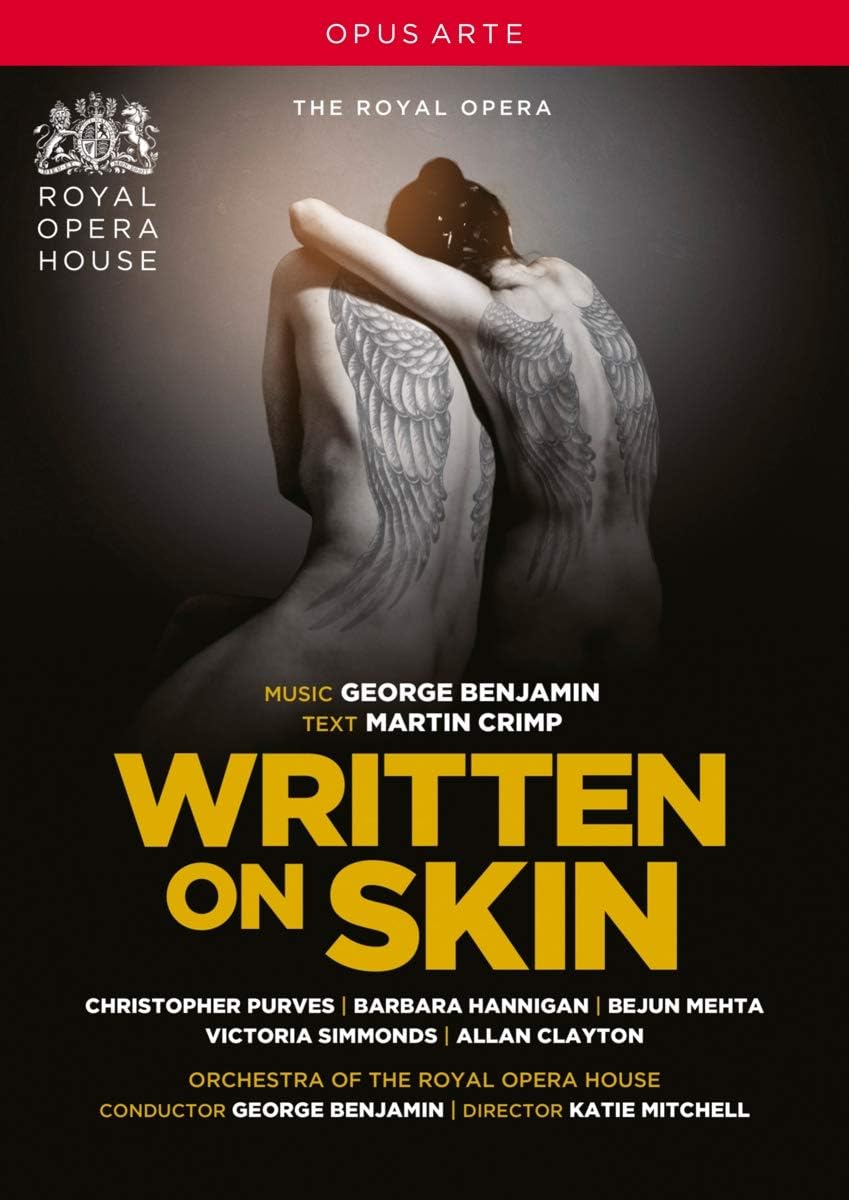
With a score by George Benjamin and text by Martin Crimp, Written on Skin has been hailed as ‘magic and irresistible … the best opera written over the last twenty years’ (Le Monde). A cruel and powerful Protector (Christopher Purves) asks a mysterious Boy (Bejun Mehta) to create an illuminated book in honour of his wealth and family. He invites the Boy into his home, little realizing that this will lead to a journey of startling, joyful and ultimately tragic self-discovery for the Protector's oppressed and much younger wife Agnès (Barbara Hannigan). Acclaimed director Katie Mitchell brings this dark and intense story to life in an inventive production that skilfully combines elements of the past and present, with Benjamin himself conducting. Filmed in High Definition 25p and recorded in true Surround Sound. "Written on Skin is close to being a masterpiece." (Le Figaro ) "Would the opera work so well without a Protector as adept at portraying cruel, complex characters as baritone Christopher Purves, or a soprano combining fierce presence with such pure tone as Barbara Hannigan, or a countertenor Boy sounding as beguiling and other-worldly as Bejun Mehta? Perhaps not quite. But it would still be a musical masterpiece." (The Guardian ) "This is music of genius. It also draws superb performances from a flawless cast: Christopher Purves (the castellan), Barbara Hannigan (his wife), Bejun Mehta (the artist), and Allan Clayton and Victoria Simmonds as the choric angels, who seem to instigate as well as observe the action. Benjamin's conducting of his own music was literally authoritative, and the orchestral playing was ravishing. After a long run of mediocrity at the Royal Opera, what joy to encounter something as enthralling and enchanting as this. " (The Daily Telegraph ) Awards Gramophone Award {2014} (Contemporary) International Opera Award (UK) {2013} – World premiere Opernwelt – Premiere of the Year {2013} – Best new work Grand Prix Du Syndicat de la critique {2013} – Opera Opéra Magazine – La Diamant d’opera {2013} – Opera BASCA Award {2013} – Stage Category New York Times –‘Favorite Classical record of the Year’ 2013 South Bank Sky Arts Award {2014} – Opera Preis der Deutschen Schallplattenkritik {2014} - DVD Choc de Classica {2014} - DVD Royal Philharmonic Society’s Large-Scale Composition {2014} – Opera Production Company: The Royal Opera Stage Director: Katie Mitchell Television Director: Margaret Williams Disc Information Catalogue Number: OA1125D Date of Performance: 2013 Running Time: 89 minutes Aspect Ratio: 16:9 Anamorphic Subtitles: EN, FR, DE, JP Label: Opus Arte This is essential viewing and listening for anyone interested in opera, or music more generally, today. --Boston Globe, David Weininger Benjamin's chromatic vocal writing is consistently mellifluous and his sensitive and radiant orchestration never fails to impress. Mehta's eerie male soprano perfectly conveys his otherworldly, angelic character, Purves' insightful interpretation lends an element of humanity to his nefarious character and Hannigan's moving portrayal of a woman coming to self-awareness is both vocally gorgeous and dramatically incisive. --The WholeNote, Daniel Foley In an age when contemporary British operas too often resort to shock-and-schlock tactics it is a pleasure to encounter such a concise and sophisticated jewel of an opera. --The Wholenote The latest opera from British composer George Benjamin, "Written on Skin," effectively exhibits the potential of 21st century opera, and how new entries in this art form can still engage a modern audience. --Steven Bergman, Edge Media Network The greatest [opera] of the past twenty years [...] Benjamin works with fastidious nuance, layering transparent landscapes that unfold in somber radiance. --Opera News, May 2014 2014 Gramophone Magazine Award Winner - Contemporary --Gramophone Magazine With a live recording already available, why take up more shelf space with the DVD? Even though George Benjamin's first full-length opera is so psychologically laden that staging might seem superfluous, Katie Mitchell's original production matches visual layers to musical ones - with subtitles to catch every turn in Martin Crimp's text. --Gramophone, December 2014 Review: A NEW OF OPERA FOR A NEW MILLENNIUM - With libretto by playwright Martin Crimp ( 1956- ), “Written on Skin” is a new opera by George Benjamin (1960 - ), a British composer, writer, conductor, pianist and music teacher, who has recently become incredibly popular, in part due to the success of the opera itself. According to an article written by Eric Dahan for French daily newspaper Libération, June 19 2014 issue, “Since the wild success of “Written on Skin“, George Benjamin has become the "Spielberg of Opera" …….“Benjamin is now the "most bankable of opera composers." Similar comments on the opera - by Corinna da Fonseca-Wollheim, for the New York Times, August 13 2013 issue - are: “Within minutes of the premiere of George Benjamin’s “Written on Skin“, at the Aix-en-Provence Festival last summer, opera houses around the world jostled for production rights to this darkly erotic opera ………. In the past year, it has been staged in London, Amsterdam, Toulouse, Munich and Vienna, each time bringing audiences to their feet and leaving critics to pull out superlatives they hadn’t thought they’d ever use in the context of new opera“. More comparably positive reviews on George Benjamin and his latest opera are available on the internet. After reading the above and similar responses to the opera and its authors, can anyone possibly give Written on Skin anything less than five stars? So, having concluded that - based on the general opinion - this new composition is a masterpiece as well as a milestone in the opera world, let us learn more about it. Written on Skin is an opera in three parts - yes, it is parts not acts, as librettist Martin Crimps assures us. It premiered at the Aix-en-Provence Festival in 2012, and was then shown at the Royal Opera House, Covent Garden in London, during March 2013. George Benjamin conducted both performances. The opera had its US premiere in August at the 2013 Tanglewood Festival of Contemporary Music, where it was also conducted by the composer. The opera in the DVD is the one presented at the Royal Opera House, Covent Garden during March 2013. It lasts approximately 90 minutes. It is sang in English, with English, French, German and Japanese subtitles. Like many 20th- 21st century operas - most prominent among them, Debussy's Pelléas et Mélisande and Berg's Wozzeck - Written on Skin is not the traditional collection of arias and recitatifs of the 18th and 19th century operas. It has been described by music reviewer and commentator, Lloyd Schwartz as “a setting for a play divided into short scenes, with some of the best music coming between the scenes“. The staging is unusual, and consists of four tableaus appearing simultaneously on the stage/TV screen - a long one above, two below, and a staircase on the right side. Two of the tableaus show 21st century environments, the third, a medieval background. The setting shifts from one tableau to another, the effect being accomplished by highlighting the tableau in question. The shifting results in an interesting overlapping of time, from 13th century to our own times. Costumes are both medieval and 21st century, probably more often 21st century, than medieval. The libretto is based on the legend of the troubadour Guillaume de Cabestany, a legend that was described in various literary works of the time, including The Decameron by Giovanni Boccaccio (1313-1375). The place is Provence. The time - as we just noted - shifts from our modern era to the 13th century, when books were rare because individually hand prepared, and precious because written and illuminated on animal skins (hence the title of the opera). Three angels - some narrators and characters at the same time - open the show by singing about how our modern civilization, with its parking lots and international airports, has been built on top of the "heaped-up dead” of the past. The actual story is not for the faint of heart. If you found disturbing the last scene from Wozzeck - where the little boy hears about the recently found body of a woman on the outskirts of town, and all alone heads for the site, without realizing that such a woman is his own mother - this opera is not for you. Neither it is, if you found in bad taste the scene from Richard Strauss’ Salomé, where the heroine sings passionate love words to the severed bleeding head of St. John the Baptist. You may not appreciate the same opera, if you think that Shostakovich’s Lady Macbeth of the Mtsensk District has too much explicit sex. Written on Skin is more graphic and more disconcerting than any of the above, possibly even than all of the above put together. Particularly so, because it is narrated by angels who - while comment throughout on the action from a modern-day perspective - do recognize the cruelty in human nature, yet realize that such cruelty cannot be controlled. This is what happens. A wealthy man, known as “The Protector” - and described by the angels as “addicted to purity and violence” - pays a character known as “The Boy” (in reality, one of the angels who assumes human form for the story) to create an illuminated manuscript which will flatter himself and his family and possibly make them immortal. The Protector treats his wife Agnès poorly, as he considers her just another of his possessions. Unhappy, Agnès turns her attention to The Boy. The two have an affair which is very short lived because The Protector - who apparently is also in love and having a liaison with The Boy (based on the way he kisses him on stage, possibly in real life as well) - soon becomes aware of it. He is wildly jealous: after all, not only has his own wife been unfaithful, so has his young male lover. He takes revenge on the two of them by murdering The Boy; by then pulling out his heart, cooking it and offering it to his unaware wife who actually finds the dish pleasant to the taste, “salt and sweet“, as she describes it………... . Such is the story so far, without any exaggerations, all details being accurately acted out on stage. Agnès is not horrified, after her husband reveals the nature of her dinner, rather she seems mildly content, as she believes that she has swallowed the heart of the man she loved and that consequently she has made him part of herself. Like in a Greek tragedy, Agnès dies in the end - by suicide, after jumping out of the balcony, and in order to avoid being killed by her husband….., “The Protector“. Her falling body appears suspended on-stage against the night sky, while three painted angels look towards the spectators. The opera ends. If we believe the unanimously positive reviews by the press both in Europe and the United States, we can only conclude that this is a work after which opera will never be the same. But then again, it may be just a question of taste. Personally, rather than moving with the times, in this particular case, I would prefer to remain behind and watch more traditional 18th and 19th century works, such as Don Giovanni or the Magic Flute; L’Elisir d’Amore; La Traviata or Aida; La Boheme. Perhaps, just perhaps, even 20th century operas such as Peter Grimes and Lady Macbeth of the Mtsensk District. Review: A Mocern Opera worth considering - This Opera, composed by George Benjamin is one of a kind, incredibly well written and performed by singers who inhabit their rolls completely. Benjamin took years to write this opera and the time has served him well. So many contemporary operas seem to be so filled with sound that there is no time for silence. Benjamin has a healthy respect for beautiful melodic lines with plenty of air between voice and instruments yet he can hit hard with a crunch of brass and percussion and create a violence unique and frightening. The libretto jumps back and forth from Medieval times to the 21sst C, without seeming like a gimmick. I love everything about this piece.
| Contributor | Allan Clayton, Barbara Hannigan, Bejun Mehta, Christopher Purves, David Alexander, Laura Harling, Margaret Williams, Victoria Simmonds Contributor Allan Clayton, Barbara Hannigan, Bejun Mehta, Christopher Purves, David Alexander, Laura Harling, Margaret Williams, Victoria Simmonds See more |
| Customer Reviews | 3.7 out of 5 stars 45 Reviews |
| Format | Classical, Multiple Formats, NTSC |
| Genre | Classical / Symphonies, Music Video & Concerts |
| Language | English |
| Runtime | 1 hour and 38 minutes |
C**E
A NEW OF OPERA FOR A NEW MILLENNIUM
With libretto by playwright Martin Crimp ( 1956- ), “Written on Skin” is a new opera by George Benjamin (1960 - ), a British composer, writer, conductor, pianist and music teacher, who has recently become incredibly popular, in part due to the success of the opera itself. According to an article written by Eric Dahan for French daily newspaper Libération, June 19 2014 issue, “Since the wild success of “Written on Skin“, George Benjamin has become the "Spielberg of Opera" …….“Benjamin is now the "most bankable of opera composers." Similar comments on the opera - by Corinna da Fonseca-Wollheim, for the New York Times, August 13 2013 issue - are: “Within minutes of the premiere of George Benjamin’s “Written on Skin“, at the Aix-en-Provence Festival last summer, opera houses around the world jostled for production rights to this darkly erotic opera ………. In the past year, it has been staged in London, Amsterdam, Toulouse, Munich and Vienna, each time bringing audiences to their feet and leaving critics to pull out superlatives they hadn’t thought they’d ever use in the context of new opera“. More comparably positive reviews on George Benjamin and his latest opera are available on the internet. After reading the above and similar responses to the opera and its authors, can anyone possibly give Written on Skin anything less than five stars? So, having concluded that - based on the general opinion - this new composition is a masterpiece as well as a milestone in the opera world, let us learn more about it. Written on Skin is an opera in three parts - yes, it is parts not acts, as librettist Martin Crimps assures us. It premiered at the Aix-en-Provence Festival in 2012, and was then shown at the Royal Opera House, Covent Garden in London, during March 2013. George Benjamin conducted both performances. The opera had its US premiere in August at the 2013 Tanglewood Festival of Contemporary Music, where it was also conducted by the composer. The opera in the DVD is the one presented at the Royal Opera House, Covent Garden during March 2013. It lasts approximately 90 minutes. It is sang in English, with English, French, German and Japanese subtitles. Like many 20th- 21st century operas - most prominent among them, Debussy's Pelléas et Mélisande and Berg's Wozzeck - Written on Skin is not the traditional collection of arias and recitatifs of the 18th and 19th century operas. It has been described by music reviewer and commentator, Lloyd Schwartz as “a setting for a play divided into short scenes, with some of the best music coming between the scenes“. The staging is unusual, and consists of four tableaus appearing simultaneously on the stage/TV screen - a long one above, two below, and a staircase on the right side. Two of the tableaus show 21st century environments, the third, a medieval background. The setting shifts from one tableau to another, the effect being accomplished by highlighting the tableau in question. The shifting results in an interesting overlapping of time, from 13th century to our own times. Costumes are both medieval and 21st century, probably more often 21st century, than medieval. The libretto is based on the legend of the troubadour Guillaume de Cabestany, a legend that was described in various literary works of the time, including The Decameron by Giovanni Boccaccio (1313-1375). The place is Provence. The time - as we just noted - shifts from our modern era to the 13th century, when books were rare because individually hand prepared, and precious because written and illuminated on animal skins (hence the title of the opera). Three angels - some narrators and characters at the same time - open the show by singing about how our modern civilization, with its parking lots and international airports, has been built on top of the "heaped-up dead” of the past. The actual story is not for the faint of heart. If you found disturbing the last scene from Wozzeck - where the little boy hears about the recently found body of a woman on the outskirts of town, and all alone heads for the site, without realizing that such a woman is his own mother - this opera is not for you. Neither it is, if you found in bad taste the scene from Richard Strauss’ Salomé, where the heroine sings passionate love words to the severed bleeding head of St. John the Baptist. You may not appreciate the same opera, if you think that Shostakovich’s Lady Macbeth of the Mtsensk District has too much explicit sex. Written on Skin is more graphic and more disconcerting than any of the above, possibly even than all of the above put together. Particularly so, because it is narrated by angels who - while comment throughout on the action from a modern-day perspective - do recognize the cruelty in human nature, yet realize that such cruelty cannot be controlled. This is what happens. A wealthy man, known as “The Protector” - and described by the angels as “addicted to purity and violence” - pays a character known as “The Boy” (in reality, one of the angels who assumes human form for the story) to create an illuminated manuscript which will flatter himself and his family and possibly make them immortal. The Protector treats his wife Agnès poorly, as he considers her just another of his possessions. Unhappy, Agnès turns her attention to The Boy. The two have an affair which is very short lived because The Protector - who apparently is also in love and having a liaison with The Boy (based on the way he kisses him on stage, possibly in real life as well) - soon becomes aware of it. He is wildly jealous: after all, not only has his own wife been unfaithful, so has his young male lover. He takes revenge on the two of them by murdering The Boy; by then pulling out his heart, cooking it and offering it to his unaware wife who actually finds the dish pleasant to the taste, “salt and sweet“, as she describes it………... . Such is the story so far, without any exaggerations, all details being accurately acted out on stage. Agnès is not horrified, after her husband reveals the nature of her dinner, rather she seems mildly content, as she believes that she has swallowed the heart of the man she loved and that consequently she has made him part of herself. Like in a Greek tragedy, Agnès dies in the end - by suicide, after jumping out of the balcony, and in order to avoid being killed by her husband….., “The Protector“. Her falling body appears suspended on-stage against the night sky, while three painted angels look towards the spectators. The opera ends. If we believe the unanimously positive reviews by the press both in Europe and the United States, we can only conclude that this is a work after which opera will never be the same. But then again, it may be just a question of taste. Personally, rather than moving with the times, in this particular case, I would prefer to remain behind and watch more traditional 18th and 19th century works, such as Don Giovanni or the Magic Flute; L’Elisir d’Amore; La Traviata or Aida; La Boheme. Perhaps, just perhaps, even 20th century operas such as Peter Grimes and Lady Macbeth of the Mtsensk District.
L**R
A Mocern Opera worth considering
This Opera, composed by George Benjamin is one of a kind, incredibly well written and performed by singers who inhabit their rolls completely. Benjamin took years to write this opera and the time has served him well. So many contemporary operas seem to be so filled with sound that there is no time for silence. Benjamin has a healthy respect for beautiful melodic lines with plenty of air between voice and instruments yet he can hit hard with a crunch of brass and percussion and create a violence unique and frightening. The libretto jumps back and forth from Medieval times to the 21sst C, without seeming like a gimmick. I love everything about this piece.
E**N
a worthwhile opera
a fascinating modern opera - not melodious but very listenable
M**A
Very interesting
Excellently sung (Ms Hannigan above all), played and staged. It is an interesting piece of contemporary opera, which has prompted me to investigate other works by Mr Benjamin
A**A
HATED IT.
I made a terrible mistake. I'm not squeamish when it comes to Modernism in music--I loved "L'Amour du Loin", also based on a medieval legend. But, when I order to understand what I am watching and listening to, I need to pore over obtuse technical explanations, the music is frankly unimpressive to my "untrained" ears, the mise-en-scene has no visual attractiveness, I say: don't go there. Only for academics, opera reviewers and the British, who, by the way, should listen to more Britten and less of this pseudo-intellectual gobbledygook. And, to add salt to the wound, the case arrived smashed. As for myself, I am sticking to Vivaldi.
J**R
very interseting
Interesting yet disturbing great premise but took two viewings to decipher what exactly is going on. This is definitely Worth watching though.
O**O
Riveting
Well cast, fascinating production.
A**D
DEGENERATE opera for DEGENERATE audiences !
This is by far the stupidest and ugliest opera that I have ever listened to & I've been going to the Opera for years... The story is incomprehensible, the music subtle to the point of inaudibility and the libretto - totally GROTESQUE! The medieval-modern mix - either in the plot itself or in the sets or the costumes - makes NO SENSE whatsoever and proves utterly inefficient, since we don't even know what the opera is about... How could anybody in his right mind give this wiling, creepy, condescending piece of CRAP more than one star (even that is too high a score!) is beyond my understanding : not only the protagonists are vilely removed from plausibility (which straight husband would reject his wife's advances on the pretext of their being puerile?!), but women are presented as solely sensual creatures, whose purpose in life is to ensnarl even angels... This opera's plot is a distasteful rewrite of the biblical story of Adam & Eve, with the ostensible pretension of empowering women by supporting the view that sexuality is divine & the driving force behind all that's good in the world... Now, that's a feeble message : what about LOVE (which surpasses sexual desire, in my humble opinion), morality, loyalty, pity, compassion for the weak, the helpless, the unfortunate? I don't remember having heard Agnes revolt against the violence her wealthy husband is inflicting upon the serfs on his fiefdom... All she cares about is the "love" story written on her skin by her lover's caress... That's the petty role model Mr. Crimp pretends to raise to mythological heights as a postmodern hero!... The frantic reception of this more than undeserving (please forgive the euphemism!) opera is the ultimate proof that we live in a society lacking both moral and aesthetic standards, a society that relishes and feeds on paradox : all the "blinded" progressists that were dazed into equating this appalling Agnes with XXI st century’s Wonder Woman should be reminded that there is more to women that lust & more to opera that George Benjamin, who shamefully discredits it...
C**N
Non saremo un lazzaretto ma almeno i sottotitoli.
Opera interessante ma senza sottotitoli in italiano. Visto che in Italia la produzione di opere è molto limitata rispetto ad altri paesi, almeno sottotitolare gli spettacoli che hanno un discreto giro nei paesi di lingua inglese... In attesa di trovare un libretto.
P**H
Gran ópera
Es una ópera maravillosa
C**R
Indispensable !
Si vous vous intéressez à l'opéra contemporain, que vous ayez ou non assisté aux représentations données à Aix pour sa création à l'été 2013 ou à Favart en Février 2014, que vous voulez comprendre pourquoi "Written on skin" ouvre une perspective nouvelle et est un acte fondateur d'un opéra différent, courrez et précipitez-vous sur ce formidable enregistrement. Ici, c'est la version donnée à Londres fin 2013 qui est gravée. On y retrouve le décor intégral de la création, dont l'escalier qui joue un rôle essentiel à la fin du troisième acte, conçu pour une large scène ce que Favart n'a pas pu offrir. On y retrouve aussi l'ensemble des chanteurs de la création à l'exception de l'ange N°2/Marie remplacée par une excellente Victoria Simmonds. C'est toujours George Benjamin qui dirige une partition dont la prise de son très précise nous livre ici, bien mieux que sur le CD capté lors du festival d'Aix, tout le détail, toute la richesse incroyable comme ce recours à un jeu de verres en cristal accordés par exemple. On reste ébloui par le texte du livret, écrit avec une langue à la fois simple et poétique. La mise en scène inventive où les chanteurs sont aussi les petites mains intervenant en coulisses (ouvertes et intégrées à la scène) pour accompagner, habiller, équiper les trois solistes. On nous conte ici l'histoire d'une histoire dont le thème est lui-même la narration post mortem d'une histoire. Subtil mais cela devient une évidence absolue, sans chichi. Que dire de l'interprétation si ce n'est qu'elle se situe au sommet. Barbara Hannigan est éblouissante à son habitude, Bejun Mehta, qui n'est pourtant pas mon contre-ténor favori, irréprochable dans son chant comme dans son jeu, Christopher Purves haletant. Formidablement capté tant en video qu'en audio, ce DVD s'impose comme une évidence et est un immense moment d'opéra !
E**S
A Fantastic New Opera
I saw this twice at the opera house, Covent Garden during its first run and was immediately taken with it as a great work with several layers of meaning. The Blu-Ray displays the production better by focusing in on the singers facial expressions when necessary. The singing and acting skills are excellent and the production is effective in switching between two sets one mediaeval, the other present day. Particular mention should be made about Barbara Hannigan (as Agnes), Christopher Purves (as The Protector) and Bejun Mehta (as The Boy and First Angel.) This is a disc that deserves repeated playings to discover each time more from this production that I cannot fault.I recommend this Blu-Ray to all lovers of opera and hope that this production gets performances at opera houses worldwide..
A**ー
偶然ながらもタイミングよく入手できました。
この作品の日本初演に先立ち、その内容を知ることが出来たのが何よりも有難く思いました。
Trustpilot
1 month ago
1 month ago