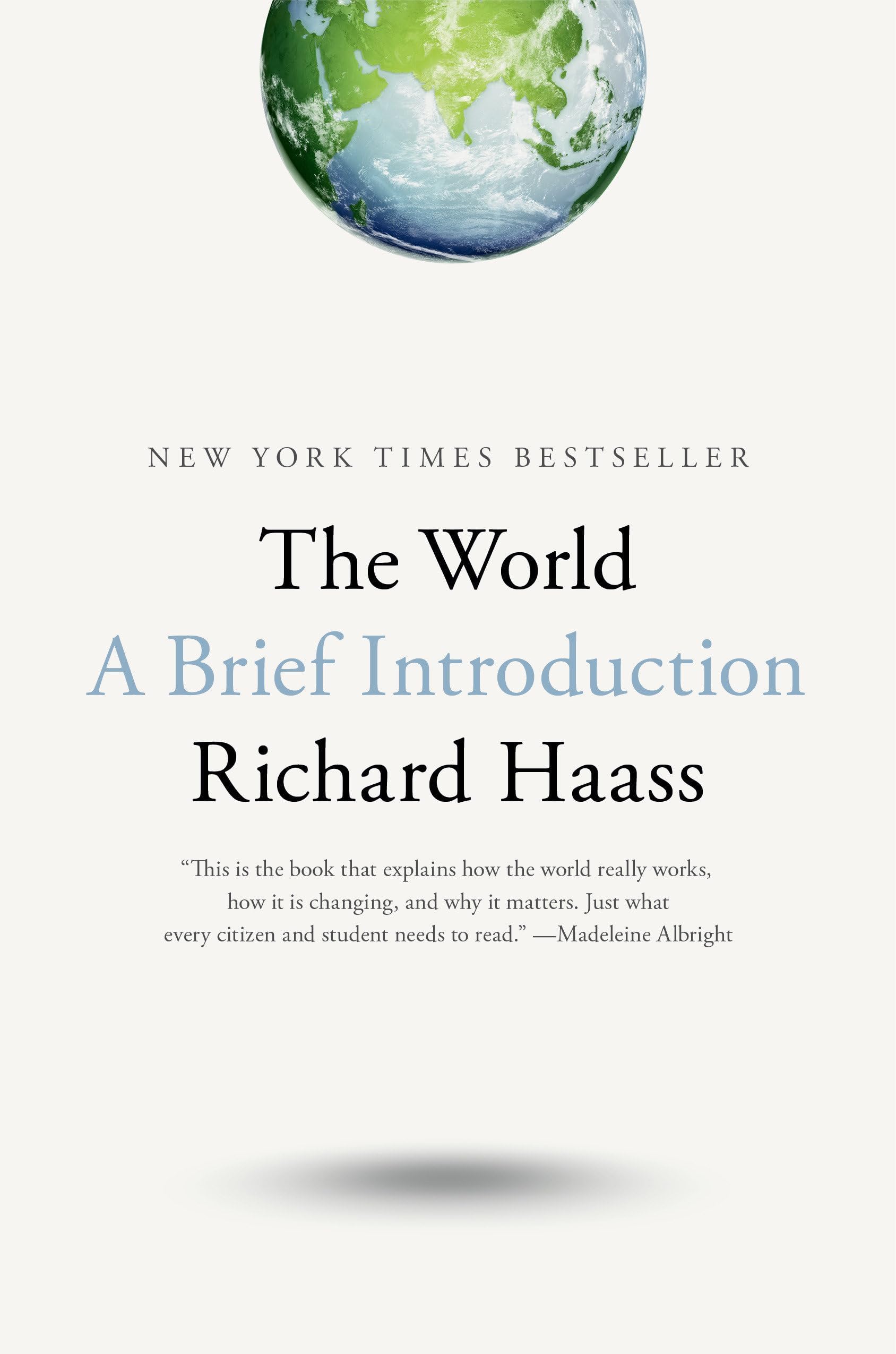
The World: A Brief Introduction
Product ID: 183033017
The New York Times b estseller “A clear and concise account of the history, diplomacy, economics, and societal forces that have molded the modern global system.” — Foreign Affairs An invaluable primer from Richard Haass, president of the Council on Foreign Relations, that will help anyone, expert and non-expert alike, navigate a time in which many of our biggest challenges come from the world beyond our borders. Like it or not, we live in a global era, in which what happens thousands of miles away has the ability to affect our lives. This time, it is a Coronavirus known as Covid-19, which originated in a Chinese city many had never heard of but has spread to the corners of the earth. Next time it could well be another infectious disease from somewhere else. Twenty years ago it was a group of terrorists trained in Afghanistan and armed with box-cutters who commandeered four airplanes and flew them into buildings (and in one case a field) and claimed nearly three thousand lives. Next time it could be terrorists who use a truck bomb or gain access to a weapon of mass destruction. In 2016 hackers in a nondescript office building in Russia traveled virtually in cyberspace to manipulate America's elections. Now they have burrowed into our political life. In recent years, severe hurricanes and large fires linked to climate change have ravaged parts of the earth; in the future we can anticipate even more serious natural disasters. In 2008, it was a global financial crisis caused by mortgage-backed securities in America, but one day it could well be a financial contagion originating in Europe, Asia, or Africa. This is the new normal of the 21st century. The World is designed to provide readers of any age and experience with the essential background and building blocks they need to make sense of this complicated and interconnected world. It will empower them to manage the flood of daily news. Readers will become more informed, discerning citizens, better able to arrive at sound, independent judgments. While it is impossible to predict what the next crisis will be or where it will originate, those who read The World will have what they need to understand its basics and the principal choices for how to respond. In short, this book will make readers more globally literate and put them in a position to make sense of this era. Global literacy--knowing how the world works — is a must, as what goes on outside a country matters enormously to what happens inside. Although the United States is bordered by two oceans, those oceans are not moats. And the so-called Vegas rule — what happens there stays there — does not apply in today's world to anyone anywhere. U.S. foreign policy is uniquely American, but the world Americans seek to shape is not. Globalization can be both good and bad, but it is not something that individuals or countries can opt out of. Even if we want to ignore the world, it will not ignore us. The choice we face is how to respond. We are connected to this world in all sorts of ways. We need to better understand it, both its promise and its threats, in order to make informed choices, be it as students, citizens, voters, parents, employees, or investors. To help readers do just that, The World focuses on essential history, what makes each region of the world tick, the many challenges globalization presents, and the most influential countries, events, and ideas. Explaining complex ideas with wisdom and clarity, Richard Haass's The World is an evergreen book that will remain relevant and useful as history continues to unfold.
| Dimensions | 5.79 x 1.5 x 8.58 inches |
| Edition | Illustrated |
| Isbn 10 | 0399562397 |
| Isbn 13 | 978-0399562396 |
| Item Weight | 1.14 pounds |
| Language | English |
| Print Length | 400 pages |
| Publication Date | May 12, 2020 |
| Publisher | Penguin Press |
User
Understanding the World Quickly and Easily
This book will really help you understand the world better, how we got here, where we are, and where we are going. He describes the many ways in which the world has gotten better as well as the ways in which our progress is being threatened by geopolitical forces. I already knew a lot of the information he presented. However, it was all put together in a nice understandable package, which coupled with excellent analysis and common sense created a lucid overview of how the world works. I can add that the author is an experienced diplomat and he had important positions in both Bush administrations.This book features a brief summary of world history from a geopolitical perspective starting with the Treaty of Westphalia in 1648. The book describes the various world orders that followed, the big wars, why wars and other things happened, and how the modern world came to be. In the next part of the book, the regions of the world, he discusses how the world works and looks like in different regions around the globe. He divides the world into six regions; Europe, Asia and the Pacific, South Asia, the Middle East, sub-Saharan Africa, and the Americas. He describes each region, the history, challenges, the geopolitics, etc. Then he continues by explaining the world from a global perspective, globalization, terrorism, nuclear proliferation, climate change, migration, cyberspace, health, trade, monetary policy and development. In the last part of the book he explains the current geopolitical situation, where we came from, how it is developing, and where we might be heading.The chapter on climate change is one of the best short summaries of climate change that I’ve seen. He explains why we should take it seriously and what we can and should do it about it and why climate change could be the defining topic of this century. He points out that Bangladesh is ground zero with likely tens of millions of people being forced to move within the next decades due to sea level rise. I am interested in this topic myself, which is why I appreciated this chapter. Well climate change is, or will be, an important part of geopolitics, which is what this book is about.He criticizes the way the United States has been conducting its foreign policy the last few years, but he also criticizes other countries, especially China and Russia. He is concerned about rising nationalism, ethnocentrism, climate change, cyber-attacks, and the emergent dissolution of the liberal world order. Just a note, he does not use the word “liberal” the way it is used in US politics. Liberal world order means that free, democratic, and open nations dominate the world. In summary, this was a very interesting book and it was quite enjoyable to read. I highly recommend it.
User
Great into
A great introduction to a lot of world history at a high level.
User
Concise, excellent synopsis enabling better understanding of the world
Admittedly, my understanding of recent history was sorely lacking after my graduation from high school and college, and this author acknowledges that this is a disheartening trend. However, this book did an excellent job of informing even the most casual consumers of world news of how to best understand the world and the challenges it faces given its history and current state. I would highly recommend this to anyone who needs to brush up on world affairs and in my opinion this should be required reading for all American citizens. The only thing preventing me from rating this more highly is its clearly liberal spin that at times is openly critical of the Trump administration, and in the "Where To Go For More" section at the end which names only liberal sources (newspapers and magazines) and nothing that is known to present fair and balanced viewpoints. He is certainly entitled to his opinions, but the criticism of non-Democratic American presidents and how their leadership and decisions have contributed to the current state of world affairs got annoying and detracted from a balanced understanding.
User
Outstanding Book
This book is written by one of the authorities on international affairs who has advised several of our US Presidents and edits Foreign Affairs and has written several others books about history and foreign affairs. The World: A brief introduction is simply put: Outstanding. As its title suggests it gives a thoughtful survey of seminal events in history from the 30 Years war in Europe through the present (2020) and addressed in survey form the core areas of study to help understand our world through a geopolitical, economic, and sociocultural lens. As one other review I read before I bought this book, wrote, it reads like an eloquent college lecture. It reflects the authors broad and insightful knowledge base and history of working in foreign affairs for decades and his clear eloquent prose reflects both intelligence and clear and direct focus on key topics and understanding of each topic (organized by chapter). This book helps you understand and see the forest, versus just the trees in our world and clearly more reading is needed to understand and know the details (Mr. Haass readily acknowleges his book as an introduction and has a chapter detailing recommended options for further reading and learning) . However, for a survey and in my view, incredibly informative understanding of the world we live in (politically, economically, and socioculturally) this book is a must read. I appreciate it, learned a great deal from this text, and will recommend it to others. I read in the areas of history, political affairs and foreign affairs regularly and this is one of the most helpful books I have read in 35 plus years.
User
The World;a brief review and Introduction is a must read.
Richard Haass provides the average reader with a primer about our world; how we got here, why; and most I importantly where we may be heading. It is very easy to read and understand. I am re commending it to everyone e I know. It provides solid bases for expanding on any of the issues discussed.HIGHLY RECOMMENDED
User
Intriguing and Comprehensive
If you were to tell me that someone wrote a book about "the world" now a days I would scratch my head and wonder how exactly one were to do that given all the vast challenges and uncertainties. However, Dr. Richard Haass manages to do in his latest book "The World a Brief Introduction" by giving a comprehensive overview of all issues from terrorism, a break down of regions, climate change and trade by providing a strong historical context with expert analysis.Dr. Haass' direct style and his ability to articulate his point of view that both intrigues the reader and makes it comprehensible to understand, given the vast array of topics. While the book does not focus on one area in particular, it's not the whole meal but sampling which I think is needed today in the field of international relations. I was particularly struck at the beginning when Dr. Haass talks about a smart young man who has a degree in Computer Science from Stanford but lacked knowledge about the greater world around him helps justify the thesis of his book. And the broad depth of his coverage goes well with his more generalized style when approaching international affairs. He is solid on the Middle East, Trade and World Order and no topic is too overwhelming. This is a necessary and interesting read.
User
Great read
Everyone should read this or similar books to help them begin to understand today's complex world order. Far too many citizens of the world would rather read a dime store novel than read something educational and much more interesting than fiction.
User
Our World
Richard Haase allows us to get her arms around our world today and how we got here and how we might move forward
User
Very enlightening!!!!
El libro contiene una descripción objetiva y factual de la historia del mundo y de sus retos. Es una obra muy valiosa. De lectura recomendada.
User
Nette zusammenfassung, mehr auch nicht
Viele wichtige Aspekte werden gut zusammengefasst. Für alle halbwegs gut informierten politischen Leute bietet jedoch die Lektüre nicht wirklich neues. Auch fehlt mir ein bisschen die kritische Perspektive auf viele Aspekte. So wird z.b die Rolle der USA durchweg als positiv in der Außenpolitik bezeichnet. Der Autor suggeriert das sich viele asiatische Länder vor allem deswegen positiv entwickelt hätten da Amerika so einen starken Einfluss auf diese gehabt hätten. Dies ist jedoch in der Wissenschaft eindeutig widerlegt. Auch die Rolle der weltbank und des Internationalen Währungsfonds wird überhaupt nicht kritisch beleuchtet. Da merkt man halt doch die starke Perspektive des Autors der jahrzehntelang in der amerikanischen Politik involviert war. Aber sonst liest sich das Buch sehr leicht und fluffig.
User
Great intro to the current state of the world
Loving it. Wonderfully well-written. But the packaging was pathetic. At least use bubble wrap.
User
Non è propaganda pro-America, è un libro molto informativo sulla situazione globale
Ottimo libro scritto da una delle massime cariche istituzionali americane. Nonostante i riferimenti continui a istituzioni, editoria e organizzazioni pro-America o comunque inglesi si nota il tono autorevole e imparziale dell'autore. La storia globale viene presentata con moltissime note di libri importanti scritti anche da persone del calibro di Kissinger.Se siete giovani e volete farvi un'idea più chiara del mondo, o comunque volete avvicinarci alla geopolitica consiglio la lettura di questo libro che utilizza anche termini molto semplici e comprensibili ai più. Come seconda lettura consiglierei il saggio politico di Huntington : Lo scontro delle civiltà e il nuovo ordine mondiale dei primi anni 2000.
User
Very good
Written in layman’s language, thank you!
Trustpilot
1 week ago
1 month ago