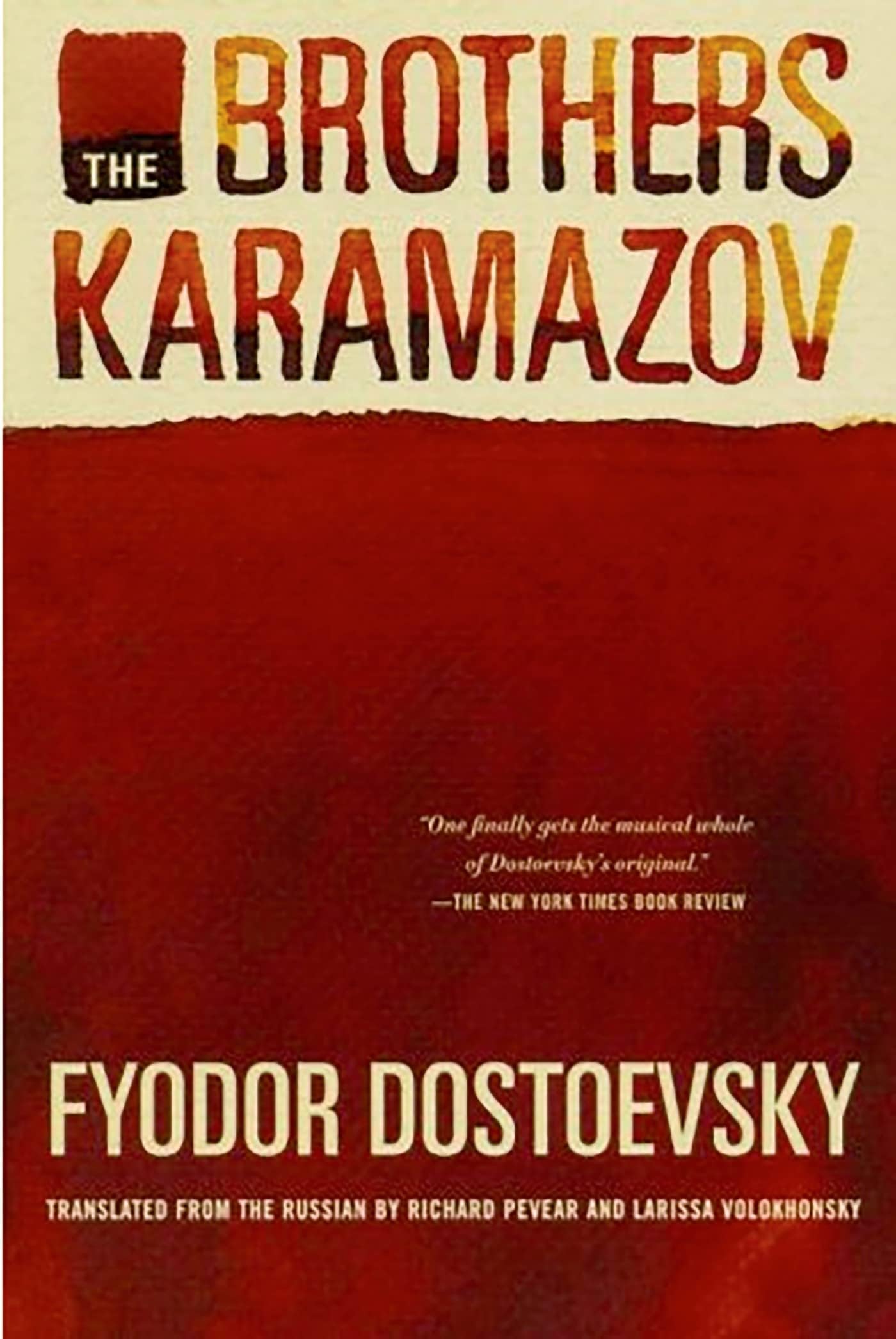
The Brothers Karamazov
Product ID: 1158262
Winner of the Pen/Book-of-the-Month Club Translation Prize The award-winning translation of Fyodor Dostoevsky's classic novel of psychological realism. The Brothers Karamasov is a murder mystery, a courtroom drama, and an exploration of erotic rivalry in a series of triangular love affairs involving the “wicked and sentimental” Fyodor Pavlovich Karamazov and his three sons―the impulsive and sensual Dmitri; the coldly rational Ivan; and the healthy, red-cheeked young novice Alyosha. Through the gripping events of their story, Dostoevsky portrays the whole of Russian life, is social and spiritual striving, in what was both the golden age and a tragic turning point in Russian culture. This award-winning translation by Richard Pevear and Larissa Volokhonsky remains true to the verbal inventiveness of Dostoevsky’s prose, preserving the multiple voices, the humor, and the surprising modernity of the original. It is an achievement worthy of Dostoevsky’s last and greatest novel. Review: A great novel with deep roots in philosophy and unbiased voices - A great novel with deep roots in philosophy and unbiased arguments between people who lived in Russia in the 19th century, but still their views and perspectives are seen till this moment within every nation known to mankind. I picked this rather lengthy novel for two reasons. One because that Einstein praised it: “the most wonderful book I have ever laid my hands on”. I said to myself then what would a great mind find in this novel, so I grabbed one on the spot. Second, I have always wanted to feel and see the life of Russians and get a tiny scoop of their culture. So, this was it, and it wasn’t voiced by someone who lived among us in the current world, but rather by someone who lived in the 19th century Russia; Fyodor Dostoyevsky, 1821 - 1881. I especially loved the rich characters of the novel. The author was able to deeply express vividly their personalities and their surroundings. I very much enjoyed the arguments and the sides taken discussing grand questions regarding God, religion, and morality. I wished there was a pure voice and image of God, like we have in Islam, added to mix. I would wonder how the debates and sides would end up like. The characterization was very well and nicely summed up towards the end of the novel by the prosecutor. I very much liked how he depicted the two extremes of European enlightenment on one side, and mysticism and chauvinism on the other side, that tormented their “Mother Russia” in the 19 century and beyond, which continued to torment nations to this point. And what we live right now in the Islamic and Arab worlds but just waves of these tormenting powers. I highly recommend reading this novel but be cautious of three things. One, that the novel sometimes goes lengthy on matters and affairs that could have been easily dropped or shortened, but still was entertaining. Two, the narrative is sometimes confusing, as it alternates between someone who lives in the village and sees and hears about the novel affairs, and some grand voice that tells you about private and intimate things that could never been seen or heard of by that villager’s narrative. Third, there is a very sensitive discussion of God in the light of Russian Christianity, which does not go well with our Islam religion, so you need to be very tolerant on that matter. So be warned. Review: Great book. Not a "first read" translation for most, but definitely recommend! - I've read and listened to the Dickens-esque Garnett translation several tines over. As a Ort Christian, I wish everyone woukd read this book. This particular translation might be easier for someone who already knows the story and is more familiar with Russian language - it's not quite what I would call literal per se, just less "cleaned up." This novel is one with themes that surapss time and culture but also paints us picture of the pre-revolution period in Russia. Dostoevsky writes himself in as the narrator, inserting witty, non sequitur, sometomes in appropriate light-hearted commentary on characters and situations, and opinionated "side notes" that results in a polyphonic, awkwardly narrated tale, but leaves you feeling like you are curled uo with a cup of tea listening to a man with an interesting story tell it all while two drinks deep. His comments keep the story amusing and make it feel as though you're acquainted with these people. Below the surface of a gossipy tale from an acquaintance about the neighbors lies a philosophical and theological description of the Characters' major existential and minor, petty personal crises into a deeply intimate description of the war within every man and woman between intellectualism and faith, cynicism and hope, expectations and reality. After some 900 pages my first read thru, I set the kindle down, turned on the Audible version and started looking for another translation to ruminate on. After Rea all of the good, bad and ugly reviews I settled on this ons and so far I'm not disappointed. However, if you want the story, try another translation first. If you're like me and can't get enough of the characters and their stories, this translation adds depth and new insights to the story, turning it from Garnett's turn-of-the-last-century Brit-Lit style narrative, into a candid story story being told to you by the old Russian man next door.
| Best Sellers Rank | #68,560 in Books ( See Top 100 in Books ) #62 in Christian Mystery & Suspense Romance (Books) #84 in Classic American Literature #259 in Classic Literature & Fiction |
| Customer Reviews | 4.7 out of 5 stars 3,995 Reviews |
A**N
A great novel with deep roots in philosophy and unbiased voices
A great novel with deep roots in philosophy and unbiased arguments between people who lived in Russia in the 19th century, but still their views and perspectives are seen till this moment within every nation known to mankind. I picked this rather lengthy novel for two reasons. One because that Einstein praised it: “the most wonderful book I have ever laid my hands on”. I said to myself then what would a great mind find in this novel, so I grabbed one on the spot. Second, I have always wanted to feel and see the life of Russians and get a tiny scoop of their culture. So, this was it, and it wasn’t voiced by someone who lived among us in the current world, but rather by someone who lived in the 19th century Russia; Fyodor Dostoyevsky, 1821 - 1881. I especially loved the rich characters of the novel. The author was able to deeply express vividly their personalities and their surroundings. I very much enjoyed the arguments and the sides taken discussing grand questions regarding God, religion, and morality. I wished there was a pure voice and image of God, like we have in Islam, added to mix. I would wonder how the debates and sides would end up like. The characterization was very well and nicely summed up towards the end of the novel by the prosecutor. I very much liked how he depicted the two extremes of European enlightenment on one side, and mysticism and chauvinism on the other side, that tormented their “Mother Russia” in the 19 century and beyond, which continued to torment nations to this point. And what we live right now in the Islamic and Arab worlds but just waves of these tormenting powers. I highly recommend reading this novel but be cautious of three things. One, that the novel sometimes goes lengthy on matters and affairs that could have been easily dropped or shortened, but still was entertaining. Two, the narrative is sometimes confusing, as it alternates between someone who lives in the village and sees and hears about the novel affairs, and some grand voice that tells you about private and intimate things that could never been seen or heard of by that villager’s narrative. Third, there is a very sensitive discussion of God in the light of Russian Christianity, which does not go well with our Islam religion, so you need to be very tolerant on that matter. So be warned.
M**Y
Great book. Not a "first read" translation for most, but definitely recommend!
I've read and listened to the Dickens-esque Garnett translation several tines over. As a Ort Christian, I wish everyone woukd read this book. This particular translation might be easier for someone who already knows the story and is more familiar with Russian language - it's not quite what I would call literal per se, just less "cleaned up." This novel is one with themes that surapss time and culture but also paints us picture of the pre-revolution period in Russia. Dostoevsky writes himself in as the narrator, inserting witty, non sequitur, sometomes in appropriate light-hearted commentary on characters and situations, and opinionated "side notes" that results in a polyphonic, awkwardly narrated tale, but leaves you feeling like you are curled uo with a cup of tea listening to a man with an interesting story tell it all while two drinks deep. His comments keep the story amusing and make it feel as though you're acquainted with these people. Below the surface of a gossipy tale from an acquaintance about the neighbors lies a philosophical and theological description of the Characters' major existential and minor, petty personal crises into a deeply intimate description of the war within every man and woman between intellectualism and faith, cynicism and hope, expectations and reality. After some 900 pages my first read thru, I set the kindle down, turned on the Audible version and started looking for another translation to ruminate on. After Rea all of the good, bad and ugly reviews I settled on this ons and so far I'm not disappointed. However, if you want the story, try another translation first. If you're like me and can't get enough of the characters and their stories, this translation adds depth and new insights to the story, turning it from Garnett's turn-of-the-last-century Brit-Lit style narrative, into a candid story story being told to you by the old Russian man next door.
A**A
Philosophically endearing and unique, amazing drama
This book has depth, and as a Christian it makes you think. Dostoevsky transports you to an era and location in Russian, to a different type of living snd engrosses the reader with a very personal story that has transcendent ramifications for the reader, so pay attention and take your time with its philosophy, even if its theology can be faulty.
G**A
moving.
This book has taken me so long to finish because of the depth of topics discussed. We have a cruel father to 3 sons. 2 of which are cynical and base - both blaming themselves for their father’s murder. Ivan, the middle son feels morally culpable for the murder of his father. Which I don’t really hold against him because fyodor was not a good man. We see that the debauched life of fyodor has lead to mistrust among his children, envy, and his untimely death. This man gave in to every carnal pleasure, without a care for how it tore his family apart. He betrayed and lied to his sons, even attempting to steal his son’s love interest. Alyosha is the youngest child, who became a monk. He becomes the moral compass for all characters in this story. Those who speak with him look for absolution and for righteousness in a world full of injustice. Alyosha is the only brother who truly believes in god and his life, values and views are shaped by his faith. Dimitri, the eldest who was charged with patricide lacks accountability for his own actions and gives in to all temptations, leading to his scorned lover betraying him, becoming the linchpin for the prosecution. This book explores the meaning of justice, the role of a parent, the way faith influences our actions, entitlement, the innocence of the youth, and the faith we have in our justice systems. I felt so much of it went over my head but I was left with a love for Alyosha and his perceptiveness, his loyalty to those he loved. Alyosha calls everyone to maintain the joy and innocence we had as children, to do right by your family, and to be faithful.
T**3
Best translation of Brothers Karamazov for modern readers
This is not an easy book for modern readers because of the obscurity of the Russian era depicted as well as the philosophical underpinnings of Dostoevsky’s novel. It requires a study guide or an outline to fully appreciate, but it’s well worth the effort for a serious reader. Dostoevsky’s portrayal of the three Karamazov brothers and their relationship with their father is one of the great themes of world literature. The two major female characters, Grushenka and Katya, represent the polar figures of women in Russia of that era. It’s standing as one of the greatest novels of the 19th century is undisputed. The chapter entitled “The Legend of the Grand Inquisitor” is a brilliant section that has been discussed and debated since its publication. I have read “BK” three times in my life, and this Pevear and Volokhonsky is undoubtedly the best one. (I listened enthusiastically to the “Audible” version as I read the text. It helped bring all the major characters to life.)
M**T
A very long, very good story
Wow! I was not expecting this. Very detailed story. Dostoevsky likes to use very long and descriptive words. Many times they are quite humorous. The most difficult part of the book were the names. Some people have five different names for the same person. I eventually printed out the various names to help. The chapters were short, so that was a good thing. I am a fast reader but I started this April 23 and finished it on June 9. I was reading another book in the same time period, but after a few weeks I decided to commit myself to this novel. This was my first Dostoevsky story. I came across many of his works, in short paragraphs, during my Existentialism class in college but never read a complete novel.
P**O
The McDuff translation blows away Pevear / Volokhonsky
I have now read this stunning book twice. The first time was about 5 years ago in the much over-hyped Pevear / Volokhonsky translation. The book was really good, and had some powerful sections, but on the whole I found myself struggling to finish. It was quite tedious. Since then I have gotten some more exposure to P/V translations and came to realize that I just don't like their translations. So I decided to try Brothers K again, this time in the Penguin edition translated by David McDuff. The difference is astounding. Every sentence jumps off the page in the McDuff. The characters come to life, the story becomes compelling, all the magic of this novel was revealed to me in this translation. I couldn't put it down. McDuff, like P/V, is in the modern school of translators. He follows the Dostoyovsky sentence structure very closely. The Encyclopedia of Literary Translation into English describes McDuff as "an out-and-out literalist, whose versions are to be commended for their uncompromising determination to convey every stylistic peculiarity and lexical repetition found in the Russian." However, unlike P/V, McDuff is an amazing English stylist. Where P/V are noted for their close adherence to the Russian, their English is, to my ear, simply boring and wooden. Here is the version I recommend: [...]
N**J
About the best ever
A rare book. There are not too many books that transcend time. It is difficult for a story to stay relevant hundreds of years later, not just because of changing times but due to changing life styles, personal interactions and issues that tend to bother people of different eras. Karamazov is a rare exception. Dostoyevsky's first big triumph is his ability to weave a highly complex intrigue in the simplest of fashion. His characters play mind games that are difficult to further evolve for writers a century later with all the modern day machinations and progress in writing styles based on experiences of generations of authors that have come before. Unlike most other classics of the nineteenth century or before, Karamazov characters are as vile, crafty, intelligent or thoughtful as any created by the best of present time novelists. The second triumph is in clearly portraying so many characters in their own unique, non-compromising ways. Few of his characters are completely good or bad. Almost no interactions between them are predictable. The story moves as unpredictably as real life, even if one was to be aware of its eventual end through spoilers or copycat reproductions by others in the following 130 years. A minor triumph must have been setting the tone for all courtroom based novels ever since. The lawyer debates, the jury reactions, the judgement, the crowd sentiments would keep the most critical action book readers glued. And the deeper purpose of the book is none of the above. It is no wonder that The Grand Inquisition chapter is considered about the best book section ever written and is separately published. Zoshima's backstory and Ivan's devil would have gone down as memorable as any in his history if not trumed within the book itself by the Inquisition. The author has a clear bias in the views he prefers, but anyone holding any other views on life, religion or morality is unlikely to feel the counterviews less explained. Apart from the five Karamazovs (including the Father and the illegitimate son), their philosophies, and interactions, one is unlikely to even forget so many other lesser characters and sub-plots. This is a must read classic, of a kind that is certainly worthy of the highest accolades from even people like Tolstoy, Einstein and Freud.
B**L
Clássico
essa versão é a mais extensa das traduções, mas teoricamente a mais fiel ao texto original. um retrato de uma sociedade não tão diferente da atual, descrita brilhantemente por dostoievsky
L**L
A classic
One of Russia's greatest novel superbly translated! Entrancing, lively, diverse ranging from theology to psychology and yet thrilling. Worth reading and rereading.
D**S
Wow
Don't be put off by the first half, that could seem clunky and contrived. The second half is truly sublime.
R**S
Gran Traducción
La traducción de Richard Pevar es muy buena. Logra contar la historia manteniendo el sentido original, sin simplificar el texto original.
T**A
Es un clásico que recoge muchas vivencias de Dostoevsky
En estos casos la traducción y las notas del traductor son muy importantes para entender los detalles y la verdad que suma mucho a l texto lineal de las descripciones y los lugares. El vendedor es muy serio, tuve problemas con el envío y me lo solucionaron.
Trustpilot
2 weeks ago
1 month ago