Desertcart purchases this item on your behalf and handles shipping, customs, and support to Peru.
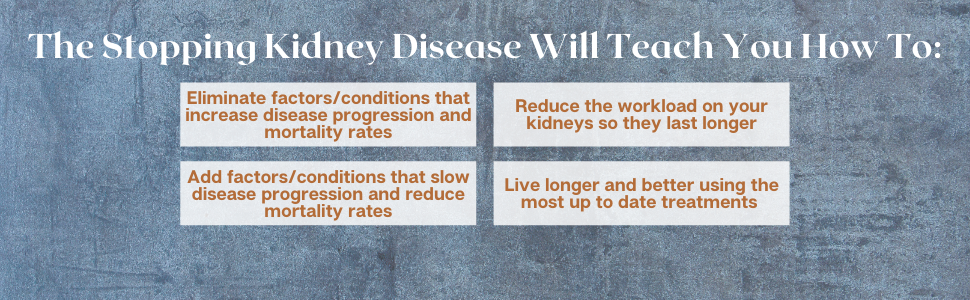
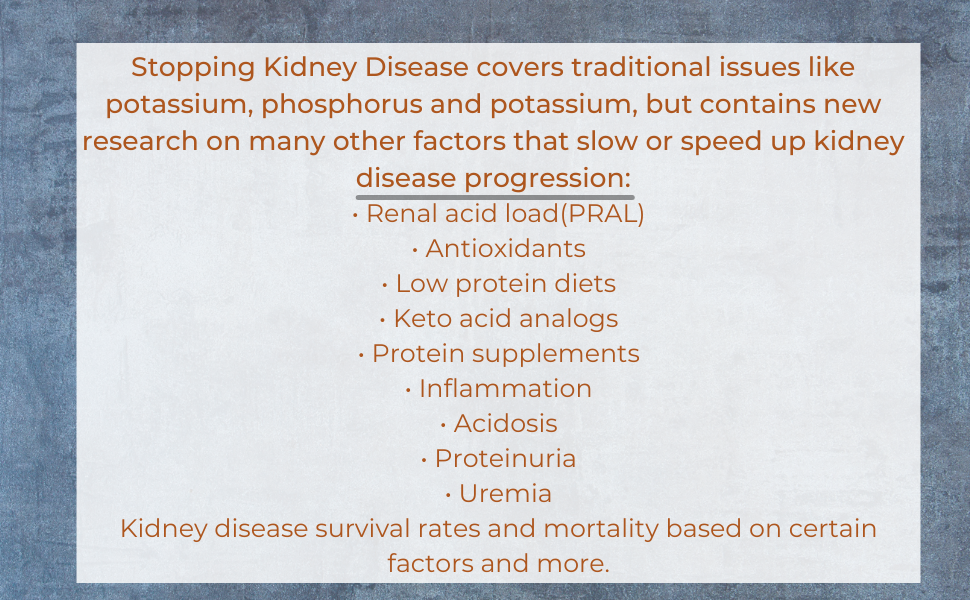
Start slowing kidney disease progression today by getting educated on the factors that speed up or slow down kidney disease progression. Stopping Kidney Disease is the most comprehensive guide to understanding how your kidneys work and how to make your remaining kidney function last as long as possible. Get measurable results in 90 days. Stopping Kidney Disease contains research on all stages of kidney disease newly diagnosed, stage three, four, five, dialysis and transplant. Stopping Kidney Disease includes over 500 pages with hundreds of Nephrology medical studies cited to give patients a modern evidence based approach to ensuring their kidneys last as long as possible. You will learn: Why patient education is always the biggest factor in your success How to reduce the workload on your kidneys in 90 days or less Positive steps to slow disease progression To eliminate factors that increase disease progression Live longer and better with the most up to date treatments Research on low or very low protein diets including keto analogs and Albutrix Also includes research on kidney diets, renal diets and ckd diets The author has been a kidney patient for over 20 years and successfully stopped kidney disease progression after steroids and immune suppressing drugs failed using the same research in Stopping Kidney Disease. Stopping Kidney Disease is part of a multi book series for kidney patients: Stopping Kidney Disease Stopping Kidney Disease Food Guide Kidney Failure to Kidney Transplantation: A Patient Guide Related terms: Kidney health book, renal diet book, chronic kidney disease, healthy kidneys, davita dialysis, Renal diet cookbook, mayo clinic low sodium cookbook, diet chart for kidney patients, reversing kidney disease, cooking for kidney disease, fight kidney disease, chronic kidney disease cookbook, stage 3 kidney disease, stage 4 kidney disease, dash diet renal health, renal diet cookbook for beginners, the doctors kidney diet, renal diet, reverse kidney disease, kidney failure, renal failure, diabetic kidney diet cookbooks, chronic kidney disease books, nephrology diet, renal cookbooks, renal diabetic cookbooks, best food for kidneys, kidney disease solution, cookbooks for kidney disease, kidney disease treatments, cookbooks for renal disease, renal health, renal books, ckd, ckd books, ckd cookbooks, Review: You Probably Need This Book - Kidney disease is on the rise, and is a silent killer. Imagine my surprise to learn through blood and urine tests that I, who thought I was in great health for my age, already have advanced kidney disease. I'm only into 100 pages but so far, I cannot help but be tremendously impressed. I'm not a medical doctor. For the past 3 years, my primary care doctor has sent me to have blood and urine drawn, and the report came back with a low "eGFR". The doctor only asked me if I was experiencing any problems with my kidneys -- a bit sluggish, and to my knowledge at that point, nothing unexpected given my age and certainly no pain. As it turns out this year my eGFR is what it was last year, only 57, when that of a healthy, young person is 100-120. So looking that up on reputable websites, come to find out that means Stage 3 kidney disease, and not only that, but that kidney disease is progressive and there are only 5 stages. My doctor still only asks if I have kidney pain or "problems" and I say no and that's it. The author of this book, although, like myself, not being a medical doctor either, does, like myself, believe in taking control of one's own health, and for laypeople, that means intensive self-study and research. He has done an impressive amount of that. I have books written by physicians who don't discuss a fraction of the confirmed information out there, just directing you to nephrologists. Well thanks but I prefer prevention and intervention to big pharma and surgery. Having had gall-bladder surgery years ago, in my experience, doctors are in a state of denial about the changes to your body when you lose an organ causing lasting problems that need to be managed. They don't say you could have repeat gallstones, that you could have gastrointestinal irritation, that many people, myself included, have to take anti-diarrheals and considerable fiber capsules and drinks to avoid "accidents", and this does not go away. So I would draw the line at having any kind of surgery on my kidneys. And I thank this author for this book. It is written in easy to understand language; the studies are summarized, however - if you are not medically trained or have done medical reading, just skip reading the studies, as you may misinterpret what they are saying. One caution also, whenever we read medical studies we need to know who sponsored them (Big Pharma sponsors many studies as the book The Truth About the Drug Companies by Maria Angell, former editor New England Journal of Medicine, details), how large, the study methods, and so forth. But when we see numerous studies that agree with one another and when we see a book author smart enough to even include studies, and that author's conclusions (such as about inflammation in the body being a major factor in disease) completely concur with numerous other books with citations written by physicians and specialists, then these are good indicators of trustworthy information. In only 100 pages, I've already gotten so many questions I had about kidneys and how they function answered. It is not fair to submit a review prior to reading the entire book so there will be an update to this review. Meantime, if only for the first 100 pages, it already has been worth the price. PROMISED UPDATE: I've now completed my first reading of this book; as is usual I will go back over it and make more notes, mark some passages. The book might benefit by editing for brevity and clarity, but that would depend on the reader. Some readers will enjoy Hull's conversational and down-to-earth style; others will want less digression. If I could put this entire book on a word processor, I think I'd eliminate a lot of overlap and repetition, get it down to more manageable size. I might also just summarize and cite the relevant studies, such as is done in the books of Sherry Rogers. That having been said, among all of the verbiage, I found quite important and interesting facts that were new to me even if it did take quite a bit of time to go through 500 pages. The use of statin drugs to lower cholesterol is endorsed in this book. Before deciding on whether to use these drugs, I recommend reading the books The Cholesterol Hoax by Sherry Rogers, MD, The Cholesterol Myth by Steven Sinatra, MD, and some of the other books on statin drugs available on desertcart. There are many reasons to avoid statins ... you just want to get all of the information before deciding, and this book does not explain the pros and cons of this class of drugs. This book lets us know that kidney disease is not curable and is progressive, but we can lower the demands we make on our kidneys and thus help them function better, putting us into remission. A strict low-protein diet is recommended along with a proprietary supplement developed by the author. I checked the current price on the website and it is about $180.00 per month, putting it out of my price range. The diet consists of whole, plant-based foods, essentially a vegan diet (a separate diet book is sold). In addition, regular exercise, stress reduction, and being smart about supplements and vitamins are included ... the chapter on the latter is especially interesting. To summarize Pros: If your blood tests low for eGFR, then you should read this book. A lot of helpful information for people with low kidney function. Conversational style and (except for the studies) can be understood by the average person. Cons: The most important of the studies could be summarized and cited; the rest just cited. Could be edited for brevity and clarity and repetition eliminated. Review: Lots of information in 500+ pages backed by research - First edition 2019. This book has a lot of information with sources. So much 'stuff' is on the internet, without any facts, research, or sources to back it up. This book has references and is backed by research. It allows you to make your own judgements and decisions using scientific evidence. It is recommended reading for anyone facing kidney disease or knowing someone who is facing kidney disease.


| Best Sellers Rank | #85,311 in Books ( See Top 100 in Books ) #11 in Genitourinary Infections & STDs #18 in Medical Research (Books) #19 in Nephrology (Books) |
| Customer Reviews | 4.3 out of 5 stars 1,658 Reviews |
P**R
You Probably Need This Book
Kidney disease is on the rise, and is a silent killer. Imagine my surprise to learn through blood and urine tests that I, who thought I was in great health for my age, already have advanced kidney disease. I'm only into 100 pages but so far, I cannot help but be tremendously impressed. I'm not a medical doctor. For the past 3 years, my primary care doctor has sent me to have blood and urine drawn, and the report came back with a low "eGFR". The doctor only asked me if I was experiencing any problems with my kidneys -- a bit sluggish, and to my knowledge at that point, nothing unexpected given my age and certainly no pain. As it turns out this year my eGFR is what it was last year, only 57, when that of a healthy, young person is 100-120. So looking that up on reputable websites, come to find out that means Stage 3 kidney disease, and not only that, but that kidney disease is progressive and there are only 5 stages. My doctor still only asks if I have kidney pain or "problems" and I say no and that's it. The author of this book, although, like myself, not being a medical doctor either, does, like myself, believe in taking control of one's own health, and for laypeople, that means intensive self-study and research. He has done an impressive amount of that. I have books written by physicians who don't discuss a fraction of the confirmed information out there, just directing you to nephrologists. Well thanks but I prefer prevention and intervention to big pharma and surgery. Having had gall-bladder surgery years ago, in my experience, doctors are in a state of denial about the changes to your body when you lose an organ causing lasting problems that need to be managed. They don't say you could have repeat gallstones, that you could have gastrointestinal irritation, that many people, myself included, have to take anti-diarrheals and considerable fiber capsules and drinks to avoid "accidents", and this does not go away. So I would draw the line at having any kind of surgery on my kidneys. And I thank this author for this book. It is written in easy to understand language; the studies are summarized, however - if you are not medically trained or have done medical reading, just skip reading the studies, as you may misinterpret what they are saying. One caution also, whenever we read medical studies we need to know who sponsored them (Big Pharma sponsors many studies as the book The Truth About the Drug Companies by Maria Angell, former editor New England Journal of Medicine, details), how large, the study methods, and so forth. But when we see numerous studies that agree with one another and when we see a book author smart enough to even include studies, and that author's conclusions (such as about inflammation in the body being a major factor in disease) completely concur with numerous other books with citations written by physicians and specialists, then these are good indicators of trustworthy information. In only 100 pages, I've already gotten so many questions I had about kidneys and how they function answered. It is not fair to submit a review prior to reading the entire book so there will be an update to this review. Meantime, if only for the first 100 pages, it already has been worth the price. PROMISED UPDATE: I've now completed my first reading of this book; as is usual I will go back over it and make more notes, mark some passages. The book might benefit by editing for brevity and clarity, but that would depend on the reader. Some readers will enjoy Hull's conversational and down-to-earth style; others will want less digression. If I could put this entire book on a word processor, I think I'd eliminate a lot of overlap and repetition, get it down to more manageable size. I might also just summarize and cite the relevant studies, such as is done in the books of Sherry Rogers. That having been said, among all of the verbiage, I found quite important and interesting facts that were new to me even if it did take quite a bit of time to go through 500 pages. The use of statin drugs to lower cholesterol is endorsed in this book. Before deciding on whether to use these drugs, I recommend reading the books The Cholesterol Hoax by Sherry Rogers, MD, The Cholesterol Myth by Steven Sinatra, MD, and some of the other books on statin drugs available on Amazon. There are many reasons to avoid statins ... you just want to get all of the information before deciding, and this book does not explain the pros and cons of this class of drugs. This book lets us know that kidney disease is not curable and is progressive, but we can lower the demands we make on our kidneys and thus help them function better, putting us into remission. A strict low-protein diet is recommended along with a proprietary supplement developed by the author. I checked the current price on the website and it is about $180.00 per month, putting it out of my price range. The diet consists of whole, plant-based foods, essentially a vegan diet (a separate diet book is sold). In addition, regular exercise, stress reduction, and being smart about supplements and vitamins are included ... the chapter on the latter is especially interesting. To summarize Pros: If your blood tests low for eGFR, then you should read this book. A lot of helpful information for people with low kidney function. Conversational style and (except for the studies) can be understood by the average person. Cons: The most important of the studies could be summarized and cited; the rest just cited. Could be edited for brevity and clarity and repetition eliminated.
C**M
Lots of information in 500+ pages backed by research
First edition 2019. This book has a lot of information with sources. So much 'stuff' is on the internet, without any facts, research, or sources to back it up. This book has references and is backed by research. It allows you to make your own judgements and decisions using scientific evidence. It is recommended reading for anyone facing kidney disease or knowing someone who is facing kidney disease.
T**W
Preserve Kidney Function Now! A Guide on How to Stop the Downward Spiral of Chronic Kidney Disease
If you have been referred to a nephrologist you are probably a little worried about your health. After my first appointment with my new doctor I realized that I was not going to get a lot of detailed information about managing Chronic Kidney Disease (CKD). Basically I was told to avoid Advil, to avoid salt (to manage my high blood pressure) and to drink enough water. All things I already knew. So where to turn for more information? A kindle book of course and one written by someone who has discovered how to put his kidney disease in remission. What I noticed right at the start of the book is how logical the author is and how well he's done his research. There are extensive footnotes on some chapters - 113 on one! Lee Hull also seems to be looking out for the reader by giving you all the facts you should be considering. This book answers the following questions: What type of protein is damaging to my kidneys? What will help cramps, edema and nausea? Which foods, supplements and medicines can help kidney disease? Why do I need to manage sodium, potassium and phosphorus? Why is albumin so important to survival? Should I avoid supplemental calcium and is calcium in food OK? By reading this book I also learned about acidic and alkaline foods. My favorite cheeses are very acidic. Parmesan is at 34.2 and cheddar at 26.4. So somehow I have to eat less of those if I don't want to make my kidneys work harder to balance my pH. To me this book presents the challenge of quantity of life and quality of life. If you want to live longer, then the information in this book will be helpful. If you want to live with less symptoms of disease, then this book gives a lot to think about. Mostly this book presents research studies to back up the medical information. I will admit that I fast forwarded through a lot of the research studies because they were beyond my understanding. Fortunately Lee Hull understands them and presents summaries at the end of them that were easy to understand. Basically this book recommends a vegetarian diet for the most part. I think with many illnesses increasing fruits and vegetables is the main recommendation because to fight disease we need more antioxidants. So I will do that. It was interesting to read that anxiety is part of kidney disease and I'm being treated for that as well. After reading this book I will pay way more attention to my blood pressure readings now that I know what the dangers are. I look forward to reading the next book with diet tips and recipes. Learning what to eat seems the most essential thing with this disease. My GFR is at 52 currently and so I'm in stage 3. This book indicates that I should do all I can to keep kidney disease from progressing further. ~The Rebecca Review P.S. - 12/11/2023 - I started taking acacia fiber and that made my GFR go back up to 68. I am not a doctor, nor is this medical advice. I should technically be dead by now because my GFR was in the 40s. I read a book about supplements for kidney disease and so here I am still alive! I'm going to my nurse again in a few weeks and will find out if I'm going to still live a bit longer. I am going to read another of this author's books since I want to live a bit longer. P.S. 2 - I have been using Lee Hull's amazing food guide cookbook and the pumpkin chili is amazing. I use vegetable base and water in place of the vegetable stock and it works!
A**.
You can save your kidneys if you’re serious. Read this book!!!
Mr. Hull is brilliant and has put mind-breaking effort into identifying the variables that affect kidneys, researching hundreds and hundreds of abstracts concerning them (thousands maybe?)) collating the data, and drawing scientific conclusions in each case that diet will help and not hurt, the whole point of the book. Diet affects kidney disease, something the medical world routinely dismisses. This book is groundbreaking inasmuch as there is NO OTHER RESOURCE like it. Over a two month period my GFR had descended from 41 to 38, and at that rate I would be looking at dialysis in about 7 months. I was frantic. My docs basically told me to eat less red meat and try to take fewer NSAIDS, (aspirin, ibuprofen etc). I had no meat in my diet and took no NSAIDS. So where did that leave me! Desperate, that’s where. I found Stopping Kidney Disease online, accessed the book, read each chapter carefully and extrapolated the information into an aggressive diet of no meat, no fish, no eggs, no dairy and no grains. (A little bit of fudging with dairy and grains). I was praying that if I went that extreme, that in two months my GFR might return to 41. I also also pulled the PRAL chart so I could calculate my datily renal acid load for each food, and I calculated the protein grams for each food consumed. It was simple math at the end of the day. There are other factors but these are the two biggies. It was all about whether my renal acid load was in the negative, and whether my my protein grams consumed were 30 or less. A helluva learning curve, but I did it, Was it extreme? Yes, but then I remembered my priorities. Dialysis is what’s extreme and that’s what I was headed for and I was terrified. Because of this diet, in two months, my GFR soared from 38 to 56 and my doctors jaws literally dropped. Now I’m seeing what it will take diet-wise to either maintain that number or keep ascending. Sort of a mathematical game at this point. How about 90-100 GFR? Today the world, tomorrow the galaxy! Veronica
A**E
This book is ACES!
My doctors have been reading my kidney tests for years and saying everything is fine. I switched from Blue Shield to Kaiser and what Kaiser does is send you your lab results directly and to the doctor. I learned from Kaiser that my kidney function is at 58%. I am 63 and I find that very concerning. I was taking lithium I’m a bipolar person and it adversely affected my kidneys. I stopped taking lithium and modified with the help of my psychiatrist and I bought this book. I started watching my phosphorus my protein and my sodium and I just got off the phone with my nephrologist and my kidney function on my last test was 78%! That is a dramatic improvement and I owe it 100% to this book. Not one doctor suggested that I should modify not one doctor told me I was at 58%. You have to find and fix your own problems you cannot rely on doctors to do it for you. The doctors don’t care if I die at 75 from kidney disease. I do. I don’t want to die early because I’m bipolar and have to take medication. I changed my meds with kidney function in mind and have modified my diet. This was a huge improvement and gives me great comfort. I’m so grateful for this book I can’t even tell you. Lee Hull has done your research for you he has backed up every word he said with quantifiable scientific research and that’s what I respect. Just the facts I’ll make my own decisions but give me the facts. I wish you the best in your kidney journey and this book will definitely definitely help.
D**.
Very well researched, but short on practical application and lack of information about author
I was recently diagnosed with stage 3 CKD with GFR 32. In my panicked state, I have turned to all the research I can find about kidney disease and what I might be able to do to keep it from progressing. Lee's book is a wonderful reference about what is happening in our bodies when we have CKD - very well researched and documented. And, as the other reviews have said, is VERY technical and somewhat difficult to understand. I skimmed over most of the cited references and went to the summaries. Where I find much of the information in the book very helpful, my SKEPTICISM about the book is that Lee is selling a product, Albutrix, (which is a nitrogen free albumin supplement) in his prescription for healing your kidneys. The other thing that makes me take the book with a grain of salt is there is virtually no information about Lee's background, other than that he is a CKD patient and was frustrated with the poor kidney care offered in the U.S. I have no idea what is educational background. Is he a scientist, doctor, nutritionist???? What are his credentials that make him such an authority about this subject. It did not state it in the book nor could I find any information about him on the internet. The third reason I give this book a 3 is that even though Lee gives excellent scientific information, there is very little practical application. I couldn't find lists of foods and what are good/ bad foods to eat that fit his diet. I did not learn what foods work in his prescription. So I do recommend this book for the information, but read it with some skepticism and do further research. I would also be careful about buying his product without talking to your doctor about it first.
S**N
Such a Godsend!
I had a severe kidney infection when I was a kid (blood in urine, etc) but recovered. Ever since then, I've felt my kidneys were "delicate" but no doctor ever mentioned anything. I'm always told my kidney values are normal and nothing more. Last week I got a message from my doctor that my kidney labs were "a little low" and that I needed to do more tests, including an ultrasound. AND, that it was urgent that I get tested immediately! No other information was given and of course, I couldn't actually talk to the doctor to get more details. I was in a panic! I didn't know if my numbers were just a tiny bit off or if I was headed for dialysis. Because too many doctors don't tell you ANYTHING. I cannot say how much comfort this book has given me over this long week of stress and worry. I know that even *if* I have kidney disease, there is something I can DO ABOUT IT. I already have started to follow the recommended diet and my blood pressure readings are now lower than they have been in a long time and some mild edema in my ankles (that I've had consistently for over 15 years) has faded. I finally heard from my doctor's office: Not all the results of the new tests have come back (but the ultrasound is normal). However, the original tests that triggered all of this say that my BUN is normal, creatinine is slightly elevated, and GFR is 52. (Which would be Stage 3a kidney disease, meaning mild to moderate.) However, GFR readings are just a "snapshot" of the status of your kidneys, so I am not officially in Stage 3 until more time has passed. I have confidence that if I continue to follow the advice in this book that my GFR will improve and hopefully I can avoid being diagnosed with kidney disease completely. But even if I do have this disease, I feel more hope and confidence now. I believe that by following this book, I can protect my kidneys and prevent a hasty decline. If I don't have kidney disease, then I know what I need to do to take the strain and stress off of my delicate kidneys and maybe I'll never get this disease. Thank you so much, Lee Hull, for this book. God bless you. It has given so many of us hope and education.
J**N
Challenging to read, but a real eye-opener!
Hi everyone! -- I have been a type 2 diabetic for 25 years now, following the ADA recommendations regarding post-meal target goals and diet, which focused primarily on low-to-moderate GI food values, and allowed lean white meats, fish, supposedly healthy grains, some dairy and modest fruit intake, with an A1c target of 7.0% -- In retrospect, BIG mistake! Two months ago, my GP down here in Costa Rica -- I'm 73 and have been retired down here for just about 8 years now -- tells me off-handedly in Spanish -- NO details! -- that I have kidney disease and need to see a specialist in mid-November, 2019! I was STUNNED! The next day, after panicking a bit, I saw Lee's book and have read it 3 times since then, even though parts of it are full of somewhat torturous, medical gobbledegook. Thank goodness for my Chemistry Minor, Calculus and Statistics classes 50 years ago! Based on Lee's action plan at the end of the book, I decided to try a strict Vegan diet, with emphasis on the PRAL, alkaline food values along with plant protein to give my kidneys a reduced urea nitrogen load, increase my albumin, and eGFR -- currently 43 = stage 3b kidney disease -- while lowering my relatively high BUN level -- 24 -- and creatinine -- 1.65 -- as well. So far, I can only say VERY positively that I have lost 13 lbs/6 kilos -- BMI now 21, down from 23 -- I'm one of those statistically atypical "thin" type 2 diabetics -- no longer suffer painful diabetic neuropathy in my feet or hands, have increased my chronic inability to sleep at any given stretch from 3 1/2 hours max to 6 hours -- this alone has been well worth the effort! -- and I am projecting an A1c in the high 5's or lower 6's, down from 7.2% last July. Since I have been very strict with the diet -- mostly raw food, no meat, no fish, no dairy, no grains, rice, bread, cookies, sweets, apple strudel, fried food, diet colas or liquor, etc -- I have never smoked -- I feel cautiously optomistic that the renal numbers will improve as well in October! I elected to try things at first WITHOUT Albutrux, partially to see how effective the dietary intervention would be by itself, partially due to the cost of Albutrix, plus the lack of independent, critical scientific reviews on the Internet about the product, where and by whom it is produced. In my opinion Lee has done an anazing amount of valuable research -- God bless him for it! -- but I feel he could be a but more transparent about the provenance of his product, especially after his well-taken, cautionary chapter on the foibles and downright fraud in the nutitional supplement industry! I reason that I can always try it as a next step refinement, if needed, in the next cycle or so. Other people seem to be reporting what look like very good anecdotal results on Lee's website.The only speed bump? Dizziness and falling 3 times because my blood pressure went from borderline HIGH to clinically LOW due to Glibencamide and a B 12 vitamin deficiency, probably caused by the diet and Metformin. I quickly resolved it by immediately stopping the Glibencamide -- known to cause dizziness, although my young GP didn't seem to know that! -- and taking a B 12 oral supplement once a day. I will give a renal update around October 25th! -- ¡Pura Vida! -- Jerry Ahearn. ---------------------------------------------- UPDATE: Sept. 25, 2919 -- Hi everyone! -- Today is exactly 2 months since I bought Lee's book and formulated a "full court press" Vegan dietary action plan following his recommendations. I would say that I was 95% compliant with my goals during this period. NOT easy at times, but definitely doable. My curiosity finally got the best of me this morning-- I couldn't wait another month for my subsidized, goverment-administrated lab tests -- so I went to a private lab for a creatinine test and my eGFR has now IMPROVED from 42% to 52%, so I am now only stage 3a and hope to KEEP improving during the next cycle! What a relief! -- And, according to the eGFR calculator on the Internet provided by the National Kidney Foundation, my kidney function would have risen to 54% if I had not lost 13 lbs, but I'm not going to complain. The program seems to WORK!! -- Since I intend to have this test done privately each month out-of-pocket, I'll try to give another update next month!☺
A**Z
Most updated information's on the CKD .
I am in stage 3 of CKD, Bought this book couple of weeks ago, reading through half way so far ,all facts about CKD are backed by medical research and evidences , except some of the medical terminologies and research notes, which are difficult to understand by a common reader ,this book is very well written and compiled, anybody with concerns about kidneys health or CKD ,this book is a must to read,I highly appreciate and recommend.
C**Y
Very helpful
I bought it for a relative who has CKD. I read it and found the book is very inspiring and useful. it covers practically all the aspects of the disease and helps to understand all the challenges. It contains many important research information and provides new ideas and practical solutions to keep the disease under control. It also helps to avoid some serious mistakes. so it is very helpful.
P**D
A must have for anyone with CKD!
This book is a goldmine of information. Like Lee, my doctors told me to carry on as I was when I was told I had stage 3 CKD. Like most people I wasn’t content with this, and the zero information I was given. I researched, But the more I read, the more confused I was. As I have type 2 diabetes I was especially confused, as I seemed I shouldn’t eat white or brown bread! So I gave up and decided to get on with my life, eating what I wanted with care checking the ingredients. Reading Lee’s book week by week online has given me a sense of direction, and the reassuring knowledge that I was not alone in feeling that doctors don’t have a clue - don’t need to do anything until you’re stage 4? I have a few ideas for the way forward now, so I am excited that the book is now available in a traditional format that I can pull these threads together and start on a plan. Thank you Lee for what you have done. You have written about something incredibly complex in a most readable and understandable way, a remarkable achievement!
M**I
Must read for all kidney patients
Very informative ,inspiring and helpful. Makes life very easy to manage for kidney patients at all stages of kidney diseases.
G**Y
Big Book
To cut down on shipping costs, I purchased the two books written by Lee Hull (the Food Guide and Stopping Kidney Disease). I immediately skimmed the pages and discovered a wealth of knowledge. This is a large book appropriate for both individuals with healthy kidneys and those who would like to learn more about CKD. The Food Guide includes illustrations, and Lee Hull offers recipes tailored for those with chronic kidney disease (CKD). You can adjust some of the components to fit your needs if you have diabetes, liver, or heart problems. The two books are providing you just enough advantage in your CKD journey; read with an open mind and remember that there is no one rule that fits all.
Trustpilot
1 month ago
1 week ago