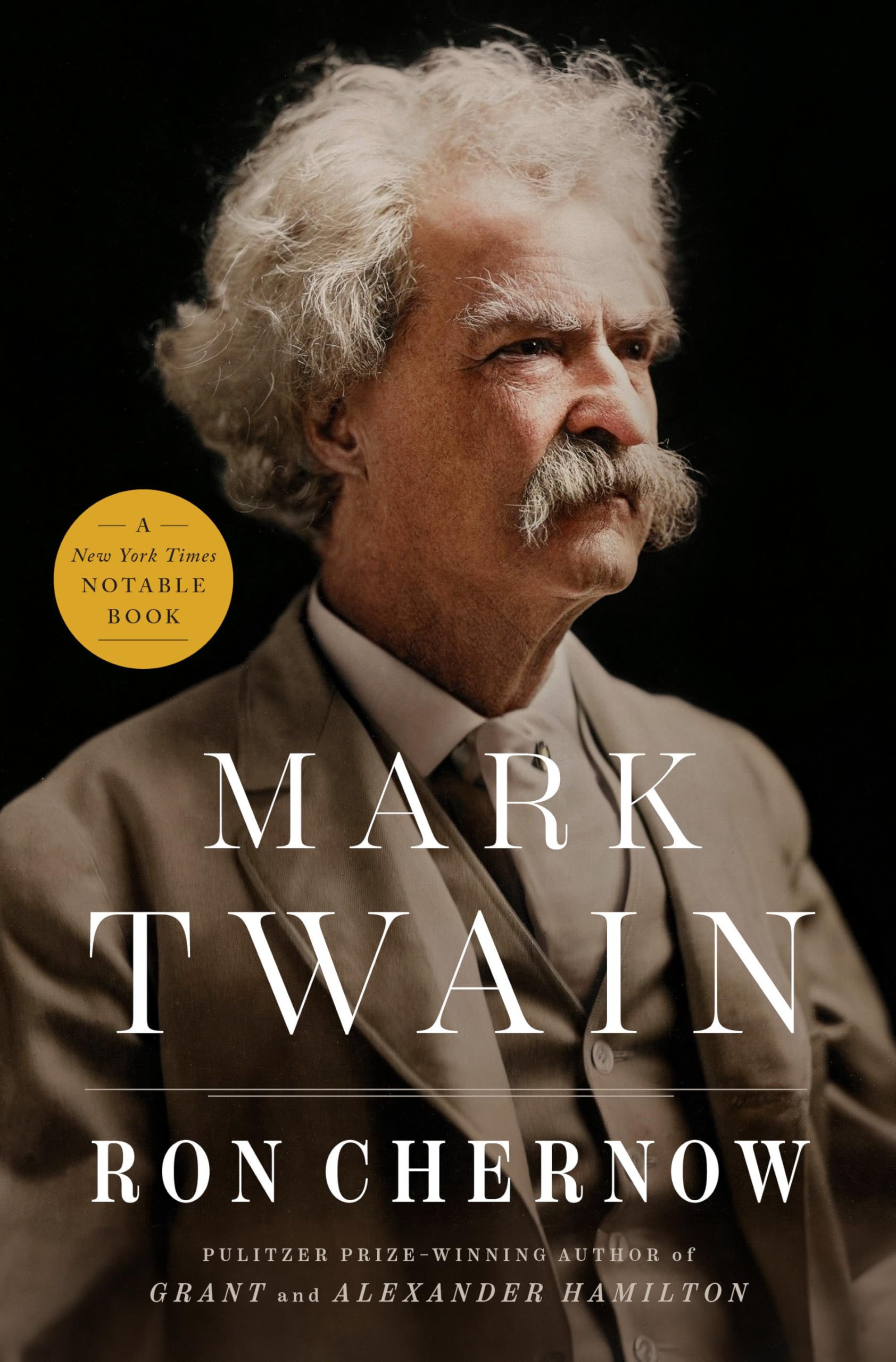
Mark Twain [Chernow, Ron] on desertcart.com. *FREE* shipping on qualifying offers. Mark Twain Review: The Adventures of Mark Twain - Anyone who has ever read a Chernow biography knows to expect comprehensive treatment of the subject that covers all phases and every aspect of their lives. The ability to pull all of those aspects of life into a single volume is what makes Chernow the premier biographer of the twenty-first century. Most people know Twain for his literary accomplishments, but he was many other things too. He was a political pundit with a wide-ranging influence and held positions that may make some modern Americans a little uncomfortable. Political commentary is often best conveyed with biting sarcasm or humor and Twain was certainly able to leverage his literary talents to this end. Chernow is very good at brining these different aspects to life, and he does it well with Twain, whose life straddled many areas. In this book, Chernow expands his bibliographic profile, embracing a subject who is not primarily a political or financial figure, but an artist who influenced his world less through policies but through cultural influence. Chernow may be accused of too much detail, but readers should keep in the mind is that his aim is author a nuanced biography that includes the good, the bad, and the ugly. He doesn’t engage in hagiography nor assassination. He writes biographies built on facts worked into a narrative replete with sound historical analysis. Facts and data must be interpreted and that is nature of historical writing. Chernow leverage nuance to build a comprehensive narrative. He interacts with the reader, he does not merely dump information on them. Looking at the manufacturing quality, this book has been elegantly put together. It has a fine matte finish on the dust jacket (much better than glossy!), and exquisite and inviting interior design and font, and is generously supplemented with photos. The spine is stitches and not glued, so readers can be assured the book will be durable. Chernow’s writing is clear and crisp, not bogging down. That may be surprising for a book of this length, but style has little to do with length. The writing is either engaging or it isn’t. This book will make a great summer read and I couldn’t recommend it more highly. Review: A must read! Despite the 1200+ pages. - Mark Twain is unique in American literary history. Ron Chernow does his best, the research is awesome, the writing is pristine. (Well, actually, the research is over the top.) Cherie alliows his own perspective to creep in from time to time but it is pretty much impossible to tamper down the radiance of Mark Twain.


| Best Sellers Rank | #3,463 in Books ( See Top 100 in Books ) #4 in Author Biographies #25 in Military Leader Biographies #31 in United States Biographies |
| Customer Reviews | 4.5 4.5 out of 5 stars (2,234) |
| Dimensions | 6.5 x 2.14 x 9.52 inches |
| ISBN-10 | 0525561722 |
| ISBN-13 | 978-0525561729 |
| Item Weight | 3.5 pounds |
| Language | English |
| Print length | 1200 pages |
| Publication date | May 13, 2025 |
| Publisher | Penguin Press |
B**R
The Adventures of Mark Twain
Anyone who has ever read a Chernow biography knows to expect comprehensive treatment of the subject that covers all phases and every aspect of their lives. The ability to pull all of those aspects of life into a single volume is what makes Chernow the premier biographer of the twenty-first century. Most people know Twain for his literary accomplishments, but he was many other things too. He was a political pundit with a wide-ranging influence and held positions that may make some modern Americans a little uncomfortable. Political commentary is often best conveyed with biting sarcasm or humor and Twain was certainly able to leverage his literary talents to this end. Chernow is very good at brining these different aspects to life, and he does it well with Twain, whose life straddled many areas. In this book, Chernow expands his bibliographic profile, embracing a subject who is not primarily a political or financial figure, but an artist who influenced his world less through policies but through cultural influence. Chernow may be accused of too much detail, but readers should keep in the mind is that his aim is author a nuanced biography that includes the good, the bad, and the ugly. He doesn’t engage in hagiography nor assassination. He writes biographies built on facts worked into a narrative replete with sound historical analysis. Facts and data must be interpreted and that is nature of historical writing. Chernow leverage nuance to build a comprehensive narrative. He interacts with the reader, he does not merely dump information on them. Looking at the manufacturing quality, this book has been elegantly put together. It has a fine matte finish on the dust jacket (much better than glossy!), and exquisite and inviting interior design and font, and is generously supplemented with photos. The spine is stitches and not glued, so readers can be assured the book will be durable. Chernow’s writing is clear and crisp, not bogging down. That may be surprising for a book of this length, but style has little to do with length. The writing is either engaging or it isn’t. This book will make a great summer read and I couldn’t recommend it more highly.
G**E
A must read! Despite the 1200+ pages.
Mark Twain is unique in American literary history. Ron Chernow does his best, the research is awesome, the writing is pristine. (Well, actually, the research is over the top.) Cherie alliows his own perspective to creep in from time to time but it is pretty much impossible to tamper down the radiance of Mark Twain.
D**Y
Well Researched and Detailed Account of Mark Twain's Life
Mark Twain by Ron Chernow Books written by noted biographer Ron Chernow are typically not for the casual or occasional reader, but more for those who love history and search for considerable detail about historical figures. Chernow accomplished this with his previous tomes about George Washington, Ulysses S. Grant and Alexander Hamilton, and he has done so once again with his latest biography of Mark Twain. And this latest effort may be his most complex, since Chernow wrote about two men in one – the person, Samuel S. Clemens, and the writer and orator, Mark Twain. Including notes, the book is 1,200 pages, so it is obvious that Chernow takes a detailed deep dive into the life, successes, and failures of the famous American author of Tom Sawyer, The Adventures of Huckleberry Finn, A Connecticut Yankee, and so much more. This level of detail reads well as Chernow tells of Twain’s early life in Missouri on the Mississippi River and his travels and adventures in the old west – likely because Twain writes of his childhood home and informative years in his novels. The book slows down, though, while sharing about Twain’s later years and his numerous personal and business setbacks. Chernow paints a picture of the outgoing and gregarious Twain who, despite being recognized as America’s greatest humorist, longs to be taken seriously. Samuel Clemens was a man who felt strongly about the things happening around him and was quick to share his opinions in public as a newspaper journalist. So, Twain’s tendency to address controversial societal and political issues after he found fame was nothing new. One of Twain’s flaws, though, was his highly impressionable tendency to immediately jump head first into an issue based upon the passion – right or wrong – of the person who last spoke to him about it. As a result, we see many instances of Twain strongly expressing his opinion only to do an about face later. Despite some actions to the contrary, Twain was mainly consistent in his feelings about the plight of black people in America and spoke out often in support of expanded rights and improved opportunities. He also supported several black people financially, for example, paying educational expenses for them to go to school. Chernow writes of Twain’s good and bad characteristics and actions, including the use of language in his books that, while vile and ignorant, was unfortunately common during his childhood years. While Twain spoke in favor of better education and treatment for blacks, for many years he held firm in his negative opinions related to native Americans. It was only much later in life that he softened that particular prejudice. It is clear that Twain, while witty and funny, was also a powder keg who could explode into controversy at any time. Most often, he was against oppression, big government, and the system that he believed was designed to hold down the common man. At the same time, he led life enjoying the finer things that included employing butlers, drivers, and other house staff caring for his needs. Accomplished as he was as an author, Twain was the opposite as a businessman and often acted on impulse regarding investments that resulted in financial distress. He was continually writing something new or out on a speaking tour because he had significant monthly expenses and considerable debt to repay. I wrote a college essay long ago where I took the position that, among other desires, Twain primarily wrote Huckleberry Finn to make money. After all, writing was his occupation. My professor held an opposite opinion and my grade for that particular essay suffered. It was gratifying, then, to read Chernow’s book and see so much attention given to Twain’s seemingly never-ending quest for financial success. Twain suffered many losses later in life, including the deaths of his wife, Livy, and daughters, Suzy and Jean, as well as people he trusted taking advantage of him. His only grandchild, a girl, was born after his death, which was sad because he longed for the days when he and Livy were raising their family, realizing he could have done a better job as an involved father. Chernow gives considerable attention to the elder Twain’s fascination with youth and his efforts to recruit and spend time with his “angelfish” – young girls ages 10 to 16 years old. Chernow shares various opinions about this obsession, some unsettling to be sure, but despite Twain’s flirtations, emphasizes there were no actual sexual interactions. Even the thought of that is abhorrent, but Twain was a lonely old man used to being in the spotlight and his angelfish looked up to him and made him feel he was still in the spotlight. Twain was born during an appearance of Halley’s Comet and often said he would likely go out when the comet returned 75 years later. That is exactly what happened, and his time on earth was both lively and sad, successful and challenging, humorous and serious, and filled with volumes and volumes of experiences, books, articles, and letters. That Twain is still relevant more than a century after his passing is reason enough to read about his life. Despite its length and some repetition, Mark Twain by Ron Chernow is worth your consideration. Visit davidajolley.com for more content. ###
C**S
An excellent read.
R**.
BIG book, but extremely interesting and well-written
A**A
Excelente libro. En muy buen estado. Ojalá vinieran más protegido para evitar manchas o raspones.
I**S
Have read Ron Chernow books before and this doesn’t disappoint. Expertly researched it runs chronologically through Twains life and writing. Though a long book it is a very easy fascinating read.
C**A
Great book that captures Samuels life in minute details. Meant for avid readers only as it's over 1k pages. I forgot matter will not be able to write about myself with such fineness and details. Though I received book with torn cover still book deserves a perfect rating.
Trustpilot
Hace 2 meses
Hace 1 día