We remain fully operational. Our teams are working around the clock to ensure your deliveries continue safely.

Descargar la aplicación


Servicios al cliente
Sobre nosotros
Copyright © 2025 Desertcart Holdings Limited
Descargar la aplicación
Buy anything from 5,000+ international stores. One checkout price. No surprise fees. Join 2M+ shoppers on Desertcart.
Desertcart purchases this item on your behalf and handles shipping, customs, and support to Peru.
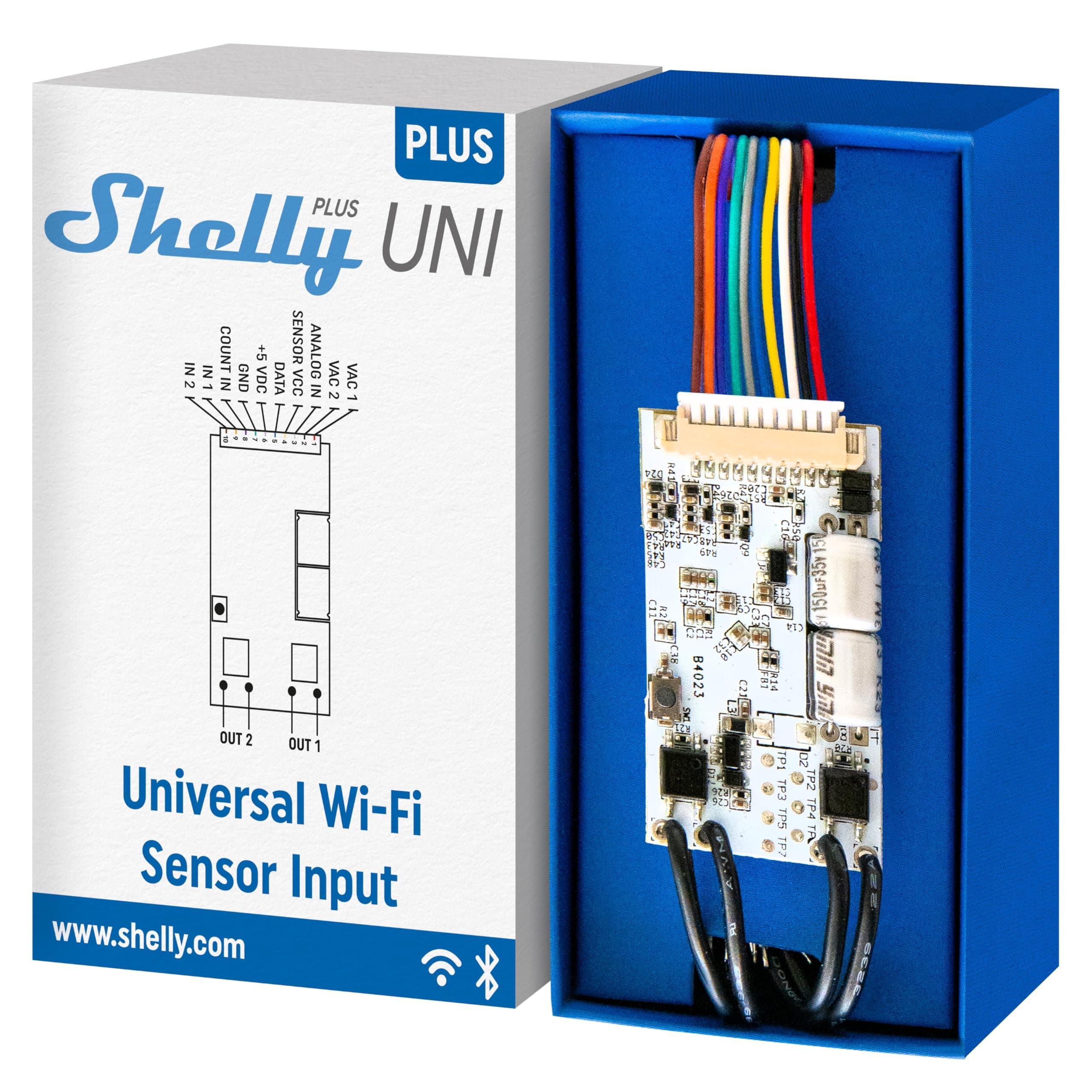
🚀 Upgrade your home’s IQ with Shelly Plus Uni — smart, sleek, and always connected!
Shelly Plus Uni is a compact, smart Wi-Fi and Bluetooth module designed for low-voltage systems (8-24 VAC, 5-28 VDC). It enables remote control and automation of traditional appliances via dry contacts, featuring a precise voltmeter, pulse counting, and sensor interfaces. Compatible with Alexa and Google Home, it requires no hub and doubles as a Wi-Fi range extender and Bluetooth gateway. Ideal for smart home enthusiasts seeking reliable, versatile automation with real-time alerts and seamless integration.










| ASIN | B0CQD1Z2K8 |
| Best Sellers Rank | #42,675 in Tools & Home Improvement ( See Top 100 in Tools & Home Improvement ) #6 in Home Automation Modules |
| Brand Name | Shelly |
| Coil Voltage | 9 Volts (DC) |
| Connector Type | Crimp |
| Contact Material | Stainless Steel |
| Contact Type | Normally Open |
| Current Rating | 300 Milliamps |
| Customer Reviews | 4.5 4.5 out of 5 stars (573) |
| Included Components | 1 x Shelly Plus Uni, User manual |
| Item Weight | 8.5 Grams |
| Manufacturer | Shelly Europe |
| Minimum Switching Voltage | 8 Volts (AC) |
| Model | 3800235265710 |
| Mounting Type | Wall Mount |
| Operation Mode | ON-OFF |
| Part Number | 571 |
| Smart Home Compatibility | Smart Home Compatible |
| Specification Met | CE, RoHS |
| Unit Count | 1.0 Count |
| Upper Temperature Rating | 105 Degrees Fahrenheit |
| Wattage | 9 watts |
C**S
I love these
I've been using UNIs throughout my van. I have 15 or so running. They aren't super durable, but printed 3d cases for them and am careful about the loads I control. The switches are low amp, so use a relay if you are controlling any real load. If you toggle power accidentally, they'll lose their connection to the wireless, but they are easy to add back with the shelly app. The devices work well with Home Assistant, and they are easy to wire up. They seem to handle a range of input power just fine (12v to 13.7v) though I did put eventually wire them with regulated 12v power just in case. The older ones use less power than the new Uni Plus. The new plus versions do seem more solidly built.
J**K
Great gadget.
It's like the Raspberry Pi of automation. The device is inexpensive and has a lot of features. The online information is scattered throughout the world so you may have to get up to speed a bit on them. For the simple task I needed this was great. I monitor battery in garage via wifi. The signal just sneaks out. I used a paint stirring stick to mount to.
D**B
Useful as a rotor control for remote HF antenna sites.
My 3rd review: I am using the Uni to remote control a Yaesu G-800DXA rotor for an HF antenna. I’m happy to report that it is functioning reliably now performing this task. The first thing to do is update the firmware. The SS relays on the Uni drive the CW and CCW rotor controls and LED indicators that I added (PU to 5V via 1k) without issue. The 0V to 4.5V directional indicator voltage from the rotor go to the analog input of the Uni which I set for the 0-15V range. You have to enable this input. It comes with a counter enabled which I did not use and disabled. I calibrated this to give 0 to 100% for that voltage range and used the equation x*4.5 to get degrees. Set the threshold to 1 for best accuracy. The app breaks the CW and CCW momentary controls into two PBs. These work okay but there is no way to disallow both on at once. There is no combinational logic available (unless you experiment with some JS). I made the degrees reading appear as a separate device. Unfortunately, useful documentation is sorely lacking and menus are not very intuitive so, if you’re not familiar with the app, you have to waste a lot of time trying to figure out what’s where in addition to what’s possible. Overall, it works and it works remotely via the Internet, it’s the only off the shelf solution that I had found that met all of the requirements for this, and it’s quite inexpensive compared with more industrial solutions.
A**N
Worked well
Worked great.
J**Z
Understand wiring before use. It's a unique gadget with many options.
Understand wiring diagram and device limitations. I fried 2 before using correctly. Don't think instructions are completely clear.
Z**D
Great for detecting power state changes for HASS triggering.
Using two USB A power adapters and an e26 to 120 female plug adapter, I set this up to watch the power status of the garage door opener light to switch other outdoor lights on when activated. Wiring follows: Red/White: +5VDC from opener adapter. Black: -5VDC from opener adapter. Grey: +5VDC always on adapter. Green: -5VDC always on adapter. All others trimmed and taped off. The White analog wire connected to the Red wire allowed me to use the Voltmeter functionality to set up a trigger in Home Assistant when voltage was detected at the garage door light socket. I now have extra lighting when I come home in the dark and the other lights are also set to turn off and mirror the status of the garage. TP-Link, while their products are my go-to for price point and functionality, they don't report power status reliably. While this module has many features, the ones mentioned in this review made it extremely useful for getting a quick report in power status change, yielding useful light triggering. I didn't go through the trouble of adding a bleed resistor to the opener power adapter because I found a usb adapter that drained quickly after power off. There was some experimentation involved and I was lucky to have a generic usb adapter that met my needs. This functionality depends on how quickly any leftover charge is left in the adapter, so your results and implementation will vary from mine.
A**R
So many options and just works
The options to power and use this module are so endless, it's well worth it. You could definitely put something together with ESPHome that would cost half the price, and that's what I almost did, but do you really want to spend hours tinkering rather than pay the extra $10 for a well-finished reliable solution that just works? In my particular case, I was trying to control an internal component of a hot tub that used 15 volts DC (what an awkward voltage), and using this module allowed me to power it directly from the same wires I was controlling, without the need for an external power supply. Super convenient. I also like that it has pretty much every integration under the sun, so I know that while I may want to control it directly with an app today, it will be able to connect to my Home Assistant instance in the future if I want more control.
M**S
Estos dispositivos son muy potentes y se puede desarrollar casi sin límites.
A**A
Il faut être ingénieur automaticien pour installer ce produit …
L**O
o produto veio com defeito e ninguém respondeu a minha reclamação.
H**A
Es muy útil para domotizar dispositivos antiguos
M**A
Excelente placa de Shelly para cualquier aparato que quieras domotizar, ejemplo una caldera. Capaz de poder programar y generar funciones para un uso autónomo y controlado con la aplicación móvil.
G**I
Il Shelly UNI è un modulo Wi-Fi estremamente versatile e compatto, progettato per integrare e controllare dispositivi non smart o sistemi esistenti. È particolarmente apprezzato per la sua flessibilità e dimensioni ridotte, che permettono di installarlo praticamente ovunque. Di seguito una descrizione dettagliata delle sue caratteristiche tecniche e funzionalità: Caratteristiche principali: 1. Connettività: Supporta connessione Wi-Fi a 2,4 GHz, compatibile con router domestici standard. Non necessita di un hub centrale, poiché si connette direttamente alla rete Wi-Fi. 2. Dimensioni ultracompatte: Il Shelly UNI è estremamente piccolo (20x10x3 mm), permettendo un'installazione anche in spazi ristretti, come all'interno di quadri elettrici, elettrodomestici o custodie di dispositivi preesistenti. 3. Ingressi e uscite: 2 ingressi analogici/digitali: Compatibili con sensori di temperatura (come NTC) o con segnali digitali (es. interruttori, pulsanti). 2 uscite a transistor (open collector): Utilizzabili per pilotare relè esterni, attivare carichi o controllare circuiti a bassa tensione. 4. Compatibilità con sensori esterni: Supporta sensori di temperatura NTC, DHT22 (per temperatura e umidità) e altri sensori esterni, ampliando le possibilità di monitoraggio e controllo. Capacità di lavorare con sensori analogici da 0-30V. 5. Tensione di alimentazione: Supporta un’ampia gamma di tensioni: 12-24V DC per applicazioni a bassa tensione. 110-240V AC per utilizzo con rete elettrica domestica (tramite adattatori esterni, se necessario). 6. Automazione e integrazione: Compatibile con protocolli domotici come MQTT, HTTP/HTTPS, UDP, o tramite REST API, permettendo l’integrazione in sistemi personalizzati. Si integra con i più comuni ecosistemi smart home come Amazon Alexa, Google Home, e Home Assistant. Dotato di funzionalità avanzate come il controllo tramite script personalizzabili. 7. Misurazione dei segnali: Può misurare segnali analogici fino a 30V, utile per monitorare lo stato di batterie, dispositivi o segnali di corrente. 8. Resistenza alle condizioni ambientali: Non è impermeabile di default, ma può essere installato in custodie protettive per adattarsi ad ambienti esterni o industriali. 9. Sicurezza: Supporta protocolli di comunicazione crittografati per garantire la sicurezza dei dati. Firmware aggiornabile per ricevere nuove funzionalità o miglioramenti di sicurezza. Applicazioni pratiche: Automazione di vecchi sistemi: Consente di rendere smart dispositivi tradizionali, come cancelli automatici, citofoni, elettrodomestici o luci non compatibili con la domotica. Monitoraggio remoto: Può essere utilizzato per controllare temperature, umidità, o lo stato di cariche elettriche (es. batterie solari). Controllo di attuatori: Può gestire relè, motori o circuiti a bassa tensione. Integrazione in sistemi personalizzati: Ideale per progetti di fai-da-te o scenari personalizzati grazie alla compatibilità con sensori analogici. Vantaggi del Shelly UNI: Design ultracompatto e flessibilità d'uso. Facilità di configurazione tramite l'app Shelly (disponibile per Android e iOS). Adattabile a una vasta gamma di scenari, da applicazioni domestiche a progetti industriali. Prezzo contenuto rispetto alle funzionalità offerte. Il Shelly UNI è una soluzione ideale per chi desidera modernizzare dispositivi esistenti o costruire un sistema domotico personalizzato, con il vantaggio di un controllo remoto efficiente e scalabile.
Trustpilot
Hace 1 mes
Hace 1 semana