We remain fully operational. Our teams are working around the clock to ensure your deliveries continue safely.

Descargar la aplicación


Servicios al cliente
Sobre nosotros
Copyright © 2025 Desertcart Holdings Limited
Descargar la aplicación
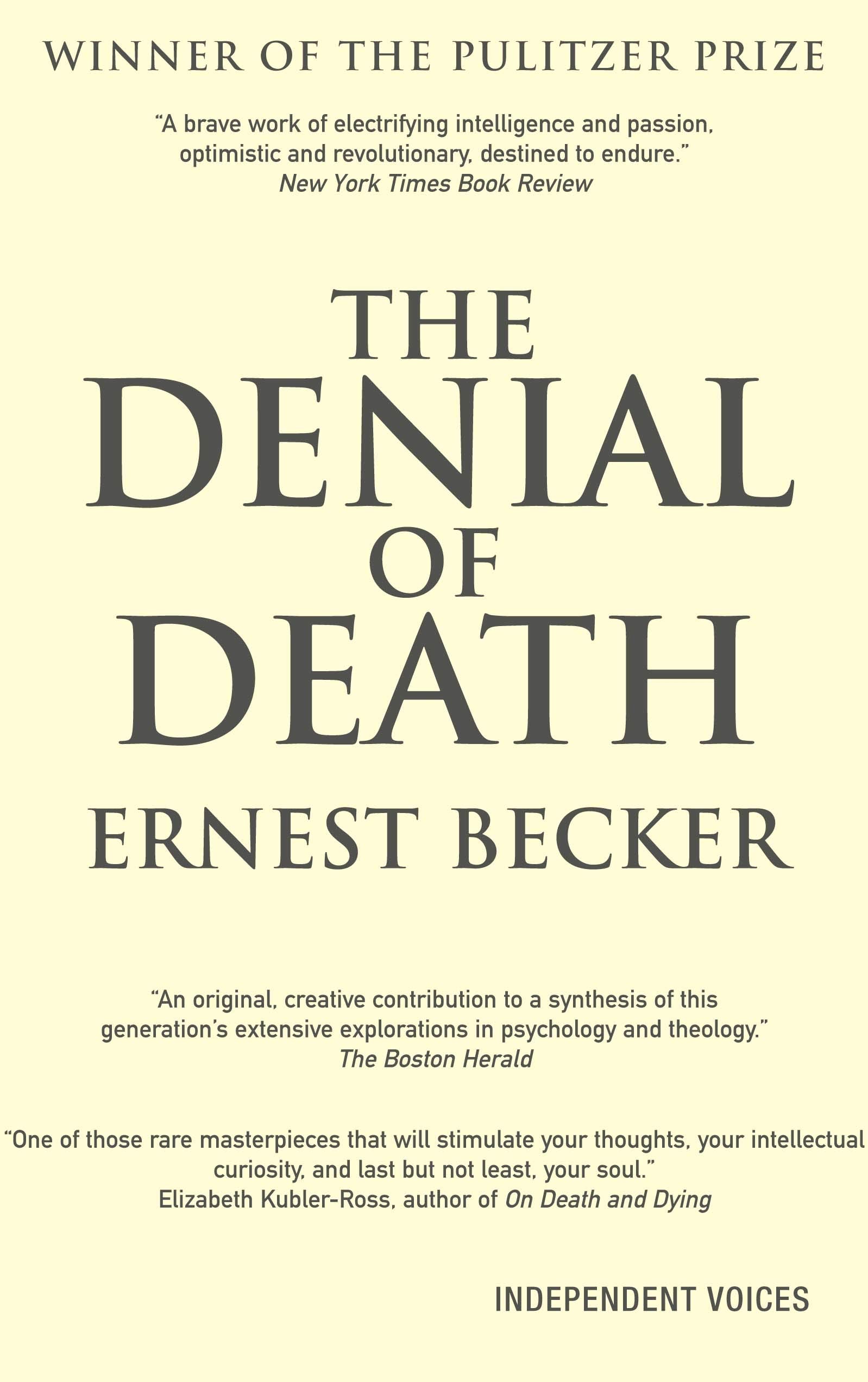
Buy The Denial of Death by Becker, Ernest (ISBN: 9780285638976) from desertcart's Book Store. Free UK delivery on eligible orders. Review: Really uplifting book - I am terrified of dying and I don't understand why no one else seems to think about it as much as I do. It's because they're all working on their, 'immortality projects' as Becker calls them. Like earning lots of money and having kids you feel more and more immortal. But you're not. You're just doing everything to try and ignore the fact that soon you will cease to exist and nothing you're doing now will mean anything to anyone! Review: Truth Tsar Bomba - I think Becker is more along the line of reality than Freud. It is my belief - take that with a grain of salt - that it is the refusal and running from the looming doom of death that is our prime mover is many things, not the libido. This book hit hard in a lot of places, and is a great insight into things of the mind including why dictators come to power, or why wish to become or admire the 'hero', in a classical sense. Beware, the page count is not the amount of time this book will take you. I found myself, like with many books of its like, setting it down after various passages to just ruminate on what I have read. A fantastic book for discussion, too.
| Best Sellers Rank | 95,015 in Books ( See Top 100 in Books ) 115 in Philosophy (Books) 697 in Health, Family & Lifestyle Self Help |
| Customer reviews | 4.6 4.6 out of 5 stars (3,135) |
| Dimensions | 13.5 x 2.3 x 21.6 cm |
| Edition | Main |
| ISBN-10 | 0285638971 |
| ISBN-13 | 978-0285638976 |
| Item weight | 372 g |
| Language | English |
| Print length | 336 pages |
| Publication date | 1 April 2011 |
| Publisher | Souvenir Press |
A**E
Really uplifting book
I am terrified of dying and I don't understand why no one else seems to think about it as much as I do. It's because they're all working on their, 'immortality projects' as Becker calls them. Like earning lots of money and having kids you feel more and more immortal. But you're not. You're just doing everything to try and ignore the fact that soon you will cease to exist and nothing you're doing now will mean anything to anyone!
R**Y
Truth Tsar Bomba
I think Becker is more along the line of reality than Freud. It is my belief - take that with a grain of salt - that it is the refusal and running from the looming doom of death that is our prime mover is many things, not the libido. This book hit hard in a lot of places, and is a great insight into things of the mind including why dictators come to power, or why wish to become or admire the 'hero', in a classical sense. Beware, the page count is not the amount of time this book will take you. I found myself, like with many books of its like, setting it down after various passages to just ruminate on what I have read. A fantastic book for discussion, too.
A**Y
Thought provoking
A little heavy in places but the book does a good job of repeating the main premise and keeping it on course. The main premise is quite easy to understand and I like this about the book. The examples he gives and the references to mental health , religions etc seem irrelevant but it al makes sense ( kind of) in the end If you are looking for a Once upon a time book then this is not for you, however if you want answers to more philosophical questions then jump in
C**N
Be careful reading Becker because you can't unread him
The above was a note I wrote to myself at one point while reading this book. That this work won't the Pulitzer Prize and has been so impactful on so many people is of no surprise to me. I read this after having already read "The Worm at the Core" by Solomon et al and would recommend the same to anyone else looking to venture into Becker. Solomon and co. provided a wonderful intro to Becker's work as well as the field of research psychology they created to investigate his work: Terror Management Theory. Both "The Worm at the Core" and "The Denial of Death" are books I would recommend to anyone who was willing to grapple with the deepest question that faces an individual human: how to live in the face of death.
D**E
Brilliant and disturbing. It tears down much of what we build up to protect ourselves
Just finished it and I'm left feeling disturbed. This is a good thing as some very deep questions have been answered and asked. Absolutely brilliant book. Very heavy going and may require some knowledge of psychology to get it. It gets right to the core of what it means to be human, how we ignore really and what we can do about it.
S**.
This is a book that should not merely be read, but interacted with.
The genius of this book and Becker’s writing is that it exudes such competence and knowledge that it cannot merely be read, it must be interacted with. I found myself reading a chapter at a time only to spend several hours spiralling off into other books and expanding upon thoughts that were evoked by this brilliant work. If the purpose of reading is to expand knowledge and further personal development, this book surely ticks all the right boxes.
M**E
Depending on what you want from a book
Like most of the books that have made my ever expanding reading list. This was at times a joy to read and others something I would have liked to set fire to. It undoes some fundamental ideas of how we are in the world, and surprisingly gives cause to laugh at some of them too. I would recommend for anyone wanting to read this, when finished. Engage in at least 30 mins of meditation, or something of similar ilk that suites your way, or cultural way of being, you might need the space to breathe afterwards. Can't complain about shipping, service etc, all went swimmingly well
L**M
A heavy read but very insightful
This is one book that I would highly recommend. The only reason I didn't give it a 5 star was due to the fact some of the language is very academic, and made the reading a bit heavy at times. Nonetheless, an excellent book to read.
N**D
My lowe starts is on the author not the sold product... Topic abit out dated
T**A
Becker's Pulitzer Prize-winning work addresses the fundamental drive of the human condition, delving into societal institutions, pathologies, and irrational behaviors. In his exploration, Becker presents a profound psychological argument for the pan-cultural religious impetus compelling individuals to merge with a beyond while also seeking individual distinction. He astutely illustrates the illusory nature of seemingly secular cultures, shedding light on the structural similarities they share with outgrown religious beliefs. Embedded within his argument is the rejection of truth as a highly valued principle in statecraft, compelling readers to reconsider their perception of societal realities. Through a three-part exploration, Becker skillfully navigates the complex human dilemma, offering a detailed outline of the problem, common solutions, and an incisive analysis of society through this framework. The fundamental struggle faced by humans, according to Becker, stems from a unique dichotomy that only humans grapple with. This symbolic identity places individuals in an existential dilemma; they are both capable of comprehending abstract concepts, such as infinity and atoms, yet they must confront the objectively meaningless nature of their lives and the prospect of their eventual demise. Becker suggests that one aspect of the fear of life lies in the overwhelming awe, fear, and incomprehensibility that comes with existence. In confronting the complexity of one's own existence, there arises a fear of being insignificant, leading to a struggle to find meaning in an incomprehensible world. These dual fears of life and death contribute to the heroic urges that Becker describes, urging individuals to strive for transcendence and create their own sense of significance even in the face of potential meaninglessness. One of the qualities of Man that fascinated Becker was how we have an instinctive sense to "be good." But what is goodness? The twin urges of Agape and Eros are a reflection of Man's pursuit of transcendence and individual significance. Agape is the reflex against the impermanence from death, seeking meaning through merging with an ultimate beyond. On the other hand, Eros is the reflex against the insignificance from life, striving for uniqueness and importance. This concept explains the dual motivations behind human behavior and the innate drive to create distinctions between Good and Evil in order to carve out meaning in the world. Both Agape and Eros enable us to navigate the complexities of existence by providing a sense of direction and cultivating individual greatness. However, there's a profound tension in this process as these twin urges can often be antagonistic to each other. In Becker’s view, character defenses, represented by identity and narrative, assist in giving individuals the sense of control and unique identity essential for functioning in the world. Becker also discusses the use of transference objects as a way for individuals to find grounding and direction in the complexities of life. These objects provide a source of identification and direction, helping individuals navigate the overwhelming awe, wonder, and fear that existence often brings. Both character defenses and transference objects serve as coping mechanisms to grapple with the terrifying dilemma of human existence. Becker’s view on how cultural elements play a role in our lives is insightful and intriguing. He discusses the concept of leaders as transference objects, emphasizing how the crowd's fascination with leaders highlights the hypnosis of power and the desire to merge with omnipotence. Beyond leaders, he delves into the idea of lovers as transference objects, explaining how romantic interests take on the role of encapsulating power, immortality, and the designator of good and evil. In both these cases, Becker demonstrates how cultural elements serve as symbolic structures fulfilling the innate human urge for heroism through Agape and Eros. This comprehensive analysis provides a deeper understanding of how individuals seek meaning and significance within cultural dynamics. Becker’s analysis of the effectiveness and benefits of religion highlights how it directly addresses the problem of transference by expanding awe and terror to the cosmos where they belong. It provides a framework that takes the problem of self-justification and removes it from the objects near at hand, allowing individuals to lean on powers that truly support and do not oppose them. However, the failures of modernity as outlined by Becker point out that globalization and analytical ability have rendered people cynical, depriving them of the ability to have faith. The diversity in ideology poses a threat to heroism, and it becomes disheartening to see 'authorities who are equally unimpeachable hold opposite views.' Becker's comparison of cultural heroes and societal outcasts sheds light on the existential dichotomy faced by those who venture into the realm of creativity. His contention that artists and societal outcasts are only separated by a small degree of "talent" implies that creativity and madness share a connectedness. Conferring cultural heroes with creative genius, Becker's analysis illustrates how the innovators who attempt to furnish an entirely new meaning to creation and history shoulder the weight of justifying previous and potential alternative meanings alone. As a result, the burden of fabricating one's own religion, as argued by Becker, leads to a hypervigilant state, facing the fear that no beyond can prevent creatives from exhausting every bit of themselves in the artistic process.
O**.
A little tough to get into but extremely insightful, and a valuable read. Well worth your time.
F**N
An epic milestone, a rare gift to humanity and must read for anybody really interested in the ways of human and the reason of being. Partly outdated, yet a true masterpiece as a whole and an invaluable piece to think about. Not an easy read but as easy written as possible given the task.
X**5
I'd say it's one of the greatest books of all time -- gives a beautiful way of seeing the world
Trustpilot
Hace 1 semana
Hace 1 mes