We remain fully operational. Our teams are working around the clock to ensure your deliveries continue safely.

Descargar la aplicación


Servicios al cliente
Sobre nosotros
Copyright © 2025 Desertcart Holdings Limited
Descargar la aplicación
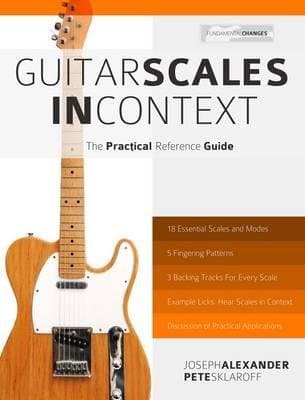
Guitar Scales in Context: The Practical Reference Guide : Alexander, Joseph: desertcart.co.uk: Books Review: Good for starting compositions - Really useful for starting off song ideas in a certain mood. I never really got modes or how to use them before, but this book has really helped me understand how to use them creatively. Review: Guitar Scales in Context - I had previously bought another book but it didn't give me what I wanted; its Ok knowing scales but, how do you use them! Fortunately i came across this book by Joseph Alexander and as the title says it puts scales into context, provides backing tracks to down load and importantly gives me licks to try and play along. This is exactly what I am looking for. The book is well laid out and easy to understand. Not all scales are included, but the main and important ones are and therefore more than enough to get on with. Mastering any or all of them would make you into a fantastic guitar player - so who knows! Whilst everything is in one key - C and it would be more helpful if there was a blend of scales, Joseph does explain how to play in different keys which helps me to improve my knowledge rather than relying on looking at scales and riffs only - which (may be an age thing I am a senior starting late on my guitar journey) just looking I don;t seem to retain as much as "learning" and figuring things out for myself! All in all a great book if you want to know more about scales and how to use that knowledge.
| Best Sellers Rank | 742 in Guitars 1,128 in String Instruments (Books) 2,081 in Music Instruction & Study |
| Customer Reviews | 4.5 out of 5 stars 507 Reviews |
A**R
Good for starting compositions
Really useful for starting off song ideas in a certain mood. I never really got modes or how to use them before, but this book has really helped me understand how to use them creatively.
P**A
Guitar Scales in Context
I had previously bought another book but it didn't give me what I wanted; its Ok knowing scales but, how do you use them! Fortunately i came across this book by Joseph Alexander and as the title says it puts scales into context, provides backing tracks to down load and importantly gives me licks to try and play along. This is exactly what I am looking for. The book is well laid out and easy to understand. Not all scales are included, but the main and important ones are and therefore more than enough to get on with. Mastering any or all of them would make you into a fantastic guitar player - so who knows! Whilst everything is in one key - C and it would be more helpful if there was a blend of scales, Joseph does explain how to play in different keys which helps me to improve my knowledge rather than relying on looking at scales and riffs only - which (may be an age thing I am a senior starting late on my guitar journey) just looking I don;t seem to retain as much as "learning" and figuring things out for myself! All in all a great book if you want to know more about scales and how to use that knowledge.
B**1
Helped me understand scales a lot better! Gave me a Eureka! moment!
I had learned the main modes of the Major of Minor scales, but I never quite dissected them in detail. If nothing else, this book led me to realize that the order of the modes and flats/sharps is movable (I know, I should've learned this YEARS ago), when I did, it was like a massive 'Eureka!' moment for me. Covers the most common scales and modes probably 90% plus of guitarists will ever use, if you're looking for a 'Dominant Neapolitan Flat 5th Major/Minor Scale' or something else equally ridiculous or obscure (i made it up...I think!) you are going to be disappointed, but for the majority of us six stringers, this should be enough. I think you should allow yourself a week at least on each mode, before moving to the next to fully absorb the uniqueness of it before moving on to another, that way, your hands and ears will have some memory of Dorian noodling and will help you identify the difference between that mode and say a Phrygian better, or at least the different flavors between them. Loses one star as, although the backing tracks are good, I would've liked them to explain why, someone would use that particular scale here as opposed to another one, why does that note sound good here and why don't we stay on that note during the chord change, as well as explaining what chords you can use or make up within certain modes. A little thing perhaps, but it could've made a big difference. Signing on to the email is a bit annoying to be honest, as you're initially flooded by loads of emails and very little time to use or open any of them, so think twice before doing so. Overall, very handy book for theory, a must for expanding your understanding of the instrument too.
R**E
Beginner Guitarists - Practical and condensed advice on learning the E-minor Pentatonic
A short and concise work with good practical suggestions from a person who knows what he is talking about. I find this book helpful in mastering the e-minor pentatonic scale.
J**.
A great resource for every guitar player
A great resource for every guitar player. It’s easy to follow and implement the scales into your practice routine. Highly recommended.
M**N
Best Scales book available
I have been playing rythm guitar for many years and wanted to learn lead and tried many scales books to help me better understand scales then came across this book from Fundamental Changes written by the excellent Joseph Alexander who de-mistifies the whole subject and makes it a pleasure to learn and develope my lead guitar skills. As a result I have now also purchased a number of other books from them and would highly recommend them to anyone wishing to learn any aspect of the guitar for all genre's.
I**U
Could Have Been Much Better
I bought this book because the writers theory book is very good. I'm a home player but working hard to progress to gigging or busking doing jazz standards and funk maybe. Here is what's missing: 1. You are learning shapes which is useless. You aren't shown the 3rd, flat7 etc only the root so if you dont' want to start the scale or arpeggio off the root you are going to be stuck. 2. Backing tracks are good but everything is in C major. 3. All the modes refer to the b2 or relevant note to make it that mode but there is no explanation of where that note is. Just the root. It could have been made much better with a bit of the theory explained and the relevant intervals shown in the figs. Instead you are left with the same problem the author tried to address. Playing shapes. Paul
C**Y
Good book
Reading this book has improved my technical ability. My solos are more varied and more fluid and I am finding I am able to access more of the fretboard. The book has a teach yourself style, despite the scales being very detailed. I would like more advice in scale progressions and examples of how to either merge or transit from one scale to another. Perhaps I will achieve this through more practise though; which is fine.
Trustpilot
Hace 3 semanas
Hace 5 días