We remain fully operational. Our teams are working around the clock to ensure your deliveries continue safely.

Descargar la aplicación


Servicios al cliente
Sobre nosotros
Copyright © 2025 Desertcart Holdings Limited
Descargar la aplicación
Buy anything from 5,000+ international stores. One checkout price. No surprise fees. Join 2M+ shoppers on Desertcart.
Desertcart purchases this item on your behalf and handles shipping, customs, and support to Peru.
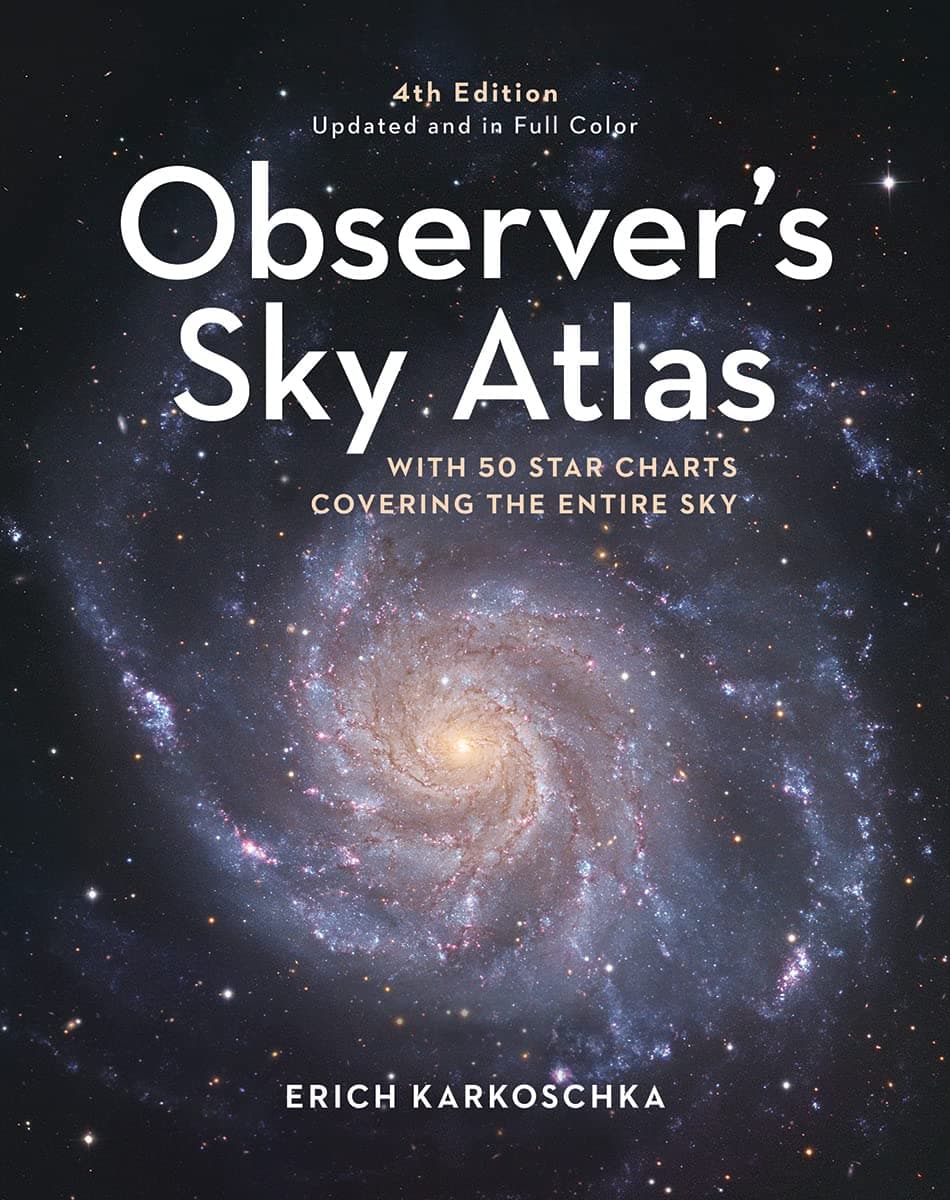
Buy Observer's Sky Atlas: The 500 Best Deep-Sky Objects With Charts and Images on desertcart.com ✓ FREE SHIPPING on qualified orders Review: One of the most well organized and thought out reference books I've ever encountered - It's absolutely gorgeous too. The stunning photographs inspire me to get out and aim my scope at something amazing. Very well laid out for allowing you to plan viewing sessions and locate your targets in the night sky. The author even built the color scheme of the star charts to aid in viewing under an astronomer's red light. I wish every product I purchased was designed this thoughtfully. One downside- now I've got to plan a trip to the Southern hemisphere because this star atlas covers some spectacular objects that can't be viewed from home! Review: Comprehensive and easy to use guide to the cosmos - This is a fantastic reference book for the casual or serious star-gazer. Each edition improves on the one before, and this one is easily the best yet. It is comprehensive, so it can be used wherever you live on planet Earth.


| Best Sellers Rank | #100,331 in Books ( See Top 100 in Books ) #26 in Star-Gazing (Books) #30 in Scientific Reference #149 in Astronomy (Books) |
| Customer Reviews | 4.7 out of 5 stars 211 Reviews |
S**L
One of the most well organized and thought out reference books I've ever encountered
It's absolutely gorgeous too. The stunning photographs inspire me to get out and aim my scope at something amazing. Very well laid out for allowing you to plan viewing sessions and locate your targets in the night sky. The author even built the color scheme of the star charts to aid in viewing under an astronomer's red light. I wish every product I purchased was designed this thoughtfully. One downside- now I've got to plan a trip to the Southern hemisphere because this star atlas covers some spectacular objects that can't be viewed from home!
J**G
Comprehensive and easy to use guide to the cosmos
This is a fantastic reference book for the casual or serious star-gazer. Each edition improves on the one before, and this one is easily the best yet. It is comprehensive, so it can be used wherever you live on planet Earth.
W**C
Amazing presentation of information for Stargazing - A must!
Incredible presentation of stellar objects! I've sat and read through this for hours to help inspire and plan my star gazing events. I've never seen a better and more dense presentation of data. Really this is a text book on how to present information. My only complaint is that there are a few items that I think weren't covered in the explanations, but I guess given the extreme density of information, it could happen.
J**S
The Next Step After Naked Eye and Binocular Astronomy: Telescopic Observing
In its fourth edition, splendidly produced by Firefly Books, Erich Karkoshka's Observer's Sky Atlas is the one indispensable guide to deep sky observing. It is one step beyond the following brilliant guides: Nightwatch, Fifth Edition by Terence Dickinson with Ken Hewitt-White; Turn Left at Orion, Fourth Edition, by Guy Consolmagno and Dan M. Davis; and Star-Hopping for Backyard Astronomers, First Edition, by Alan M. MacRobert. These books (and others) get you started. They prepare you for this book, which is aimed at deep sky observing. What sets this guide apart is the degree of its organization. Your journey begins on the inside front cover, which depicts the best times to observe each region of the sky. Select Leo, which is region E11; it is best placed for viewing in April. Navigate to E11, which occurs in order of the regions, on pages 74-75. You observe along the top photographs of bright objects in Leo. On the left page are Leo's coordinates, its broad location among nearby constellations, the distance of its main stars from earth, its deep sky objects ('Nebulas'), its most notable stars, including double and variable stars. This gives you tabular information that is actionable information for the telescopic obsever. One curious feature is the domino next to each object: the more dots in the domino, the more easily seen is that object. On right page middle is a map of Leo showing locations of the main objects. Below this map is a lozenge shaped closeup of the objects. These closeups point out the essentially clumpy nature of deep sky observing. The maps are essential for effective seeing at the telescope's eyepiece. Throughout the book is an emphasis on stellar distances, a situation made much less uncertain for nearby stars by the launch of the Hipparchos satellite in 1997 and the Gaia satellite in 2016. We know the distances of local stars with much more certainty than we did 30 years ago thanks to these satellites. I don't know about you, but the pleasure that I, a mortal being, get from the contemplation of the long-lasting universe is increased considerably by knowledge of the sky while observing. The Observer's Sky Atlas delivers this knowledge as never before.
A**V
Unique little atlas of the night sky!
Though the information in this book is brief and condensed, the very concept of this atlas is intriguing to me. It is primarily a picture book, not just photos (there are a few but they are generally small), but of maps and charts and insets and more. This book is very rich in graphics and printed on high gloss paper, stylish and appealing to those tuned into visual learning. And though the book never goes into any great detail, it covers quite a wide range of objects, listing some of the main items of interest for each constellation. It's a good starter for newcomers to the hobby, providing a great overview and with enough material here to keep someone engaged for many months. It's even a book seasoned observers can turn to on cloudy nights and still find themselves exploring all that the heavens have to offer. My one criticism of this book is that it is too small! I wish it was bigger so i could see all the info in the graphics in more detail. But apart from this I've really enjoyed this book and I consider this a worthy addition to my astronomy library. I can certainly recommend it to others.
K**M
Lots of info, very well organized
I've been an amateur astronomer and telescope maker since childhood, and am normally pretty skeptical about night sky observing books, which tend to be pitched at a novice level, and filled with diffuse and general info that I know cold. I received a flyer featuring this and three other books at Stellafane last week, and while I could quickly rule out three of the four, this one seemed worth a preview on Amazon, and what I saw convinced me to give it a try. It arrived yesterday, and I have to say that I am really impressed, and will be using this observing atlas regularly. It has an incredible amount of information, arranged in a clever and highly organized manner. Lumping globulars, open clusters, galaxies, and actual nebulae all together under one "nebula" category is a bit odd, but these are in fact properly sub-categorized by number. It takes a little while to decode the dense info that is served up, but explanatory pages just before the core set of "star charts" do a good job of this, and once you are up to speed on the pattern, you have a lot of info at your disposal. Having this all in a single compact volume makes it more likely to be put to use at the telescope, where more verbose multi-volume approaches stay put on the shelf. I think that the author has done a great job, providing the observing community with a valuable new resource.
Á**L
Good binocular astronomy Atlas
This is a magnificent atlas. At first glance it seems perhaps too abundant in details, but the organization of the data is so good that its reading does not overwhelm the reader. It is incredible how it has been possible to condense as much information in so few pages. I stargaze with binoculars and this guide is a good reference. When deep sky objects are suitable for binoculars, it is specified with an icon. More than half of the 500 objects cited in the Atlas are available to 10x50 binoculars. The atlas is designed in such a way that by illuminating it at night with red light some details of the maps stand out and others disappear, so at night it looks like another book different from when read by day. A superb book for binocular astronomy.
M**2
A unique compact Sky Atlas
Incredible amount of information in a compact form. Data is presented using color coding, symbols, numbers, and drawings. It takes a little effort to understand the presentation, but it is well worth it. One example that I enjoyed is a complete calendar for every year from 1993 to 2076 that fits on a single page!!!
Trustpilot
Hace 2 semanas
Hace 1 mes