We remain fully operational. Our teams are working around the clock to ensure your deliveries continue safely.

Descargar la aplicación


Servicios al cliente
Sobre nosotros
Copyright © 2025 Desertcart Holdings Limited
Descargar la aplicación
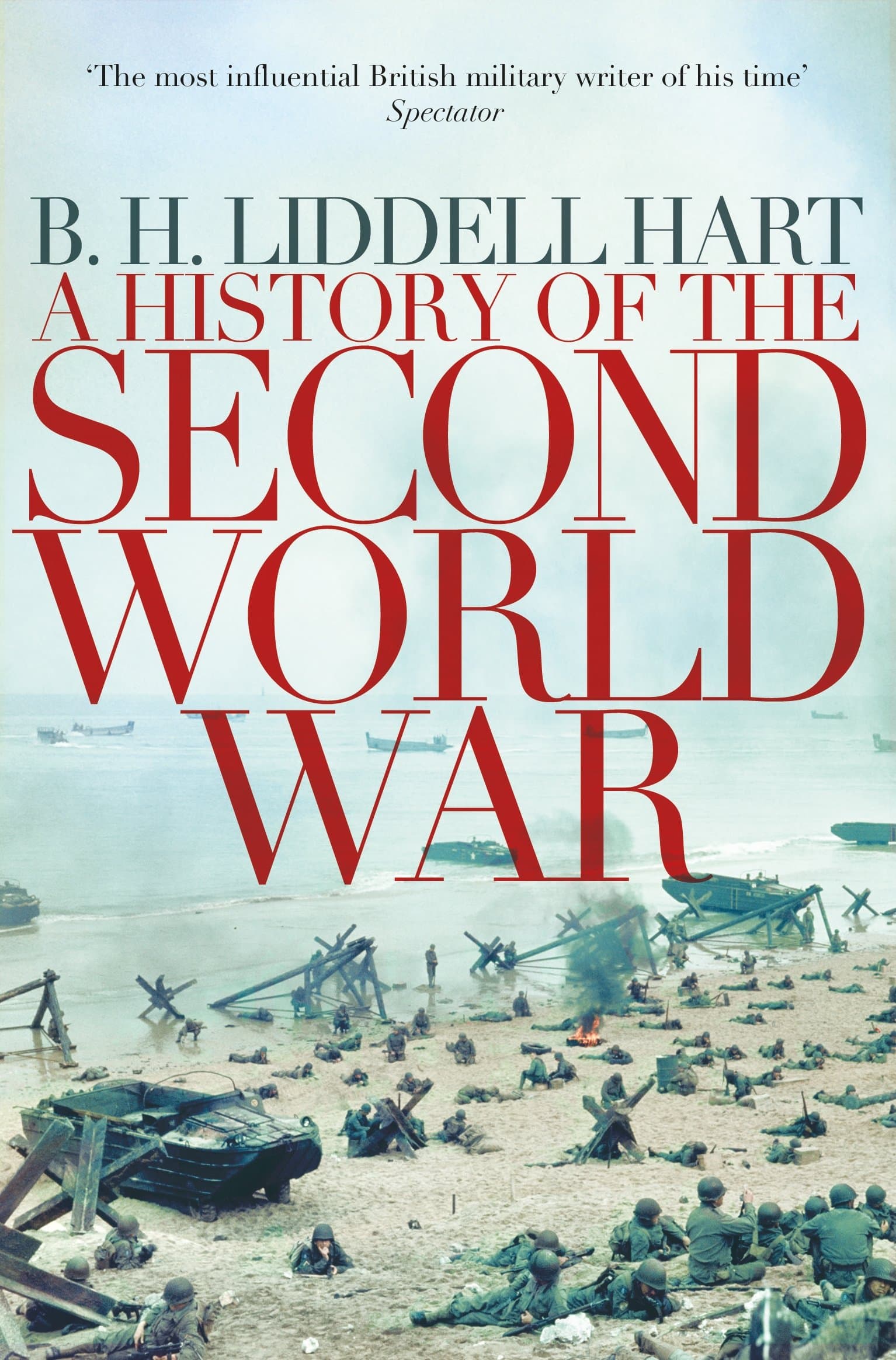
A History of the Second World War
F**L
WWII: Revisited by a Maverick Mandarin.
Sir Basil H. Liddell Hart can be fairly introduced as the premier British 20th Century military historian to have been a career, as opposed to a temporary wartime, officer. He emerged from the First World War much disillusioned, as was hardly uncommon, but remained in the military world through his long working life as critic, historian, and strategist. He applauded the British Army's tragically abbreviated experiments in tank strategy (the tank is a British invention and for a while in the 1920's Britain looked to seal her position as the master of tank use). During and after the Second War he interviewed a number of German POW senior officers; from this he developed probably the most complete sense of German military thinking on the Allied side. "The History of the Second World War" was the last of his many considerable works, finished very shortly before his death in 1970.The History (712 pp. of fairly dense print) is a general history of the War in all theaters. It has its fair share of slugging from battle to battle, though Sir Basil penetrates the fog of war better than most and as well as any. To most readers its most interesting chapters will likely be near the beginning and the end.Sir Basil's contempt for the gyrations of the British and French governments' early attempts to deal with Hitler is comprehensive and mordant. Unfortunately, he is probably right. It was always clear, and is now accepted, that the opportunity to stop Hitler was at the moment of his reoccupation of the Rhineland in 1936. That this action could have been challenged by a single French division is clear, and that this in turn would have destroyed most home confidence in Hitler's still young regime is a close certainty. Sir Basil keeps his still greater ridicule for the eventual Polish line in the sand (which actually precipitated WWII); Britain and France had no means of stopping Hitler in the East in time to save Poland--the only force that could have done so was Stalin's Russia, which the British and French (not entirely wrongly, to be sure) had already alienated.Thus, "It is only too evident that [Churchill], like most of Britain's leaders, acted on a hot-headed impulse--instead of with the cool-headed judgement that was once a characteristic of British statesmanship."For though Sir Basil had been a general supporter of Churchill in the late 1930s, he is very far indeed from joining the customary hosannas to the hero. He does not stop at Churchill's more obvious blunders (so starving Singapore's defenses that her fall to the Japanese was inevitable, the connected loss through lack of air-defense of the battleships Prince of Wales and Repulse, the obsession with the Africa campaign, the hideously expensive and generally useless second front in Italy, and many others). He goes straight to a point: Britain's lone stand against Hitler was doomed, and was thus a fraud.This is not entirely original. It was set forth by Churchill's predecessor, Joseph Chamberlain. Britain and France, to Chamberlain, lacked the military force (by 1940) to win a quick war against Hitler and lacked the economic resources to fight a long one. Victory, if it ever came, would leave Britain, France, and their empires shattered and drained of all power for the future. This, obviously, went twice for Britain standing without France and four times for Britain standing without France against not only Germany, but Russia as well. It was believed by many Englishmen, since branded as moral cowards. Hitler, it appeared and may well have been true, had little interest in war with England; his desired sphere was the Continent, more especially the Slavic east. England should reach a modus vivendi with Hitler and continue with her trade and her empire. Churchill was positioning his country for inevitable, and more or less pointless, destruction. England was saved by dumb luck.This deserves serious attention, as the truth, or the very near truth, always does. To one who grew up, as I, in the limping and subfusc England of the late 1940s and most of the 1950s it demands serious attention, indeed.And yet...Sixty years after the last shots England is one of the most prosperous nations of the world. Her institutions have come through largely intact. Her foreign posture may leave much to be desired, as her apparent lack of will to deal with her Muslims, but there is still a good deal of the old lion left, very different from the cowardice and moral relativity of France, Germany, and the Low Countries. The United States' entry into the war was not so sure as Churchill, Consuelo Vanderbilt's son, liked to think--but it was not very unlikely. Hitler's Germany was far more demonic that it might have seemed in 1939. And Hitler's self-defeat could somewhat have been profesied of a monster.Sir Basil has much of interest to say over the anatomy of the fall of France--but I will not enter into that here.His parting shot is Hiroshima and Nagasaki. It is the present consensus that that the Bomb was justified or that its use, given its existence, was made inevitable by the Japanese Empire's evident refusal to accept defeat and by the hideous cost, to Allied troops and to the Japanese civilians, of an invasion of Japan.This is a good argument. It becomes a bad argument if it can be shown that the Japanese government had, by that time, on the contrary, accepted that defeat was inevitable and was in fact trying very hard to surrender.It is this that Sir Basil tries, not without evidence, to put forward. Japan had apparently made, with the Emperor's blessing, overtures to Russia (with whom she was not then at war) to arrange talks of surrender. Stalin, with hopes of territorial larceny, sat on these. But further attempts by Japan did finally come to Western ears. They were largely ignored, or pushed aside by Truman's insistence on unconditional surrender. There is evidence that voices in the American and British military felt that they had high stakes in the dropping of the Bomb, in part as a warning to Stalin, and that any Japanese hesitation whatever made for a very good excuse.Sir Basil has not completely convinced me here--possibly only because I have heard the contrary argument too much.But like everything in this book, his ideas are trenchant, very well researched, and come out of a mastery of his subject and period. This is a major book. It is not a small project for the reader (I found myself turning past some pages of the endless tank battles in Russia, the complexities of Burma, among others). But this is the last work of a great man and should be read by anyone who takes the history of the 20th Century seriously.
A**F
Best book ever on World War II
B. H. Liddle Hart is the finest writer ever on World War II. This was his final work, distilling decades of research and delivered with the most concise, clear writing possible. He is an exceptional historian, and a most unusual writer. Not to be missed!!
N**.
Must read on WWII from a very informative historian. ...
Must read on WWII from a very informative historian. This is comes to my first few recommendations to start on WWII. That have a place shoulder to shoulder with Weinberg
D**R
Very informative. A must read that will raise a ...
Very informative. A must read that will raise a host of "what if" questions.
M**S
A classic of military history!
Liddell Hart was not only a knowledgable historian, but also a military man himself. His background clearly informs his insights -- particularly as relate to military strategy. It is especially worth reading to understand his critique of Churchill and the attempts to apply ideas from the Great War (World War I) to the Second World War. For a full discussion of the Holocaust, however, one need look elsewhere.
S**R
best of its kind
as an 88 yearold world war vet -this has the best written information of all my books on the war
G**Y
The best strategist, period.
He is the master! The best strategist of modern times, author of "Strategy."
J**N
The Actual History of the Second World War
Sir Basil Henry Liddell Hart has written this definitive piece of history!After pursuing truth about WWII I found this hardcover at B Dalton for $9.98. It was like a revelation after reading volumes of "politically correct" ideas about the subject.JUAN SULLIVANArlington, Virginia
Trustpilot
Hace 1 semana
Hace 4 días