We remain fully operational. Our teams are working around the clock to ensure your deliveries continue safely.

Descargar la aplicación


Servicios al cliente
Sobre nosotros
Copyright © 2025 Desertcart Holdings Limited
Descargar la aplicación
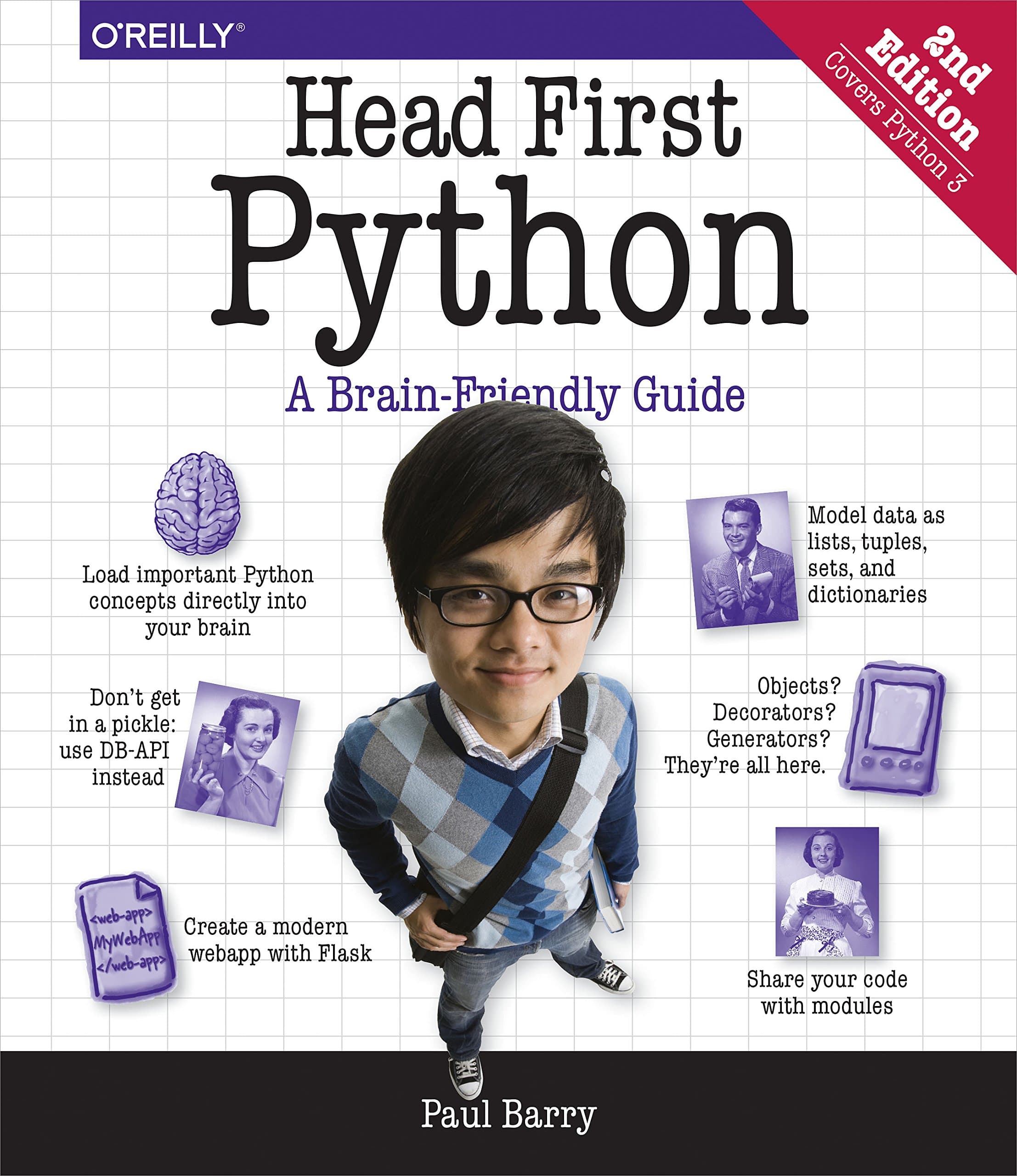
Explore the full series Visit the Store Explore the full series Visit the Store Brain-Friendly Guides Visit the Store Brain-Friendly Guides Learning isn't something that just happens to you. It's something you do. Learning means building more mental pathways, bridging connections between new and pre-existing knowledge, recognizing patterns, and turning facts and information into knowledge (and ultimately, wisdom). Based on the latest research in cognitive science, neuro-biology, and educational psychology, Head First books get your brain into learning mode. Learning isn't something that just happens to you. It's something you do. Learning means building more mental pathways, bridging connections between new and pre-existing knowledge, recognizing patterns, and turning facts and information into knowledge (and ultimately, wisdom). Based on the latest research in cognitive science, neuro-biology, and educational psychology, Head First books get your brain into learning mode. Review: I Highly Recommend This Book, Especially in Conjunction With Others - I'm learning Python for my job. My specific application is focused on data science and rote task automation. Before getting this book, I had picked up a copy of "Automate the Boring Stuff With Python" and "Python for Data Analysis". Both books do a solid job of introducing you to the areas of interest, but neither do a very good job of teaching a novice like myself how to start programming in Python (in my humble opinion). In those two books, I would struggle to get through the end-of-chapter test programs, because they required a lot of information that either wasn't addressed, or wasn't discussed until later in the book. That's where this book comes in. The explanations are intuitive, easy to follow, and the topics are covered in a way that facilitates (successful) user experimentation. Right now, I'm using all three books in tandem and things are starting to click and my code is starting to work with a lot less Googling and a little more tinkering on my part. Head First Python is a pretty quick read because of all of the graphics and generous spacing. Although I tend to prefer a sense of order, the cartoonish-looking page layouts really do aid the learning process. I believe that there is a psychological effect experienced by some people, wherein turning a page imparts a sense of progress. You will certainly turn a lot of pages quickly when reading this book, because of the layouts. This may give some people the fuel to keep going for longer stretches than they would if they were reading 50-page chapters of dense, verbose material. At the end of the day, I highly recommend this book, especially if you want to supplement it with something that pushes you a little more toward a specific application of Python. In my spare time over the last three weeks, I've cleared about 200 pages of each of the 3 books and I've written around 20 or 30 little programs (on top of dozens of hours in the iPython shell). By the end of week 4, I expect to start producing code for some of my medium-scope projects, and I'll continue to build on it as I learn. Review: Easier to get through the book because its fun to read. - Excellent introduction to Python. The book focuses on being fun to read and providing a real understanding of why things work the way they do. The other two intro to Python books I have are not fun to read and concentrate more on trying to teach the reader as many functions as possible but at the cost of being a bit dry. The author spends several chapters explaining how Python can be used to create a web app that stores and manipulates user entered data in text and SQL databases. This is also a topic I was very interested in but assumed I would need another book for it. I invested about 30 hours over 2 weeks going through this book and I feel that I now truly understand the foundation of how Python works. This book is definitely not a reference book but that's what Google is for.







| Best Sellers Rank | #1,051,774 in Books ( See Top 100 in Books ) #70 in Object-Oriented Software Design #854 in Python Programming #2,197 in Software Design, Testing & Engineering (Books) |
| Customer Reviews | 4.6 out of 5 stars 983 Reviews |
A**Y
I Highly Recommend This Book, Especially in Conjunction With Others
I'm learning Python for my job. My specific application is focused on data science and rote task automation. Before getting this book, I had picked up a copy of "Automate the Boring Stuff With Python" and "Python for Data Analysis". Both books do a solid job of introducing you to the areas of interest, but neither do a very good job of teaching a novice like myself how to start programming in Python (in my humble opinion). In those two books, I would struggle to get through the end-of-chapter test programs, because they required a lot of information that either wasn't addressed, or wasn't discussed until later in the book. That's where this book comes in. The explanations are intuitive, easy to follow, and the topics are covered in a way that facilitates (successful) user experimentation. Right now, I'm using all three books in tandem and things are starting to click and my code is starting to work with a lot less Googling and a little more tinkering on my part. Head First Python is a pretty quick read because of all of the graphics and generous spacing. Although I tend to prefer a sense of order, the cartoonish-looking page layouts really do aid the learning process. I believe that there is a psychological effect experienced by some people, wherein turning a page imparts a sense of progress. You will certainly turn a lot of pages quickly when reading this book, because of the layouts. This may give some people the fuel to keep going for longer stretches than they would if they were reading 50-page chapters of dense, verbose material. At the end of the day, I highly recommend this book, especially if you want to supplement it with something that pushes you a little more toward a specific application of Python. In my spare time over the last three weeks, I've cleared about 200 pages of each of the 3 books and I've written around 20 or 30 little programs (on top of dozens of hours in the iPython shell). By the end of week 4, I expect to start producing code for some of my medium-scope projects, and I'll continue to build on it as I learn.
B**T
Easier to get through the book because its fun to read.
Excellent introduction to Python. The book focuses on being fun to read and providing a real understanding of why things work the way they do. The other two intro to Python books I have are not fun to read and concentrate more on trying to teach the reader as many functions as possible but at the cost of being a bit dry. The author spends several chapters explaining how Python can be used to create a web app that stores and manipulates user entered data in text and SQL databases. This is also a topic I was very interested in but assumed I would need another book for it. I invested about 30 hours over 2 weeks going through this book and I feel that I now truly understand the foundation of how Python works. This book is definitely not a reference book but that's what Google is for.
A**K
Best book for basic pythonic techniques.
This book does a great job at explaining all the fine details of Python 3, and makes it easy for both beginners or intermediate developers alike. I was able to quickly get back up to speed with my programming skills with this book and now feel confident in my basic understanding of Python. The practice problems in this book help keep you up to speed with each chapter as well. If you want to take you Python skills from 0-100, I would highly recommend this book as you’ll learn more than any university book that’ll be given to you. I honestly with my university had made this my first book. In my opinion, this the best beginner book by a long shot.
P**N
Great book although Kindle search is lacking
When faced with a bunch of different Python books, this one looked like the most engaging. I opted for the Kindle edition, as I assumed that the search function would be essential. To be sure, HFP gets you right into coding. Before you know it, you're writing programs. I also revisited some SQL statements and learned some Mac Terminal commands along the way. I found Homebrew and MariaDB far easier to navigate than MySQL. I was able to follow along and endure the inevitable bumps. (One minor pet peeve: Kindle search didn't pick up code because the publisher chose to store these snipets as pictures. This made searching more difficult.) My mind is like oatmeal because a newbie programmer cannot learn a robust general-purpose language such as Python in ten days. Still, I enjoyed the book and know 100x as much about Python as I did two weeks ago.
N**R
Great intro to Python, very readable
This was exactly what I was looking for. Get's right to the point. Starts with simple yet interesting little programs right away. I started with "Learning Python". That book is so insanely mis-titled. It's freakin 1650 pages and introduces a tiny idea followed by 100 pages of permutations. The most boring book in the universe. Okay if you want a reference. This book has you start programming right away. It's written in a readable style and teaches you the stuff you want to know to get rolling. Infinitely preferrable.
N**S
As a seasoned professional, I enjoyed this as a walkthrough of a new language.
I've been learning from O'Reilly books for 21 years now, and I've never found anything to complain about in them. The Head First group of books has over the last few years become on of my favorite series from them. I've been programming for 24 years. My first O'Reilly book was the Camel book--the PERL reference, which helped me quickly reach a new level of competency in programming. My affinity for the Head First books is that they take the usual 101 textbook format and make it fun, interesting, and dialectically unique, in a common format. Down to a science. The writing, images, diagrams, asides, and everything else makes each book familiar but distinct, and easy to work through as leisure. I've been programming since I was 17, and most books back then were aimed at college students or professionals. It's nice to find books I can learn from leisurely, as I want to learn as many languages as I can. And these are also books I would suggest for younger programming enthusiasts at any level as a thorough introduction.
U**E
Love Head First
I haven't started this one, but I love Head First books. They helped me start and enjoy coding during the pandemic. I expect nothing less, but will add an update later.
R**C
Great for learning python quickly, because this book is different
This book makes you think, instead of all the other books that just show you examples and force you to learn through repetition. The authors did a great job of making the topics so much more interesting with different pictures and graphics and fonts, AND they ask you to create solutions for progressively more difficult problems. I have read many technology related publications over many years and this book is different from everything else I have read, and I learned much more quickly using this style.
Trustpilot
Hace 1 mes
Hace 4 días