
Descargar la aplicación


Servicios al cliente
Sobre nosotros
Copyright © 2025 Desertcart Holdings Limited
Descargar la aplicación
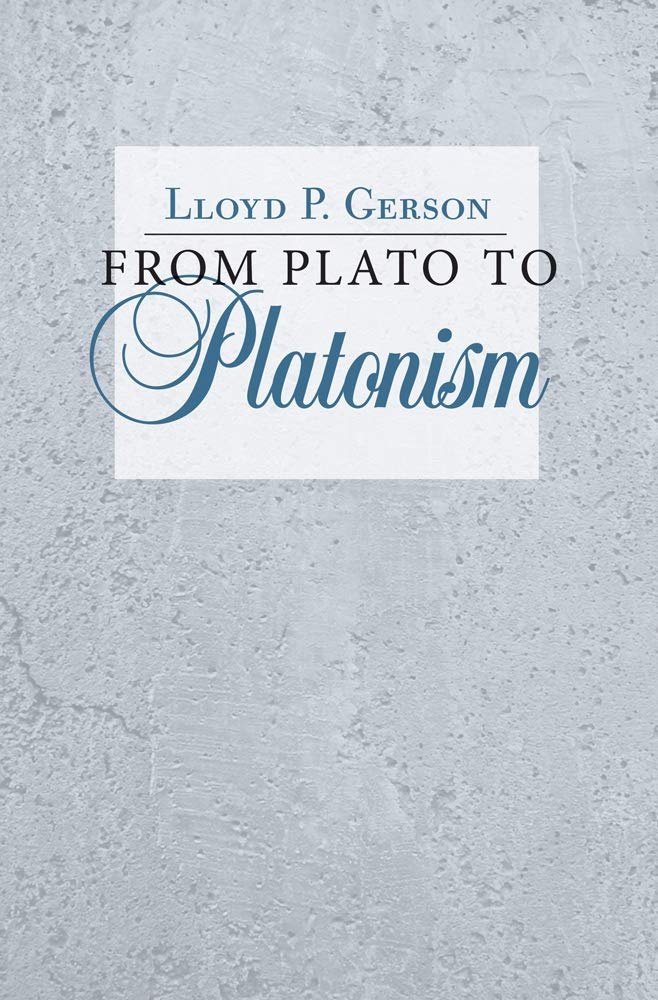
From Plato to Platonism : Gerson, Lloyd P.: desertcart.co.uk: Books Review: Wide in Scope - I'm about two-thirds of the way through this, and thoroughly enjoying it. It ties in a lot of the loose strings of thought that have come down to us, and knowing the history of the tradition gives a rich insight into the philosophy itself. Review: Demonstrates the unity of the Platonic school - Collingwood once pointed out that no-one writes a book unless they think that they can do better than their predecessors; hence, to understand a philosopher fully one needs to ask what they are opposed to as well as to what they advocate. Gerson has adopted this approach and identified the essence of Platonism in the rejection of five positions: skepticism, ethical relativism, materialism, determinism, and nominalism. On this basis we can see why Aristotle was considered a Platonist, albeit a deviant one, in Antiquity, while no-one could take a Stoic or Epicurean as a Platonist. Like all Gerson's work, this is thoughtful and convincing.
| Best Sellers Rank | 339,463 in Books ( See Top 100 in Books ) 4,061 in Religious History 4,292 in Religious Studies (Books) 8,092 in Philosophy (Books) |
| Customer reviews | 4.8 4.8 out of 5 stars (24) |
| Dimensions | 15.54 x 2.06 x 23.5 cm |
| Edition | Reprint |
| ISBN-10 | 150171063X |
| ISBN-13 | 978-1501710636 |
| Item weight | 508 g |
| Language | English |
| Print length | 360 pages |
| Publication date | 15 Dec. 2017 |
| Publisher | Cornell University Press |
| Reading age | 18 years and up |
S**N
Wide in Scope
I'm about two-thirds of the way through this, and thoroughly enjoying it. It ties in a lot of the loose strings of thought that have come down to us, and knowing the history of the tradition gives a rich insight into the philosophy itself.
D**N
Demonstrates the unity of the Platonic school
Collingwood once pointed out that no-one writes a book unless they think that they can do better than their predecessors; hence, to understand a philosopher fully one needs to ask what they are opposed to as well as to what they advocate. Gerson has adopted this approach and identified the essence of Platonism in the rejection of five positions: skepticism, ethical relativism, materialism, determinism, and nominalism. On this basis we can see why Aristotle was considered a Platonist, albeit a deviant one, in Antiquity, while no-one could take a Stoic or Epicurean as a Platonist. Like all Gerson's work, this is thoughtful and convincing.
F**O
Gerson begins by arguing how modern scholarship on Plato is flawed. Then begins to offer his own rationale for his approach to 'Platonism' generally. Platonism is any positive metaphysical construct on the basis of what Gerson calls Ur-Platonism or UP. UP is the matrix on which Platonism is founded on. UP consists in 5 antis- : antinominalism, antimaterialism, anitmechanism, antirelativism, and antiskepticism. The contradiction of these (which constitutes 'pure' Naturalism) is explicitly denied and argued against by Plato in the dialogues. Platonism is what you get when you start from these 5 anits and attempt to construct a positive metaphysical system on its foundation. Since UP is a matrix of antis, various versions of Platonism are inevitable. Making Platonism a large tent, though not infinitely large. Plato's philosophy (what is revealed in the dialogues though not identical with them) is ONE VERSION of Platonism (it is true that virtually all later Platonists believed Plato had the superior version). Gerson's central thesis is that the entire history of Platonism beginning from Plato (perhaps the Pre-Socratics as well) to the Platonists of late antiquity all share a life commitment to construct the most consistent, defensible, positive metaphysical system out of the foundational matrix that is UP. This positive metaphysical system is what Platonism Truly Is.
G**E
AS "the summary of the study of all Classical philosophy", 1] the whole history of Neoplatonism including especially the REJECTION by modern 'scholars' is LOGICALLY reexamined as the dual lens of Platonism (but where did it come from? Why is it so different from Presocratic philosophy?) and Aristotelianism (Where did IT come from if its MAJOR SOURCE is NOT Plato? What is the solid evidence that Aristotle is NOT through and through 'Platonic' and what does "Platonic" PRECISELY mean here?) 2] All the terms ONLY emotionally - from Christianity - grounded in Aristotle by modern scholars (from the Enlightenment on) such as "God", "love", "desire", "good", etc., are treated in their PROPER technical aspects not only as Plato and Aristotle did but even more so the Neoplatonists. 3] The logical structure of Platonism primarily established by Plotinus is such that technically a really brilliance mathematician or physicist could translate all of the ENNEADS into mathematical formulae EXACTLY AS THE PLATONISTS BOTH EXPLICITLY AND IMPLICITLY DID! When read correctly, all of their logic is precise and correct (within various parameters) according to a strictly hierarchical logic tree of genus and species. that must - at either end - resolve into an "indemonstrable First Principle" according to Aristotle's POSTERIOR ANALYTICS (among many other of his works) Book 2, chaps 19-20.
Trustpilot
Hace 1 mes
Hace 4 días