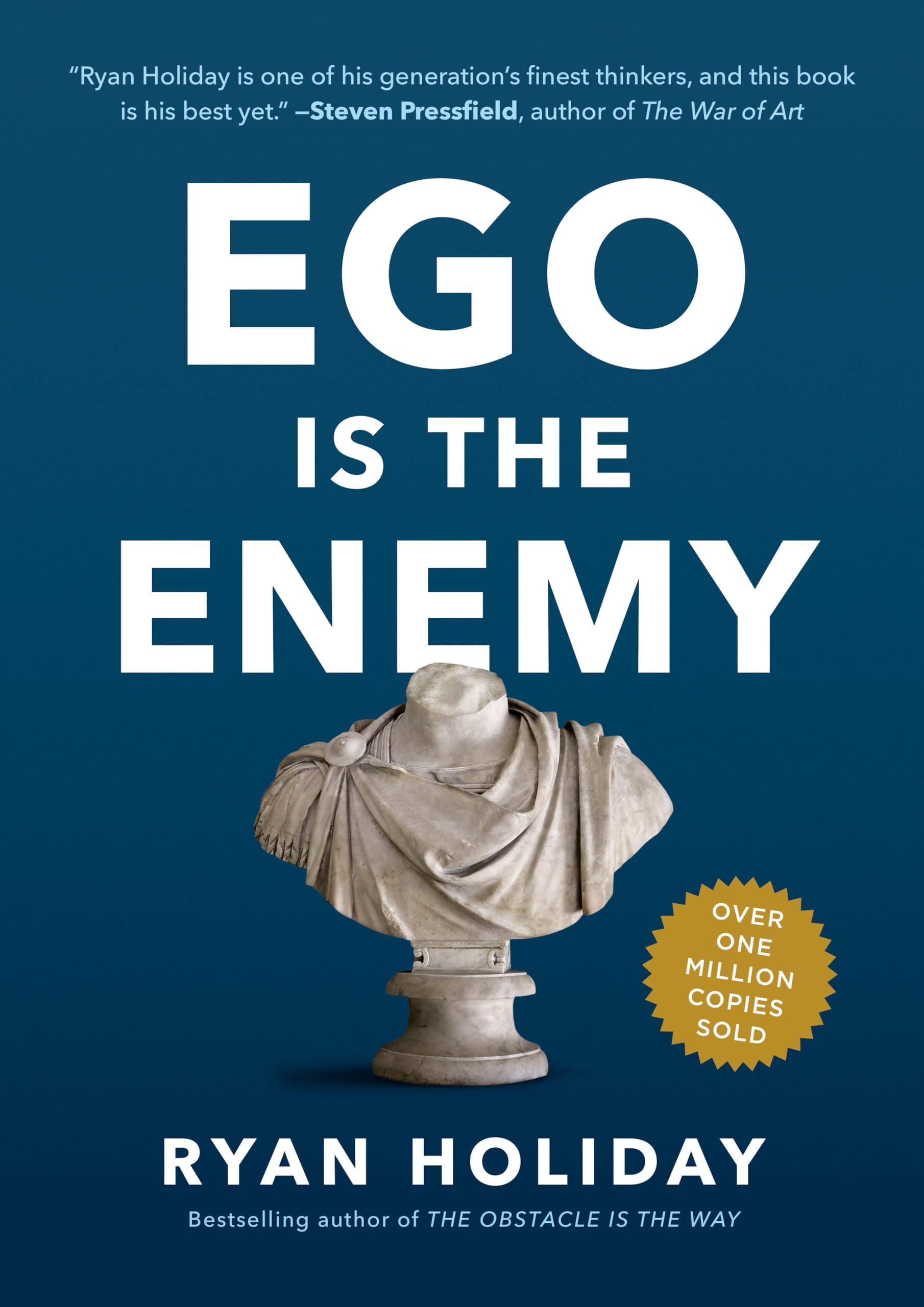

Ego Is the Enemy [Holiday, Ryan] on desertcart.com. *FREE* shipping on qualifying offers. Ego Is the Enemy Review: Well-written, Well-researched and Very Relatable - I have read many books on leadership throughout my graduate studies in organizational leadership and management, and throughout my own career in management. While this is not specifically a book on leadership or management, it has become absolutely clear that success in these fields requires an understanding of how ego affects one’s self, and others in a professional setting. What I appreciated most about this book over all the others is it’s candid approach to identifying the effects of ego on individuals, organizations, and on society as a whole. The author’s straightforward examples will repeatedly provoke the reader to recall their own real-life experiences where someone’s ego has impacted their personal or professional life. Maybe these realizations will involve past events or occurrences where the reader didn’t recognize ego as a factor until the author’s examples made comparisons to such past events so clear. Throughout the book, I found myself saying, “Damn! I did that, and it really was my ego that was running things. I should have thought it through better. It cost me....” Quite frankly, I have nothing but praise for this book, which I believe is a “must-read” for managers within any profession. It is neither oversimplified, nor overstated. In fact, the author drives his points home through multiple approaches and with a diverse array of references to historical figures and events, which exemplify both the control of ego and the lack thereof. The book is beyond a mere self-help resource, and is actually quite interesting to read. The author is obviously well-prepared and has done the reader the favor of dissecting individual, organizational and political actions through a specialized lens that ferrets out how ego has led to failure. These examples are not archaic parables, but include modern business figures, both well known and virtually unknown. Yet he does not simply call out failures of renowned egotistical figures, but offers analysis of how successful individuals chose the high ground over receiving personal praise in order to produce favorable outcomes on a much larger scale and for the greater good. Perhaps more importantly, he provides an equal number of examples were a humble individual or approach led to success on many levels. In the end, the reader will hopefully and candidly assess himself/herself, or as was the case for me, become more self-aware and see the glaring comparisons to my own past acts of egotistical actions. If one accepts the author’s many examples that support the assertion that ego holds so many of us back from our potential, then his ensuing suggestions and stoic philosophies become meaningful propositions worthy of our considerations. I did not find the book preachy or sanctimonious. I didn’t feel the author was pushing any specific dogma, but he does use the platform of stoicism as the guide here. Nonetheless, subsequent to laying out his case, the author’s pronouncemnts appear less as indictments of people, but rather the specific natural human tendency that is stronger is some of us than it may be in others: unchecked self-indulgent ego and the overemphasis on one’s own importance. The author challenges us to think back to the reason we started a career, chose a profession, accepted an assignment or launched a project. Was the purpose to feed our own egos, or did that proclivity sneak in somewhere along the way. The author aptly discusses the paradox wherein we must either choose to complete the job we originally were tasked to do, or merely to achieve recognition without truly accomplishing as much as we would have without expending the energy and capital seeking personal accolades. I found the author’s choice of content and his writing style to be inspiring, while still being very readable and relatable. I would propose that those considering this book are somehow aware that they could be affected by their own egos. Perhaps someone suggested it to them, or maybe a review or ad made them curious about how their ego might be at work. The paradox, of course, is that many people with pronounced egos will reject overtures into the examination of their own egos, as self-awareness is not a common trait among egotistical people. Hopefully, they will be motivated by some measure to start reading this book. As for me, the way I came to read the book is unimportant here, but within the first few pages, I found myself intrigued and looked forward to each reading session until I had finished. Aside from the impact it has had on me of purposefully controlling my own ego, a never-ending task indeed, the book has also launched me into seeking a better understanding of stoicism, and practicing it in my daily life. Now, as an instructor of organizational leadership, I’ve incorporated into my presentations quite a bit of the author’s teachings and even quotes from his book (because he seems to capture some points so well that I could find no renowned scholars or historical figures that said it better). I certainly hope we see more offerings of this caliber and practical utility from author Ryan Holiday. Review: Everyone Should Read This - This is one of the most needed books today. Everyone has an ego, and those who do not believe this truth, are the most blinded themselves. This was a great read, the stories are excellent, the wisdom is true, and the book helps to navigate an ego inflating world. "Now more than ever, our culture fans the flames of ego. It’s never been easier to talk, to puff ourselves up (4)". This is a book that everyone young person should read. It will inspire you to focus on substance, and not on image. We need more people of real character, and not more people trying to make a name for themselves. "Impressing people is utterly different from being truly impressive." The book talks about staying the student, still working hard, and realizing actions should be motivated through true motives. Too often we hid away from feedback, because we cannot admit we are wrong. We protect ourselves, but really behind these actions is an ego. We create static positions for ourselves. The author writes "It is impossible to learn that which one thinks one already knows,” Epictetus says. You can’t learn if you think you already know. You will not find the answers if you’re too conceited and self-assured to ask the questions. You cannot get better if you’re convinced you are the best." I really like some of the characters from history that the author talked about. One was General Sherman, and his approach to fame. Other men who were successful during this time, demanded power, but it seemed that Sherman was happy to serve, and be content with this truth. The book talks about the need to help others. Imagine if for every person you met, you thought of some way to help them, something you could do for them? And you looked at it in a way that entirely benefited them and not you. The cumulative effect this would have over time would be profound: You’d learn a great deal by solving diverse problems. You’d develop a reputation for being indispensable. You’d have countless new relationships. You’d have an enormous bank of favors to call upon down the road." Instead people sometimes write and work to help themselves, to create advantages for themselves, but this approach is more concerned with YOUR needs, and not those around you. Help others, and others will help you perhaps. Ego is probably one of the most destructive forces in the world today. Too many of fallen to its sweet song of pain. Great book to read.


| Best Sellers Rank | #1,967 in Books ( See Top 100 in Books ) #9 in Motivational Management & Leadership #38 in Success Self-Help #82 in Motivational Self-Help (Books) |
| Customer Reviews | 4.6 out of 5 stars 21,035 Reviews |
H**Z
Well-written, Well-researched and Very Relatable
I have read many books on leadership throughout my graduate studies in organizational leadership and management, and throughout my own career in management. While this is not specifically a book on leadership or management, it has become absolutely clear that success in these fields requires an understanding of how ego affects one’s self, and others in a professional setting. What I appreciated most about this book over all the others is it’s candid approach to identifying the effects of ego on individuals, organizations, and on society as a whole. The author’s straightforward examples will repeatedly provoke the reader to recall their own real-life experiences where someone’s ego has impacted their personal or professional life. Maybe these realizations will involve past events or occurrences where the reader didn’t recognize ego as a factor until the author’s examples made comparisons to such past events so clear. Throughout the book, I found myself saying, “Damn! I did that, and it really was my ego that was running things. I should have thought it through better. It cost me....” Quite frankly, I have nothing but praise for this book, which I believe is a “must-read” for managers within any profession. It is neither oversimplified, nor overstated. In fact, the author drives his points home through multiple approaches and with a diverse array of references to historical figures and events, which exemplify both the control of ego and the lack thereof. The book is beyond a mere self-help resource, and is actually quite interesting to read. The author is obviously well-prepared and has done the reader the favor of dissecting individual, organizational and political actions through a specialized lens that ferrets out how ego has led to failure. These examples are not archaic parables, but include modern business figures, both well known and virtually unknown. Yet he does not simply call out failures of renowned egotistical figures, but offers analysis of how successful individuals chose the high ground over receiving personal praise in order to produce favorable outcomes on a much larger scale and for the greater good. Perhaps more importantly, he provides an equal number of examples were a humble individual or approach led to success on many levels. In the end, the reader will hopefully and candidly assess himself/herself, or as was the case for me, become more self-aware and see the glaring comparisons to my own past acts of egotistical actions. If one accepts the author’s many examples that support the assertion that ego holds so many of us back from our potential, then his ensuing suggestions and stoic philosophies become meaningful propositions worthy of our considerations. I did not find the book preachy or sanctimonious. I didn’t feel the author was pushing any specific dogma, but he does use the platform of stoicism as the guide here. Nonetheless, subsequent to laying out his case, the author’s pronouncemnts appear less as indictments of people, but rather the specific natural human tendency that is stronger is some of us than it may be in others: unchecked self-indulgent ego and the overemphasis on one’s own importance. The author challenges us to think back to the reason we started a career, chose a profession, accepted an assignment or launched a project. Was the purpose to feed our own egos, or did that proclivity sneak in somewhere along the way. The author aptly discusses the paradox wherein we must either choose to complete the job we originally were tasked to do, or merely to achieve recognition without truly accomplishing as much as we would have without expending the energy and capital seeking personal accolades. I found the author’s choice of content and his writing style to be inspiring, while still being very readable and relatable. I would propose that those considering this book are somehow aware that they could be affected by their own egos. Perhaps someone suggested it to them, or maybe a review or ad made them curious about how their ego might be at work. The paradox, of course, is that many people with pronounced egos will reject overtures into the examination of their own egos, as self-awareness is not a common trait among egotistical people. Hopefully, they will be motivated by some measure to start reading this book. As for me, the way I came to read the book is unimportant here, but within the first few pages, I found myself intrigued and looked forward to each reading session until I had finished. Aside from the impact it has had on me of purposefully controlling my own ego, a never-ending task indeed, the book has also launched me into seeking a better understanding of stoicism, and practicing it in my daily life. Now, as an instructor of organizational leadership, I’ve incorporated into my presentations quite a bit of the author’s teachings and even quotes from his book (because he seems to capture some points so well that I could find no renowned scholars or historical figures that said it better). I certainly hope we see more offerings of this caliber and practical utility from author Ryan Holiday.
M**E
Everyone Should Read This
This is one of the most needed books today. Everyone has an ego, and those who do not believe this truth, are the most blinded themselves. This was a great read, the stories are excellent, the wisdom is true, and the book helps to navigate an ego inflating world. "Now more than ever, our culture fans the flames of ego. It’s never been easier to talk, to puff ourselves up (4)". This is a book that everyone young person should read. It will inspire you to focus on substance, and not on image. We need more people of real character, and not more people trying to make a name for themselves. "Impressing people is utterly different from being truly impressive." The book talks about staying the student, still working hard, and realizing actions should be motivated through true motives. Too often we hid away from feedback, because we cannot admit we are wrong. We protect ourselves, but really behind these actions is an ego. We create static positions for ourselves. The author writes "It is impossible to learn that which one thinks one already knows,” Epictetus says. You can’t learn if you think you already know. You will not find the answers if you’re too conceited and self-assured to ask the questions. You cannot get better if you’re convinced you are the best." I really like some of the characters from history that the author talked about. One was General Sherman, and his approach to fame. Other men who were successful during this time, demanded power, but it seemed that Sherman was happy to serve, and be content with this truth. The book talks about the need to help others. Imagine if for every person you met, you thought of some way to help them, something you could do for them? And you looked at it in a way that entirely benefited them and not you. The cumulative effect this would have over time would be profound: You’d learn a great deal by solving diverse problems. You’d develop a reputation for being indispensable. You’d have countless new relationships. You’d have an enormous bank of favors to call upon down the road." Instead people sometimes write and work to help themselves, to create advantages for themselves, but this approach is more concerned with YOUR needs, and not those around you. Help others, and others will help you perhaps. Ego is probably one of the most destructive forces in the world today. Too many of fallen to its sweet song of pain. Great book to read.
A**R
Good book... would recommend for leaders
I enjoyed this book... good reminder for us on keeping our egos in check. I enjoyed the stories and history used to teach lessons. Each chapter is sort of it's own little story. You could almost read the chapters out of order, and it would still be a good read. I've stolen some ideas for sure to use with future presentations and reminders for myself.
S**E
Absolutely worth reading right away.
This is the first time I've felt compelled to write a review as soon as I've finished reading a book. I set out to read a few chapters this morning and instead devoured the whole thing in one sitting, wrote something about it for my personal site, and then clicked over to Amazon to order a hardcover copy (to go along with the kindle version I have). I have a hunch that hardcover is gonna be beat to hell, full of underlines, highlights, and notes over the next decade as I continue to refer back to it. This book is important and I'm glad Ryan battled his way through to publish it. if you're a creative, you do any work on the internet, you're climbing a corporate ladder, you play sports, or you're just trying to do good work and live a decent life, this book is a worthwhile read. It touches on entitlement, paying ones dues, apprenticeship, and probably most importantly...what to do AFTER you've found success (which is where so many lose their edge or get too self-important and don't realize it until far too late). It gets a bit quote-heavy throughout, but thankfully 95% of the quotes aren't the same recycled ones that many self-help books regurgitate. These were all new ones from people I was unfamiliar with that led me down new rabbit holes. Read it, and really think about the questions it provokes in your brain. It made me think about a LOT of things and analyze what's truly important in the pursuit of success, financial stability, fame, happiness, etc. I'm sure subsequent readings will reveal even more questions that I'll have to answer myself. No plans on moving to a hut in Tibet, just will make an effort to be constantly aware of my internal monologue and why I feel compelled to do certain things! Thanks for putting together a succinct and thought provoking book Ryan!
B**S
Well thought out and quick read
A short book which is broken up into individual 'chapters' which each seek to convey a message of self-restraint and humble introspection. The author uses quotes and quips from historical figures both ancient and modern to bolster his message that it is only through being aware of our own false sense of being more than what we actually are (ego) and fighting against the false security that the ego provides that we are able to become better than we were before we became aware and actively sought to fight against the false security. The book is broken up into three sections. The first is about when you seek to start something. The second is when that something is going well. The third is when that something fails. Each section has a few 'chapters' made up of paragraphs. Each paragraph contains a quote or example of someone in history who had wise words or went through a period of growth/strife. The examples are all well placed and the author took his time in making sure that there was an actual point to why he chose the things he did. Many of the lessons and the further writings of these individual historical figures are worth further examining and many I had never heard of before. The author goes to great lengths at the end of the book to point out that his work is only possible because of the preceding works by those he cites. I enjoyed the quick read and will definitely take some of the advice to heart. Having many different perspectives on success and failure as well as failure to launch in a concise and quick to finish format was a refreshing few hours and gave me many new authors to add to my reading list.
C**R
A modern work of practical philosophy
If ego is nothing more than a Freudian concept to you, then you may not have any idea how it’s holding you back right now. But don’t think that author Ryan Holiday aims to bore us with the same stale pop-psychology tropes that most books on the Self-Help shelf use to fill out their pages. What the author has provided us is actually a great work of modern practical philosophy. Those familiar with Holiday’s last book, “The Obstacle is the Way,” will know exactly what practical philosophy means. Eschewing the commonly held view that philosophy is the province of academics in classrooms bloviating about abstract concepts, Holiday follows the Stoic tradition that puts philosophy firmly in the realm of everyday life. It’s about learning to deal with destructive emotions, unpredictable circumstances, self-interested people, and yes, ego, without succumbing to them. It’s philosophy as a way of achieving a better life. In “Ego is the Enemy,” Holiday moves beyond the clinical definitions of ego and places the concept firmly in the realm of the practical. To be sure, the clinical and the practical in this case have some common ground. Modern psychologists define the ego as a critical part of identity construction, and further, an egotist as someone excessively focused on himself. Holiday defines ego along those lines: “an unhealthy belief in our own importance. Arrogance. Self-centered ambition…It’s when the notion of ourselves and the world grows so inflated that it begins to distort the reality that surrounds us.” The idea that becoming untethered from reality is the primary symptom of an ego out of control is the thread that unites all three sections of this book. Holiday expands this idea throughout the three sections that form a continuum - Aspire, Success, and Failure - to show how this form of ego plagues everyone from the ambitious and striving, to the wildly successful and those who have been crushed by personal and professional defeat. In our own lives, we are always somewhere on that circle of aspiration, success and failure. To this end, Holiday goes right to the sources of practical wisdom: the primary sources of great practical wisdom – Seneca, Marcus Aurelius, Aristotle, and Martial to name a few - and the biographies of those who apply that wisdom to great effect or ignore it at their own peril. This is where Holiday’s other key influence, strategist and author Robert Greene, becomes apparent. Like Greene, all of Holiday’s chapters start out with a short, pithy title sets the direction of the advice contained within the chapter. From there, Holiday mines the stories of great men and women who have either applied the advice laid out in the chapter title or ignored it and shows us the consequences of both. For example, in the chapter titled, “Restrain Yourself” in the Aspire section of the book, Holiday launches right into the story of Jackie Robinson. As the first black player in the newly integrated MLB, Robinson faced discrimination and outright abuse at the hands of everyone from his own teammates and opponents, to hotel managers and restaurant owners and, of course, the press. At any point, Robinson could have lashed out, fighting back to defend his dignity against the injustices he faced. But Robinson knew that if he fought back even once, it would end his MLB career and set the prospect of full integration of the league back for a generation. As Holiday writes, “Jackie’s path called for him to put aside both his ego and in some respects his basic sense of fairness and rights as a human being.” Now, it’s likely that few of us will face the kind of treatment Robinson did, but the lesson here is that when we have ambitions and goals, we’re likely to run into the kind of people that Robinson did. The kind who react to your striving with cold indifference. The kind who aim to weaken your will with taunts and jeers. The kind who will go out of their way to sabotage you and undo all your efforts. Holiday concludes here that ego tells us to snap back at these people and demand the respect we think we deserve. But that won’t earn it from anyone. We must ignore this impulse, no matter how badly we’re treated, and continue to work on our craft and ourselves. We must forget what we think the world owes us and focus on building our base, developing our skills and continuing to learn. The rest of the chapters follow this same model, and plumb the depths of modern and ancient history to show us how those who put their egos aside achieve great things. Think of New England Patriots head coach Bill Belichick spending years doing unpaid grunt work and film study before finally getting a chance to put his knowledge into practice. Think of the great conqueror Genghis Khan seeking greater knowledge and expertise from those he defeated, rather than forcing them into silent subservience. Yet, others turn themselves into cautionary tales. Howard Hughes was a mechanical genius who inherited a successful family business, and then squandered all of it through a lack of focus, entitlement and paranoia. John DeLorean had a great vision for an automobile company, but never built the solid foundation of leadership skills he would need to run a successful company. Holiday gives us a healthy dose of both kinds of stories, and that’s what makes the advice in this book stick with us. Ultimately, practical philosophy is meant to be used in our daily lives, away from the safety of our reading chair. Holiday’s aphoristic style of advice, bolstered by memorable stories is what gives us the tools we need to remember this wisdom when our egos start to take control of us. Holiday positions the three states of our lives – Aspire, Success and Failure – as being a never ending continuum. We must put our egos aside as we aspire to our goals, aside when we achieve them, and aside again when we flame out and have to start over. At each stage, ego threatens to knock us off the continuum altogether and lock us into an unproductive state of stasis. Taming your ego is never easy, but it is essential when we are confronted by failure or bolstered by success, as we all will be in our lives. Ego can easily let both conditions become debilitating: With success, we think we can stop being humble and working hard. In failure, we can become paralyzed, blaming others for our rotten luck and ignoring the fact that it’s on us to right the ship. Ego is always encroaching on us, even after we think we’ve beaten it back. As Daniele Bolelli puts it, a floor doesn’t stay clean because you’ve swept it once; you must sweep again and again. With this short, accessible book, Holiday gives us the tools we need to do just that.
A**R
Great read, will read this book many times
This book is a great read and a book that I will go back to for many years to come. Filled with wisdom and many great case studies and anecdotes. Immediately applicable for all stations of life. Buy it now
O**K
⭐️⭐️⭐️⭐️⭐️ A Timeless Wake-Up Call – Even Chapter One Hits Hard
I just started Ego Is the Enemy and after reading only the first chapter, I already feel the impact. Ryan Holiday doesn’t waste time sugarcoating—he dives right into the hard truths. The writing is sharp, thoughtful, and refreshingly grounded. Even from the opening pages, you can tell this book has the power to shift perspectives. Physically, the book is excellent quality. Crisp pages, sturdy binding, and yes—I have to say it—that fresh book smell we all secretly love. It’s a small detail, but it made cracking open the first page feel even better. Excited to keep reading. If the rest of the book is anything like the first chapter, I’m in for something transformative.
Trustpilot
Hace 1 mes
Hace 1 mes