We remain fully operational. Our teams are working around the clock to ensure your deliveries continue safely.

Descargar la aplicación


Servicios al cliente
Sobre nosotros
Copyright © 2025 Desertcart Holdings Limited
Descargar la aplicación
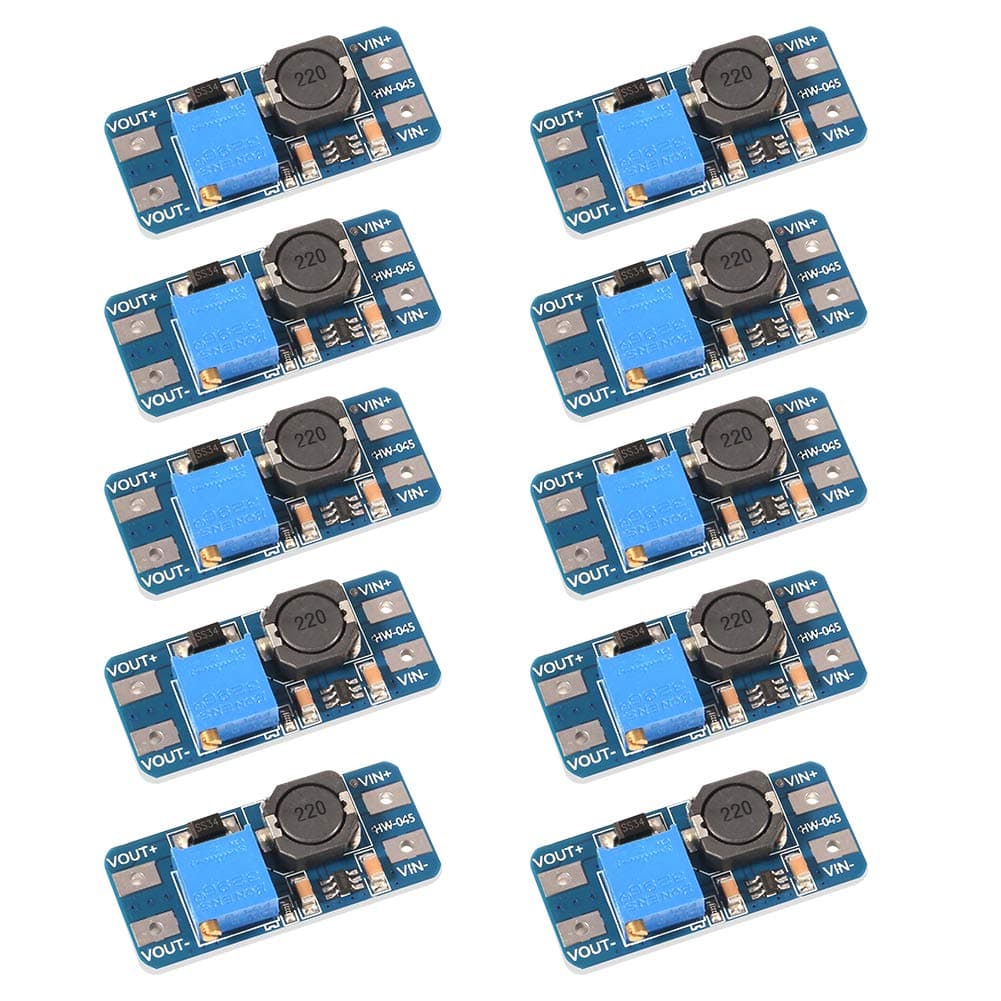
⚡ Elevate Your Voltage Game — Power Up Like a Pro!
The Mt3608 DC-DC Step Up Boost Power Converter is a compact, high-efficiency voltage regulator module capable of boosting input voltages from 2V to 24V up to an adjustable 5V-28V output at a maximum 2A current. Featuring a small PCB footprint and integrated safety protections, this pack of 10 modules is ideal for DIY electronics, industrial equipment, and power supply customization, delivering reliable performance with up to 93% efficiency.
| ASIN | B089JYBF25 |
| Best Sellers Rank | #28,003 in Electronics ( See Top 100 in Electronics ) #444 in International Power Adapters |
| Brand Name | DORHEA |
| Current Rating | 2 Amps |
| Customer Reviews | 3.9 3.9 out of 5 stars (420) |
| Item Dimensions D x W x H | 14D x 17W x 14H millimeters |
| Item Weight | 1.76 Ounces |
| Manufacturer | Dorhea |
| Model | U13538-1 |
| Mounting Type | PCB Mount |
| Part Number | U13538-1 |
| Power Source | DC |
| Specification Met | CE, RoHS, UL |
| UPC | 701715434011 |
| Unit Count | 10.0 Count |
O**Y
Quality is good
Quality is good
P**G
I received 10 boards and tested 1 of them and did not work with 4.1v input. No change in output voltage regardless of potentiometer. Tried two more boards and they are the same. The boards should work with greater than 2v but did not work. I am returning them no point of checking remaining 7 boards. After further testing none of the boards are defective. The issue is that you need to turn potentiometer at least 20~30 turns all the way both sides and at one point output voltage will increase. Turn until u hear click sound. If no change then turn opposite direction and it should work but many turns in that direction.
L**K
I had the desire to reliably control my Noctua 12V 0.6Amp fan, but when powered from the wall-mounted, socket with a USB port (5V, 3.1Amp max supply). The fan works brilliantly within the full voltage range between 5.2V-12V. I am very happy with the purchase as the unit does not heat up at all and is stone-cold even after 3h of continuous work. The pot is quite sensitive, circa 2 turns per Volt Little side note: Comments sections are really entertaining: it appears that only a few people had sufficient grasp of knowledge, that from 4.2V LiPo battery, even if you connect four of those boost units, you will not get reliable 110V AC ;) On the other hand - always choose the boost applicable to the project. Happy tinkering, guys.
G**Q
I use these module in a product I sell. I need a source of 20V from the internal 12V supply. They are simple, convenient, readily available and inexpensive. So far, they have been reliable and easy to use.
J**S
It didn't work out of box. VOUT reads a bit lower than VIN, suggesting the chip not switching. I tried to adjust the pot and no luck. After reading so many 1 star reviews with the same behavior I was a little worried. Then I checked the datasheet of the IC (MT3608), measured the layout of the board out, eventually figured it out. Is it a 100k pot and when out of the box it was adjusted so that VOUT is almost shorted to FB, in which case the IC won't be able to regulate FB to 0.6V, which is its desired setpoint. One might want to crank the pot all the way counterclockwise (oh boy it was a lot of turns) so that resistance between VOUT and FB is closer to 100k instead of 0 and then go from there. I then connected VOUT net to my electronic load for up to 5.2V@2A load and it handles that just fine. It does get uncomfortably hot when wattage is above 15w or so, you will want to validate for your application. Also the regulation linearity is just so so underload. But hey I paid 8 bucks for 10pcs so wouldn't complain too much. TLDR: Measure resistance between pot pin 2 (the pin in the middle) and VOUT. If too low (less than a couple kOhm or so), it's not likely to work as intended. Turn the pot counterclockwise until this resistance reads in 10kOhm or higher, then connect your VIN and adjust from there.
T**S
I saw the copious negative reviews for these, but they were dirt cheap so I gambled anyway. I rapidly tested three modules on my bench just to see what all the fuss was about. They all worked perfectly fine. Even with 3.4V input I could take them past 20V output at moderate load. At lower voltage delta, I could push them past an amp. Yeah, voltage will sag at high loads, so adjust based on your load. Voltage was reasonably stable for a given load and pot adjustment. At certain points I could hear some switching harmonics, but that’s normal. I think people need a reality check. You want a truly constant voltage power source? You ain’t getting it from a <$1 module. Sure the listing rates these at 2A, but also use some common sense. That’s probably an intermittent maximum rating and it very much depends on how much of a step up you are asking the little device for. More realistically, put a realistic power expectation in your head and understand that you need to derate as you increase the step up. I tested 12Vin and 16Vout with 2A output and had no issues. Efficiency drops as voltage delta increases. It’s a tiny little switcher IC and there’s no heatsink. Play stupid thermal games with it and win stupid thermal prizes. You want a comprehensive datasheet with exact thermal and load ratings? Go spend more money or build your own to spec. If you don’t understand that most trimmer pots are 20 turn, don’t play with module level components. If you just want a really cheap way to step up a voltage and you have realistic power expectations based on the size of this little IC, hard to beat these.
Trustpilot
Hace 1 mes
Hace 2 meses