

Desert Online General Trading LLC
Warehouse # 7, 4th Street, Umm Ramool, Dubai, 30183, Dubai
Desert Online General Trading LLC
Warehouse # 7, 4th Street, Umm Ramool, Dubai, 30183, Dubai




🚀 Elevate Your Tech Game!
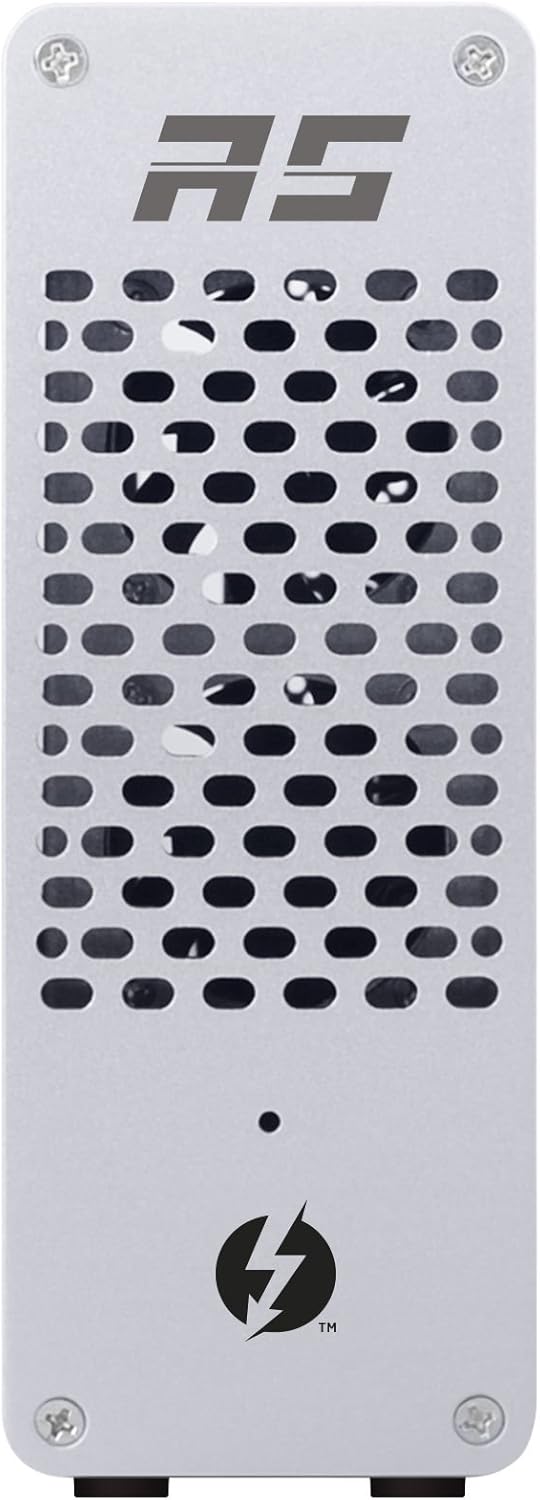
The HighPointRocketStor 6661A is a cutting-edge Thunderbolt 3 to PCIe 3.0 X16 expansion chassis, designed for professionals seeking high-speed connectivity and versatile expansion options. With support for daisy chaining up to 6 devices and compatibility with a wide range of PCIe cards, this chassis is perfect for enhancing your storage and connectivity capabilities while maintaining a quiet and efficient operation.


| Brand | HighPoint |
| Series | RS6661A |
| Item model number | RocketStor 6661A |
| Operating System | Windows, Linux, macOS |
| Item Weight | 4.6 pounds |
| Product Dimensions | 6.3 x 2.24 x 10.12 inches |
| Item Dimensions LxWxH | 6.3 x 2.24 x 10.12 inches |
| Color | White |
| Manufacturer | HighPoint Technologies Inc. |
| ASIN | B07CTL7XWJ |
| Is Discontinued By Manufacturer | No |
| Date First Available | April 30, 2018 |
R**L
This little thing did the trick. I have a modern Asus mobo that supports Thunderbolt. I use LTO drives to backup my content. This enclosure does the trick
J**I
Setup: * 27" iMac 5k with TB2 ports. * HighPoint RocketStor 6661A * Third party PCIe to NVME adapter * Generic 1TB NVME & SSD in a USB 3.0 case (for APFS Fusion) Some Pros: Quiet or the fans don't work. Solid build. Easy to get into the device. Discreet. No crazy vibrations. (I don't like fan or drive vibrations) Cons: No On/Off switch. These devices (external chassis) still have a low adoption and the information out there only focuses on graphics. The one that did focus on NVME did not cover this information. Now for the TL;DR user experience: I wanted to future proof myself with a Thunderbolt 3 expansion to use with my 27" iMac 5k (late 2015). I was very nervous at first since the device had poor reviews. I've had it for 2 weeks now and it's had there has been a fair share of issues but I wouldn't say all of them are Highpoint's fault. I used the Apple TB3 (USB-C) to TB2 adapter to get this to work on my iMac with TB2. I placed a Vantec PCIe card in the enclosure and used a generic 256GB Inland Professional NVME I took out of my Windows box. At this point, I had a secondary SSD in a TB2 dock form a different Vendor. My first step was to even see if macOS saw the device. When I first turned it on, it did not recognize or power up. I was starting to get nervous. For some reason it did not like the Apple TB2 cable. I swapped it out with a 3rd party TB2 cable that I previously purchased. Voila. There's the device. I reformatted macOS and set it up to use the combined 480GB OCZ SSD w/ 256Gb Inland NVME. This setup worked like a charm but it had issues returning from sleep. This is apparently a known issue on a lot of devices. It's not just Highpoint. I got around this by turning off certain power settings such as auto shutoff, standby, and hibernation modes using pmset. Now It was working brilliantly. However, the NVME was only 256GB and I wanted more... I decided to take the TB2 dock back and buy a 1TB NVME instead. The original OCZ 470GB SSD was using USB 3.0 and I wanted to try the TB2 dock. I couldn't afford both the dock and the enclosure though. Now to get macOS on a new APFS Fusion drive using the 1TB NVME plus the OCZ SSD (now in a USB 3.0 enclosure). That's when all the troubles started. The fusion was created automatically and set the 1TB to the "main" device and the 480GB to the "Secondary (Aux" device. (Personally I wish APFS could span drives or use JBOD similar to Windows Storage Spaces. Right now it defaults to Fusion.) Over the next few days, I would have to unplug the Highpoint, cross my fingers, and hope I could option boot and see the drive during selection. Otherwise I'd get the folder with the blinking question mark or have to reset PRAM. Being an old timer Mac guy, I remembered that Macs would scan ports in a specific order during boot time. This apparently never changed from the old SCSI days. I started wondering if the Thunderbolt is last on the chain. I checked disk utility and found the synthesized APFS fusion drive was showing up as USB. Below that was the container and volume. Each were showing up as PCIe. I knew that had to be an issue. Apparently, it was scanning the USB device first before getting to the TB3 device and that in turn led to the question mark. It couldn't find the system on the USB device because the system resided on the NVME. I reformatted and reinstalled but it always showed up the same. You are probably wondering why even set it up that way. Well even with TB2, NVME, and a USB SSD, I was getting ~1200MB/s write and ~1400MB/s read. Together they made up 1.5TB of solid state love. That's a lot of space. What can I say? I am a glutton for space (punishment). Unfortunately, I had to redo the whole installation and manually create the APFS fusion drive so that the slower 480GB SSD was the "main" device and the 1TB NVME was the secondary (Aux) device. Voila! Now it boots up fine. It still doesn't respond to sleep well. That's a known issue though. It's not just Highpoint and I *did* use a generic NVME. (Inland Premium without firmware patches) Is it fast? Not as fast as the original setup but that's only when benchmarking. It's fast when booting up. When starting apps, I get about one bounce. Sometimes no bounce. So yeah. That's fast. Plus maybe it's better to have the secondary drive this way to prevent overall wear on that drive. I will report back in about a month. Fingers crossed.
G**L
I purchased one of these to so I could use a LTO tape drive with my Intel NUC. Pros: cheaper that the rest and works. Cons: the PCIe slot is smaller than most cards with an open end. At first it thought there was no chance this thing would take my card. Fans are a little rattly and build quality is about 70% of what you’d like. I’d be happy to pay $50 more to get better quality (but all products on the market like this get the same critical reviews on quality). But the biggest problem is if you’re unfamiliar with how Thunderbolt interacts with windows security. When you plug the device in Windows pops up a message asking if you approve the device. But even when you say yes it doesn’t work. I had already started an Amazon return when I decided to take another look. Device manager has a Cisco driver with an arrow icon on it. I opened the properties and saw that it was disabled. After enabling the driver up popped my SCSI adapter and then my LTO tape drive. $300 for this, $100 for a SCSI card and $500 for a Dell external LTO5 drive and for $30 a tape I can mount an LTFS drive and drag and drop files to tape at high speed. Would buy again.
S**.
Dell XPS 12 9250とRazer Blade Stealth 13 2019で使用したところ、特に問題なく使えました。 購入当時は25,000円以下とほぼ変換基板単体のような価格のため、電源と筐体が中途半端(NVMe SSDには大きすぎ、GPUには小さすぎ)であり、基本的にドッキングステーションのようなカジュアルな用途よりBplus PE4Cのような際物に近い用途に向いています。 電源を別に用意し筐体を取り外す必要がありますが、電気信号的およびファームウェア的にはPCI Express接続のグラフィックスボードも動作しeGPUとしても使えます。 2019/09/11追記 GeForce RTX 2060を接続してみたところ、問題なく動作しました。 実効通信速度も約2,700MB/sで他の外付けグラフィックスと遜色ありません。 ただし上側のポートをPCへ接続し、下側のポートには何も接続しないようにする必要があります。
C**N
This is a review for the bare case to which you can add a PCIe card of your choice. For example, I use it for my Myricom SFP+ 10GbE network adapter. In order for a PCIe-card of your choice to work, it needs to be Thunderbolt-aware and not draw more than about 45W. The two internal fans keep the card cool (many competing products only use one fan) and the case is spacious enough to accept cards up to 8.2" long @ full height. The case is solid extruded Aluminum, clear-coated to a finish similar to the 2010-era Power Macs. There is one open standard PCIe slot (x4 3.0) and enough room between the slot and the thunderbolt interface to accommodate a pretty wide variety of cards. This means you can attach cards that have more PCIe lanes (x8 or x16, for example) but the cards will only function at x4 speeds, which is allegedly good for 4GB/s raw throughput. Many folk are happy at those speeds with current eGPUs and that's about 3x what my network card can theoretically handle. I would not attempt a eGPU rig with this unit unless you're willing to either tone down the power needs significantly and/or make significant modifications. For example, the OEM power supply is only good for about 60W (12VDC @ 5A), which isn't going to get you very far. Similarly, while the OEM cooling will work just fine for a network card, SAS controller, etc., I doubt it will suffice for a graphics rig under intense load. It would be great if Highpoint allowed the customer to easily mount this case horizontally. The fans are also little buzzy and hence I may elect to replace them with Noctua models in the future. Thankfully, there are standard pin headers for the the fans on the inside, so the swap is easy. Compared to competing products, this case is longer, narrower, and less expensive. EDIT on Nov. 9, 2018: Too bad. As of today, the unit is no longer functioning. The lights come on, the fans start spinning, then the power cuts and the cycle repeats. I doubt it's the external power supply (which was easy to test, but then again, it wasn't under load). I've contacted Highpoint to get a replacement / repair. However, less than a months worth of occasional use shouldn't cause a unit to fail. After some back and forth, a RMA was authorized, I sent in my unit in, and eventually a replacement was sent to me. The replacement has been working fine since. By now there are better options re network adapters than combining this enclosure with a PCIe card. However, it’s a workable solution and I really like how the unit only comes on whenever it is plugged into a active thunderbolt bus.
Trustpilot
Hace 1 semana
Hace 3 semanas