

Desert Online General Trading LLC
Dubai, United Arab Emirates
Desert Online General Trading LLC
Dubai, United Arab Emirates


Full description not available
C**S
Outstanding Work on Hierarchy, Egalitarianism, and Altruism
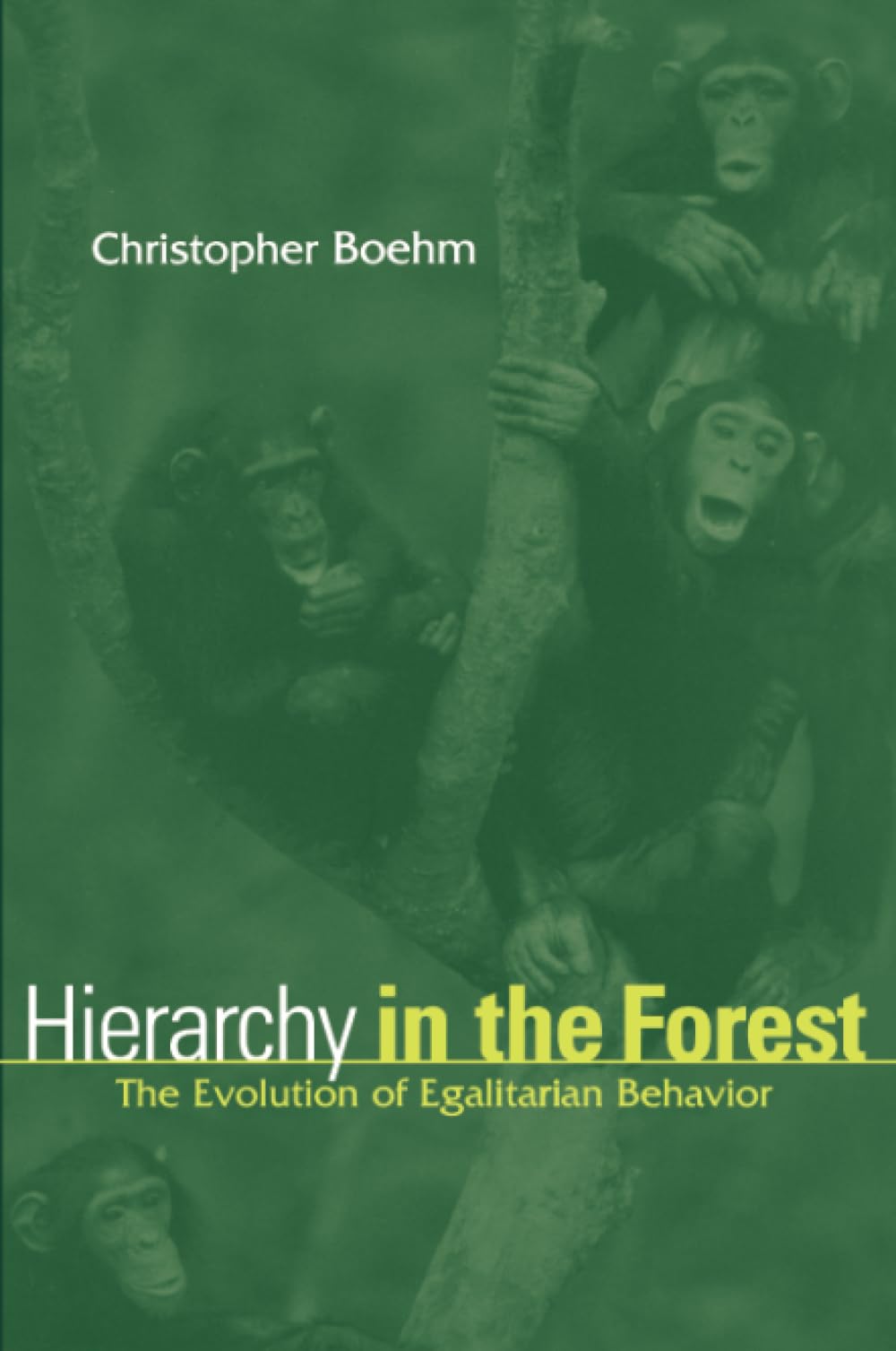
The author, an anthropologist at the University of Southern California, presents a fascinating explanation of hierarchy, egalitarianism, and altruism among humans. By examining human, chimpanzee, bonobo, and gorilla behavior (and, particularly, human and chimpanzee behavior), the author concludes that all four species are hierarchical, with inherent dispositions to dominance and submission. In addition, these species are capable of forming alliances and, importantly, resisting and overthrowing an abusive alpha male.The development of tool use and language enabled humans (or their ancestors) to more effectively form coalitions, overthrow abusive alphas, and establish and maintain a "reverse hierarchy" whereby the weak many ruled over the strong few. The author argues that once a few early human bands established this reverse hierarchy, this example spread through other human bands until, by no later than 100,000 BCE, all human bands were living in reverse hierarchy.Further, this reverse hierarchy leveled, to some extent, reproductive success/failure within the group, thereby reducing within-group selection and increasing between-group selection. Between-group selection would reward altruistic behavior, as altruistic bands would be more cohesive fighting forces and the individuals would suffer less variation in protein intake.Interestingly, the author shows that reverse hierarchy is universal among nomadic foragers and common among pre-literate agriculturalists and pastoralists. This suggests that humans maintained egalitarian status in the early years of the Neolithic Revolution.
K**N
Then he points out how unique that ethic is among the other species of great apes that are our closest cousins
This book is not new, but for anyone interested in human nature, it is still entirely relevant. Boehm points to some very incongruous phenomena. First, most evidence suggests that the earliest groups of humans seem to have been governed by a very strict egalitarian ethic, much as surviving communities of nomadic hunters and gatherers still are. Then he points out how unique that ethic is among the other species of great apes that are our closest cousins. Most notably, the chimps and gorillas live in despotic bands led by despotic alpha males, all of whom are eventually overthrown by younger stronger depots. Finally he notes that as human societies developed settled agriculture and then civilization, despotism and hierarchy reemerge. How can we explain these things? Boehm's answer is that anatomically modern humans emerged in a widespread upheaval in which cooperative groups of non-dominant humans--sometimes including females--made a compact with each other to join against any potential alpha despot. Boehm calls this an "inverted hierarchy" by which he means that humans retained their competitive urges and their will to dominate others. Nevertheless, their will to be free from the domination of alphas was an even stronger urge. Further, their ability to cooperate within the constraints of an egalitarian ethic gave them an evolutionary advantage over other foraging nomads. Then, as new economies and more sedentary lifestyles began to emerge, they lost that competitive advantage and the old despotism reemerged. Anyone interested in the struggle between egalitarian and hierarchical styles of social organization--as well as the concept of human nature should not miss reading this very important book.
K**.
Egalitarian behaviour
A finnish geneticist wrote a book about the relationship between humans and dog: the wonderfull relationship, as far I know has its basic rules in the forest were we learned how to handle another individuals and also other animals near by us. Understanding the basics is very important; this book is most valuble.
M**S
One of the Best Books on the Emerging Science of Morality
I originally got this book from the library but I kept checking it out because I wanted to refer to it, cite it in papers, etc. so I decided to buy it. I love the Kindle format for academic books, it's so great to be able to highlight, add/find/edit/delete comments, etc. I even have a highlighting system I've worked out so I can find specific kinds of highlights. But back to the book this is one of those rare academic books that I just keep going back to again and again. If you are interested in the topic of how evolution played a role in the definition of our human moral sense this book is a must have as well as the author's other book Moral Origins. Well written, deep, and also very scientific in that unlike other authors on the topic Boehm is very circumspect in differentiating things that are well supported from possible hypotheses from interesting speculation.
J**.
How evolution shapes our thinking & politics
I am very interested in how evolution has shaped our minds, culture and politics. Boehm is an expert in this field with unique and insightful theories. If your interested in this subject this book is an excellent choice.
J**N
Five Stars
This text offers one of the clearest understandings of hunter-gatherer lifeway I have ever read.
U**E
Long supportive text after short concept presentation.
Arduous and overpriced.
J**S
buyer beware
This book is not without significant merit in its discusion of egalitarian politics. Unfortunately, Boehm goes way out on a limb in his central argument.Boehm is an intelligent and thoughtful observer of political and social realities, but he is a cultural anthropologist, not a political scientist, not a game theorist, not a primatologist, not even a biological anthropologist. The main argument he is making is a slippery departure from his own field.Boehm would do well to stick to what he knows. He is an excellent ethnographer. His published writings on the Serbian tribes of Montenegro represent a significant and solid contribution to cultural anthropology scholarship.In "Hierarchy of the Forest," Boehm's argument relies on disciplines about which he lacks sufficient expertise to come down as strongly as he does. His argument may be attractive to those of us who have an interest in building egalitarianism in political, social, and cultural practices, but it is best to avoid the trap that Boehm has fallen into, being seduced by an attractive hypothesis and sacrificing rigor.
Trustpilot
Hace 2 días
Hace 5 días