We remain fully operational. Our teams are working around the clock to ensure your deliveries continue safely.

Descargar la aplicación


Servicios al cliente
Sobre nosotros
Copyright © 2025 Desertcart Holdings Limited
Descargar la aplicación

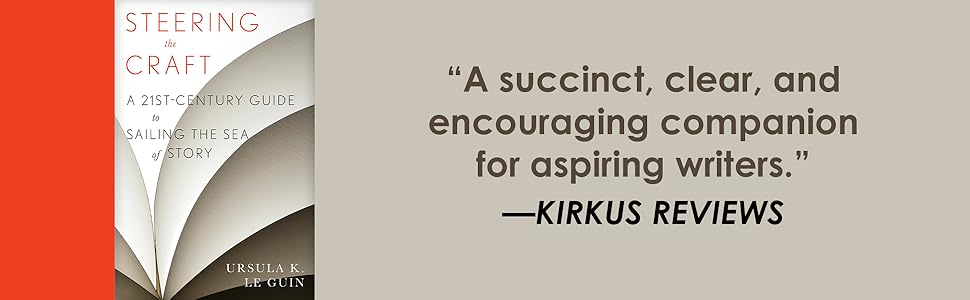
desertcart.com: Steering The Craft: A Twenty-First-Century Guide to Sailing the Sea of Story: 9780544611610: Le Guin, Ursula K.: Books Review: Great for writers! - Steering the Craft: A Twenty-First-Century Guide to Sailing the Sea of Story by Ursula K. Le Guin is a fantastic book, but don't read it thinking it will teach you how to write a novel. Instead, read Write and Revise for Publication by Jack Smith to learn how to take an idea from an outline to a novel. Then, when you finish with that, buy this book, Steering the Craft. In Steering the Craft, Ursula Le Guin talks about all the things that make good prose such as the sound of the language, rhythm, descriptions, story verse plot. She brings up all the rules we have heard over and over again such as: show don't tell; write in active voice, not the passive voice; don't use "be" verbs; and more -- and then tells you how to break them. She talks about grammar only to explain how not to be afraid of the semicolon or comas. She slices through so much of the bad advice I see over and over again online with an effortless logic that had me laughing at the truth of her statements. This is not a humorous book, but I tend to laugh at things gives me relief. Writing as contortionist around such arbitrary rules is tough! This book gives you the license and freedom to use all the tools the English language provides without fear or guilt. This book is orchestrated in such a way that it could be used in a writing group. Every chapter has exercises at the end to help you explore and learn the concepts by doing them. I am not a great team player, but I can see these activities would be beneficial for me to do on my own. I intend to go back and do them. This book makes a lot of sense once you are already writing and discover that something just doesn't sparkle. It is specifically for fiction writers and covers a lot of the vague frustrations of crafting elegant sentences, paragraphs, and chapters. I honestly would understand how vital her advice in this book was before I started writing. It is like learning to paint or play an instrument; certain lessons on make sense after you have been doing it some. So if you are a writer, I highly recommend this book! Review: Sailing the Sea of Story with an Expert Navigator - “Craft enables art” Ursula K. Le Guinn tells us in the introduction to her ‘Steering the Craft: A 21st-Century Guide to Sailing the Sea of Story’. “There’s luck in art. And there’s the gift. You can’t earn that. But you can learn skill ... You can learn to deserve your gift.” Overflowing with valuable insight and inspiration, 'Steering the Craft' is among the best single-volume works on writing I’ve ever read—and I’ve read a lot of them over the decades, positively devouring anything I can get my hands on. If Stephen King’s wonderful ‘On Writing’ is a helpful and encouraging introduction to the subject—call it Writing 101—Le Guinn offers a more advanced and rigorously focused 200-level course that will be most helpful to those already-experienced writers in search of self-improvement and a more acute understanding of how story works. There is a difference, Le Guinn tells us, between the kind of straightforward expository prose we all learned to write in school, and the language of effective fiction—a distinction far too many aspiring storytellers have yet to grasp. The important thing for a writer, she says, “…is to know what you’re doing with your language and why.” She then proceeds to enlighten us in the most pleasing of ways, gently but firmly, never dogmatic, often with humor, stressing fundamentals without coming off as a snob or a “correctness bully”. “To break a rule you have to know the rule,” she says. “A blunder is not a revolution.” Le Guinn challenges received and conventional wisdom at every turn. For instance, where Stephen King tells us that “the road to hell is paved with adverbs,” Le Guinn gently insists that adjectives and adverbs “add color, life, and immediacy … They cause obesity in prose only when used lazily or overused.” And again, she points out, “It’s a myth that short-sentence prose is ‘more like the way we speak’ … The marvelously supple connections of complex syntax are like the muscles and sinews of a long-distance runner’s body, ready to set up a good pace and keep going.” And there were so many more wonderful, refreshing observations throughout the book, I found myself obsessively marking and underlining to a point where my copy could never be resold—not that I would ever part with it! I very much appreciate the way Le Guinn draws parallels between music and prose, stressing the essential importance of rhythm and the physical sound of language: “The similarity of … incremental repetition of word, phrase, image, and event in prose to recapitulation and development in musical structure is real and deep.” Elsewhere, punctuation is brilliantly demystified as it is likened to the use of rests in a musical score. The volume is designed as a workbook, and includes a number of skill-enhancing exercises, with copious examples of the various concepts discussed, drawn from classic works from the Brontë sisters to Dickens, Hardy and Virginia Wolfe, always with fascinating, trenchant commentary from Le Guinn. ‘Steering the Craft’ is a treasure! Enthusiastically recommended.



| Best Sellers Rank | #14,240 in Books ( See Top 100 in Books ) #5 in Creative Writing Composition #8 in Authorship Reference #21 in Fiction Writing Reference (Books) |
| Customer Reviews | 4.7 4.7 out of 5 stars (944) |
| Dimensions | 5.31 x 0.45 x 8 inches |
| Edition | Reprint |
| ISBN-10 | 0544611616 |
| ISBN-13 | 978-0544611610 |
| Item Weight | 2.31 pounds |
| Language | English |
| Print length | 160 pages |
| Publication date | September 1, 2015 |
| Publisher | Harper Perennial |
L**E
Great for writers!
Steering the Craft: A Twenty-First-Century Guide to Sailing the Sea of Story by Ursula K. Le Guin is a fantastic book, but don't read it thinking it will teach you how to write a novel. Instead, read Write and Revise for Publication by Jack Smith to learn how to take an idea from an outline to a novel. Then, when you finish with that, buy this book, Steering the Craft. In Steering the Craft, Ursula Le Guin talks about all the things that make good prose such as the sound of the language, rhythm, descriptions, story verse plot. She brings up all the rules we have heard over and over again such as: show don't tell; write in active voice, not the passive voice; don't use "be" verbs; and more -- and then tells you how to break them. She talks about grammar only to explain how not to be afraid of the semicolon or comas. She slices through so much of the bad advice I see over and over again online with an effortless logic that had me laughing at the truth of her statements. This is not a humorous book, but I tend to laugh at things gives me relief. Writing as contortionist around such arbitrary rules is tough! This book gives you the license and freedom to use all the tools the English language provides without fear or guilt. This book is orchestrated in such a way that it could be used in a writing group. Every chapter has exercises at the end to help you explore and learn the concepts by doing them. I am not a great team player, but I can see these activities would be beneficial for me to do on my own. I intend to go back and do them. This book makes a lot of sense once you are already writing and discover that something just doesn't sparkle. It is specifically for fiction writers and covers a lot of the vague frustrations of crafting elegant sentences, paragraphs, and chapters. I honestly would understand how vital her advice in this book was before I started writing. It is like learning to paint or play an instrument; certain lessons on make sense after you have been doing it some. So if you are a writer, I highly recommend this book!
T**W
Sailing the Sea of Story with an Expert Navigator
“Craft enables art” Ursula K. Le Guinn tells us in the introduction to her ‘Steering the Craft: A 21st-Century Guide to Sailing the Sea of Story’. “There’s luck in art. And there’s the gift. You can’t earn that. But you can learn skill ... You can learn to deserve your gift.” Overflowing with valuable insight and inspiration, 'Steering the Craft' is among the best single-volume works on writing I’ve ever read—and I’ve read a lot of them over the decades, positively devouring anything I can get my hands on. If Stephen King’s wonderful ‘On Writing’ is a helpful and encouraging introduction to the subject—call it Writing 101—Le Guinn offers a more advanced and rigorously focused 200-level course that will be most helpful to those already-experienced writers in search of self-improvement and a more acute understanding of how story works. There is a difference, Le Guinn tells us, between the kind of straightforward expository prose we all learned to write in school, and the language of effective fiction—a distinction far too many aspiring storytellers have yet to grasp. The important thing for a writer, she says, “…is to know what you’re doing with your language and why.” She then proceeds to enlighten us in the most pleasing of ways, gently but firmly, never dogmatic, often with humor, stressing fundamentals without coming off as a snob or a “correctness bully”. “To break a rule you have to know the rule,” she says. “A blunder is not a revolution.” Le Guinn challenges received and conventional wisdom at every turn. For instance, where Stephen King tells us that “the road to hell is paved with adverbs,” Le Guinn gently insists that adjectives and adverbs “add color, life, and immediacy … They cause obesity in prose only when used lazily or overused.” And again, she points out, “It’s a myth that short-sentence prose is ‘more like the way we speak’ … The marvelously supple connections of complex syntax are like the muscles and sinews of a long-distance runner’s body, ready to set up a good pace and keep going.” And there were so many more wonderful, refreshing observations throughout the book, I found myself obsessively marking and underlining to a point where my copy could never be resold—not that I would ever part with it! I very much appreciate the way Le Guinn draws parallels between music and prose, stressing the essential importance of rhythm and the physical sound of language: “The similarity of … incremental repetition of word, phrase, image, and event in prose to recapitulation and development in musical structure is real and deep.” Elsewhere, punctuation is brilliantly demystified as it is likened to the use of rests in a musical score. The volume is designed as a workbook, and includes a number of skill-enhancing exercises, with copious examples of the various concepts discussed, drawn from classic works from the Brontë sisters to Dickens, Hardy and Virginia Wolfe, always with fascinating, trenchant commentary from Le Guinn. ‘Steering the Craft’ is a treasure! Enthusiastically recommended.
P**A
Calisthenics for writers
There is a certain kind of aspiring writer who will do everything to master their craft except the one thing that really matters -- writing. Unsurprisingly, most writing guides ask as little of the reader as possible. They are full of inspiration, encouragement, and even wacky exercises to stimulate creativity. But they don't demand that you sit down and use your keyboard or pen. This book is not for them; it's for people who want to become better writers by writing. Each of the short chapters follows a formula: a new concept is introduced, a few excerpts from great writers are used to illustrate the concept, and then it's on to writing exercises. These are short (generally a paragraph to a page), and less stories than building blocks of scenes. The reader is asked to write scenes using only dialogue, or cross-cut between different timelines as a character remembers something. LeGuin recommends that you write quickly, take a day to cool off, then revise until it's polished. This is not a publishing guide, and it's not about creativity or writer's block per se. It's focused narrowly on practicing the fundamentals. I think it'll be useful for a writer at any point on their journey, just as anyone from couch potato to pro athlete benefits from a stretching or calisthenics routine. The rewards are proportional to the effort you're willing to put in. Reading this book does't *feel* as good as some fluff about how everyone is already an artist, but it is more likely to help your writing. And "reading" is the wrong word anyway, because most of your time with this book will be spent practicing. I suspect the rewards would be even greater if used as part of a group with peer critique, but I found it valuable as a solo exercise too, as long as I stayed diligent.
M**R
Dieser Ratgeber verzichtet auf schnelle Lösungen und Formeln und ist daher vor allem für fortgeschrittene Autoren hilfreich. Am besten fand ich die Erklärung des Unterschiedes zwischen Story und Plot.
R**R
Great book, though not large.
A**E
LeGuin was such a brilliant author. I feel so fortunate that she left behind some advice for other authors in this book. So many nuances that I had never considered before. It will definitely be a book I reread regularly until everything in this book becomes second-nature to me.
M**N
Ursula K. Le Guin est une des plus grandes écrivaines de 20ème siècle, alors ses mots sur la fiction ne sont pas une perte de temps.
A**L
Steering the Craft is a fantastic short guide packed with lots of great insights and writing exercises across a range of different aspects of the craft. Mainly aimed at the kind of writer who’s been doing this thing a little while and wants to hone their craft, it’s an excellent resource for both lone and group work. As such, it doesn’t go over the basics like how to create characters, build fictional worlds etc… But focuses more on style. I have to admit, I haven’t tried the exercises myself at the time of writing this review - I wanted to read through and see what they were first - but I’ll absolutely be going back to do them, because they seem very useful indeed. The examples in the book are plentiful, and they’re all excerpts from classic literature (Twain, Austen, Woolf, Dickens etc…) which precisely illustrate the aspects of writing the section highlights, from how to use repetition to the different types of POV (and switching between them), and much more besides. There’s nothing specific about writing science fiction in here, apart from a passing mention about worldbuilding in the context of avoiding info-dumps, but I didn’t expect there to be. All the lessons within are applicable to writing as a whole, regardless of genre. One of the things that particularly spoke to me was the section about writing from a perspective that is not your own. I don’t struggle to empathise usually, but writing from a perspective I personally disagree with can be tricky to get right; to go deep and nuanced so as to not create a cartoon. And it’s a necessary part of writing complex characters, rather than simple authorial mouthpieces. The exercises in this section force you into writing from those kinds of perspectives a few times over with variations, which seems a good way to drive the point home. It’s especially good for those who learn by doing. Never fear, though, Le Guin doesn’t force us to do all the work. Thankfully, she provides a wealth of suitable prompts and ideas as jumping off points, as well as word count limits and detailed instructions. There’s even an exercise on writing a page worth of narrative with no adjectives or adverbs! It sounds like a marvellous challenge. Speaking of adverbs, as expected Le Guin takes a far more balanced stance on their use than a lot of writing advice you might find on the internet, which oftentimes tells budding authors to never use them. In fact, Le Guin deliberately avoids hard and fast “Rules of Good Writing”, and the book holds a good few opinion pieces in which she expresses her general disdain for them, as they often strip out all nuance. As with all of Le Guin’s books, her style of prose even in non-fiction flows so smoothly that it makes the whole thing remarkably easy-reading. And she even includes a glossary of grammatical terms at the back just in case we get stuck (I didn’t think I’d need it at all, but towards the end I certainly did, and I was grateful it was there). Best of all, I think, is that Steering the Craft is absolutely designed as a longer term study book, rather than a reference to dip in and out of. Another thing is that by no means is this a “how to write like Ursula K. Le Guin” book. Everything is carefully chosen to challenge a writer’s own creativity, rather than imposing a certain style. I’m looking forward to going back through it and trying out some of the exercises. Hopefully it’ll improve my writing and understanding of the craft a great deal. If you’re looking to go deeper with your own writing, I would absolutely recommend Steering the Craft. I’ve seen some people criticising the book for being a study guide, which I find a bit strange, because it’s very clearly marketed as such. It requires interactivity from the reader in order to be most useful as a resource. Although, there are plenty of passages of explanation and advice from Le Guin around the exercises and examples, such that you can indeed read it passively and still learn something.
Trustpilot
Hace 1 semana
Hace 3 semanas