We remain fully operational. Our teams are working around the clock to ensure your deliveries continue safely.

Descargar la aplicación


Servicios al cliente
Sobre nosotros
Copyright © 2025 Desertcart Holdings Limited
Descargar la aplicación
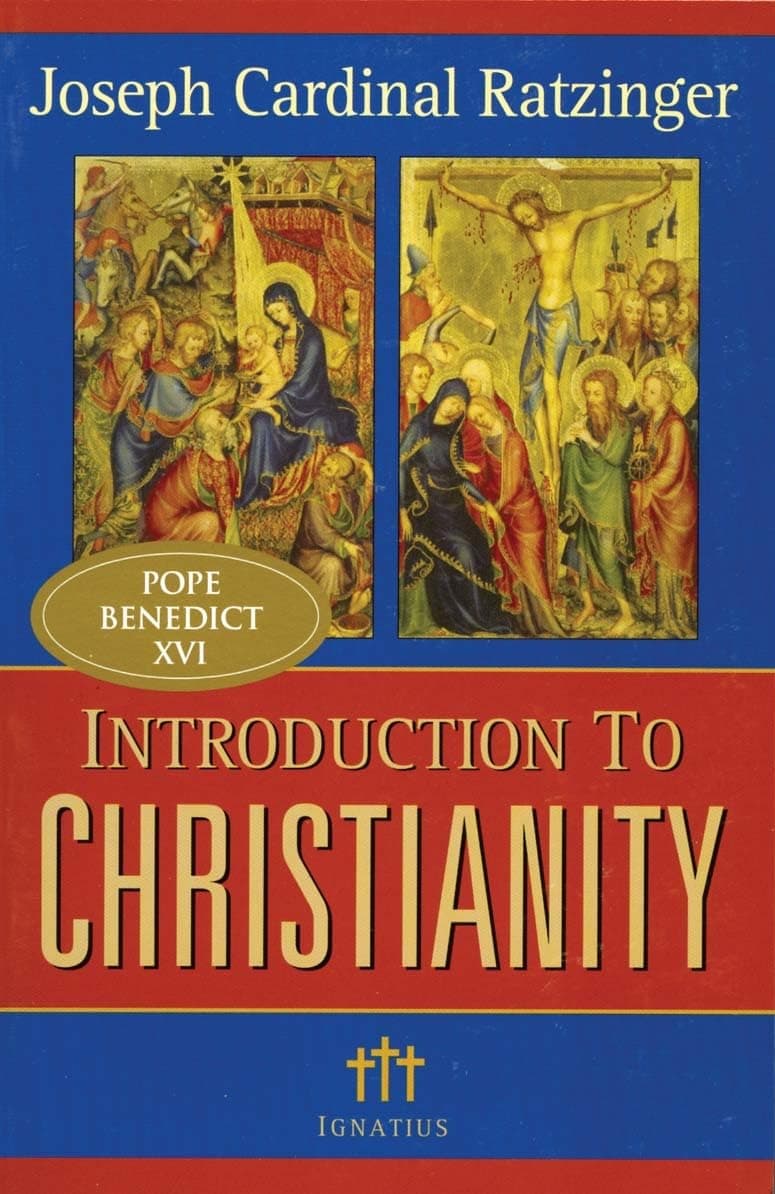
Introduction to Christianity (Communio Books) [Ratzinger, Cardinal Joseph] on desertcart.com. *FREE* shipping on qualifying offers. Introduction to Christianity (Communio Books) Review: An updated view of Christianity for the modern human being - Cardinal Ratzinger puts in modern words that clarify eternal christian truths that have become difficult to grasp due to the rapid evolution of mankind. The depth of his knowledge and clarity of his language I know no pararell. A beautiful read for all the Christian faithful and anyone wanting to deepen their knowledge of the Catholic faith. Review: An introduction in depth! - I first encountered Joseph Ratzinger in 1974 when I was a graduate student at Saint Meinrad School of Theology in Southern Indiana. I was preparing to write my master’s thesis in systematic theology and I was reading some really “heavy” theologians. When I first began reading Introduction to Christianity, I discovered that Ratzinger was an exception. Unlike the others I was reading, he was not only profound and insightful; his book was well written (even in translation from the original German) and inspirational, and his teaching was clear as crystal. This first encounter with Joseph Ratzinger changed me. It taught me that serious reflection on God’s Word does not have to be obscure or remote or impenetrable. It can be communicated in simple, straightforward language that is accessible to everyone. Ratzinger's Introduction to Christianity is easier to read than most comparable works, but it's not simplistic or superficial. In fact, this is an "introduction in depth"-- a beginning look at the heart and substance of what Christians' believe. I recommend it highly to anyone who wants to dig deep into the meaning of life in Christ. Joseph Ratzinger, the introverted scholar from Bavaria who became pope, has now retired from public life. I hope he has not retired from his life's work--introducing the world to Christianity and (most importantly) to the person of Jesus Christ.


| Best Sellers Rank | #39,760 in Books ( See Top 100 in Books ) #20 in Adult Christian Ministry (Books) #29 in Christian Popes #58 in Adult Christian Education (Books) |
| Customer Reviews | 4.7 4.7 out of 5 stars (485) |
| Dimensions | 5.25 x 1 x 8 inches |
| Edition | Revised |
| ISBN-10 | 1586170295 |
| ISBN-13 | 978-1586170295 |
| Item Weight | 14.4 ounces |
| Language | English |
| Part of series | Communio Book |
| Print length | 300 pages |
| Publication date | November 19, 2004 |
| Publisher | Ignatius Press |
R**E
An updated view of Christianity for the modern human being
Cardinal Ratzinger puts in modern words that clarify eternal christian truths that have become difficult to grasp due to the rapid evolution of mankind. The depth of his knowledge and clarity of his language I know no pararell. A beautiful read for all the Christian faithful and anyone wanting to deepen their knowledge of the Catholic faith.
D**Y
An introduction in depth!
I first encountered Joseph Ratzinger in 1974 when I was a graduate student at Saint Meinrad School of Theology in Southern Indiana. I was preparing to write my master’s thesis in systematic theology and I was reading some really “heavy” theologians. When I first began reading Introduction to Christianity, I discovered that Ratzinger was an exception. Unlike the others I was reading, he was not only profound and insightful; his book was well written (even in translation from the original German) and inspirational, and his teaching was clear as crystal. This first encounter with Joseph Ratzinger changed me. It taught me that serious reflection on God’s Word does not have to be obscure or remote or impenetrable. It can be communicated in simple, straightforward language that is accessible to everyone. Ratzinger's Introduction to Christianity is easier to read than most comparable works, but it's not simplistic or superficial. In fact, this is an "introduction in depth"-- a beginning look at the heart and substance of what Christians' believe. I recommend it highly to anyone who wants to dig deep into the meaning of life in Christ. Joseph Ratzinger, the introverted scholar from Bavaria who became pope, has now retired from public life. I hope he has not retired from his life's work--introducing the world to Christianity and (most importantly) to the person of Jesus Christ.
G**H
A surprising book
I was reading through Pope Benedict's first book on Jesus, Jesus of Nazareth: From the Baptism in the Jordan to the Transfiguration , and I began to feel a little bit wobbly --- out of my depth, so to speak. So I "retreated" to this book, and found it even more compelling. For one thing, Benedict's first item for discussion is DOUBT, something which applies in roughly equal measures to believers and non-believers, although you will never find Richard Dawkins admitting to such a thing. "Yet, perhaps it is true..." is the thought echoing in the minds of some atheists. This is followed by a penetrating argument which actually startled me, because I had just written something similar in an Amazon review a few days before. What I said was that scientists who refused to discuss Intelligent Design because "it was not science" may have walled themselves off from the truth. What Benedict wrote was much more sweeping: because positivist science deals only with the visible and the material, it CANNOT discover the truth, because the most important things in human life are invisible. Now, think about that for a few moments: "the most important things in life are invisible." That would, of course, include your soul, and God as well. If God is the root of all the meaning in life, well, science cannot possibly discover this, because they have ruled him out of the game by manipulating the rules! There are other "invisible" things which rule our lives; the most important is love. There are many ways to make love manifest on the physical level (flowers, kisses, etc.) but love itself cannot be touched or seen. Of course, I can think of a lot more things which make philosophical materialists ill at ease: information, ideas, music, poetry...the list is really quite long, and philosophical materialists who try to reduce these things to the billiard-ball view of the universe really go through quite remarkable contortions trying to do this. On the other hand, if we admit the existence of non-material things, the problems disappear. "What is belief really? We can now reply like this: It is a human way of taking up a stand in the totality of reality, a way that cannot be reduced to knowledge and is incommensurable with knowledge; it is the bestowal of meaning without which the totality of man would remain homeless, on which man's calculations and actions are based, and without which in the last resort he could not calculate and act, because he can only do this in the context of a meaning that bears him up. For in fact man does not live on the bread of practicability alone; he lives as man and, precisely in the intrinsically human part of his being, on the word, on love, on meaning." In any case, if you are curious about Christianity, this is a superb book. And it puts some of the efforts of C.S. Lewis in the shade. Very high recommendation!
T**X
Give it a try
First, my vantage point in a concise ad hoc auto-analysis: No formal training in theology. Pleasure reader. Good general education and state of knowledge by ordinary standards. A disposition to religiosity. Sixty-three. In my opinion prospective readers of this book would do well to realize that texts on such fundamentals as those it discusses are of necessity more subtle, and more prone to be understood by the reader in a way the writer may not have meant, than texts about, say, historical "facts", empirical sciences, or technicalities. I believe it is a matter of taste whether one likes such reading. Frequently one has to proceed slowly and cautiously, often taking a pause to ask oneself what the writer is trying to say. Not that there is anything that detracts from his ability to express himself. But we are moving about on slippery ground, at the very fringe of human understanding. The writer is - with absolute sincerity - trying to give us a glimpse of the truth beyond the visible and tangible, the actual reality outside our Plato's cave. His convictions are catching, and inevitably his book confers with it some of the beauty and serenity of pure Christianity, giving a reader tuned for receiving such vibes a notion of some inexplicable light shining from somewhere. The book is no "introduction" in the sense of being a statement of dogmas or an enumeration of the elements of the faith, as its title may be perceived as indicating. It is indeed an explanation of the elements of the faith, but in such fundamentals that one has long failed to realize that they are there. In that unexpected way, its title is true and descriptive. It makes challenging reading, which may, if one is interested in theological subtleties and explanations of the very grounds on which the dogmas stand, be much enjoyed in the manner of those who like to have a look at Hawking's Brief History of Time before going to sleep. It is not a book to read in a hurry, but it can be delicious in morsels of suitable size. The book is to a large extent a history of ideas, and yet another reminder that we really do not know of our own accord how, or even what, the world is - for us it is, and remains, what we think it is. Thus the book illustrates the necessity for firm ground from which we can reach out in order to understand (or rather try to). It is interesting and encouraging to access this scholar's reasoning and his explanations of what really took place in Palestine 2000 years ago, and how the most capable minds have interpreted it through the centuries. I am not a native speaker of English, but all the same I can readily see that special thanks are due the translator. It is no small job to translate a book of this kind. Such work demands a number of abilities that few persons can muster. Although I should be capable of detecting Germanisms, I haven't found a trace. The book reads to me as having been written in English from the start. As it happens, I know that exactly this is the hallmark of a good translation. So far, this critique of mine is in every respect positive. Why then only four stars? Well, I have not searched for or stumbled upon any rules for granting stars. Being conservative (strictly in the sense of "prudent"), it seems to me extravagant, as a matter of principle, to grant the maximum number of stars for any endeavour. One could be surprised by something still better some day. I may also mention that the sentences are sometimes longer than I suspect is necessary. Whether this is due to the author or the translator I can`t say, but I happen to know that when translating, one must sometimes chase subtleties of meaning out along branches or into corners. This is because a term in one language seldom corresponds exactly to a term in another, and the translator can not depart from the meaning which he perceives as the author`s. This demands words. The author is now Pope, with all the authority this entails. The question whether the book would have become as widely known if he were not Pope Benedict is one I cannot answer. While such a question may have a bearing on the book's publicity, it has no bearing on its value. All I can say is that heavy stuff as it is, I have found it enjoyable, and in reading it, a repetition of the self-discipline one all too seldom managed to summon in school really pays off. If you have interests in common with the writer - and if you feel capable, with regard to respect for your origins and affiliations, your historical, cultural, religious, national and regional identifications, and your relatives and friends, to study the writer's faith seriously, this book is capable of providing intellectual enjoyment and edification in large measure. It is a ruttier for navigation in very deep waters.
C**E
For years, I ignored Ratzinger's Introduction on the assumption that it was simply another basic catechism. It's not! It is a profound yet readable post-Nietschean Christian theology, genuinely wrestling with the meaning of Faith in the modern and post-modern world. Written in 1962, this is the reason Ratzinger went into Vatican Two with the reputation of a Bad Boy. But looking back, it is now plain that Ratzinger's Personalism provided the theological foundation for St. JP II's philosophic theology of the body. This is a timeless as the Summa, but Very, Very different.
H**Z
Awesome read from one of the greatest minds in modern Catholic (and in general, Christian, I must say) history! Cardinal Ratzinger makes a world-class exposition of the contents of the Faith through a fresh vision that exudes life in every page. After being honestly somewhat bored from reading the same Thomistic approach to the faith over and over again, this book finally struck a new chord that kindled the flame for the Faith once again in me. Cardinal Ratzinger engages here with the biggest objections the modern secular world (and the atheistic mindset) have to the Christian worldview [honestly, there were times where the objections to the Faith he was quoting left me at a blank at how could he possibly ever answer something like that], only to masterfully answer them without even skipping a heartbeat himself. In contrast to most academic works before his time, which limited themselves to copy-and-paste Thomistic formulas, Cardinal Ratzinger's exposition and response is based primarily in an existentialist philosophy and approach to the Faith. Being himself an Augustinian at the core, his way of explaining the Faith has a really powerful ability of reaching the heart, and is great for setting hearts and minds afire in Love for God. [A caveat I must mention is that his thought is so full of meaning and concepts, that some sections may come across as overwhelming for some readers, including myself. Even so, I think every reader will be handsomely rewarding by persevering through the book, as there a lots of gems in it for everyone to gather].
M**S
Ich würde die Herangehensweise des Autors als kontemplativ beschreiben. Erwartet hätte ich eher, dass mir Dogma um die Ohren gehauen wird. Unstrukturiert ist es zwar nicht, da sich Benedikt am Credo der Apostel entlang arbeitet aber ich muss auch gestehen, dass ich nach dem Lesen nicht in der Lage bin das vermittelte wiederzugeben, da es eben nicht auf Stichpunkte reduzierbar ist. Stattdessen muss man dieses Buch wohl auf sich wirken lassen. Es handelt sich also meines Erachtens eher um eine Initiation als eine Introduction.
R**S
Then - Prof Ratzinger launched this book as a cardinal & archbishop, now - Pope Benedict XVI. Formally 'just' an exposition of the Apostles Creed, in reality a wide ranging, deeply probing, assessment of the spiritual needs of the world via philosophy and Christianity and through exploring the text of the creed and it's OT & NT Biblical sources. It is absorbing. It requires concentration. It is thought provoking. Sometimes he just gives his opinion on a topic, at other times he gives a brilliantly constructed series of arguments to a biblically based simple (not simplistic) statement. Every minute spent in this book is rewarding. He is that important combination of a widely respected academic with a pastoral heart for individuals, the church, and a lost and wandering world. You need to be reasonably well read at least in theology, the history of theology, and philosophy of religion to really get much out of this book. As a protestant (small 'p') conservative evangelical my heart and mind sings in many places along with this man of God.
K**S
It is a wonderful piece of work. I believe it is recommended for all who desire to have the best basics of our christian faith especially in this age.
Trustpilot
Hace 3 días
Hace 2 semanas