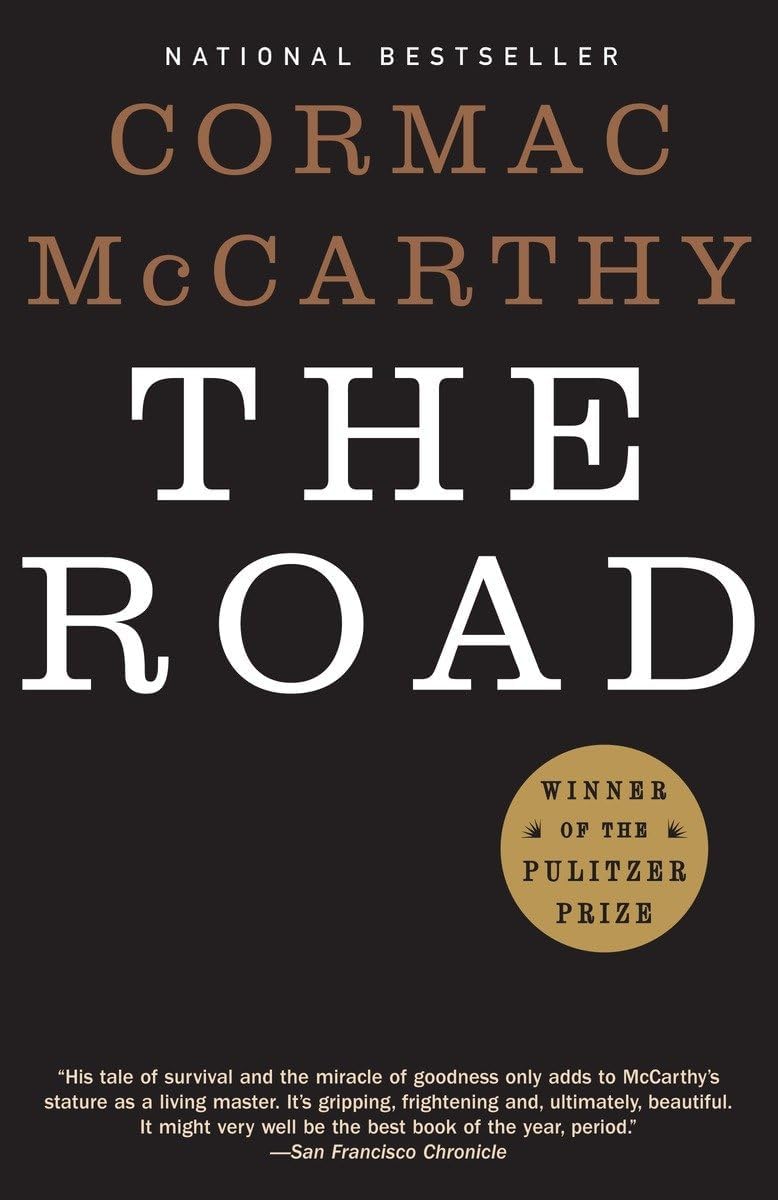
📖 Survive the silence, feel the fire — The Road is the literary journey you can't afford to miss.
The Road by Cormac McCarthy is a critically acclaimed post-apocalyptic novel featured in Oprah's Book Club. It chronicles a father and son's harrowing journey through a devastated world, exploring themes of survival, love, and humanity with a sparse yet powerful writing style. Ranked #17 in Contemporary Literature & Fiction and boasting over 36,000 positive reviews, this bestseller is a profound and unforgettable literary experience.


| Best Sellers Rank | #723 in Books ( See Top 100 in Books ) #17 in Contemporary Literature & Fiction #46 in Reference (Books) #62 in Literary Fiction (Books) |
| Customer Reviews | 4.4 out of 5 stars 36,180 Reviews |
K**R
Literary Horror in the Oprah Winfrey Book Club???
It was right there, in the description of the item in my Amazon cart; it was in parenthesis: (The Oprah Winfrey Book Club)--and, after a few clicks and an innocuous transfer of some money-numbers on a computer screen, the book was mine and it was on its way. Over the next couple of days, as I awaited the book's arrival, I had to wonder what I'd done. Was I actually going to like this book or was I going soft, like a piece of fruit being tossed (and dropped a few times) around the library by a couple of bored high-school kids that don't understand why anyone would read the book when you can just watch the movie? I'd been told to check out Cormac McCarthy several times over the past few years and I'd been putting it off. I like stories of the macabre, I told myself. I'm not mainstream. I don't like the sort of books that populate the shelves of Barnes and Noble. (Although I couldn't quite stifle that voice in the back of my head that kept whispering: What about King, you idiot. How much more mainstream can you get, you hypocritical bastard.) I thought that if Oprah liked it, the woman adored by so many middle-aged woman across America, it probably wasn't for me. When the book arrived, sure enough, there it was: that great big gleaming O sticker, stuck to the front of my new book like a tumor, a mark that, to me, was as glaring and hideous as a scarlet A. I took the book to work with me, shamefully hiding the Oprah Book Club sticker with my fingers, and I read the first 50 pages or so. I read some more at lunch. I was intrigued; I was curious; I was drawn into the world of the book. I hadn't imagined a place so perversely dark and hopeless, so vague and yet so very real--so very human. I forgot about that little sticker on the front cover and I finished the book in a day and I immediately looked up Oprah's Book Club--what other kinds of things were on that list? What was I missing? "The Road" by Cormac McCarthy is a very good book. Its subject matter is most decidedly horror, but its style and restraint are the qualities of good literature. It chronicles the journey of a man (never named) and his young son as they travel through a world after some sort of apocalyptic disaster (never explained). All we know is that it's cold, food is extremely scarce, and everything is in ruins, covered in ash and falling to pieces. McCarthy's sparse writing style works perfectly to convey the desperate numbness of humanity reduced to a state of aimless survivalist. People are kept locked in basements like cattle to be eaten by other people; a woman gives birth to a baby and roasts it on a spit for dinner with her male companions; all the plants and birds and everything is dead. It is a bleak world and a bleak story, but with a lot of heart and much to say about the nature of altruism and the human spirit. Now, I've looked through Oprah's list of books from the past few years and most of what's listed there are not of much interest to someone like me who loves the horror genre and loves subversive fiction (besides a few works of Faulkner), but I have to say it is a solid list of 'literary' pieces of writing that I'm sure are important and powerful in the canon. I must say, my respect for Oprah has jumped considerably after looking over her list of books and knowing that she actually reads and encourages others to read--in a society that is becoming more and more illiterate and loosing its historical memory, anyone totting the value of the written word is a commendable and upstanding member of the human race in my eyes. Read "The Road." It is a wonderful piece of literary horror fiction.
T**E
Beautiful and Desolate
This review contains SPOILERS. I will discuss plot points and the how the book ends in detail. IF YOU HAVE NOT READ THIS BOOK, AND DO NOT WISH TO KNOW HOW THIS BOOK ENDS DO NOT CONTINUE READING THIS REVIEW. Now if you continue on, I have given you ample warning and it's your own fault. The Road is a beautifully written account of a man and his son traveling the wasted post apocalyptic world. Love is the only thing that holds the two together and keeps them alive and moving forward where all things have become ash and death. McCarthy's style is compact and succinct in a way that is reminiscent of Hemingway's direct terseness. He effortlessly conveys deeply emotional situations with a few well chosen phrases. This book is a marvel to read simply for the language employed. The juxtaposition of the absolute horror of a world without life or joy set against the father and son whose love for each other is the only reason to continue to live is compelling and will keep the reader engrossed throughout the narrative. The two are constantly hungry and constantly on the lookout for "the bad guys". It turns out that "the bad guys" are any other living human being where all are starving without much food but the flesh of their fellow survivors. The boy never knew the world without this horror and the man can't let himself remember it, or else he will despair and give up. I loved this book, until the final pages. THIS IS THE MAJOR SPOILER PART. All throughout the book the man has been fighting tuberculosis, and at the end it finally kills him. He has saved one bullet in his revolver so that if the time should come he could kill the boy so that the boy could be spared the terrible fate of being raped, killed and eaten by other survivors as his dead mother had feared. Instead of killing the boy the man says that he just can't bear to hold his dead child in his arms, and tells the boy that he will be okay. Soon after the man dies a survivalist with a shotgun shows up and takes the boy with him where there is a safe home with a woman and two other children. This ending does not ring true. In all of the time that we follow the man and the boy they never meet one decent person. Then all of a sudden the boy is safe in the care of some miracle savior at the perfect time? I don't believe it. I think that it is the author who can't bear to hold the dead child in his arms. He could not face the grim ending he had set up for the entire span of the novel. Do I want to see the boy die? No, not at all. But the true ending is that the man kills the boy with that last bullet and then is himself overcome by his illness and dies. It's not pretty, but it is the real ending. If you have ignored my warnings about the spoilers and gotten this far, then I have to encourage you to read this book anyway despite the imperfect resolution. There is too much here that is of great value to dismiss the book because it has an unrealistic conclusion. It is deep and ponderous and will linger in your thoughts for a long, long time.
S**.
My second McCarthy read
Cormac McCarthy’s The Road is one of the most hauntingly beautiful novels I have ever read, and it deserves every bit of five stars. After Blood Meridian, I needed another. On the surface, it’s a post-apocalyptic survival story, but beneath that, it is something much greater: a meditation on love, hope, despair, and the unbreakable bond between father and son. McCarthy’s writing is stripped bare, almost skeletal, yet it carries immense weight. His prose mirrors the barren landscapes of the novel, sparse, cold, and unforgiving, but within that starkness, he manages to capture breathtaking moments of tenderness. Every word feels deliberate, every silence intentional, creating a rhythm that keeps you both unsettled and deeply invested. The father and son’s journey is nothing short of heartbreaking. Their struggle against hunger, cold, and the lurking dangers of other survivors paints a grim picture of humanity’s collapse. Yet what shines through the darkness is their devotion to each other. The boy becomes the embodiment of innocence and goodness in a world that has forgotten such things, while the father’s relentless will to protect his child becomes both heroic and tragic. Their relationship is the glowing ember at the heart of the book, the “fire” they carry through the ashes of the world. What elevates The Road beyond other dystopian tales is its spiritual weight. It feels biblical in scope, as though McCarthy has written a modern lamentation or scripture of loss and endurance. The imagery is desolate but poetic, pulling you into the gray ruins of a world that is both alien and eerily believable. It lingers long after you’ve finished, not just as a story, but as a reflection on what it means to love, to sacrifice, and to endure in the face of nothingness. The Road is not an easy read, it is bleak, unrelenting, and at times devastating, but it is also one of the most powerful works of literature I have encountered. Few books manage to capture the raw core of the human spirit the way this one does. For me, it is not just a masterpiece of the genre, but a masterpiece of storytelling itself.
A**A
6 stars, but not perfect...
Cormac McCarthy presents bleak as no other writer can. While I was reading The Road, several times I thought that I’ll never again believe a writer who uses the word “hopeless” to describe the plight of their character. In The Road, there is nothing but hopelessness. Almost. Which leads to where I struggled with this novel. I’m giving it 5 stars, though it deserves at least 6 even though I think it has a few flaws. And even with 6 stars, I strongly suspect he was awarded the Pulitzer Prize not so much for this work as much as for his body of work. If you can stomach the astounding violence in Blood Meriden, it is the far better book of the two. On the off chance, you don’t already know the details of the plot, this is your spoiler warning. I have long avoided reading The Road though friends have encouraged me to. I only read it after reading McCarthy’s Blood Meridian. I’ve long avoided the novel because the premise is that they are traveling down a road in a hostile, post-apocalypse setting. One of the first things you learn as a combat soldier is you never take the road. In the military, these are called “natural lines of drift.” It’s a clever way to say “the route people will take”. If you have ever walked across fields that cows frequent, you know what I mean. Cows find the easiest path and tread it over and over. If you want to kill a cow, just wait along one of those paths. Roads for humans are the same. If you want to kill a human, just wait along a road. This world of McCarthy’s is populated with “bad guys” who are almost invariably cannibals. This is because there is simply no food left, no living thing other than the last scraps of humanity preying on each other. They are often also on the road or setting up ambushes along it. Several times during the story, the man, and the boy avoid dying in such encounters. Too many times to my thinking. So, if you take the road literally, the entire premise seems flaky. But the road is needed as a literary device: The two main characters have to start somewhere and end somewhere else. It is both physical and metaphorical. So they travel a road for hundreds and hundreds of miles, miraculously, without getting hurt. I was so taken with McCarthy’s writing after Blood Meridian, I decided to read The Road in spite of my doubts about their travels on this road of theirs. So getting into the book, and starting down the road, the next issue I had was that they were pushing a shopping cart full of their meager belongings. You may see homeless people pushing shopping carts under bridges or down a sidewalk. You don’t see people pushing shopping carts hundreds of miles over roads after a decade of neglect and (apparently) nuclear blasts. To his credit, McCarthy had his character’s wear out one and often had to dig a path through sand or snow to keep the cart going. Doable? Maybe…for a while. But the doable part had another issue. It takes a lot of water and a lot of calories to keep pushing such a cart. The Road‘s landscape — world — is depressingly bleak and gray; even the snow falls gray. Rivers are described as ugly sludge. For much of the book, I wondered where they were getting water clean enough to drink. Though they stumbled across a few forgotten caches of food and water from time to time, not until the last few pages did we actually see them getting water out of a creek, straining it to clean it. It was a weak throw to acknowledging how they were getting their water. But he did not share it until the end of the book because it mitigates the desolate, rotted Earth images of the earlier portion of the book. Maybe the streams are not quite so dirty. Another problem I had with the book was how they were getting enough calories to keep their strenuous trek going (in freezing weather, no less). I’ve lived outside doing hard work for weeks at a time. You burn 3K calories a day…easily. That is a lot of food. When the book starts, there is no explanation of how they came to have a cart full of supplies. No matter. But as they deplete them through the story, they invariably stumbled upon more food as they were about to starve to death. And it was food the rest of humanity had missed while they were starving to death, seemingly over five or ten years. Yet the man and the boy found it, which was all too convenient. I also struggled with what event would kill all life on Earth other than humans? I don’t doubt there could be a nuclear exchange, or a devastating meteorite strike, or some other terrible event. But what puzzled me was that there is no other life. Nothing. There were no rats, flys, crickets or cockroaches… These are forms of life that are amazingly resilient. But somehow there are humans wandering about but none of these little critters. Not a lot of humans, but enough that we run into one or two or a dirty gaggle once every twenty or thirty pages. But not a mouse in sight. Seemed odd. And after hundreds of pages and hundreds of miles on the road, and after most of the people they came across were cannibals that wanted them for dinner, at the end, after the man dies, and the boy sits beside him for three days on the verge of dying, who walks up? A well-armed father with a good (Christian?) wife and their two children who are about the same age as the boy. The man has delivered his son into the hands of someone who will care for him and raise him in a safe environment. Not are these just playmates, but there is potential to propagate and start humanity anew. There is hope. Of course, there is no food and the Earth is incapable of growing anything. There are no animals, no living plants, nothing. Are we left to believe that the boy has been saved? Or will he live in misery and despair until one way or the other, he also falls? This, in turn, leads to the novel’s strengths. Beyond the extraordinary writing and the stunningly bleak vision, beyond the smart way McCarthy never feels the need to explain why or how it all happened, he sets up unrelenting tension. Arguably the core story is that the man — the father — does not have the courage to kill his son and then himself to escape their hell. Where is the wife? The boy’s mother? She killed herself, we discover, before the story opened. And when the story opens, the man has a pistol with — you guessed it — two bullets. So we know from the start he has not yet found the courage to kill them both, and not long after we start our trip down the road, the man has to use one bullet. With only a single bullet left, his dilemma is even more profound: Should he use it to kill the boy in his sleep? Get it over with? If so, how would he kill himself? He could do it, but he no longer would have such a simple and easy means as a self-inflicted shot to the head after killing his son. In short, he can’t bring himself to kill his child, the child he loves so dearly, the child that trusts him so totally, which is shown over and over through the story in deeply emotional, compelling ways. Thus the tension mounts as we see the man, coughing his lungs out, sick and wounded, starving, limping toward his own death. We are left wondering until the end if he has the guts to kill his child and save him from what will befall him when taken by the cannibals. In the end, though McCarthy could horrify us, the man could not kill the child, his child, so he created an ending that (to this reader) was completely out of step with the rest of his dark vision. All said, the book is brilliant and I highly recommend it. The writing is uniquely McCarthy’s and the vision, the tension and the violence are also something few (if any) writer can match. I urge you to read The Road. McCarthy is a literary treasure and his works – gut wrenching though they are – should be experienced because they are so unlike the tediously similar books that frequent the bestseller lists. Just don’t think it is going to be a fun trip down the road.
T**E
95% scene descriptions 5% story
I really wanted to like this book--it came with an endorsement from a person I really respect (not Oprah). I'm not discounting some of the deeply emotional dialogue between the dad and his son. But mostly, I felt that 95% of the book was McCarthy describing the scene and 5% on telling a compelling story. It just moved too slowly for me. It's not a book I'll re-read, and I probably won't pick up another of McCarthy's books. Just one guy's opinion.
D**L
perhaps the greatest work of art I've ever encountered
Art is different from entertainment because art changes you, and this book affected me more deeply than any piece of art I've ever encountered. Not that I think it's perfect -- I see many flaws. But they don't matter. It accomplished its mission. Cormac McCarthy has written the definitive literary depiction of the power of love. Although they were cold, dirty, starving, frightened, I was surprised to find myself at one point envying them, for they were nurtured from within by the power of love. Especially the father, as it's the nature of the parent-child relationship that the parent gives and the child receives. CM is saying, that when all hope is gone, love remains. And he's done it so convincingly that during the days I was reading this book, when I had occasion to throw away some food, I found myself thinking "I wish I could give it to them." In some part of my mind, I felt convinced that these people really existed. That was how completely I entered into their world. Caution: spoilers ahead!! I have never cried so hard at any death in a movie or book. It started with the line: "when he lay down he knew that he could go no further and that this was the place where he would die. The boy sat watching him, his eyes welling. Oh Papa, he said." I'm crying for the loss to the man, who showed so much courage, self-denial, sheer grit, and boundless love. We want to see that kind of all-out effort succeed and be rewarded, but life isn't like that. We know the horror the man must feel in leaving his son alone in that world, with nothing but a half a tin of peaches to sustain him. In his final gesture of love, the man declines the peaches and tells his son to save them for him -- for tomorrow, when he knows he'll be gone. I'm crying for the loss to the skinny, starving boy, who has lost his smart, determined, vigilant and tender father -- the only thing standing between him and a horrific future as a catamite or cannibal's dinner. And I'm crying for the loss to myself of the most inspiring character in the fiction world: a man with the strength to keep going, keep walking, keep searching, when almost all others have given up (like his wife) or given in to their basest instincts (the roadagents). "The Road" left me knowing that love is all that matters, and determined to live my life out of that knowledge. I want to give up living from my mind and start living from my heart. Perhaps I will adopt a child. The story is more powerful than a thousand sermons. Cormac McCarthy strips away all the superfluous stuff that has nothing to do with love. We don't know whether the man preferred to go out for sushi or steak, jazz music or country. Was he a lawyer, salesman or mechanic? None of that is essential to who he is. We don't need him to crack jokes or say profound things. All we know of him is what he does, and that's plenty. We see him putting his son's welfare first, over and over again. When they are hiding from the cannibals, he considers running to draw them away from the boy. That he himself will end up in that basement doesn't even figure in his decision not to do it -- only that he doesn't think it will work. His own pain weighs nothing when compared to his motivation to save the boy. As for those who fault the man for not helping strangers -- I don't agree. Any morsel of food given to strangers is taken from the mouth of his son, or lessens his own chance to stay alive long enough to get his son south. He had to choose and he chose his son. So the story had a deep emotional impact on me. But in addition, it is a story of ideas. How low can man go? What darkness beats in the heart of men, only thinly veiled by our (currently) abundant society? At what point is life no longer worth living? At what point should the strong drive for self-preservation be ignored, if it means committing atrocities on others? And lastly, to what extent am I taking life's current luxuries and comforts for granted? I'm sure many a reader of "The Road" has collapsed into bed after a night of reading and felt immense gratitude for their cozy bedroom, their clean sheets, their fridge and a tasty midnight snack. Things that troubled me about the story: I wanted them to stay longer at the bunker. At least to make full use of those provisions and take the time to fatten up and rest before heading on. They could've hauled a load of groceries off a mile or two and pigged out for a few weeks before coming back for more. The more weight they put on, the less crucial it would be to find fresh provisions when they finally did leave. I wanted to see him make a major effort to find a way to disguise the trap-door to the bunker. It had gone undiscovered for almost ten years, if it was well hidden perhaps it could go undiscovered for at least a few more months. Setting off the flare gun was irresponsible. They wasted a flare and announced their position, perhaps drawing the thief. But those are minor quibbles. After finishing "The Road," I felt profoundly blessed, and cleansed from within from the tears shed. I knew I was in the presence of greatness. Cormac McCarthy has given mankind an immense gift, for which I paid only $7.99. Thank for Cormac McCarthy.
K**Y
Heavy
Cormac McCarthy’s The Road is a bleak yet unforgettable novel set in a post-apocalyptic wasteland. It follows a father and his young son as they walk through a world stripped of life, carrying little more than each other and the will to keep moving forward. McCarthy’s prose is sparse, almost skeletal, which perfectly mirrors the emptiness of the setting. Though the book is filled with despair, hunger, violence, and hopelessness, its core is deeply meaningful. The father and son’s bond is what gives the story weight. Their love, trust, and shared struggle transform the novel into something larger than survival. As a father, the story hit especially hard, capturing the drive to protect and pass on strength even when the world offers nothing back. The Road is both depressing and profound, showing that even in ruin, love can be the last fire worth carrying.
J**N
The Life We Long For
"She would of been a good woman," The Misfit said, "if it had been somebody there to shoot her every minute of her life." These words, near the end of Flanner O'Connor's "A Good Man Is Hard to Find," bounced around in my head as I made my way through Cormac McCarthy's novel The Road. The man and son on the road live every day knowing that someone is there to shoot them, just around the bend, in the weeds across the ditch, or coming up behind them. Along with the constant threat, McCarthy's spare prose builds a world in which trinkets and distractions have been stripped away. Neither color nor sunshine decks this landscape. The story confronts us with characters forced moment by moment to recognize what matters. "No lists of things to be done. The day providential to itself. The hour. There is no later. This is later. All things of grace and beauty such that one holds them to one's heart have a common provenance in pain. Their birth in grief and ashes. So, he whispered to the sleeping boy. I have you." The man and son in this predicament testify by their very existence that humans must live for others, else there's no reason to live. And they show us that we cannot live without hope. World as We Know It The novel's opening paragraph invokes Plato, Bunyan, Jonah, and Dante: "In the dream from which he'd wakened he had wandered in a cave where the child led him by the hand. Their light playing over wet flowstone walls. Like pilgrims in a fable swallowed up and lost among the inward parts of some granitic beast. Tolling in the silence the minutes of the earth and the hours and the days of it and the years without cease. Until they stood in a great stone room where lay a black and ancient lake. . . ." Like Dante finding himself in a dark wood, McCarthy's pilgrim will be led through hell to love not by Virgil but by the child. Like Bunyan's Christian he shoulders his pack, which he will lose on the way to the celestial city. Like Jonah this man's journey and experience are in themselves a message that calls Ninevites to repentance. Like Plato McCarthy seeks to deliver us from the illusion of the cave to know what is real ("forms" are invoked throughout, as is the image of "philosophers chained to a madhouse wall"). McCarthy's pilgrim is loath to wake from dreams of the world as we know it, and McCarthy calls his audience to repent of discontented distraction and awaken to this world, the world of our dreams. At one point the man finds clean water, "water so sweet that he could smell it," and he finds "Nothing in his memory anywhere of anything so good." Savor your next drink of the same. Like Job's wife, the man's wife gave up (the line "Curse God and die" appears in the novel, followed shortly by the suggestive word "Blessed"). She asserted that those who had survived were "the walking dead in a horror film." She claimed that there was no counterargument, that she hoped "for eternal nothingness." But the counterargument McCarthy shows---not tells---is faith, hope, and self-giving love. These show the bankruptcy of hopeless, faithless existence that ends in nothingness. The man even pled that his wife not kill herself with the words, "For the love of God, woman. . ." These Three Remain McCarthy's words depict a world of "The frailty of everything revealed at last," and the story he sets in that world shows that when all else is gone hope, faith, love, and life remain, that a man knows no greater love than to lay down his life for another, that life itself---the fact that we go on living---argues against despair. The birth of the boy was the man's warrant for hope and faith against the devastated despair of his wife that a child had been born into such a world. The man and his wife responded in opposite ways: to her the child was a sorrow that tore out her heart, to him a miracle aglow with goodness: "They sat at the window and ate in their robes by candlelight a midnight supper and watched distant cities burn. A few nights later she gave birth in their bed by the light of a drycell lamp. Gloves meant for dishwashing. The improbable appearance of the small crown of the head. Streaked with blood and lank black hair. The rank meconium. Her cries meant nothing to him." The alternatives are clear: death/life; despair/hope; selfishness/love. And in this book the good guys choose life, hope, and love. The good guys never give up. The good guys don't break small promises because it leads to breaking big ones. The good guys carry the fire. "The nights were blinding cold and casket black and the long reach of the morning had a terrible silence to it. Like a dawn before battle. . . . There were times when he sat watching the boy sleep that he would begin to sob uncontrollably but it wasnt about death. He wasnt sure what it was about but he thought it was about beauty or about goodness. Things that he'd no longer any way to think about at all." Sharp Contrast Other religious answers are also contrasted. At one point man and boy encounter a traveler, "a starved and threadbare buddha," and this traveler regards the world and his experience as though nothing matters. When the man asks the buddha, "How would you know if you were the last man on earth?" The buddha says to the man: "It woudnt make any difference. When you die it's the same as if everybody else did too." The man replies: "I guess God would know it. Is that it?" Buddha: "There is no God." The man: "No?" McCarthy condemns the buddha's logic by presenting him contradicting himself with the retort: "There is no God and we are his prophets." The man meets the buddha's nonsensical assertion that he is the prophet of a God who does not exist with a counterargument for the buddha's indifferent rejection of God: "I dont understand how you're still alive. How do you eat?" The assertion "There is no God" is answered with the counter-assertion "you're still alive." The man seems to be suggesting that life itself is proof of God, evidence against meaninglessness. To the question "How do you eat?" the begging buddha replies: "People give you things." With these words the buddha confesses that apart from the Christian virtue of charity he has no hope of life. The man has countered the buddha's rejection of God with the fact of the buddha's ongoing life, and the buddha himself has acknowledged that the generosity of others sustains his life. The wider narrative makes plain that generosity and charity spring only from faith in God, from hope that God will deliver and provide, and from love that mimics the very love of Christ, who gave his life that we might live. As the man and boy move on, the man asks if the buddha will thank the boy for giving him food, but the buddha refuses to do so. Christianity makes gratitude possible, but the buddha will not give the thanks he owes. This conversation with the buddha shows that love is distinctly Christian. The buddha has no category for love, goodness, or kindness, and the man's suspicious interchange with him also shows how essential trust is to human communication. God is basic to human kindness and essential to human dignity. That is to say, apart from God there can be neither kindness nor dignity. The buddha will not even wish the man and the boy luck, and McCarthy seems thereby to intimate that a belief in God's providence undergirds the kind of luck the man knows the buddha will not wish him. As they leave him, the man tells his son, "There's not a lot of good news on the road" (175). The buddha has no gospel. The book opens with the man waking to grope for his son, earnest for reassurance that he is there, that they are safe. The book closes with the man going to sleep, choosing not to kill his son before he dies, clearly trusting that though he will not be awake to protect the boy, he can rest knowing that the boy will be safe. For this pilgrim, dying is an act of faith. They have not wandered in a cave but in a world without civilization, a world without forms. The forms are the world we now enjoy, if . . . if McCarthy's Jonah can lead us to repentance by escorting us through the inferno, pilgrims making their way through the ruins of Vanity Fair. McCarthy seems to want us to know that the life we long for is the life we have.
Trustpilot
Hace 2 días
Hace 1 mes