We remain fully operational. Our teams are working around the clock to ensure your deliveries continue safely.

Descargar la aplicación


Servicios al cliente
Sobre nosotros
Copyright © 2025 Desertcart Holdings Limited
Descargar la aplicación


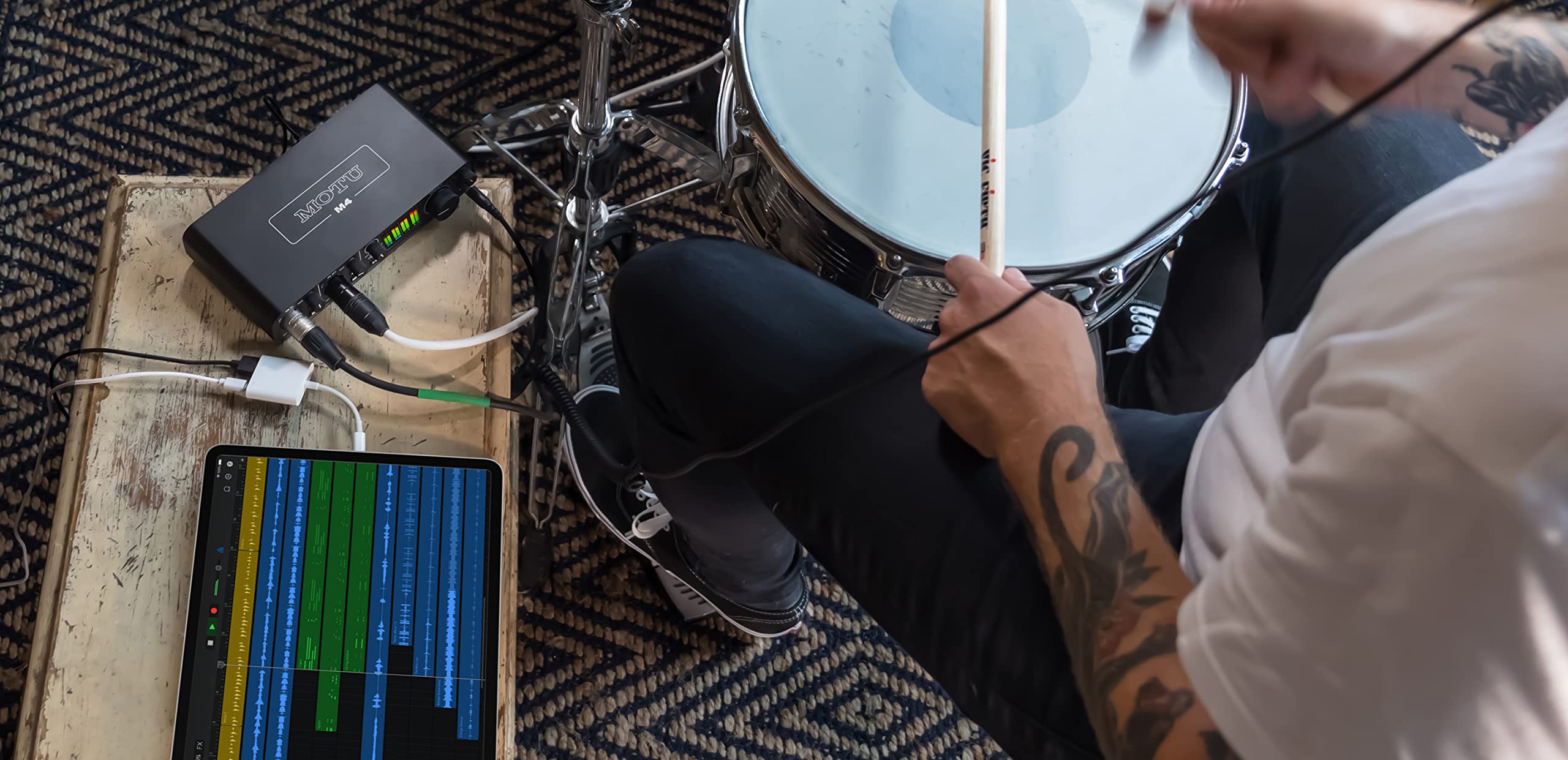


🎧 Elevate your sound game—pro audio power in a sleek USB-C package!
The MOTU M4 is a compact 4-in/4-out USB-C audio interface featuring two premium microphone preamps, ultra-low latency direct monitoring, and a bright LCD meter display. Compatible with Mac, PC, and iOS, it delivers studio-quality sound with 6+ GB of free content included. Ideal for professionals and multitaskers seeking transparent audio and seamless workflow without the clutter of extra gear.


| ASIN | B08129P2XY |
| Batteries | 1 Product Specific batteries required. |
| Best Sellers Rank | #2,331 in Musical Instruments ( See Top 100 in Musical Instruments ) #22 in Computer Recording Audio Interfaces |
| Color Name | Black |
| Compatible Devices | Personal Computer |
| Customer Reviews | 4.5 4.5 out of 5 stars (861) |
| Date First Available | November 6, 2019 |
| Hardware Interface | USB |
| Is Discontinued By Manufacturer | No |
| Item Weight | 1 pounds |
| Item model number | M4 |
| Material Type | Stainless Steel |
| Operating System | Mac |
| Product Dimensions | 8.25 x 4.25 x 1.75 inches |
| Supported Software | Performer Lite, Live Lite production |
J**N
Perfect for Multitasking with Rhythm Games
Upgraded from a Focusrite Scarlett to the Motu M4 for a couple reason. I heard that this was an upgrade in terms of audio quality, which is good but it's also just the interface, so it's not going to be a big change. It can also give more gain to the monitoring headphones, which is something I was looking for since my headphones were starting to hit the maximum of what the Scarlett could give. The main feature I was interested in with this upgrade are the two line in inputs on the back. This is mostly meant for instruments, but I was interested in using this for rhythm games. If you've played a rhythm game at home before, you know that you need the lowest latency you can get with your audio. Often times, the best way to make it work is to directly connect speakers to the device or use the device's own speakers. This works great if that's the only thing you're doing, but there are times where that's not the case. I often find myself on my desktop listening to a video in the background if I'm playing casually or talking to my friends along with screensharing the game. In these cases, there are two options for listening to both at once: buy a dedicated mixer or plug the outgoing audio directly to the computer. Using a mixer does work, but I found it to be a hassle to set up. An extra usb port for power, extra wires being looped around my desk, and carefully setting everything up to not introduce any noise (admittedly, that's probably because I went cheap on the mixer). All that just to play one game for an hour did not feel worth it. The easiest alternative is to directly connect the audio to the computer and listen to the playback, but Windows likes to introduce extra latency in the process. It's not enough to ruin every game, but for rhythm games especially, it's easy to notice the difference between this method and directly plugging in headphones. This leads to why I was interested in the Motu M4. The back 3 and 4 inputs are line inputs, exactly like how I had the audio currently connected to the computer. They're similarly passed to the computer as an audio input, so I can bring the audio over for screensharing. The real benefit to having this connected to the audio interface itself is that these inputs can be directly monitored. Just like the microphone on the Scarlett, monitoring these inputs directly has practically no latency. Monitoring these inputs still allows the audio from the computer to go through, which gives the exact setup I was looking for! The main concern I still had before getting this was the volume of this input. Many people were complaining that the gain is a little low and would need an external amplifier to make usable in many situations. However, I could never find anyone discussing it in terms of the use case I was looking for, so I wasn't sure how well it would work. I'm happy to say this this worked very well for me, but I do want to add some details to that. I did find it to be a little low at the start, leading me to raise the volume almost to max while before I had it a little over half. I also had to mess around a bit with the volume of everything involved. There's a knob that balances between the computer audio and the direct monitored audio, so as long as you have some leeway in headphone volume or computer volume, you should be able to make it work. That doesn't affect the recorded volume though, so you'll want to make sure that other's listening through a screenshare can hear the game fine. Lastly I'm used to listening to things at a bit of a lower volume than others, so if you like to have things loud and would want both of these sources to do that, this setup may not be perfect for you. At the end of the day, the Motu M4 gave me exactly the setup I was looking for without all the extra clutter of a mixer with my previous audio interface. If you have been looking for a setup like this for a similarly specific reason, I think this is worth trying out.
S**T
MOTU Is My Go-To
I have used MOTU interfaces for decades. I just keep coming back to them? Why? They sound completely transparent and have rock solid drivers for Windows. The preamps are clean and clear, the noise floor and distortion are extremely low, and jitter is non-existent. It does not hurt that they are priced so competitively. My current home studio setup consists of an MOTU M4 and a pair of Neumann KH120II monitors and Luna Pro, and I am very pleased with it. Features that set it apart at this price point are the LED meters and physical direct monitoring mix control. Nothing else has those, and they work very well. My only complaint is the headphone amp's power. It is on the weak side, but that is the price you pay for USB bus power. Headphone amp output requires power, and there simply is not much available after running the rest of the device. The good news is the headphone out can serve as a preamp of an external headphone amp, so the problem is easily solved. I use a Schiit Heresy to drive my cans. Very happy overall. All the stars.
T**S
Excellent audio interface
I discovered the MOTU M series of audio interfaces when I was looking to solve a specific problem that I had. I'm using this as my primary audio input and output for my PC, driving both my monitors and headphones with independent volume control is an incredible quality of life enhancement. The LCD display for the levels is extremely helpful when I'm dialing in my gain on my input or trying to confirm that I'm speaking loud enough. The ability to mix between playback and input monitoring when monitoring your input gives a very dialed and natural experience to even normal calls, gaming, or meetings for work. I take advantage of the ASIO drivers in my DAW for low latency audio as well, and this thing fits right in. It has a dedicated loopback output in the software as well, so you can direct loopback to be captured as a source out of the box if that's something you need for your workflow. It has an impressive array of physical inputs and outputs, to the point where I'm not even able to take full advantage of it yet in my setup. One unexpected bonus for this was that the 48V phantom power switch is on the front of the unit, where on my previous audio interface phantom power was running 24/7. With the MOTU M4, I'm able to turn off the mic's power quite easily, leading to a much more efficient setup. It was easy to set up and remains a hassle-free component of my everyday usage of my computer. It's a little expensive but worth every penny for me.
O**_
Great little interface
I was a previous FocusRite Scarlett user. I found having to use the software to adjust certain settings was very annoying. The MOTU I like much better because all the controls are on the unit. So much easier to use. Plus, it offers a ton of output options. While I would say the Focusrite might have slightly warmer preamps than the MOTU, the features on the MOTU win. I also love having an On/Off switch on a USB bus powered unit. It allows me so I can keep it plugged into my computer, but turn it off to save its screen. Really well designed. I don't think I'd go back to FocusRite after owning one of these.
J**L
Ya me habían recomendado la Motu M4 y sin duda por el precio es una interfaz muy completa, se nota una gran nitidez y profundidad en sus salidas de audio tanto en la de los monitores como en la de los audífonos a comparación de DAC's que rondan un precio similar, no presenta ruido de poping ni claping. Había escuchado que las perillas estaban algo flojas pero veo corrigieron ese problema en éstos nuevos lotes. Aún me falta probar las entradas con micrófonos. Ya veré a futuro su vida útil.
C**T
Great construction, solid feeling knobs. Powered by USB so one less cable to worry about. Use it with a MacBook and it just worked out of the box, no messing about with drivers or firmware. Has big midi ins and outs also which I thought I wouldn’t need but came in really handy with a old synth that only has midi. the screen is great and gives you a much greater representation of your sound level compared to a lcd strip. lastly being able to route audio from your laptop back into it is very handy for sampling in a daw. great box.
L**Y
Does a great job but you may benefit from using a USB-C to USB-C cable (not supplied) PC/Mac interface is great and intuitive. Sound quality as good as you would hope for. Lovely display on the unit helps set levels. Chose this over the "lower" model as it has 4 ins/outs and midi but didnt need the "bigger" versions with more ins/outs.
A**R
Easy to use with great interface, installed all extra software with no problems.
C**N
Ravi de cette carte son ou je branche mon micro et mes enceintes actives ,fait tres bien le job sans que l'investissement soit élevé ,un tres bon produit
Trustpilot
Hace 2 semanas
Hace 3 días