
Descargar la aplicación


Servicios al cliente
Sobre nosotros
Copyright © 2025 Desertcart Holdings Limited
Descargar la aplicación


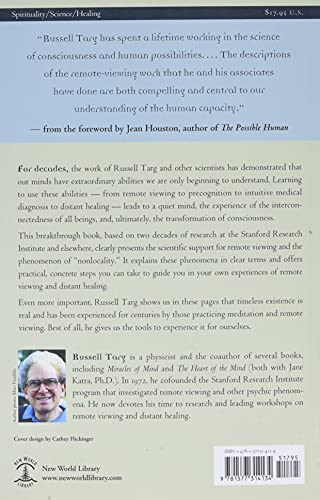
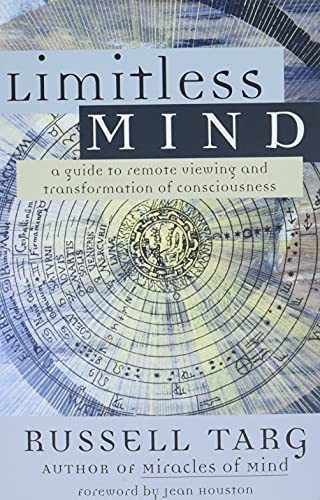


desertcart.com: Limitless Mind: A Guide to Remote Viewing and Transformation of Consciousness: 9781577314134: Targ, Russell, Houston, Jean: Books Review: Spirituality Gained From ESP - Remote Viewing and Self-Realization What would Edgar Cayce think about the recent fascination with remote viewing? He'd have to admit he'd done it himself sometimes, like when he announced from his self-induced clairvoyant consciousness that his next client had not yet arrived at home where he was to be for his reading from Cayce, or when Cayce noted that the prescribed remedy, "oil of smoke" was hidden in the back room shelf of the pharmacist. Cayce used remote viewing, and especially "remote knowing" to help others, and thus he would be satisfied with its serviceability. On the other hand, so much of his readings were filled with wisdom, providing much more guidance than could be provided by what a remote video camera could see, that his work involved more skills than simply remote viewing. I believe that Mr. Cayce would say remote viewing was, in itself, not sufficient. I suspect that, independent of the purposes toward which remote viewing might be applied, its procedures make self-actualization doubtful. Simply relaxing the mind may be sufficient to experience and report imagery that others might evaluate for its validity, but it doesn't seem sufficient to provide self-actualization guidance to the person practicing this skill. Something else has to be added. What is required beyond merely freeing consciousness is "raising one's consciousness to an ideal." Such grooming of consciousness might prove useful to become a channel of wisdom. The purpose to which value added remote viewing might be applied would also affect its serviceability for self-actualization. Remote viewing sessions typically begin with a "tasking assignment." As a tasking focus, I suggest something akin to an Edgar Cayce affirmation, with a bit of precognition thrown in: "I foresee an opportunity coming to me today where I may be of service to someone else by discovering more of my soul's abilities." I turned to a recent book by one of the pioneers of remote viewing. Russell Targ, Ph.D., writes in Limitless mind: A guide to remote viewing and transformation of consciousness (New World Library), to discover that the author writes, "Why bother with ESP? ...Dzogchen [Buddhist ideal of "great perfection"] teaches us to look directly at our awareness and experience the geometry of consciousness--the relationship of our awareness to the space-time in which we live.... these teachings of expanded awareness and the experience of spaciousness are not about self-improvement or gaining power; they are about self-realization: discovering who we really are.... This can be revealed in many ways, one of them being the practice of remote viewing....we discover through this process that we are the flow of loving awareness that is available to us whenever we are quiet and peaceful." The question I have in considering Targ's thoughtful and valuable book is whether his support of remote viewing as a tool of self-realization comes from the meditative part of the practice (in which case meditation itself may be a more direct route), from what is remotely viewed (as in my suggested tasking focus), or from the theoretical implications of the results of remote viewing, namely, that ESP is real and that there is more to us than the space-time materiality. Many have experienced ESP effects, yet go on living in material consciousness, so I suspect that this third alternative is not much of a candidate for the source of remote viewing's support of self-realization. Targ does provide four proven applications of remote viewing: evaluating given choices, locating objects or persons, medical diagnosis, and forecasting. At the end of his book, he confesses that he has spent his life trying to change a rocket scientist into a human being. His ESP research motivated him further, but it was contact with a spiritual teacher, Mangaji, that did the trick, opening his heart. In the final analysis, Targ admits that remote viewing itself is not a spiritual path. He claims that it is the meditative skill developed by it that can, when furthered by spiritual mentoring, lead to the self-realization that "we are the love we seek". The meditative skill he refers to is that of becoming aware of awareness itself, because that is where the boundless self awaits discovery. I find myself uplifted by Targ's book and feel a kinship with his desire to explain the value of ESP research in the context of the spiritual search. I now realize that my own suggestion about how to use remote viewing for self-actualization, although of value, actually misses the mark. There really is no need to go "remote" as what I'm seeking is within my own open heart. I agree with the author that the best way to keep it open is through gratitude. With such an attitude, I'm sure I'll have many opportunities to grow by helping others without having to remote view the opportunity in advance. Read a summary of this book at [...] Review: Outstanding presentation of mind potential - Russell Targ is a physicist who has written many books on psychic phenomena. In "Limitless Mind" he covers a wide spectrum of paranormal phenomena that he believes show the potential of the human mind, including: remote viewing; psychokinesis; intuitive diagnosis and distant healing; intercessory prayer; ESP; and thought-transferrance. Targ believes that "our mind is limitless and that our awareness both fills and transcends our ordinary understanding of space and time. Psychic abilities, and remote viewing in particuar, point to the possibility of our residing in - and as - this state of expanded, timeless, fearless, spacious awareness. Psychic abilities are neither sacred nor secular; they are just natural human abilities." While much of what Targ describes has its origins in Buddhism and Hinduism, he also calls upon some of physicist David Bohm's ideas and modern quantum theory as part of the explanation for psychic phenomena: "the individuals have gone beyond the bandwidth of local perception and memory and entered a field of knowing in which much larger information can be accessed via the quantum hologram. It has been suggested that this quantum hologram is made of a higher light vibration and holds all knowledge and information ... the quantum hologram is an order of pure beingness, pure frequency - perhaps the essential Light itself - which transcends all specifications and knows neither 'here' nor 'there'." The following words certainly resonated with me: "In science ... it is just as serious an error to ignore real but unpredictable data as it is to accept false data as true." Many of the phenomena to which Targ refers are well documented and statistically meaningful, yet mainstream science has generally avoided them. He explains why preconceived ideas can directly and adversely impact the interpretation of results: "analytical overlay (AOL) is [Ingo Swann]'s idea for the process of contaminating our direct experience of a target with the analysis of the images based on our imagination and memories of similar images. the unconscious naming of the images on our mental screen causes this mental noise. In the Dzogchen Buddhist tradition, this naming, guessing or grasping is called "conditional awareness." This is one of the best books I have read on the subject of paranormal phenomena in general and remote viewing in particular. Targ's ideas are very accessible; he is credible and provides evidence to support his conclusions. His comments about famous psychic Edgar Cayce included that: "Cayce considered his entranced self to be a channel of higher consciousness. He believed that he obtained his information from the storehouse of universal information, known in ancient Eastern philosophy as the akashic record." This reminded me that Targ's ideas are largely compatible with those of Irvin Laszlo and I suspect anyone who enjoys this book would also find the latter's "Science and the Akashic Field" equally absorbing.

| Best Sellers Rank | #72,079 in Books ( See Top 100 in Books ) #2 in Out-of-Body Experiences (Books) #49 in ESP (Books) #325 in Personal Transformation Self-Help |
| Customer Reviews | 4.6 4.6 out of 5 stars (737) |
| Dimensions | 5.5 x 0.8 x 8.3 inches |
| Edition | First Edition |
| ISBN-10 | 1577314131 |
| ISBN-13 | 978-1577314134 |
| Item Weight | 11 ounces |
| Language | English |
| Print length | 176 pages |
| Publication date | January 26, 2004 |
| Publisher | New World Library |
H**D
Spirituality Gained From ESP
Remote Viewing and Self-Realization What would Edgar Cayce think about the recent fascination with remote viewing? He'd have to admit he'd done it himself sometimes, like when he announced from his self-induced clairvoyant consciousness that his next client had not yet arrived at home where he was to be for his reading from Cayce, or when Cayce noted that the prescribed remedy, "oil of smoke" was hidden in the back room shelf of the pharmacist. Cayce used remote viewing, and especially "remote knowing" to help others, and thus he would be satisfied with its serviceability. On the other hand, so much of his readings were filled with wisdom, providing much more guidance than could be provided by what a remote video camera could see, that his work involved more skills than simply remote viewing. I believe that Mr. Cayce would say remote viewing was, in itself, not sufficient. I suspect that, independent of the purposes toward which remote viewing might be applied, its procedures make self-actualization doubtful. Simply relaxing the mind may be sufficient to experience and report imagery that others might evaluate for its validity, but it doesn't seem sufficient to provide self-actualization guidance to the person practicing this skill. Something else has to be added. What is required beyond merely freeing consciousness is "raising one's consciousness to an ideal." Such grooming of consciousness might prove useful to become a channel of wisdom. The purpose to which value added remote viewing might be applied would also affect its serviceability for self-actualization. Remote viewing sessions typically begin with a "tasking assignment." As a tasking focus, I suggest something akin to an Edgar Cayce affirmation, with a bit of precognition thrown in: "I foresee an opportunity coming to me today where I may be of service to someone else by discovering more of my soul's abilities." I turned to a recent book by one of the pioneers of remote viewing. Russell Targ, Ph.D., writes in Limitless mind: A guide to remote viewing and transformation of consciousness (New World Library), to discover that the author writes, "Why bother with ESP? ...Dzogchen [Buddhist ideal of "great perfection"] teaches us to look directly at our awareness and experience the geometry of consciousness--the relationship of our awareness to the space-time in which we live.... these teachings of expanded awareness and the experience of spaciousness are not about self-improvement or gaining power; they are about self-realization: discovering who we really are.... This can be revealed in many ways, one of them being the practice of remote viewing....we discover through this process that we are the flow of loving awareness that is available to us whenever we are quiet and peaceful." The question I have in considering Targ's thoughtful and valuable book is whether his support of remote viewing as a tool of self-realization comes from the meditative part of the practice (in which case meditation itself may be a more direct route), from what is remotely viewed (as in my suggested tasking focus), or from the theoretical implications of the results of remote viewing, namely, that ESP is real and that there is more to us than the space-time materiality. Many have experienced ESP effects, yet go on living in material consciousness, so I suspect that this third alternative is not much of a candidate for the source of remote viewing's support of self-realization. Targ does provide four proven applications of remote viewing: evaluating given choices, locating objects or persons, medical diagnosis, and forecasting. At the end of his book, he confesses that he has spent his life trying to change a rocket scientist into a human being. His ESP research motivated him further, but it was contact with a spiritual teacher, Mangaji, that did the trick, opening his heart. In the final analysis, Targ admits that remote viewing itself is not a spiritual path. He claims that it is the meditative skill developed by it that can, when furthered by spiritual mentoring, lead to the self-realization that "we are the love we seek". The meditative skill he refers to is that of becoming aware of awareness itself, because that is where the boundless self awaits discovery. I find myself uplifted by Targ's book and feel a kinship with his desire to explain the value of ESP research in the context of the spiritual search. I now realize that my own suggestion about how to use remote viewing for self-actualization, although of value, actually misses the mark. There really is no need to go "remote" as what I'm seeking is within my own open heart. I agree with the author that the best way to keep it open is through gratitude. With such an attitude, I'm sure I'll have many opportunities to grow by helping others without having to remote view the opportunity in advance. Read a summary of this book at [...]
R**6
Outstanding presentation of mind potential
Russell Targ is a physicist who has written many books on psychic phenomena. In "Limitless Mind" he covers a wide spectrum of paranormal phenomena that he believes show the potential of the human mind, including: remote viewing; psychokinesis; intuitive diagnosis and distant healing; intercessory prayer; ESP; and thought-transferrance. Targ believes that "our mind is limitless and that our awareness both fills and transcends our ordinary understanding of space and time. Psychic abilities, and remote viewing in particuar, point to the possibility of our residing in - and as - this state of expanded, timeless, fearless, spacious awareness. Psychic abilities are neither sacred nor secular; they are just natural human abilities." While much of what Targ describes has its origins in Buddhism and Hinduism, he also calls upon some of physicist David Bohm's ideas and modern quantum theory as part of the explanation for psychic phenomena: "the individuals have gone beyond the bandwidth of local perception and memory and entered a field of knowing in which much larger information can be accessed via the quantum hologram. It has been suggested that this quantum hologram is made of a higher light vibration and holds all knowledge and information ... the quantum hologram is an order of pure beingness, pure frequency - perhaps the essential Light itself - which transcends all specifications and knows neither 'here' nor 'there'." The following words certainly resonated with me: "In science ... it is just as serious an error to ignore real but unpredictable data as it is to accept false data as true." Many of the phenomena to which Targ refers are well documented and statistically meaningful, yet mainstream science has generally avoided them. He explains why preconceived ideas can directly and adversely impact the interpretation of results: "analytical overlay (AOL) is [Ingo Swann]'s idea for the process of contaminating our direct experience of a target with the analysis of the images based on our imagination and memories of similar images. the unconscious naming of the images on our mental screen causes this mental noise. In the Dzogchen Buddhist tradition, this naming, guessing or grasping is called "conditional awareness." This is one of the best books I have read on the subject of paranormal phenomena in general and remote viewing in particular. Targ's ideas are very accessible; he is credible and provides evidence to support his conclusions. His comments about famous psychic Edgar Cayce included that: "Cayce considered his entranced self to be a channel of higher consciousness. He believed that he obtained his information from the storehouse of universal information, known in ancient Eastern philosophy as the akashic record." This reminded me that Targ's ideas are largely compatible with those of Irvin Laszlo and I suspect anyone who enjoys this book would also find the latter's "Science and the Akashic Field" equally absorbing.
A**R
In-depth look at alternative psychic techniques
This book unexpectedly drifted off outside of remote viewing but the other topics were related, mostly Buddhist thought. I still found it to be enjoyable to read, which was a few years ago now. I think the book is something more of an elaborate companion book to psionic guides you may find online rather than being a guide in itself. There is a small how-to example but no example targets or exercises. It touches on concepts such as dreams and distant healing. The notes and bibliography is quite huge for a small book. I like the book's construction with a very attractive cover with a slight grip texture yet smooth. The binding is well done. The paper is somewhat typical of the paper you may find used in novels while the text and pictures look good. The inner margin is too small but the other page margins are good.
J**N
THE INTRO SAYS IT ALL...
Most people have the ability to describe and experience events and locations that are blocked from ordinary perception. Limitless Mind illustrates this perceptual ability by presenting decades of experiments in remote viewing, or remote perception of events. Targ, Russell (2010-10-04). Limitless Mind: A Guide to Remote Viewing and Transformation of Consciousness (p. 2). New World Library. Kindle Edition. IF YOU LIKE HISTORY, SCIENCE, SPIRITUALITY AND TRUTH, YOU WILL LIKE THIS BOOK. I FIND THAT REMOTE VIEWER AUTHORS ARE EXCELLENT, THOROUGH, METHODIC WRITERS. FLOW AND SOURCES GREAT. EASY TO READ IN SPITE OF COMPLEX ISSUES. BY NO MEANS DULL. GOOD SUBJECT READ FOR ANYONE WITH A BRAIN. WILL CHANGE HOW YOU THINK FOR THE BETTER. JEANNINE ANDERSON, WAYNE, NJ
G**E
Such an amazing book! one of the most influential books I have ever read. the author is an experienced scientists which you can really feel while reading the book. the book does not give you a standalone subjective opinions of the author, instead facts are strengthened by the existing literature. I enjoyed the book, it changed my perspective of thinking tremendously. I definitely recommend this book as one of the most read books in life.
F**S
Feels gread inthe hands and in the mind
R**Y
An extremely interesting book
C**N
Recomiendo para los que estan ineresados en este tema y no tienen ningun problema en leerlo en ingles. La aplicación de Kindle ayuda muchisimo para entender ciertos terminos.
S**A
El tema de la percepción remota se explica de forma fácil. Muy interesante.
Trustpilot
Hace 1 mes
Hace 1 semana