
Descargar la aplicación


Servicios al cliente
Sobre nosotros
Copyright © 2025 Desertcart Holdings Limited
Descargar la aplicación
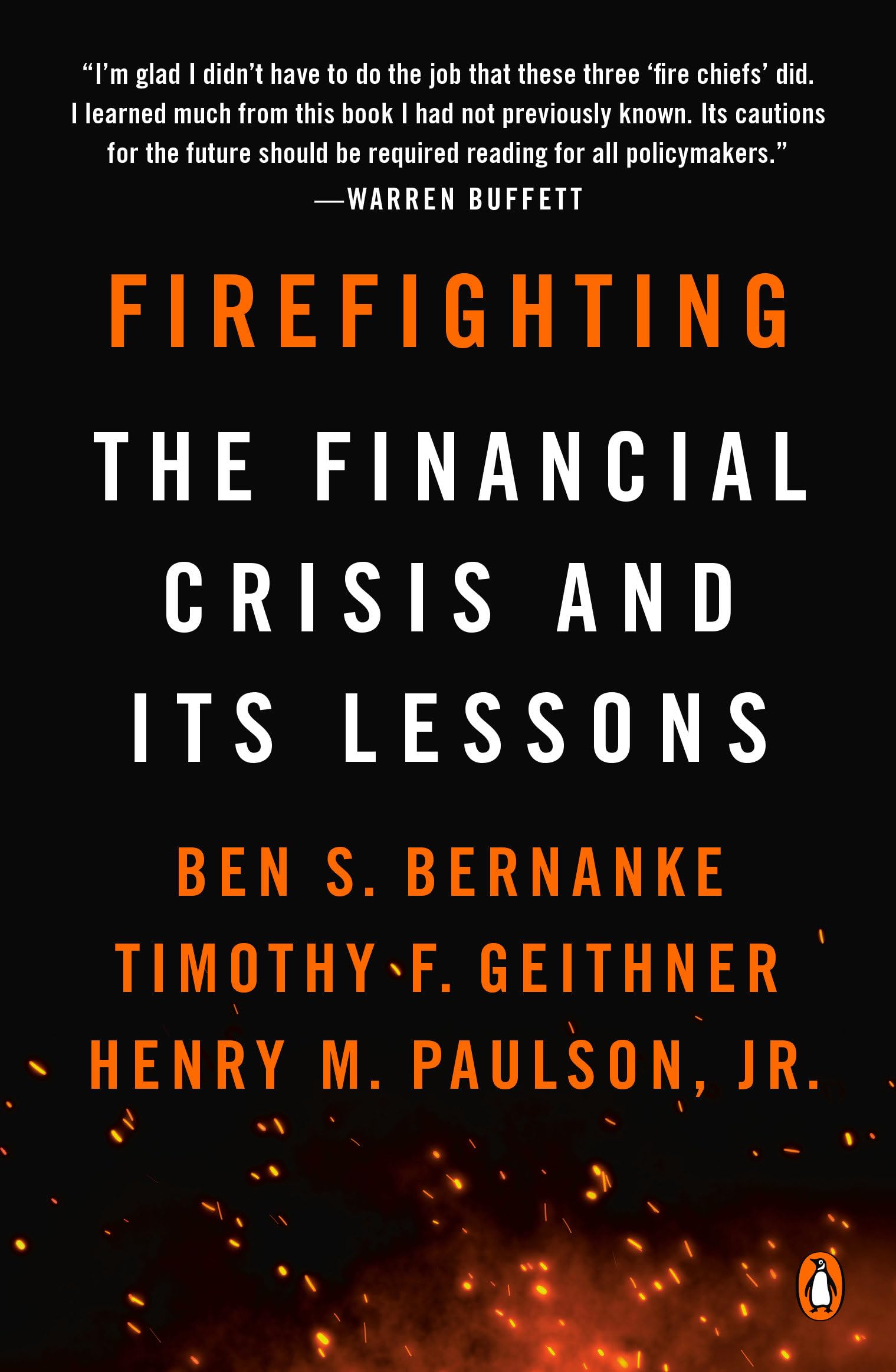
Firefighting: The Financial Crisis and Its Lessons [Bernanke, Ben S., Geithner, Timothy F., Paulson Jr., Henry M.] on desertcart.com. *FREE* shipping on qualifying offers. Firefighting: The Financial Crisis and Its Lessons Review: Concise, well written summary of the 2008 crisis - This book is well written, giving the audience a simple and clear understanding of how the financial crisis of 2008 happened, how government actors acted and how future crises could be mitigated based on what the 3 leaders learned. The core text, at roughly 130 pages, is well written and easy to follow and in layman's language, which is appreciated. It could easily devolve into a finance tome or a policy wonk's work. Additionally, there is a roughly 70 page Powerpoint-style presentation which is great to visually tell the story and to bring it to life. As such, it would be great to see high school and college classes leverage this work, where appropriate. Review: Interesting and well-written, but excessively self-satisfied - The three authors were at the epicentre of the financial crisis. They do a good job in explaining how it came about and the steps they took to counter it. One small criticism: the 'firefighting' metaphor is absurdly overused. The book is commendably short - just 130 pages of text, but with a 70+ slide PowerPoint presentation at the end. That was a new one on me. I suspect the book is aimed at everybody and, in that, I am not sure that it succeeds. As a financial expert, I had no problem with the simple stuff being explained so carefully. Maturity transformation, securitisation, credit ratings etc are not part of everyday conversation for most people. These are explained with varying clarity. However, other things remain unexplained. CDS spreads are referred to constantly, but left insufficiently explained. The LIBOR-OIS spread is a prominent feature of the Powerpoint sides, but its significance is similarly unexplained. Not a problem for me, but I suspect it would be for many others. My final criticism, which still keeps my rating up at 4*, is that the authors come across as excessively self-satisfied at the action they took. Personally, I'm inclined to think that they got things pretty well right, but their constant claiming of bragging rights throughout the book comes across as a little unseemly.
| Best Sellers Rank | #470,736 in Books ( See Top 100 in Books ) #82 in Government & Business #172 in Economic Policy & Development (Books) #356 in Economic History (Books) |
| Customer Reviews | 4.4 out of 5 stars 354 Reviews |
J**K
Concise, well written summary of the 2008 crisis
This book is well written, giving the audience a simple and clear understanding of how the financial crisis of 2008 happened, how government actors acted and how future crises could be mitigated based on what the 3 leaders learned. The core text, at roughly 130 pages, is well written and easy to follow and in layman's language, which is appreciated. It could easily devolve into a finance tome or a policy wonk's work. Additionally, there is a roughly 70 page Powerpoint-style presentation which is great to visually tell the story and to bring it to life. As such, it would be great to see high school and college classes leverage this work, where appropriate.
D**.
Interesting and well-written, but excessively self-satisfied
The three authors were at the epicentre of the financial crisis. They do a good job in explaining how it came about and the steps they took to counter it. One small criticism: the 'firefighting' metaphor is absurdly overused. The book is commendably short - just 130 pages of text, but with a 70+ slide PowerPoint presentation at the end. That was a new one on me. I suspect the book is aimed at everybody and, in that, I am not sure that it succeeds. As a financial expert, I had no problem with the simple stuff being explained so carefully. Maturity transformation, securitisation, credit ratings etc are not part of everyday conversation for most people. These are explained with varying clarity. However, other things remain unexplained. CDS spreads are referred to constantly, but left insufficiently explained. The LIBOR-OIS spread is a prominent feature of the Powerpoint sides, but its significance is similarly unexplained. Not a problem for me, but I suspect it would be for many others. My final criticism, which still keeps my rating up at 4*, is that the authors come across as excessively self-satisfied at the action they took. Personally, I'm inclined to think that they got things pretty well right, but their constant claiming of bragging rights throughout the book comes across as a little unseemly.
A**N
The Little Brown Book
In what is a stunning turn of events, the three Firefighters from the crisis of 2008 have published a mea culpa where they succinctly connect their unfortunate actions to the triumph of populism and the election of Donald Trump a short eight years later. Firefighters aside, nobody escapes criticism here, from (i) FDR, who redlined black America out of the New Deal, to (ii) Clinton, who completely deregulated derivatives and slashed the capital gains tax to 20% (indeed, setting it to zero for one’s primary residence), to (iii) the deductibility of interest expense from some of the planet’s highest corporate income taxes, rendering the unleveraged CEO suicidal or (iv) the Greenspan Fed’s permanent policy of standing behind the value of assets in one way or another, all together conspiring with some sixty years of post-war prosperity to concentrate immense wealth in the hands of a narrow minority of white, hyper-leveraged, urban baby boomers. It all came to a head in 2008, when it became clear that this minority (i) outright and (ii) via its pension plans and mutual fund holdings had successfully contracted to own the rights to all existing assets, to say nothing of the rights to the future sweat of all other Americans and at least a couple yet-unborn generations, naturally also packaged into tradable assets. Not only that, via trading with one another, these boomers had “marked” these holdings at prices that the rest of the world, to say nothing of the unborn, could no longer afford to pay from its daily earnings. The only vulnerability to the system was that it was held together by leverage and the leverage was a monster that needed to be fed by increasingly higher valuations in these contracts. “The fundamental instability of capitalism is upward,” the firefighters note wistfully, but matters conspired in 2008 to momentarily halt this ascent. And when this monster is not going up, it goes down. So down it went. Fatefully, the firefighters admit, rather than do the right thing and wipe out the bankrupt owners, inviting the rest of America and the world back into participation in the capitalist economy, the easier choice was made: In a stunning array of four-letter programs, trillions and trillions of government money was injected back into the system (with particular care taken to get the government out of the scam before it explodes again) and all property was placed even further beyond the reach of the average American, making the owners whole and fast-forwarding the country to its first proper existential crisis since the Civil War. The book comes out just as we’re about to crash again, and the authors warn that (in a replay of the 1921 – 1929 episode) this time round there’s probably nothing we can do to save the white, urban baby boomers, because, well, because they will all die very soon from natural causes. ------ > WELL, NOT QUITE (for the avoidance of doubt, the above review is my attempt at parody) In reality, what we have here is the “official” blow-by-blow account of the heroic, selfless fight the three Firefighters waged with one hand tied behind their back as they fought to prevent a re-run of the Great Depression. It all ends well. Not only was the worst outcome prevented, but the US has done better than any other major economy since 2008, with the economy enjoying its longest recovery ever and unemployment hitting some unprecedented lows. What’s not to like? Quite a bit, it turns out. Let’s start with Paulson. Paulson is deeply unhappy that the “canonical” book about the 2008 crisis, that written by Blinder, blames the crash on what is perceived to be Paulson’s decision to allow Lehman to fail. The book makes it clear that Lehman was a symptom of a crisis that had been going for a while, not a cause. Somebody was bound to go down, because the Firefighters did not have the authority to intervene. Somebody big. If it was not Lehman then it would be somebody else. There was going to be a big failure. And only after the big failure could the Firefighters get the authority to go ask for the necessary tools to deal with the crisis. So that’s Paulson sorted, he was a good guy after all. The blight on selfless public servant Tim Geithner has always been that he was the man who made the choice to protect the banks rather than the homeowners. Not one, but several books have come out by eyewitnesses who were there in the meetings when he talked about “foaming the runway” for the endangered banks with sundry programs to slow down the defaults. My favorite is probably by SIGTARP Neil Barofsky. That is a total misunderstanding, it turns out. The Firefighters explain that herculean efforts were made to protect homeowners. We are made to wait until page 103 out of 136, but there comes QE and brings those mortgage rates right down. Oh, and make no mistake, Timmy talks about “foaming the runway” in multiple contexts, it’s just something he likes to say a lot. For example on page 48 you can witness “foaming the runway” in the form of injecting liquidity into the markets after Bear Sterns goes down. It comes up more. It’s just something he says a lot. So that’s Geithner sorted, he was a good guy after all. And that leaves us with Bernanke. We all know what he stands accused of. Yes, fine, he got rather inventive during the crisis, he did some krazy stuff even FDR would not dare do in his most improvisational breakfast-in-bed times, but that saved the day. What people want to know is why he kept rates down for so long after the crisis. Even his biggest fans do acknowledge that a bad part of his legacy is that some very well-connected people took advantage of the permanently low rates the homeowners were meant to benefit from and made for themselves some fortunes like we have not seen since the twenties. Whisper it, folks, QE bred inequality. Ah, no it didn’t! Inequality, the Firefighters will have you know, had been increasing for at least a decade prior to the crisis. This was masked by the fact that there was growth. But don’t go thinking it was caused by the response to the crisis. It had been long in the making. Charts are in the back that prove this, in case the relevant prose is not good enough for you. So there you have it. Something for everyone. In the words of Winston Churchill, “I know history will be kind to me, because I intend to write it.” But what we have here is something much more grand than that. It’s much more akin to Chairman Mao’s Little Red book. Or perhaps Colonel Ghadaffi’s Little Green Book. I propose we call it “the Little Brown Book.” A five-star effort!
C**M
2008 Banking Crisis was based on narrow part of market, new 2040s crisis effects high and low end
The "borrowing frenzy" and "subprime mortgages" were factors in the 2008 Banking Crisis (p. 12). Responses or bailouts had supporters and critics, with the latter worried about hyperinflation. The 2008 bailouts were successful however there is now moderate inflation (but of course not hyperinflation). Perhaps it is surprising, though, that there are new lessons about excessive debt -- from new housing booms led by affordable housing construction for illegal immigrants, many units of which are in cheaply built wooden housing, and on the high end of the market, from over-construction at or near sea level (one foot or less above sea level). Systemic banking risk could be worse in the 2040s with global sea level rise.
T**L
**IMPORTANT** Who will say it but Bernenke
Don't fully credit my words, i am only 20 years old. But as i understand, Ben Bernanke always tells it like it is. Former Fed chair sees no reason to sugarcoat anything. This book is IMPORTANT, highly applicable to the everyday person. Black and White language that my non economic brain can understand. I can even compare this to a reality show drama with the way things are set down between the treasury, fed and congress. Book is 128 pages of words, the rest is excellent and relevant charts!! THANK YOU, BEN, TIM AND HENRY. I wish you all the best
X**X
Everyone on mail street should read this.
This is a nontechnical concise history of the financial crisis and its aftermath. There are several messages. Financial markets evolved faster than regulation, in part because of regulatory capture. The dogmatic political far left and far right opposed bailouts and were willing to let the country and the globe fall into another Great Depression. Congress is better at grandstanding than avoiding and responding to disasters. Taxpayers made money on the bailouts. Financial regulation remains balkanized. Dodd-Frank makes the next crisis less likely, but there will be another crisis. Wall Street will use regulatory arbitrage to avoid Dodd-Frank's safeguards. The public forgets while the financial industry erodes the safeguards. Congress (Dodd-Frank) took away the tools that the Fed, Treasury and FDIC used to fight the crisis. Congress will be too slow to give back these tools in an emergency with a predictable and very negative result.
C**T
Brief summary of a complicated topic.
If you did not read "Stress Test" then read "Firefighting". It's a quick read and portable. It's incredible the things they had to do to prevent a Depression. I'm glad that Geithner was at the center, and Bernanke as well, and Paulson in the early part. I will forever be thankful to them and to the hundreds of staff what worked with them during the crisis. This little book should be part of your bookshelf, next to Galbraith "The Great Crash 1929".
A**R
When Arsonists become Firefighters- the 3 horsemen of the apocalypse.
History is written by the victors. these 3 authors wrote this book to pat themselves on the back. Yes they did put out the fire eventually after their first efforts were to use a squirt gun, while in fact under their own rules 13(c) they had enormous discretion which they did not use until the fire was raging. Also many conflicts of interest. For example Paulson was a former head of Goldman Sachs, an arch enemy of Lehman, so he took the opportunity to fatally slit Lehmans throat. Paulson saved AIG after panicking over the Lehamn meltdown that he caused, which allowed AIG to pay GS in full without a haircut on AIGs' debts to GS. Nothing like having the former GS head in charge of the treasury to help his alma mater. Lehman could have been taken into receivership and liquidated in an orderly fashion as argued by author Ball in another book, to avoid the inferno that followed Lehman bankruptcy. Fannie and Freddie, the source of the problem because they bought all the Liars Loans at the source of the 2008 credit crunch, the loans generated by the banks that were encouraged (coerced?) by the government community reinvestment act to make Loans that they bought, were taken over by the government, but were kept alive to this day and the shareholders were bankrupted. The excuse that to save Lehman would create too much moral Hazard is weak, because The government could have taken Lehman over in receivership bankrupting the shareholders but kept their creditors alive with a gradual unwinding of the debt Instead the forced bankruptcy by Paulson turned the flame into an inferno.The Fed took over AIG with over a hundred billion $ and kept it alive and ultimately AIG paid back all the government money and then some profit for the govmint as well. No Sir, these three horsemen of the apocalypse did eventually put the fire out, after their weak initial response, but not until many lost their house and a few people committed suicide over their loss. Paulson has been hiding ever since, knowing he screwed up. Bernanke just wants more government regulation, in spite of the fact that he had all the necessary tools which he waited too long to use in 2008.
Trustpilot
Hace 3 semanas
Hace 2 semanas